I began production of a 53-second short film titled Wild Gold Chase in September 2018, and finished it and uploaded it to YouTube on 23 August 2019.
The short film’s plot goes like this: Oliver M. is walking out of a forest with a pot of gold, saying, “I can’t believe I’ve found myself a pot of gold! I’m rich! Yippee!”, and after that Gary Smith jumps out at Oliver and snatches it, causing him to fall to the ground. Oliver looks up at Gary as he laughs, “Heh-heh-heh-heh-heh-heh-heh! That pot of gold is mine now!” Oliver jumps up and angrily tells Gary to give the pot of gold back to him, but Gary refuses and says, “You’ll have to catch me first!”, which leads to Oliver chasing him through a park, a Scooby-Doo!-esque hallway, the Arctic, Japan, a city, my house, a French café and a desert. When they reach the desert, Gary slips on a banana peel, causing him to let go of the pot of gold, which lands in Oliver’s hands. Gary is about to fall off a cliff. He looks down, then sadly looks and waves at the viewer, before falling and letting out a low-pitched version of the Howie scream and landing in a trinitrotoluene shed, which explodes. Oliver waves at the viewer, ending the short film.
On 13 June 2019, I uploaded a 47-second short film titled Karate Klash! to YouTube. The short film was made using Moho 12 and was my Final Major Project at college and is themed around power, which is shown/demonstrated with strength, skill and fighting (a combination of karate and boxing), and was inspired by Japanese manga, the Japanese sport of karate, and the sport of boxing, all of which show/demonstrate power with their strength, skill, fighting and drama. Karate means “open hand” or “empty hand” in Japanese, and an open hand is not only welcoming, but powerful, as well. I based the short film on a karate-themed comic strip that I drew at the beginning of my Final Major Project’s production.
The short film’s plot goes like this: Oliver M. and a goblin named Gary Smith are wearing white karate gis and standing outside a building in Japan. They bow, and they glare at one another with determination in their eyes. They begin with flying kicks. Oliver begins to punch and block. Gary begins to perform many roundhouse kicks and punches (including double punches) and block with upper blocks. Boxing gloves appear on Oliver and Gary’s hands when they punch, and both characters are shown against anime-style speed line backgrounds when they fight. Gary does a flying kick and tries to hit Oliver, but misses, when Oliver ducks to the side. After Gary gets up and glares at Oliver with determination in his eyes, Oliver begins to punch at him, and, while doing so, notices a cliff with pink and yellow daffodils. They approach the daffodils as they fight. Oliver tries to punch Gary who defends himself with an upper block. However, he is too quick for Gary and his punches are far too strong for him, and they push and send him falling off the cliff. After Gary hits the ground, Oliver bows out of respect for him and waves at the viewer, ending the short film.
The film’s YouTube upload.
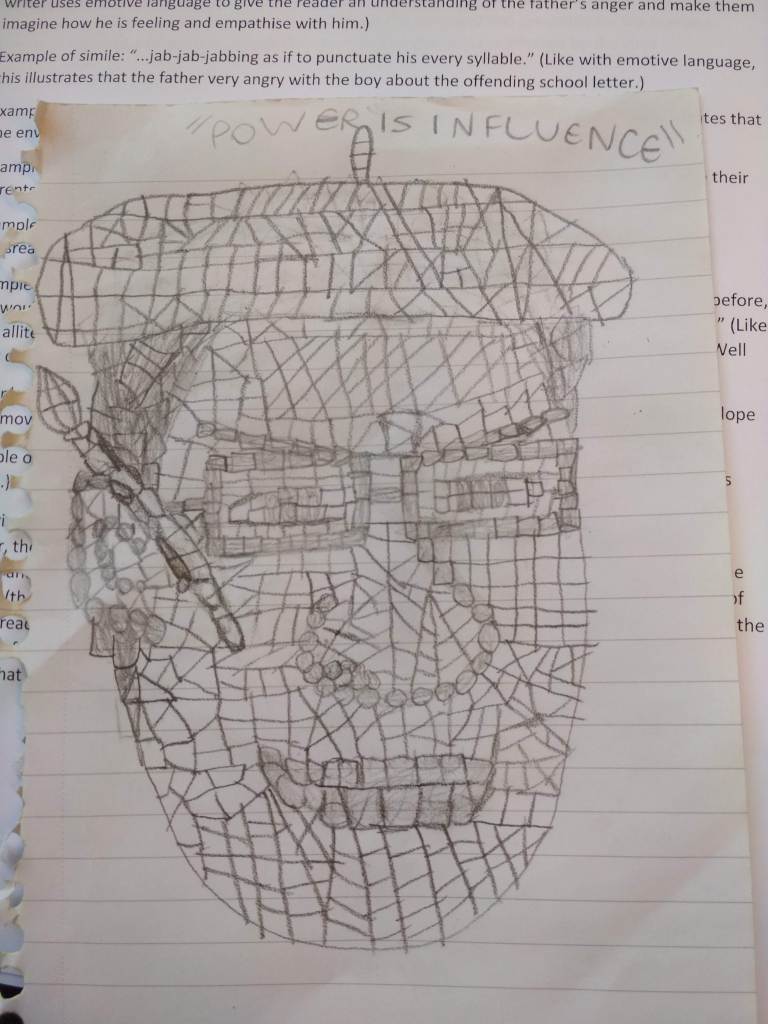
My original idea for my Final Major Project.
I was originally going to use a mosaic picture of myself as my Final Major Project, as the face can be powerful in revealing a person’s life journey, but I changed the idea and decided to make the short film instead.
My poster for Karate Klash!
Concept designs for Karate Klash!‘s title.
Concept designs for Karate Klash!‘s title.
Early karate poses for Oliver M. and Gary Smith in Karate Klash!
From September to November 2021, I dedicated my 14 remaining sessions with Arts Education Exchange by designing a poster for Karate Klash! as a final project. The poster was put up on display at the Turner Contemporary as part of an exhibition named Power to the Young People on 2 December 2021.
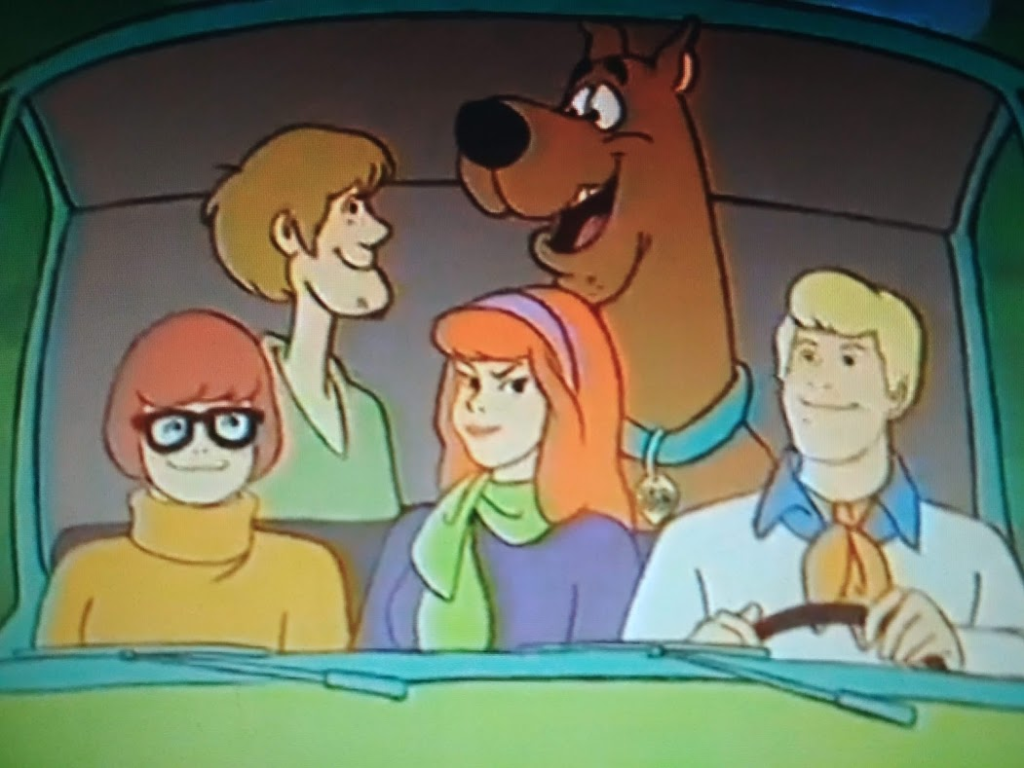
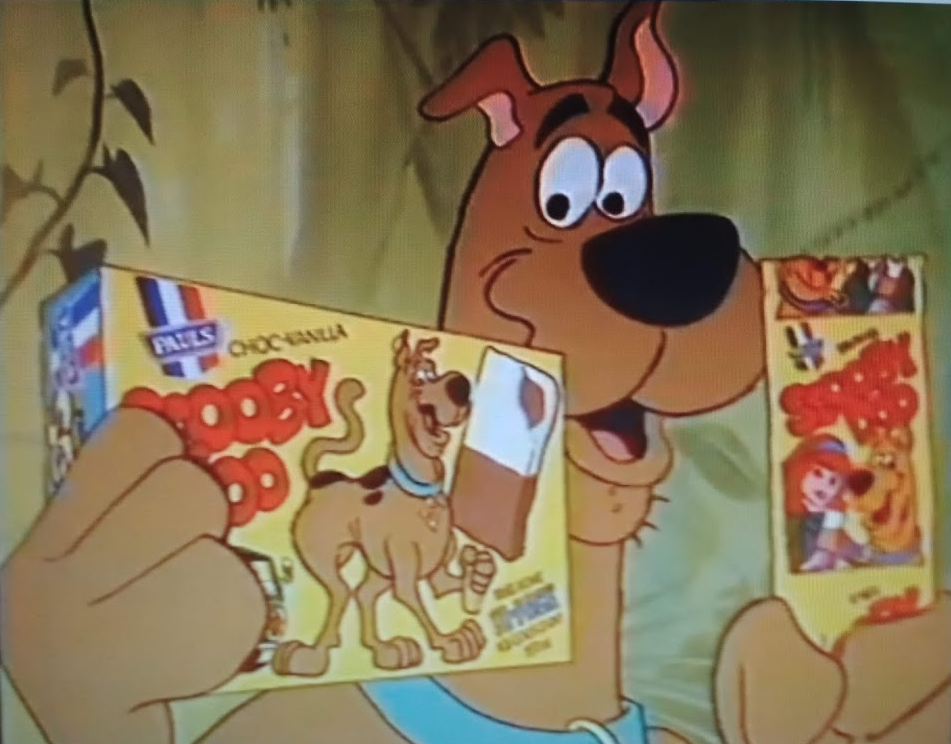
In 1981, a Pauls commercial featuring characters from Scooby-Doo! aired on Australian television. The commercial begins with the Mystery Incorporated gang driving along the road in the Mystery Machine. Scooby-Doo says, “Ri’m rungry!”, to which Fred Jones replies, “Me, too!” Shaggy Rogers says, “Let’s stop for a Pauls Scooby-Doo!”, after which the camera spins around, and the scene cuts to Scooby, Daphne Blake and Fred watching Velma Dinkley open the Mystery Machine’s back doors, revealing boxes and packets of Pauls Scooby-Doo Ice Cream, which all fall out. Daphne picks up one box and one packet and says, “I like these Pauls Scooby-Doos! They’re milky chocolate and vanilla!” Suddenly, a blue gorilla appears, stealing the Pauls Scooby-Doos and letting out a Tarzan yell. Velma says, “The Chocolate-Chomping Vanilla Gorilla!” Scooby runs off, only to crash into the Chocolate-Chomping Vanilla Gorilla, who is revealed to be Shaggy in disguise. Shaggy reveals, “I just wanted to make sure Scooby didn’t get them all!” The scene fades to Scooby holding a Pauls Scooby-Doo box and a Pauls Scooby-Doo packet. He says, “Rhy ron’t you have a Pauls Scooby-Doo, too?”, and moves his head to make way for the Pauls logo, ending the commercial.
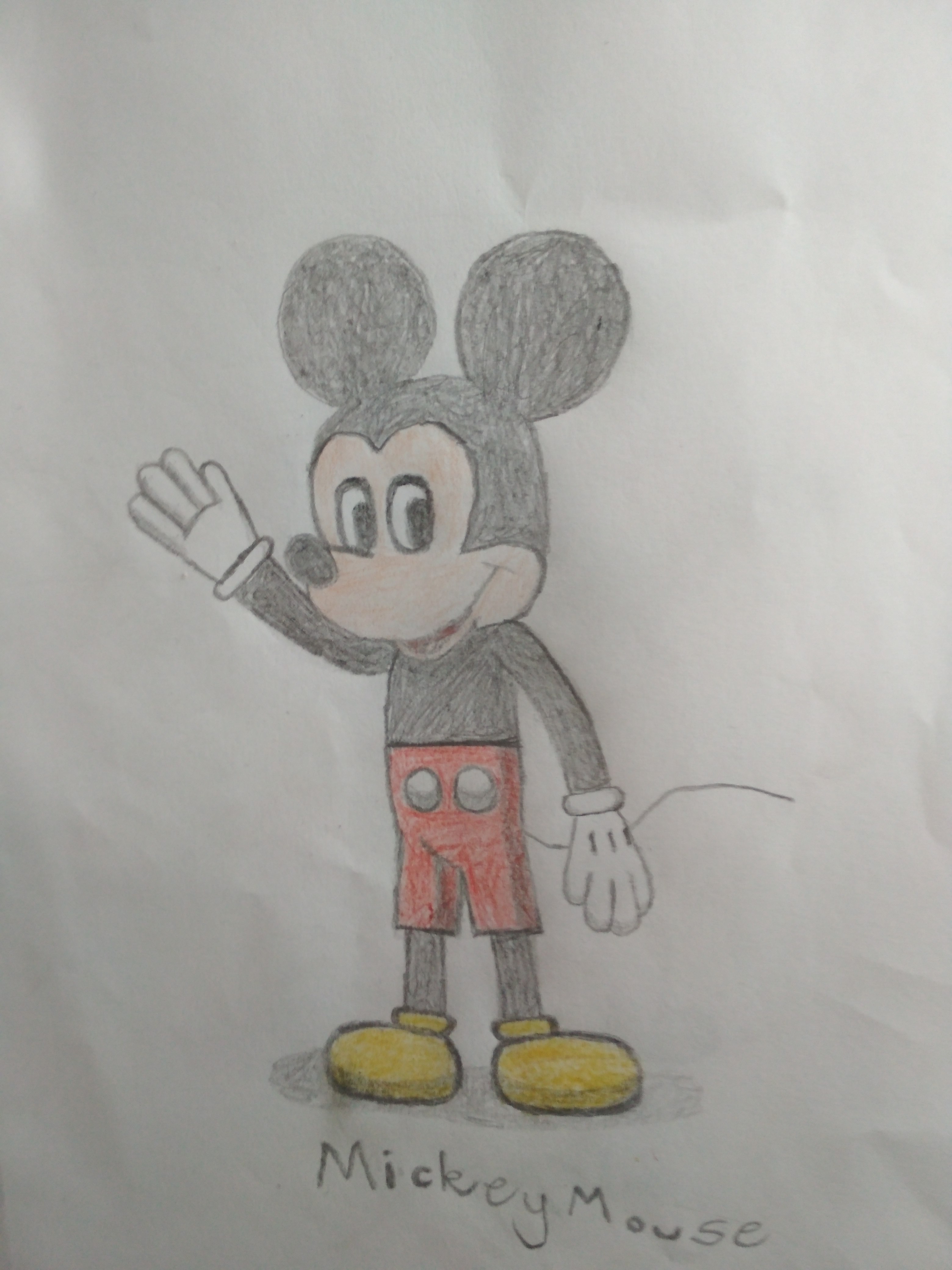
Like The Funky Phantom (1971) (another Hanna-Barbera Productions, Incorporated television show that is similar to Scooby-Doo!) and The New Scooby-Doo Movies‘ (1972) second season, the commercial was produced in Australia, resulting in poor, sloppy animation and editing. YouTuber Fire Dust mistakenly said, “You can tell the people voicing the gang have ZERO voice-acting experience.” I decided to identify the people who voiced the Mystery Incorporated gang and go over each character individually. Scooby-Doo: Keith Scott. To compare, here is Scott as Scooby in Hanna-Barbera Gala Celebrity Nite (1997). The voice in the commercial sounds slightly different from Scott’s portrayal in the live show but similar enough to still be him, particularly when Scooby says, “Ri’m rungry!” (“I’m hungry!”). The voice also sounds like Scott’s Homer Simpson impersonation, and you also hear hints of his SuperChook and DaffyDuck at 0:17 when Scooby yelps with fear after seeing the Chocolate-Chomping Vanilla Gorilla and begins to run. Shaggy Rogers: Keith Scott. Scott’s raspy portrayal of Shaggy sounds close to his Mickey Mouse, SuperChook and this high-pitched voice in Scott’s Character voice demo (0:59). Chocolate-Chomping Vanilla Gorilla: Keith Scott. The Gorilla’s Tarzan yell sounds vaguely like Scott’s Fred Flintstone. Fred Jones: Keith Scott. Scott’s portrayal of Fred sounds close to a deeper part of his Shaggy when he says, “I just wanted to make sure Scooby didn’t get them all!” Daphne Blake: Robyn Moore. Moore’s portrayal of Daphne sounds close to her portrayals of Nutsy and Penny. Velma Dinkley: Robyn Moore. Like Daphne, Moore’s portrayal of Velma sounds close to her portrayals of Nutsy and Penny. On December 1, 2015, YouTuber FLEMISHDOG uploaded the commercial to YouTube. The commercial was reuploaded by YouTuber Ricco Canipe after FLEMISHDOG’s termination.
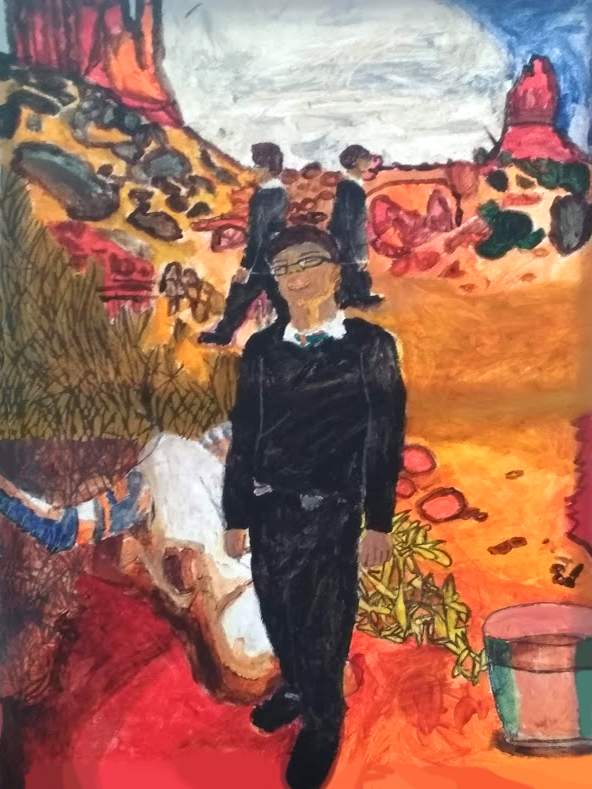
In 2017, my Art class were doing our out-of-place projects. I painted and drew a picture of three thirsty clones of myself in a North American desert, the clone in the centre standing in front of a cow skull and next to a big glass of water. The big glass of water is out of place as water is scarce in the desert, but is needed to stay alive. This painting was exhibited at the Turner Contemporary as part of the 2017 Thanet Schools Art Competition, and stayed there for a week. It was then taken back to school to be exhibited around there and locally in an art gallery in Ramsgate. I was finally able to take it home on 11 October 2019.
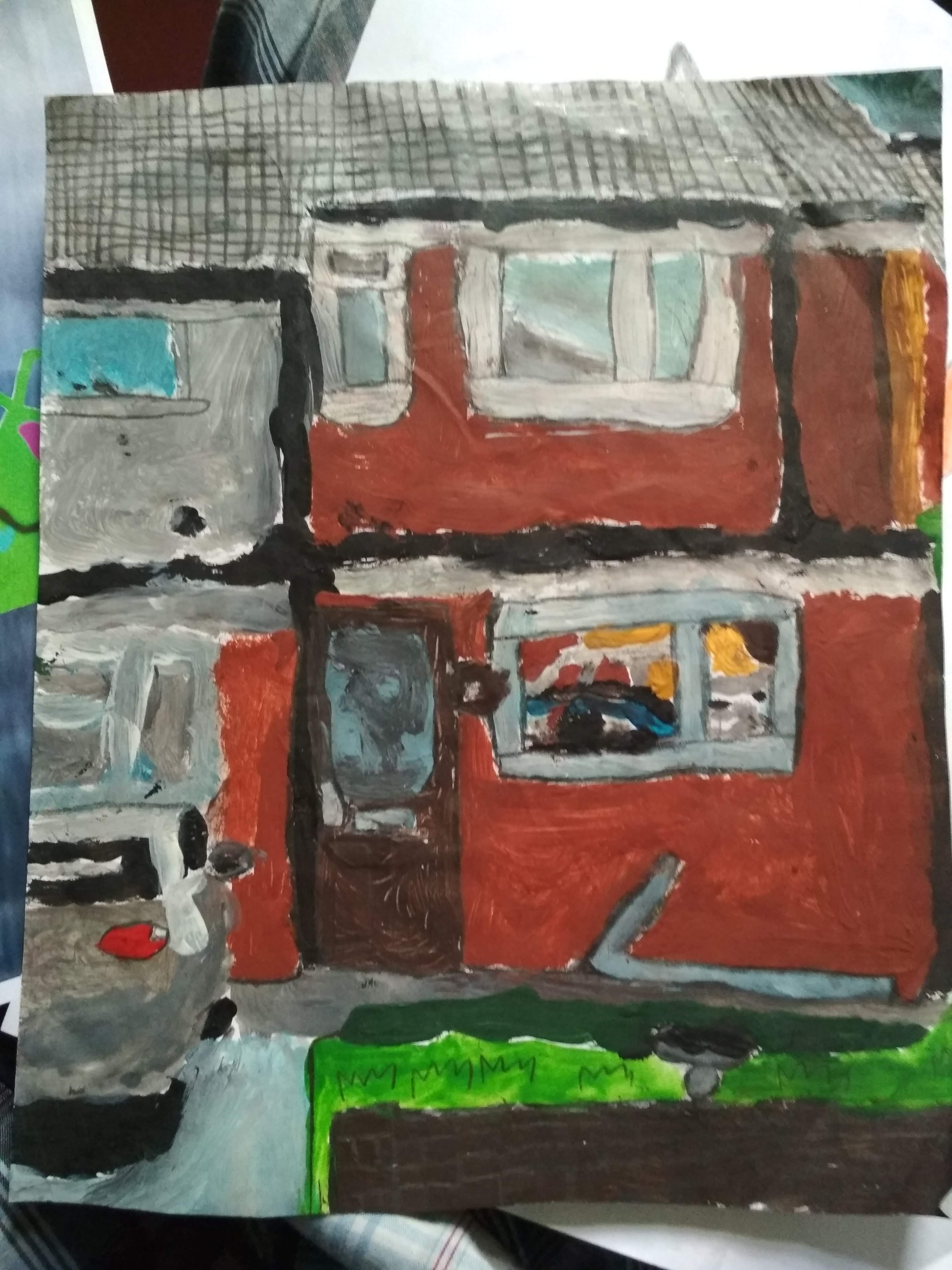
My house.
On 20 January 2018, I drew a picture of my house and used acrylic paint to colour in the picture, and used a printed print screen of my house from Google Maps for reference.
Welcome to Fuzzyville!
On 2 February 2019, my father and I were at his friend John’s art studio. I used coloured chalk and colour in a surrealist picture named Welcome to Fuzzyville!, which depicts a 10-year-old boy named Oliver M. (based on myself) arriving in an unusual, jagged, fuzzy-looking city (with red, orange, yellow, green and blue buildings and blue, jagged, fuzzy clouds in the magenta sky) and looking around in astonishment.
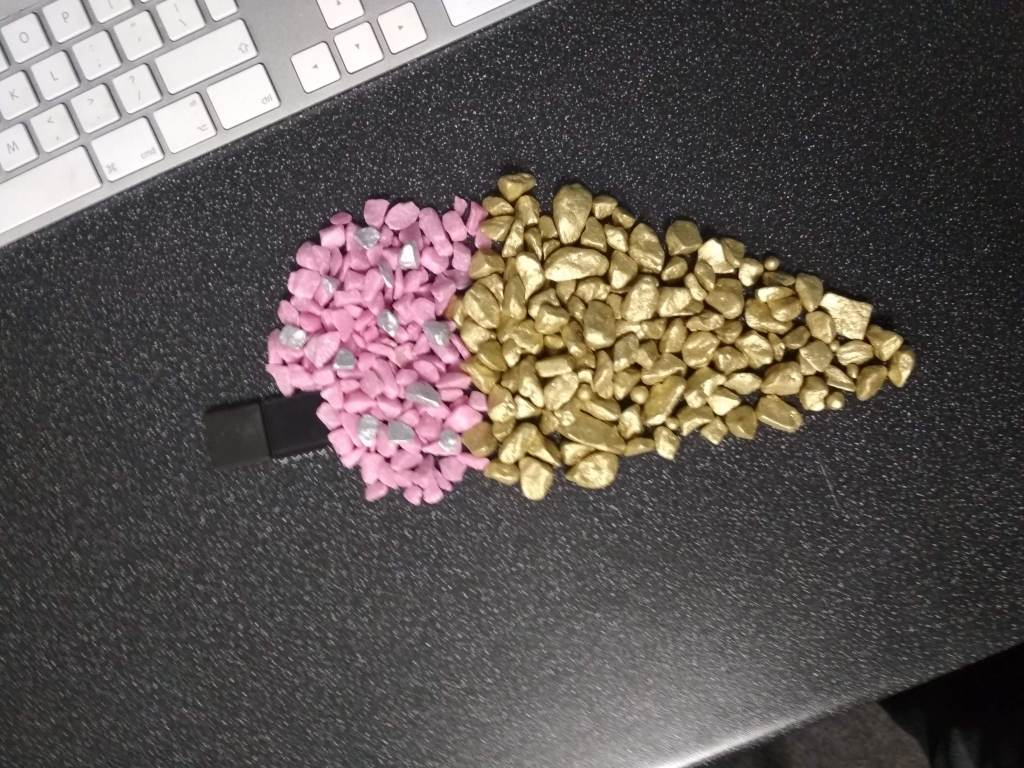
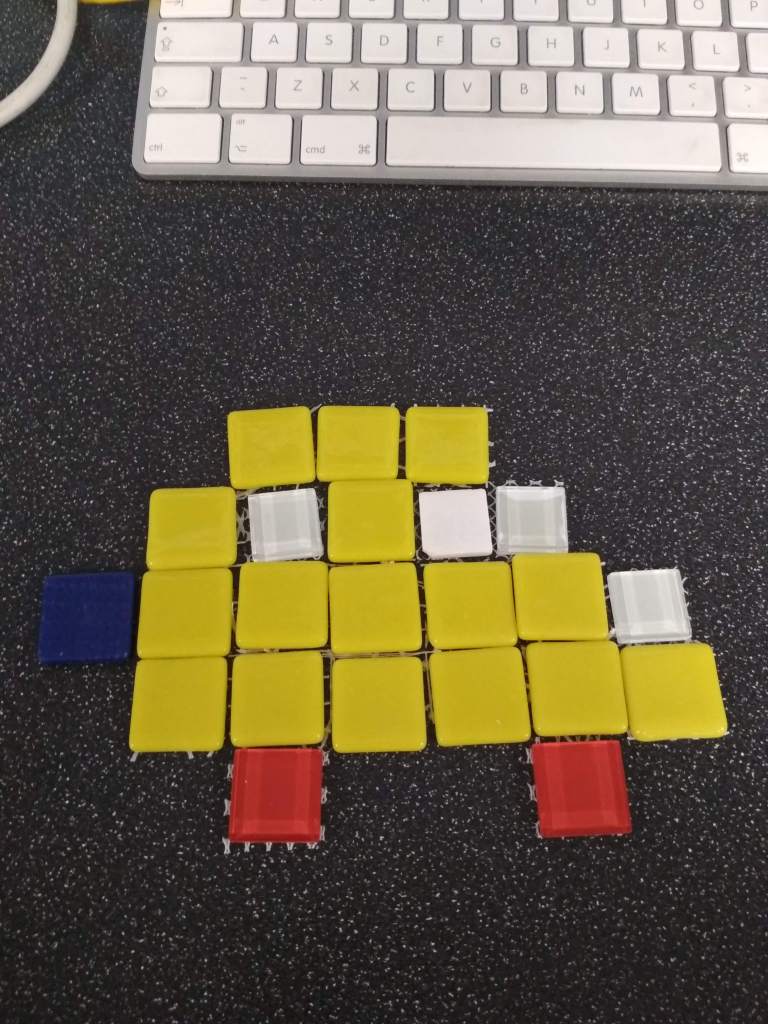
On 18 March 2019, my class from college went to the Charles Dickens Mosaics on Saint Peters Road to study its mosaic pictures and murals for our research for our mosaic projects. On 19 March 2019, we used little stones and tiles to make some mosaic pictures. I made mosaic pictures of a pair of shoes, an ice cream and a car.
My pair of shoes.
My ice cream.
My car.
For my mosaic project, I chose to make a mosaic address marker. I did an analysis of three examples of my chosen craftwork (three other mosaic address markers), and designed the draft mosaic address marker (on 27 March 2019) and the final mosaic address marker (2 April 2019). Both were designed using the following equipment: a pencil, some pieces of paper, a rubber, stones, tiles, sand, poly(vinyl acetate) glue, a spoon to mix the sand and poly(vinyl acetate) glue, and a piece of wood.
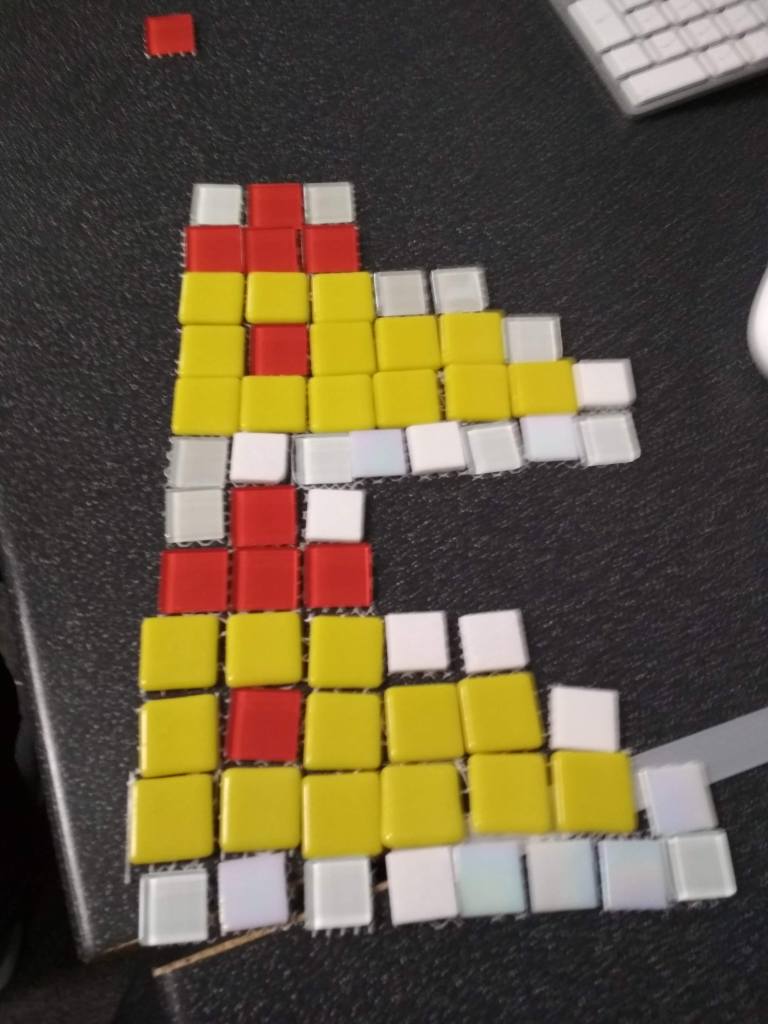
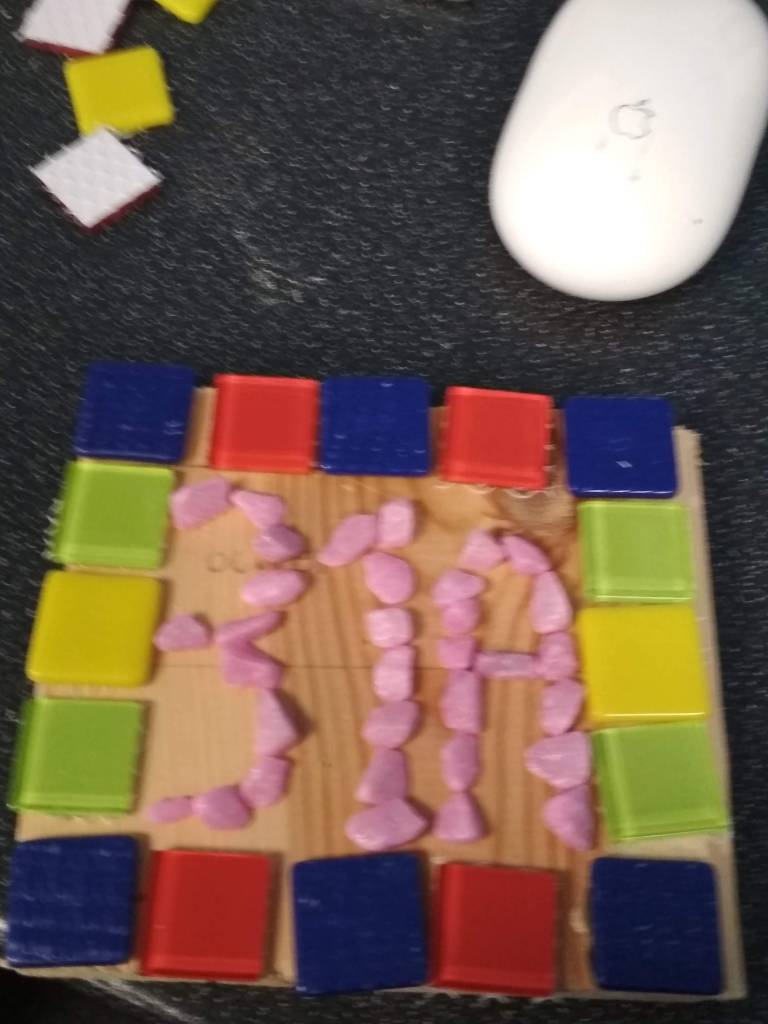
The draft mosaic address marker without its background.
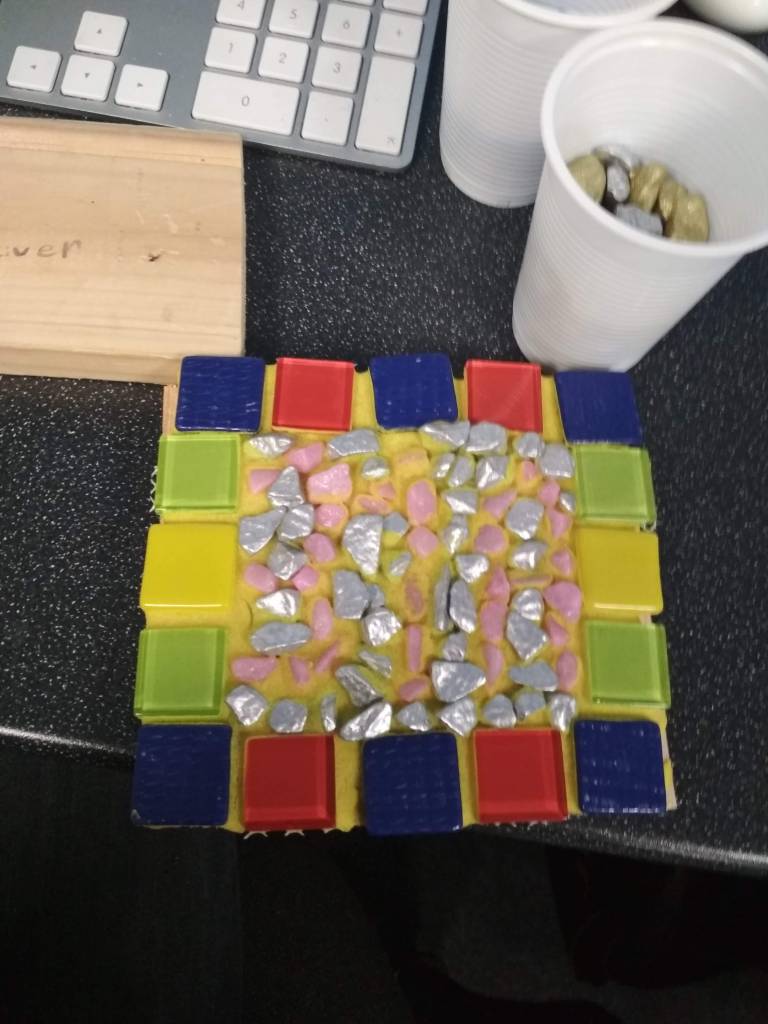
The draft mosaic address marker with its background.
The draft mosaic address marker was designed using big, flat tiles (coloured red, yellow, green and blue) for the border, grey stones for the background, pink stones for the address marker numbers, and a piece of wood. I think my design is good, but I put too much glue on the piece of wood, making the address numbers ’31A’ (made from the pink stones) impossible to read. Here are my improvements for the next time: I could add more colours to my mosaic address marker, put less glue on the piece of wood and use smaller tiles or stones in my mosaic address marker.
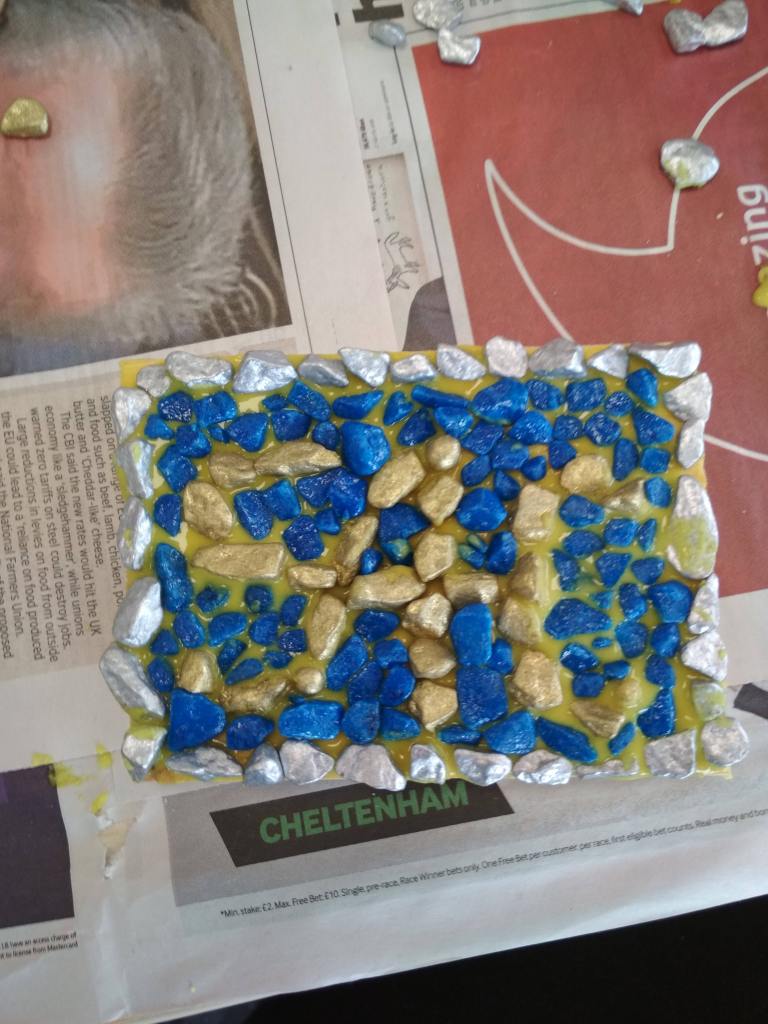
The final mosaic address marker.
The final mosaic address marker was designed using small, grey stones for the border, small blue stones for the background, small golden stones for the visible address marker numbers, and a piece of wood, and used less glue than the draft mosaic address marker.
I got my fingers covered in glue when I was trying to rearrange the stones in the draft mosaic address marker and the final mosaic address marker. Tasting or swallowing glue could cause an illness. Glue causes irritation to the skin and eyes, and may also cause allergies to people who are allergic to glue. I got to take the draft mosaic address marker and the final mosaic address marker home on 2 April 2019.
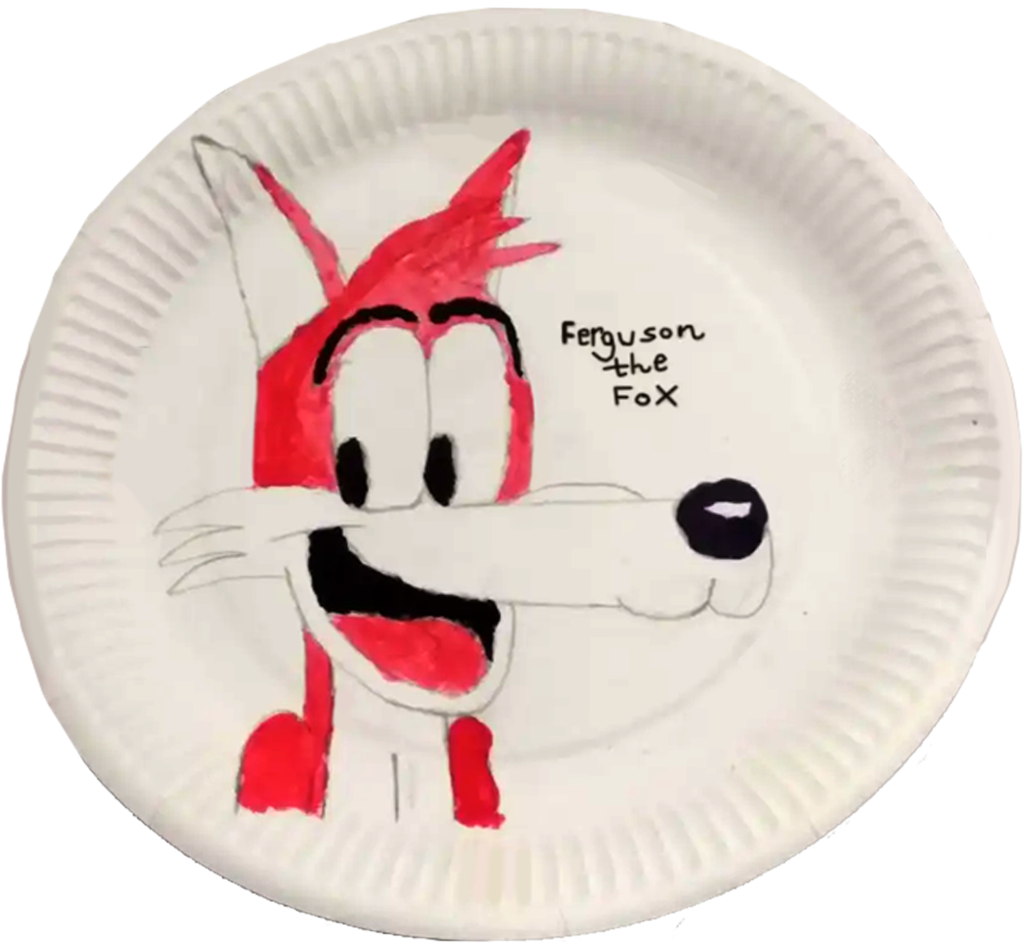
Ferguson the Fox.
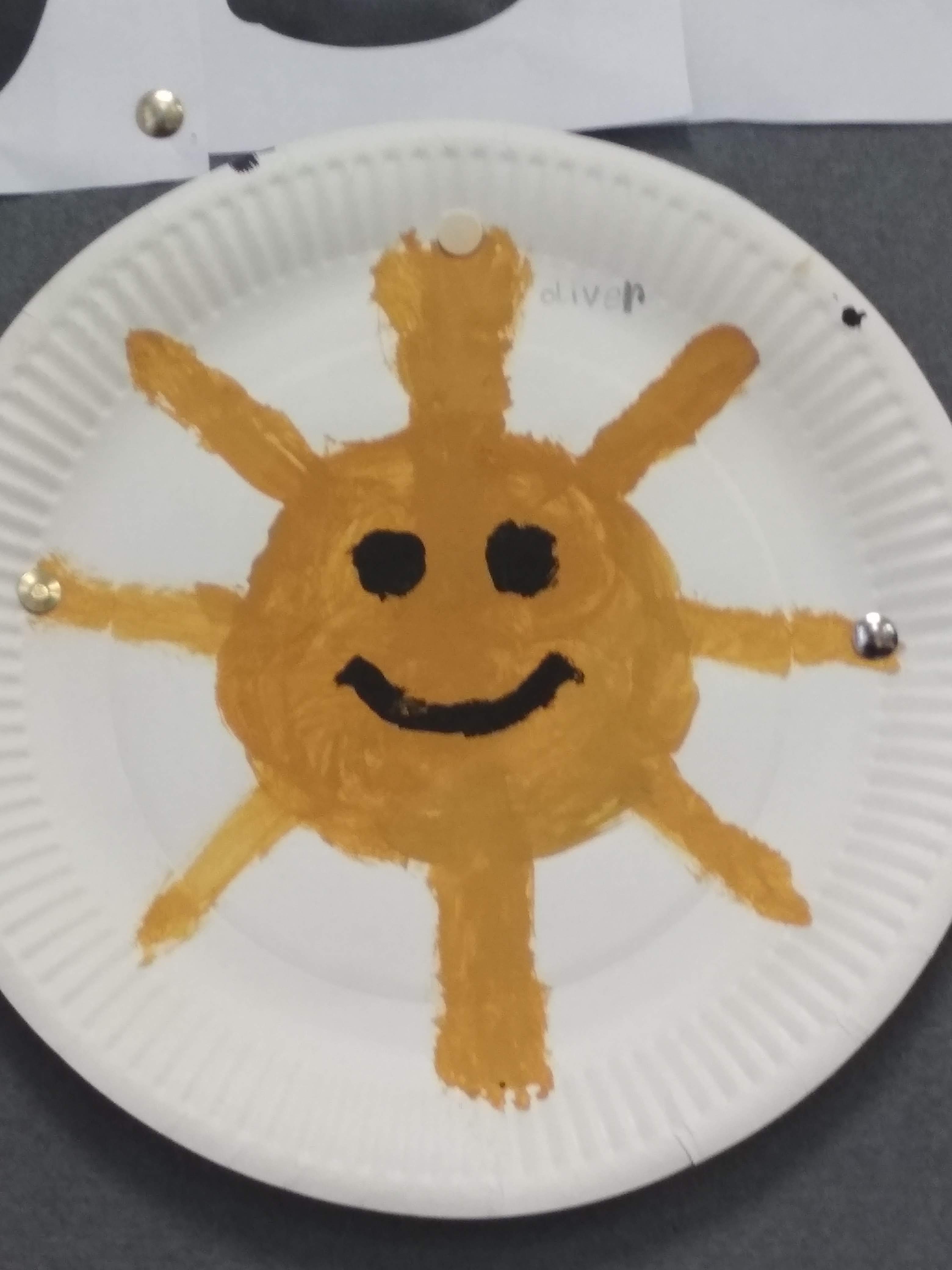
My sun.
On 27 March 2019, in my Personal Social Achievement lesson, I drew and painted a fox named Ferguson the Fox (I based his design on Tom Cat from Tom and Jerry) and a cute sun on paper plates. The drawings were pinned to the Student Gallery wall, and stayed there from that day to 27 June 2019.
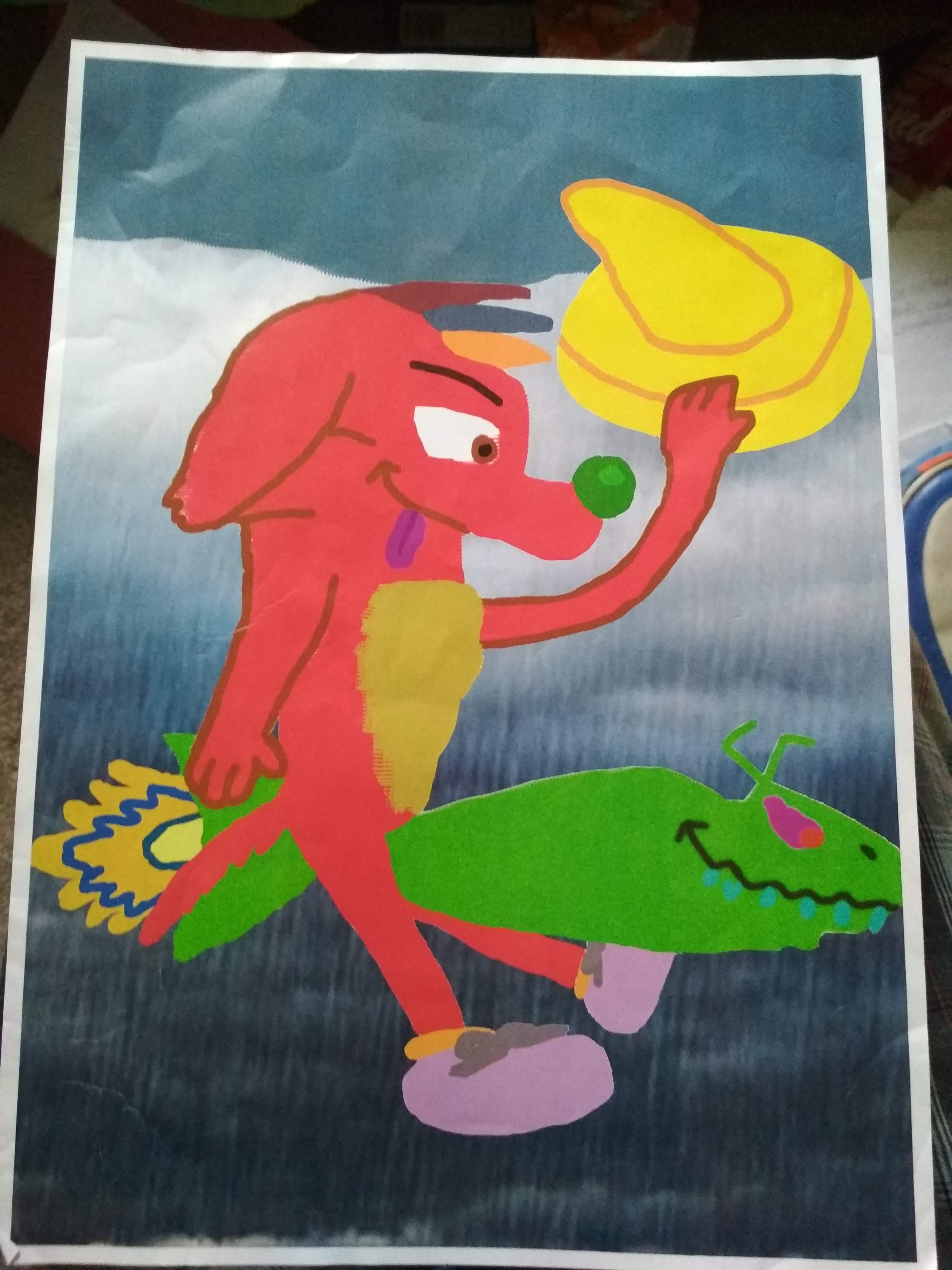
Ride ’em…in the Rain!
On 23 April 2019, I got to take a surrealist picture that I made on Adobe Photoshop home. The picture is named Ride ’em…in the Rain!, and depicts a red, green-nosed Mexican dog (with hairs somewhat similar to Crash Bandicoot) riding on a green missile with ant-like antennae and a crocodile-like face and waving his sombrero during a stormy, rainy day, which is out of place as no person could ride a missile when it is raining in real life. The picture was inspired by the scene in which Major Kong rides the H-bomb in Doctor Strangelove (1964).
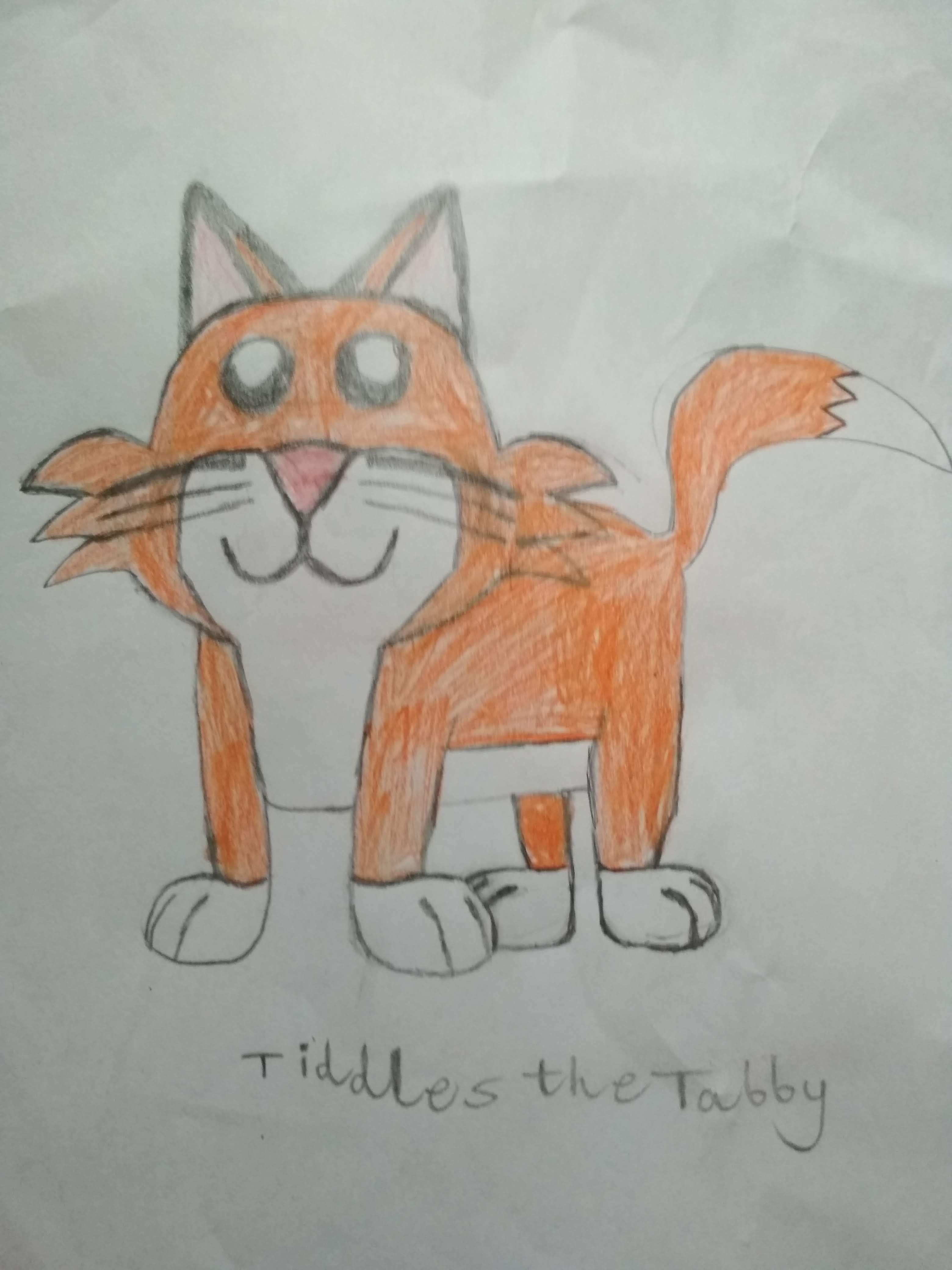
Tiddles the Tabby.
On 3 May 2019, I drew a picture of a kitten named Tiddles the Tabby, and showed it to my mother, and she liked it.
Dead Ringer.
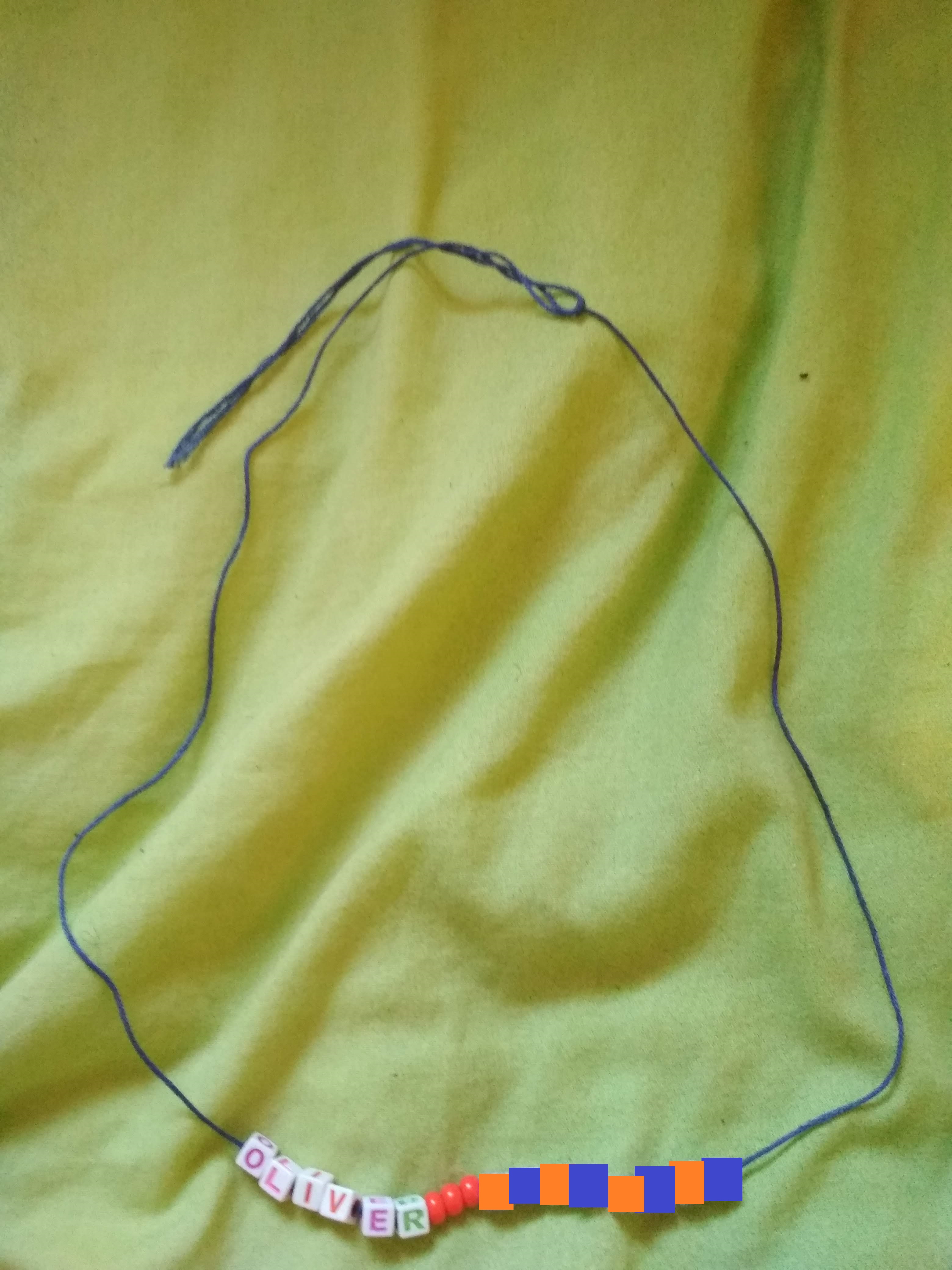
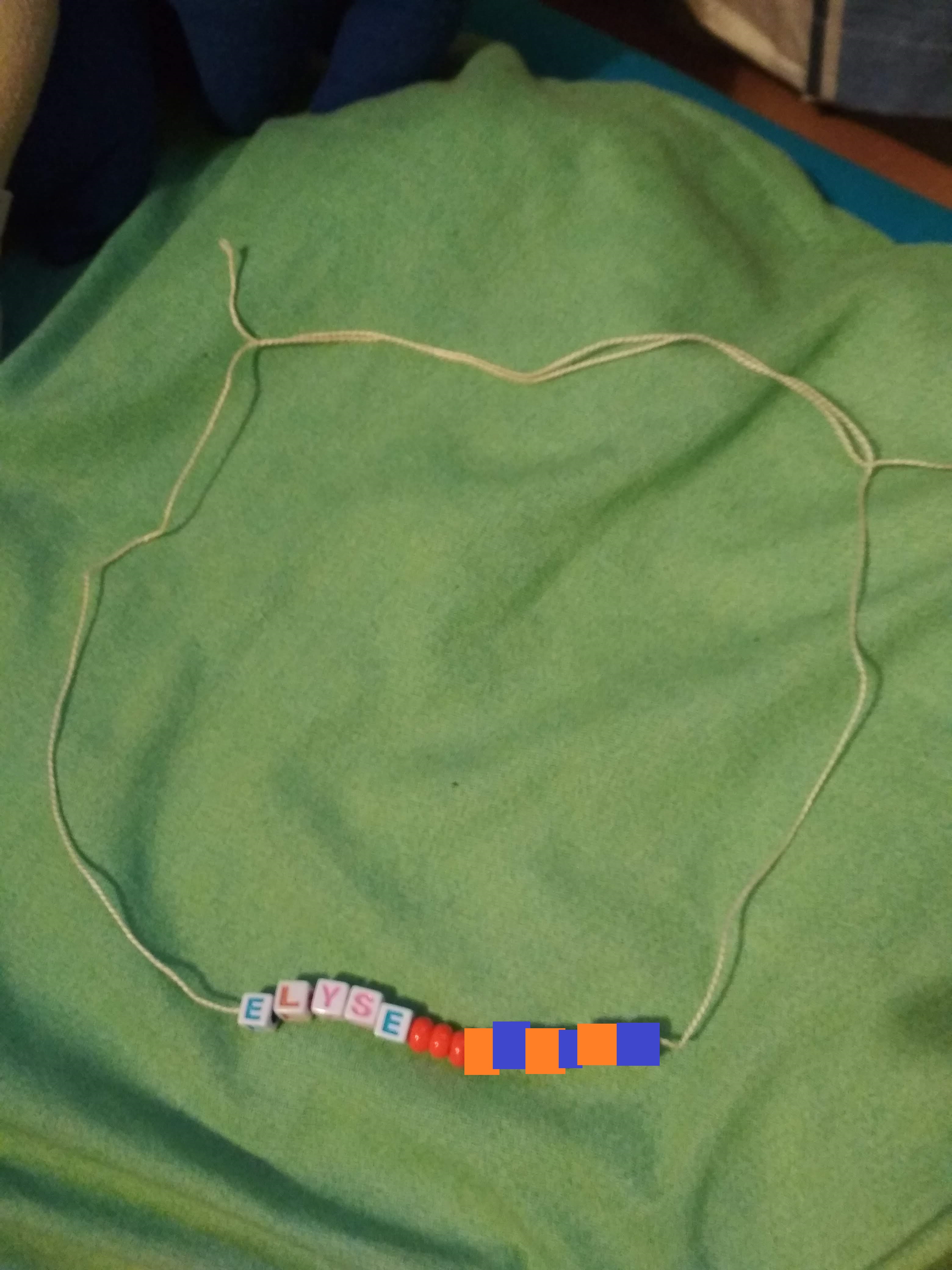
My first name necklace.
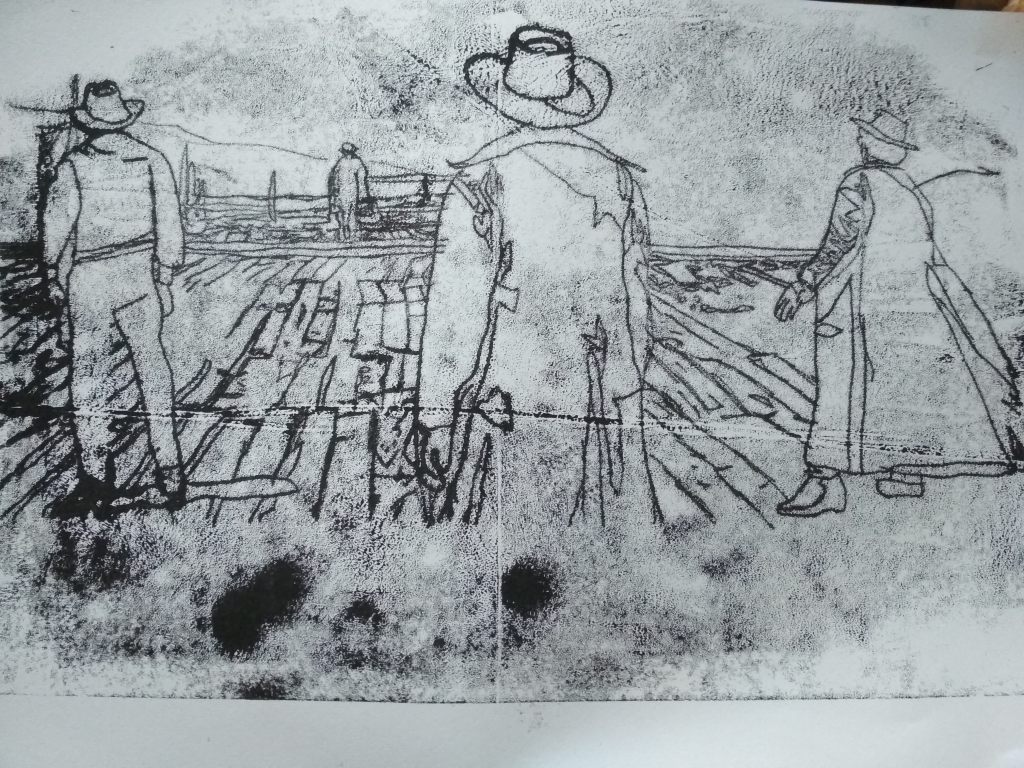
My original ink drawing of the still photograph taken from The Good, the Bad and the Ugly.
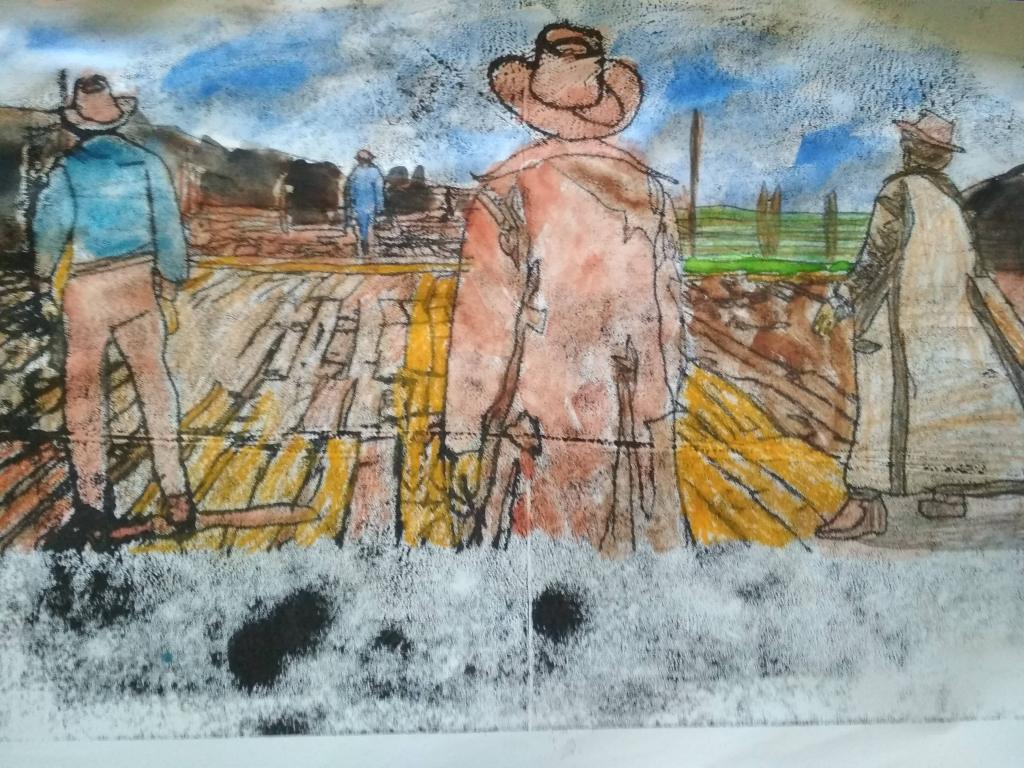
My coloured ink drawing of the still photograph taken from The Good, the Bad and the Ugly.
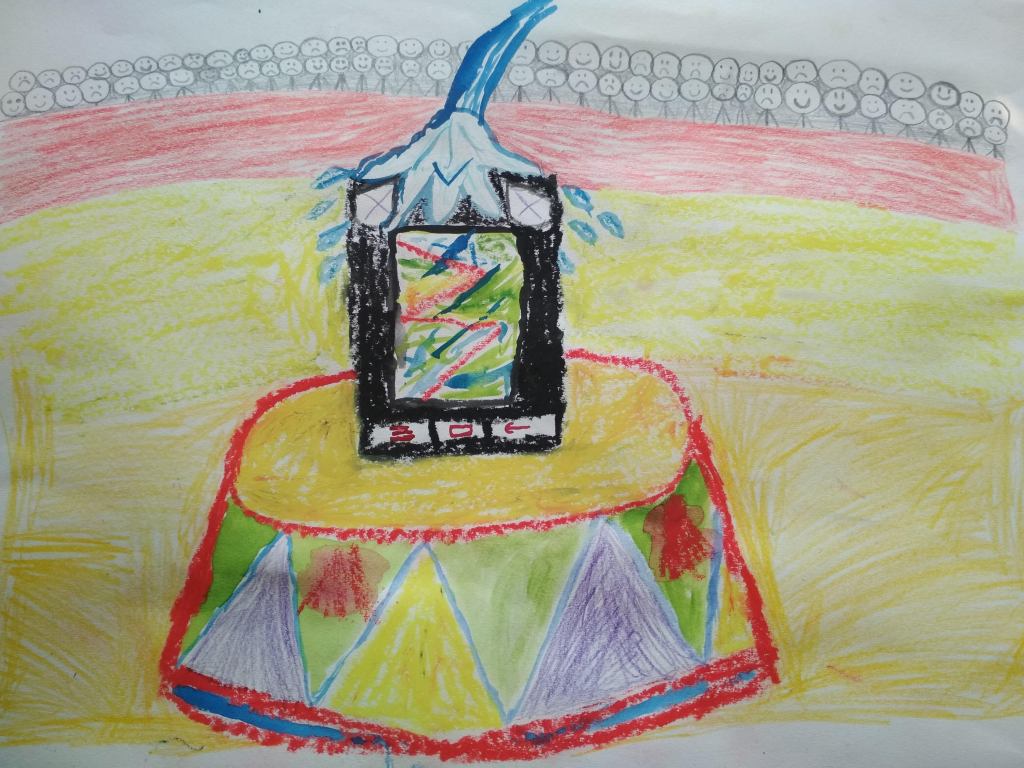
On 22 May 2019, I had a Taster session in Art and Design, and made a picture named Dead Ringer. The picture depicts a phone (which looks exactly like my old Xiaomi Redmi 4X phone, explaining the meaning of “dead ringer”) getting splashed with water by an unseen bully or troublemaker at a circus and dying (phones ring, and water is dangerous to electronics like phones; the phone’s death explains the picture’s title and is a pun on “dead ringer”). Half of the audience focuses sadly on the phone, while the other half of the audience focuses happily on the other acts and performances in the circus. The picture was made using a combination of watercolour paint, oil pastels and coloured pencil. I got to take the picture home, along with a necklace with my name on it (which I made in one of my Personal Social Achievement lessons) and ink drawings of some other pictures, two of them being ink drawings of a still photograph taken from The Good, the Bad and the Ugly (1966). I coloured in one of the ink drawings of the still photograph taken from The Good, the Bad and the Ugly. The ink drawings were made in a Taster session in Art and Design on 14 May 2019.
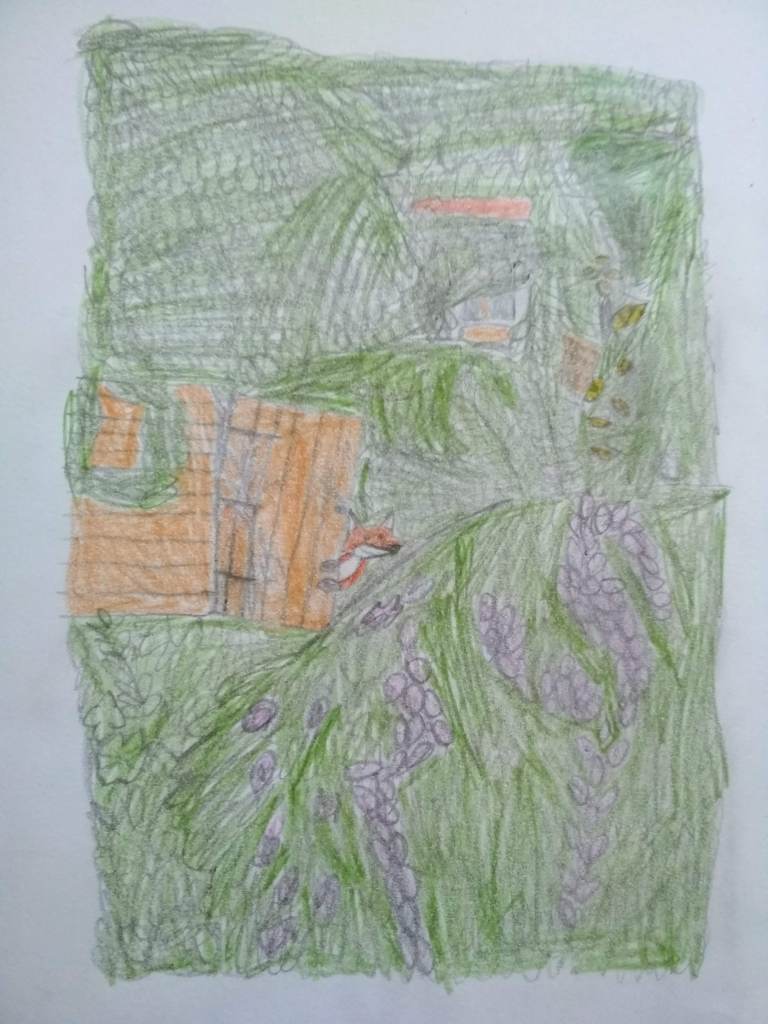
On 25 May 2019, I was in my father’s bedroom drawing a picture of the garden outside his flat. I put lots of detail in the picture, including the flowers, grass, bushes, et cetera. There used to be a fox and her noisy kits living in the shed with its door hanging off one of its hinges in the garden. Because of that, I added the fox peeking out from behind the shed’s door in the picture.
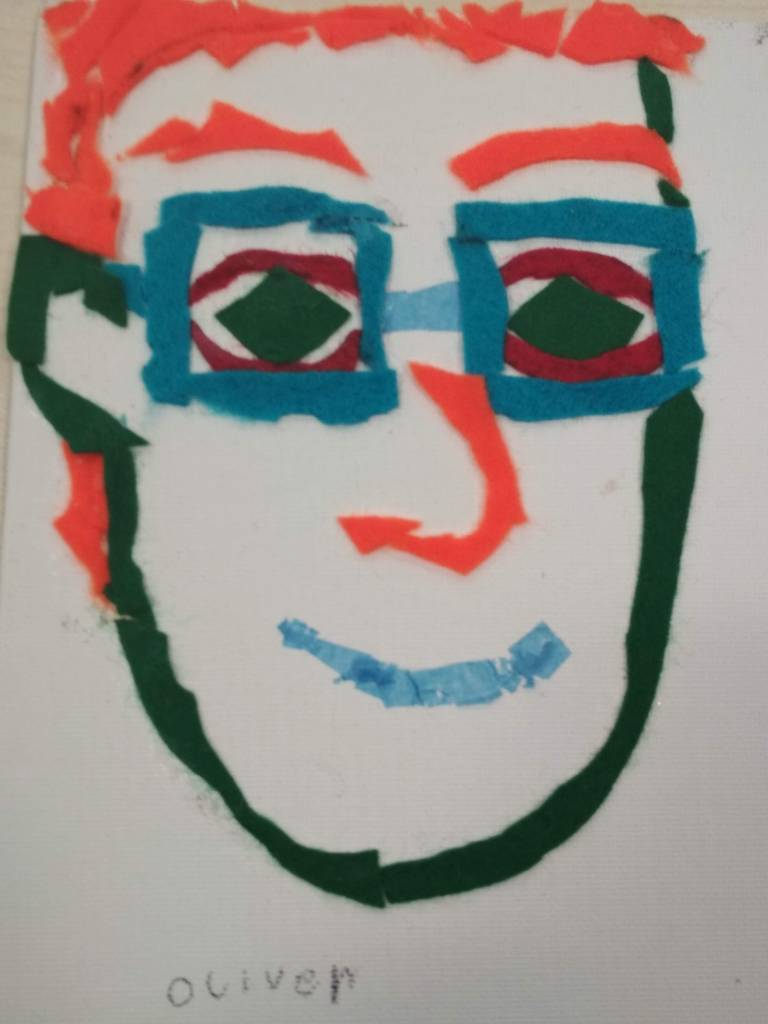
My blue paper and coloured fabric strip self-portrait.
My second name necklace.
My sister’s name necklace.
On 5 June 2019, in my Personal Social Achievement lesson, I made a self-portrait of myself. I used glue to “paint” the outline of my head on a white canvas, and pasted blue paper and strips of coloured fabric onto the outline of my head, my hair, my ears, my glasses, my eyes, my nose and my mouth. The self-portrait was pinned to the Student Gallery wall, and stayed there from that day to 27 June 2019. I made a second necklace with my name on it and a necklace with my sister’s name on it, and got to take them home.
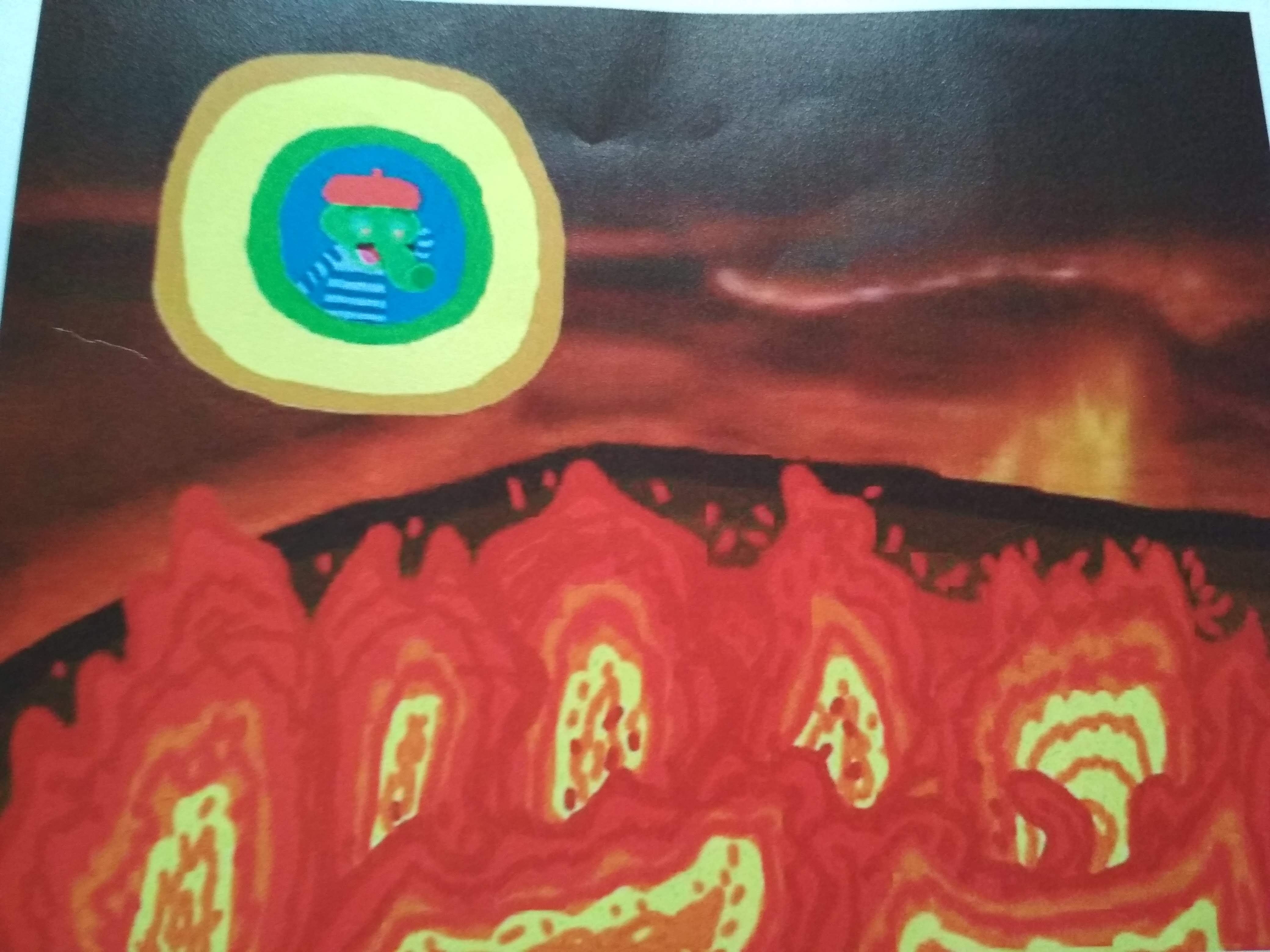
Sacré Burn!
On 10 June 2019, I made a surrealist picture on Adobe Photoshop. The picture is named Sacré Burn!, and depicts a French elephant-like alien peeking out of a drum and, to his surprise and horror, seeing a dark pit filled with detailed fiery flames in a dark cave, which is out of place as no person could survive in such a dangerous cave. The picture’s name is a cross between ‘Sacré bleu!’, a French expression of surprise, exasperation or dismay, and “burn”, which is what fire does.
Under the Weather.
On 18 June 2019, I made a surrealist picture on Adobe Photoshop. The picture is named Under the Weather, and depicts Ferguson the Fox lying in his bed and feeling ill, complete with a thermometer in his mouth, while the sky pours with rain outside, and a rain cloud rains on him, which visually explains the meaning of “under the weather”. I was originally going to use Oliver M. in the picture, but decided to use Ferguson instead. Ferguson was originally going to have his tongue hanging out of his mouth instead of the thermometer.
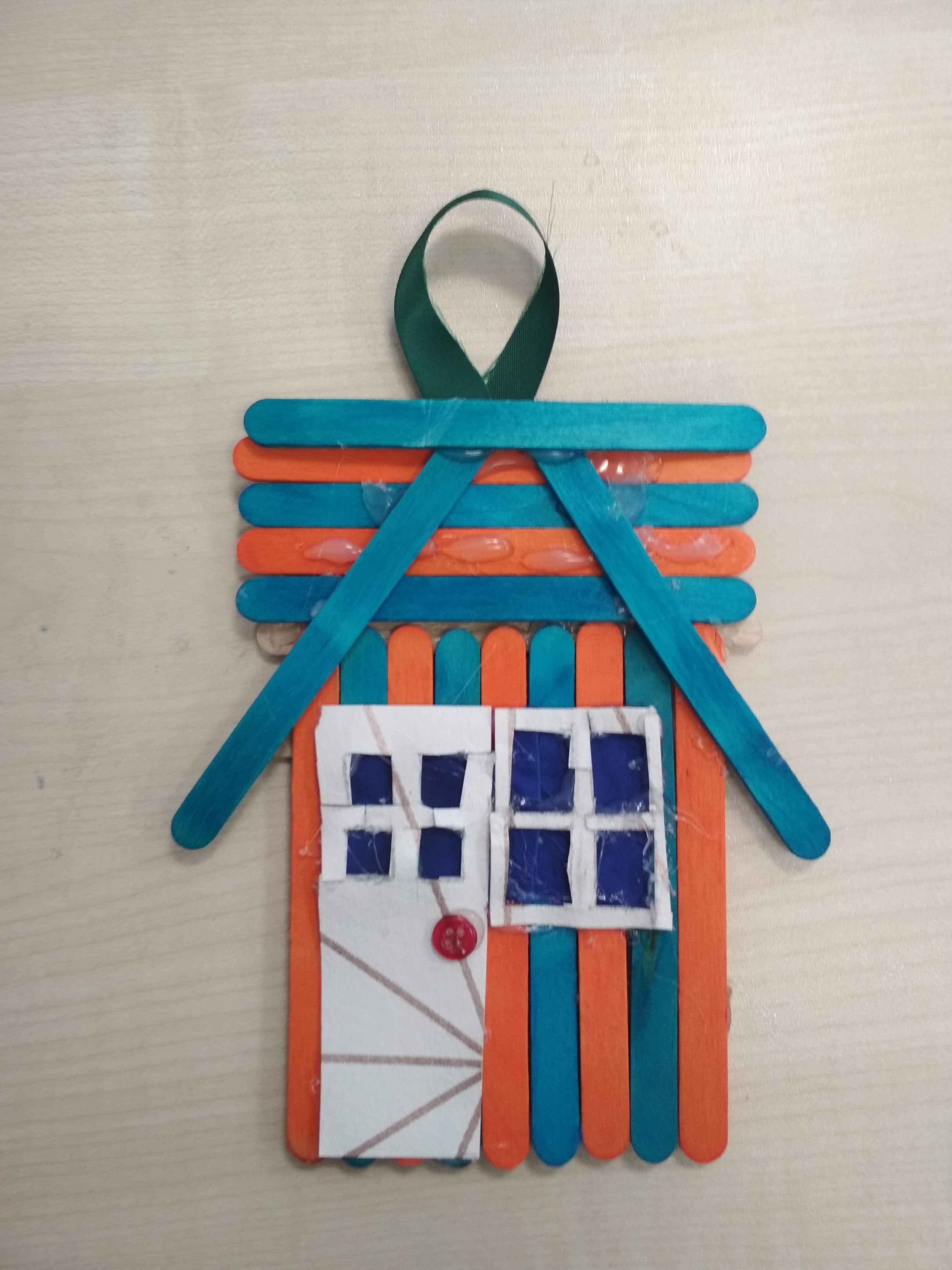
My popsicle stick house.
On 19 June 2019, in my Personal Social Achievement lesson, I made a house using popsicle sticks, orange popsicle sticks, blue popsicle sticks, a glue gun, blue pieces of cloth, paper, a pencil, a rubber, a little red button and a green ribbon. The house was pinned to the Student Gallery wall, and stayed there from that day to 27 June 2019.
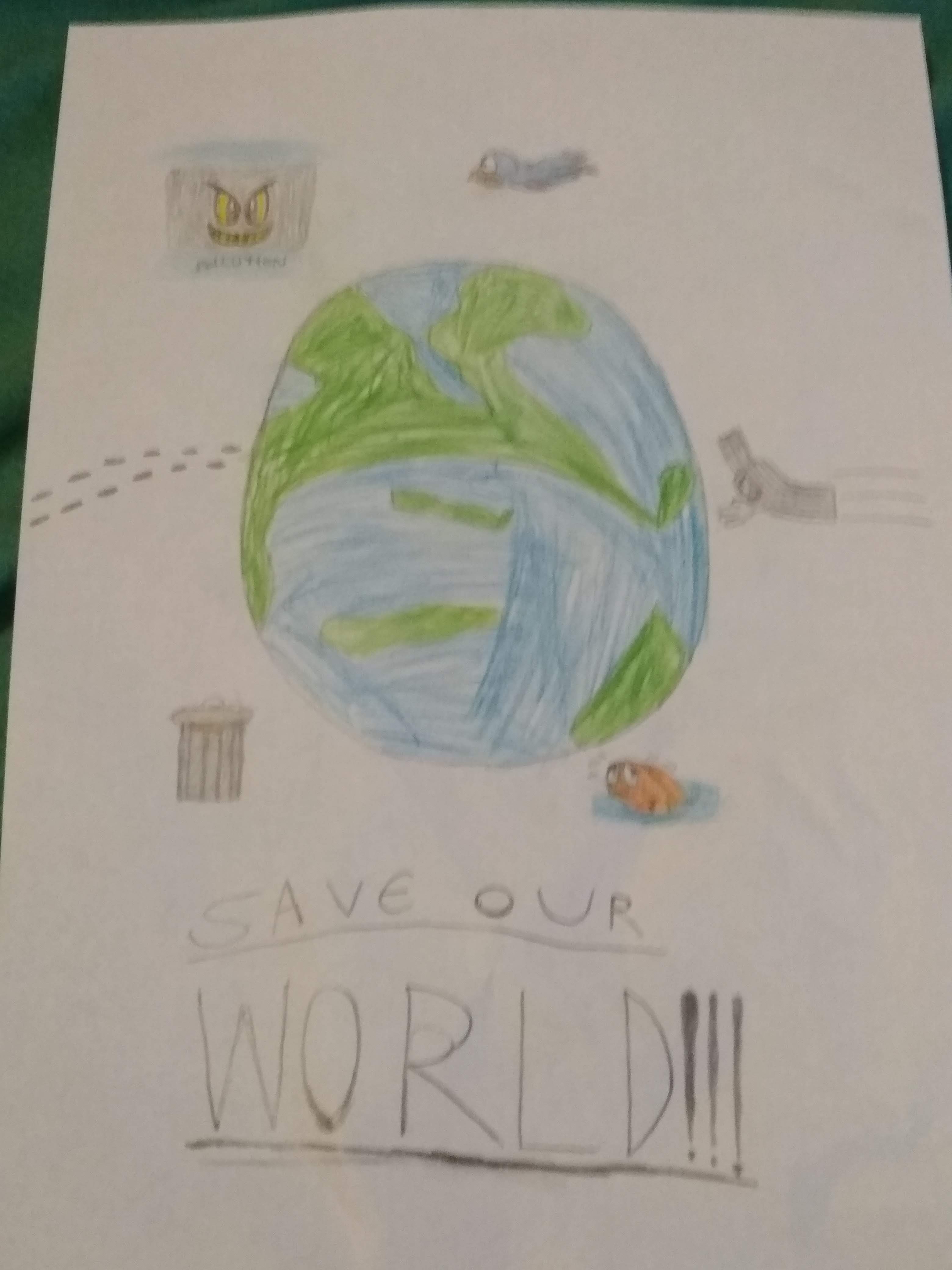
My poster about saving the planet.
On 21 June 2019, I made a poster about saving our planet. My sister was thinking about setting up an Instagram account for saving our planet, so I designed the poster for it. The poster depicts the Earth surrounded by an evil plastic bottle diving towards the sea, a fish afraid of meeting his demise, which is caused by plastics in the sea; a bird with a blood-filled cut in his body, footprints from the humans, signifying our responsibility; a rubbish bin, and pollution in the sky, represented by a pair of devious, yellow eyes with red pupils and a devilish smile with yellow teeth.
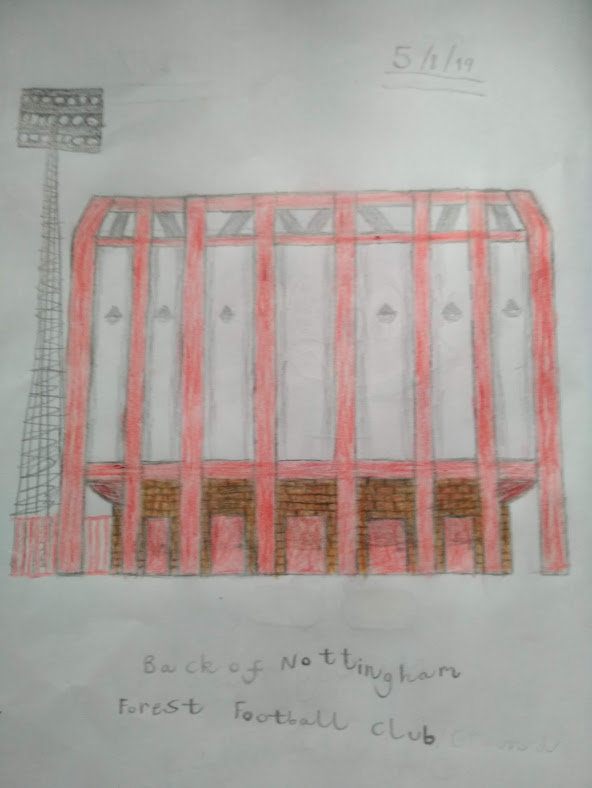
The back of Nottingham Forest Football Club.
On 4 August 2019, I was in my mother’s friend’s son’s bedroom drawing a picture of the back of Nottingham Forest Football Club. The picture was finished on 5 August 2019.
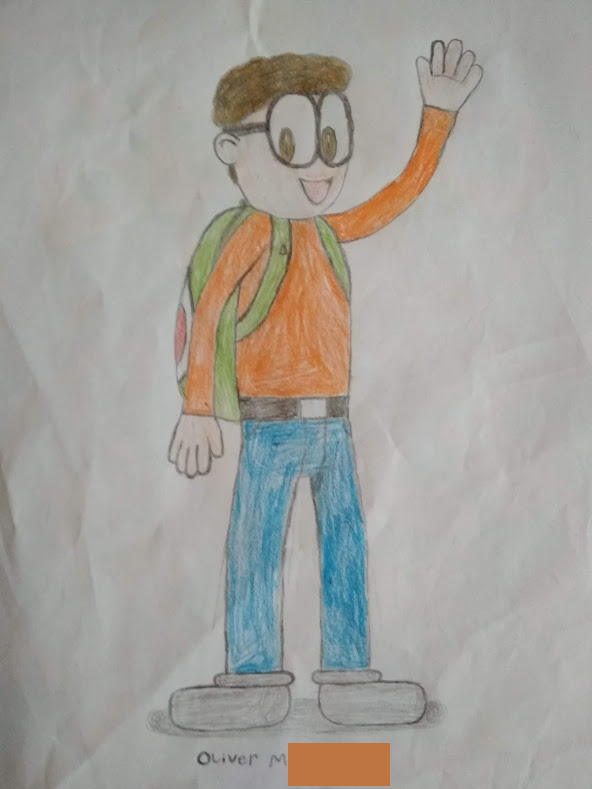
My drawing of my 10-year-old self.
On 24 September 2019, I began drawing a picture of Oliver M., and finished it on 25 September 2019. Being a 10-year-old was a good time in my life, because I had the toys that I could play with, was energetic and fun-loving, played with other children, and took part in many activities.
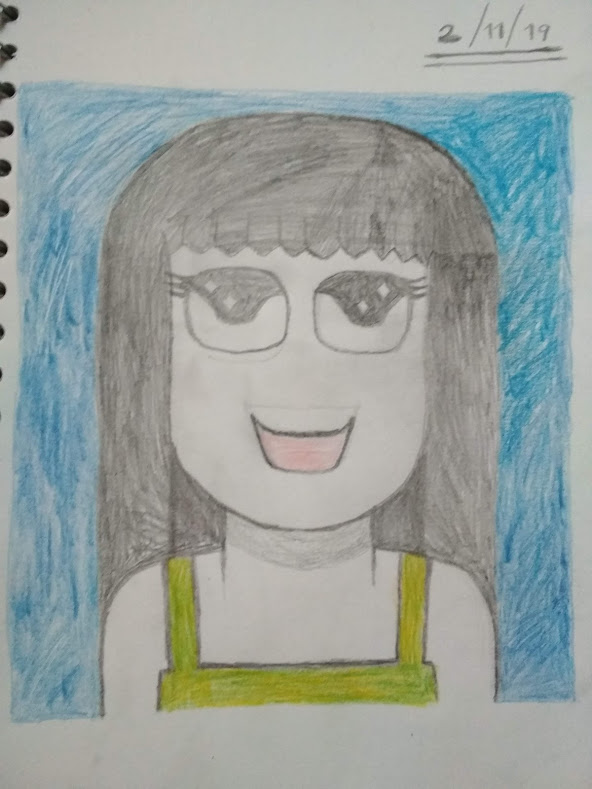
My Goth girl picture.
On 1 November 2019, I began drawing a picture of a Goth girl with black hair and sparkly, dark eyes, which I found harrowing, and finished it on 2 November 2019. This is my take on a painting that I encountered at a possible college placement on 31 October 2019. The painting was done by a student at the college, and I was told that the painting had a mixed review because of the creepy look of the Goth girl depicted in it. However, it was given to one of the teachers as a present, and therefore, it was displayed on a shelf in her office in the college until June 2020.
Oliver and the Stinkbombs.
I began production of a 77-second short film titled Oliver and the Stinkbombs in September 2019, and finished it and uploaded it to YouTube on 12 November 2019. The film’s plot goes like this: Gary Smith sneaks a stinkbomb into Oliver M.’s sandwich before running off. Oliver walks up to the table and sits at it and takes a bite out of his sandwich, causing the stinkbomb inside to burst and emit a ghastly, grizzly, stinky stench. Oliver coughs and gags, and Gary laughs and points at him from outside. Oliver angrily yells, “GARY!”, and chases after Gary, telling him, “Get back here, you dirty prankster!” Gary runs off, and Oliver screeches to a halt (like a Hanna-Barbera character) when coming across a box of stinkbombs that Gary bought from a joke shop. He declares, “He can’t get away with a disgusting prank like that. I’ll show him!” The next scene shows Oliver in a hangar, standing on one of the wings of Gary’s futuristic-looking plane. He sneaks one of Gary’s stinkbombs into a parachute pack, and runs off with the box of stinkbombs. Later, Gary is flying his plane in the sky. Oliver watches Gary with a telescope from inside a bush, and says, “Here he comes.” He then jumps out of the bush and lands on a see-saw, sending the box of stinkbombs flying into the sky towards Gary’s plane. A huge, loud, stinky explosion occurs. Gary, wearing his parachute, falls from the explosion, coughing and gagging. He laments, “My stinkbombs!”, and he shakes his fist at Oliver, saying, “I’ll get you for this, Oliver!”, and pulls the ripcord of his parachute, which causes the stinkbomb inside his parachute to burst. Gary is trapped in a stinky cloud and coughs and gags, and lands in a pigsty with a giant SPLAT! Oliver waves at the viewer, ending the film. The film can be viewed here.
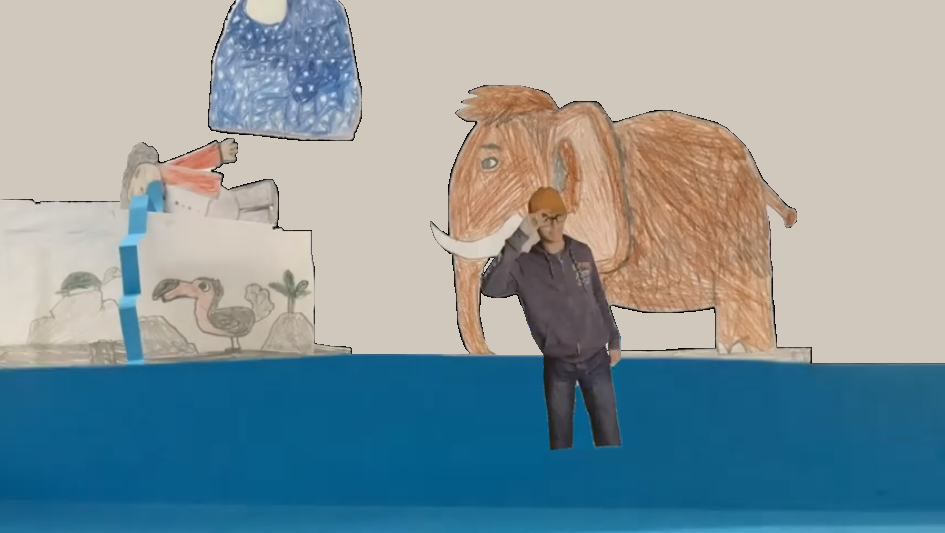
On 28 September 2019, I began drawing and cutting out characters and props to use in my scene for a book project done by Young Animators Club for the Folkestone Book Festival. The scene was adapted from The World’s Worst Children‘s (2016) Dribbling Drew. I finished drawing and cutting out the characters and props and animated the scene on 12 October 2019. On 26 October 2019, photographs of myself bending/leaning forward were taken, and I edited the background around myself out on Adobe Photoshop, and printed the photographs out. On 30 November 2019, I cut out the photographs of myself and animated them against a white background. The scene shows Drew walking across the museum, climbing onto a glass case with a dodo in it and sleeping and flooding the museum with his sea of dribble, and I am then shown wading through the sea of dribble. The scene can be viewed here and here. I also did a surprise stop motion animation with some big cardboard robots/aliens (made by children in a project from the previous week). I animated the big robots/aliens, while another student animated the little robot/alien.
A Week in the Life of Dad and I.
I began production of a 72-second short film titled A Week in the Life of Dad and I in October 2019, and finished it and uploaded it to YouTube on 16 January 2020. The film was made using Adobe Animate CC and was based on my holiday in Denmark in July 2019. The film’s plot begins on Monday, with Oliver M. and his father planning to go to the Westway Sports and Fitness Centre to play table tennis. However, it began raining outside, so they watched two films (Ready Player One (2018) and Alpha (2018)) on Oliver’s father’s computer together. One bright sunny Tuesday, Oliver and his father went to the Westway Sports and Fitness Centre to play table tennis. On Wednesday, Oliver and his father flew to Denmark and went for a walk in Skanseparken in Nørresundby (Oliver’s father used to play there when he was a child). On Thursday, Oliver and his father went to the very top of Denmark known as Grenen. On Friday, Oliver and his father came across an automatic car-like lawn mower named Robert, and went to Lindholm Høje, a Viking burial site and former settlement. On Saturday, Oliver and his father went to Nordsøen Oceanarium, where they saw seals swimming around and being fed some fish and blowing raspberries, and Ørnereservatet: Eagleworld, where they saw different types of eagles and falcons, including a Verreaux’s eagle/African black eagle. On Sunday, Oliver and his father flew back to London, and after all that activity, Oliver had a nap on his father’s bed, which ends the film. The film can be viewed here.
My National Book Token for World Book Day’s Design a National Book Token Competition.
On 27 February 2020, I designed a National Book Token for World Book Day’s Design a National Book Token Competition, depicting a boy reading an orange book while he is surrounded by a red star, a yellow star, a green star, a blue spiral and an orange, purple and pink spiral.
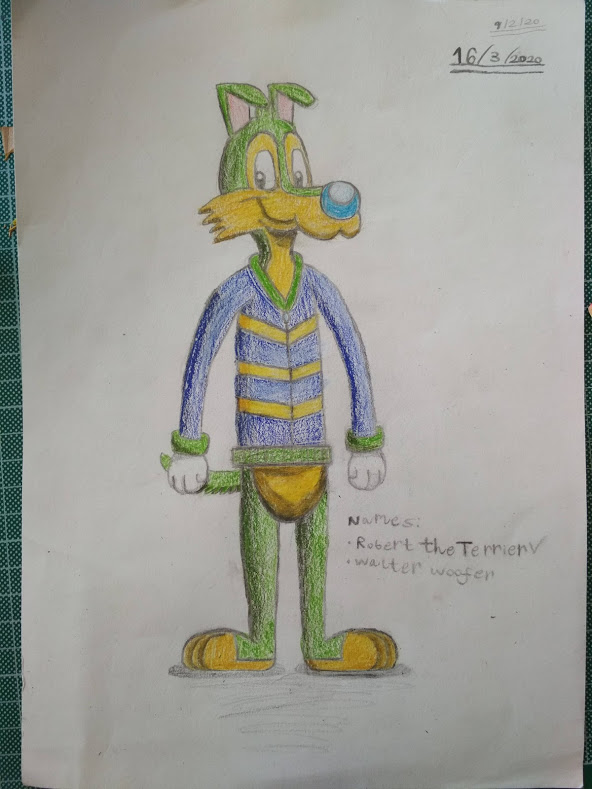
Robert the Terrier.
On 5 February 2020, I began drawing a dog named Robert the Terrier. The picture was finished on 9 February 2020. On 16 March 2020, I coloured Robert in, gave him shading, and gave him his name. I was originally going to name him “Walter Woofer”. Robert has green fur, a head and face similar to Tramp from Lady and the Tramp (1955), with yellow Sylvester the Cat-like cheeks, a Scooby-Doo-like muzzle and a blue Wowser-like nose; and big Bugs Bunny-like feet with yellow toes, and he wears a blue Conker the Squirrel-like cardigan with yellow stripes and white Mickey Mouse-like gloves.
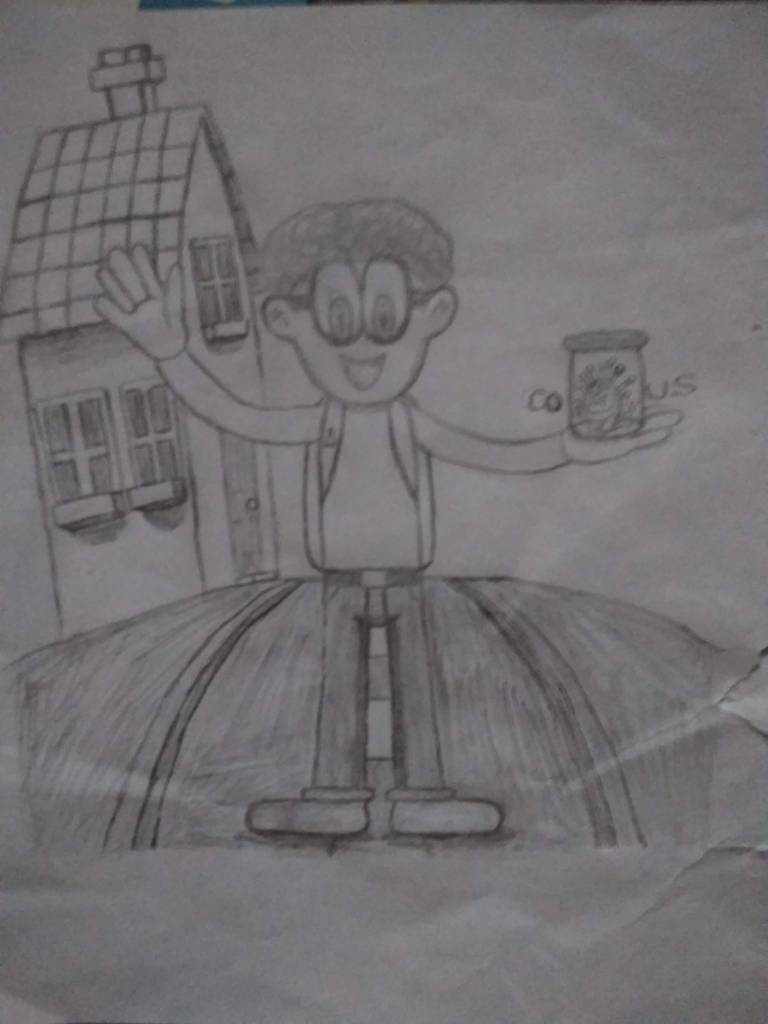
The draft version of Captured Coronavirus.
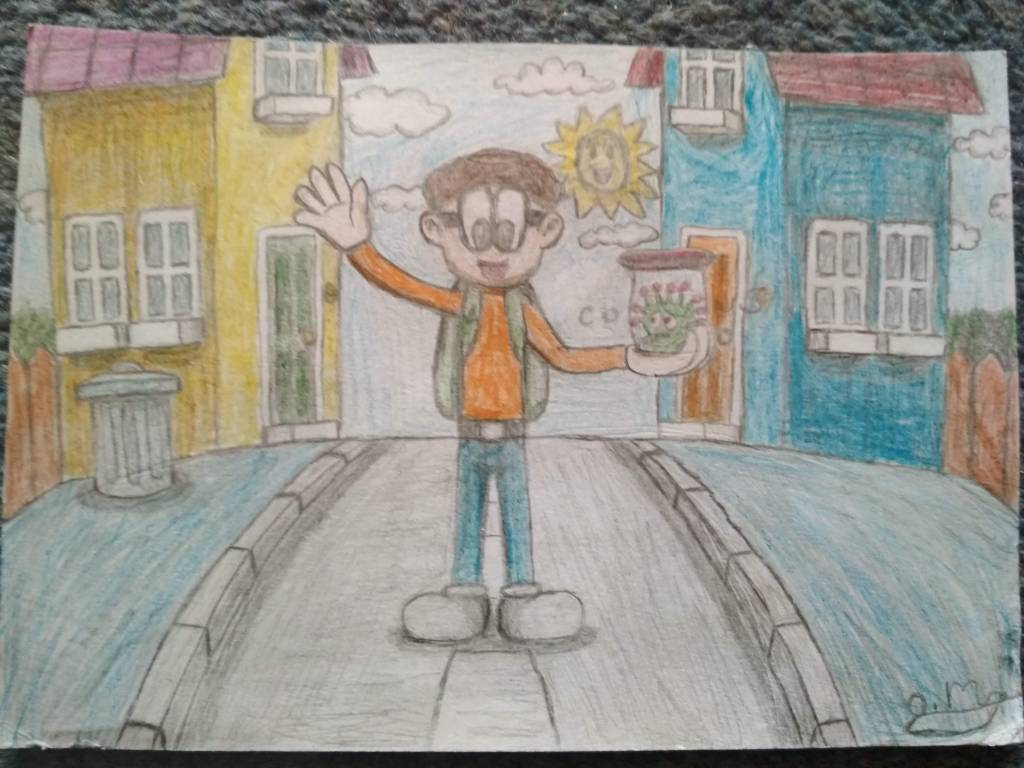
Captured Coronavirus.
On 31 March 2020, I drew a draft version of a picture for a postcard to post to Arts Education Exchange, named Captured Coronavirus. The picture depicts Oliver M. standing in the middle of the temporarily carless road outside two houses, waving and holding a jar with the coronavirus trapped inside, begging to be freed, which symbolises the fact that the virus is gone and Oliver can now go outside. I drew and coloured in the final version of the picture during the first week of April 2020, finishing it on 7 April 2020. On 9 April 2020, I posted the postcard to Arts Education Exchange through the letter box.
How to Use the Toilet.
I began production on a 72-second educational short film titled How to Use the Toilet in March 2020, and finished it and uploaded it to YouTube on 1 May 2020. The film was made using Moho 12 as an entry for the Canterbury Anifest’s Animation in Isolation competition, and teaches autistic people who may have sound sensitivity about using the toilet and keeping safe. The film’s plot begins with Oliver M. drinking from a glass and beginning to walk away. Suddenly, he starts shaking and has a sensation to go and use the toilet. He says, “When I feel that my bladder is bulging after I have consumed food or liquid, I may have a sensation to go and use the toilet.” Oliver then sees a toilet, and enters it. After that, he tells the viewer, “Using the toilet requires many, many steps, like sitting on the toilet if you are a girl, or standing if you are a boy. The important steps afterward are wiping your private parts and bottom, putting your pants back on, flushing the toilet and washing your hands.” After the important steps are shown and explained, Oliver is shown holding a pointer. He says, “We must always remember these steps in order to keep ourselves safe from dangerous germs and viruses.” As he says this, he taps on a picture of a green, grinning germ, who laughs evilly. The scene cuts to a young boy who finds flushing the toilet frightening. Oliver says, “For some people who find flushing the toilet frightening, especially if they are at a young age and have sound sensitivity, they can wear ear-defenders or focus on something positive.” He walks up to the boy and gives a pair of ear-defenders to him. The boy is then seen coming out of the toilet wearing the ear-defenders after using and flushing it, with Oliver congratulating him with a thumbs up, saying, “Well done!” Oliver then waves at the viewer, ending the film. The film can be viewed here.
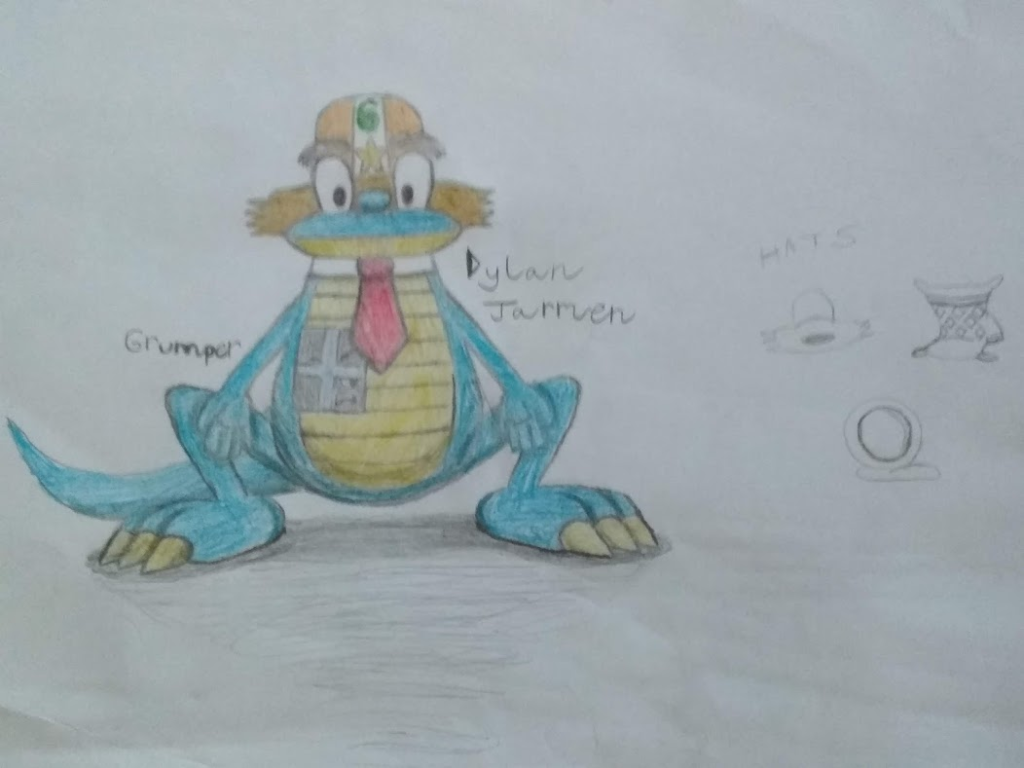
Dylan Jarmen and Grumper.
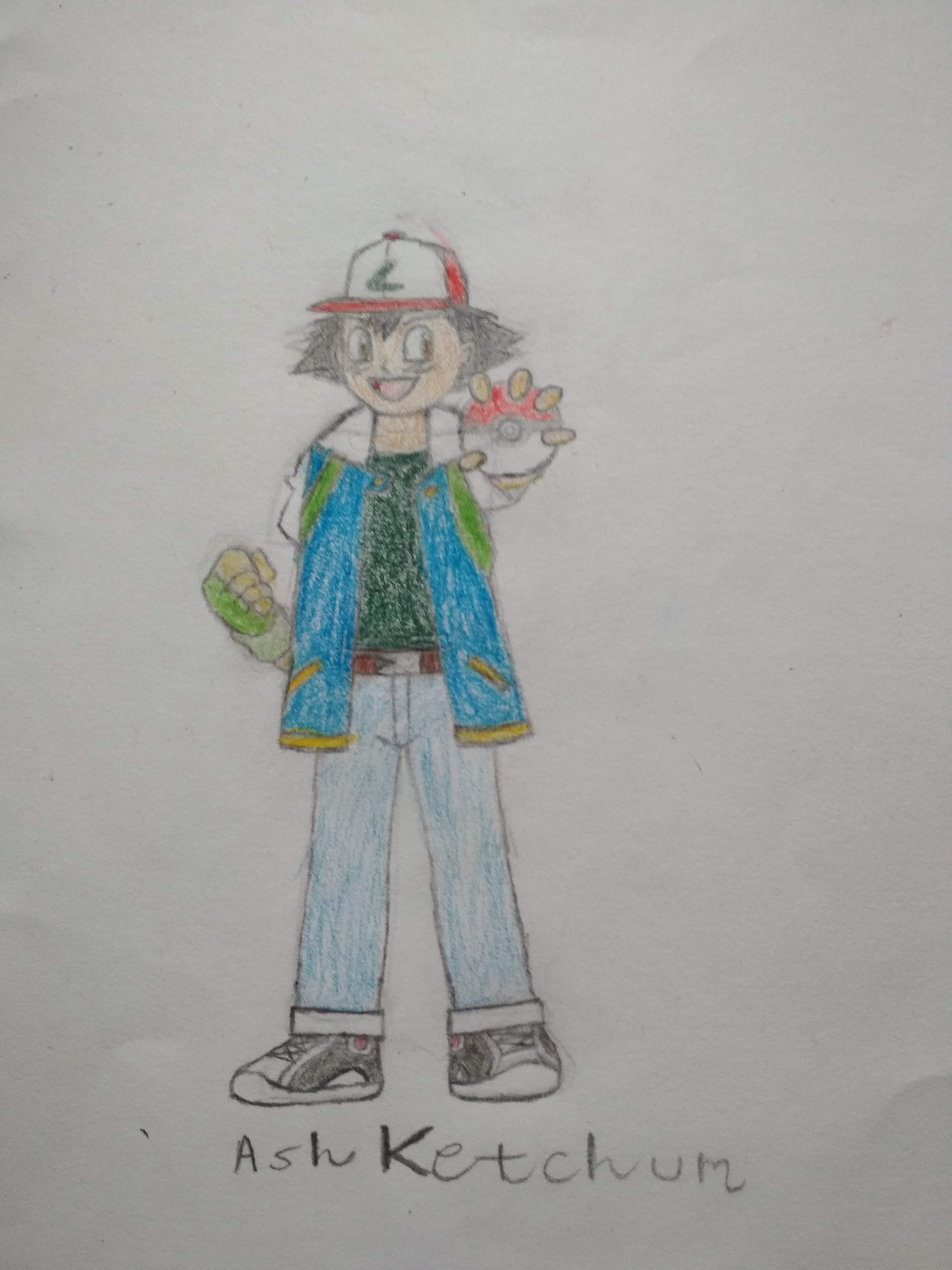
On 29 April 2020, I began drawing a frog-jar hybrid named Dylan Jarmen. The picture was finished on 8 May 2020. I based Dylan on a jar in the British Museum, and his name comes from the fact that he was inspired by the jar. Dylan hails from Texas, is coloured blue and has big feet with yellow toenails and a kangaroo-like tail, and he wears a brown Ash Ketchum-like hat with a green spiral and a yellow star on it and a red Yogi Bear-like necktie. Living inside Dylan is a grumpy, purple gopher named Grumper.
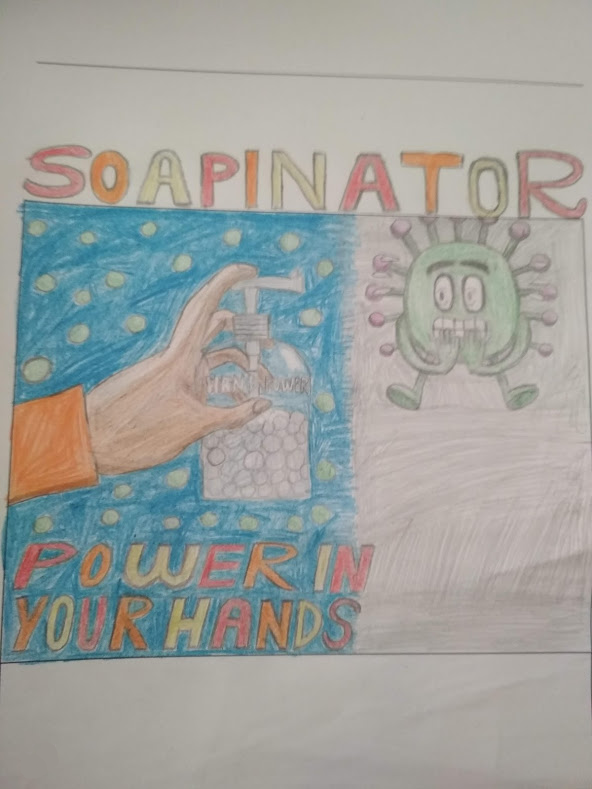
Soapinator: Power in your Hands.
On 12 June 2020, I drew a poster in response to Arts Education Exchange’s Illustration Activity Pack, and coloured it in. The poster is named Soapinator: Power in your Hands, and depicts a hand holding a hand wash bottle labelled ‘Hand Power’ and using it like a gun, aiming it at the panicking coronavirus. The title is a play on Terminator. The poster teaches people how to stay safe, be clean and avoid infecting others during the pandemic, and is a ‘Protect Others’ Poster.
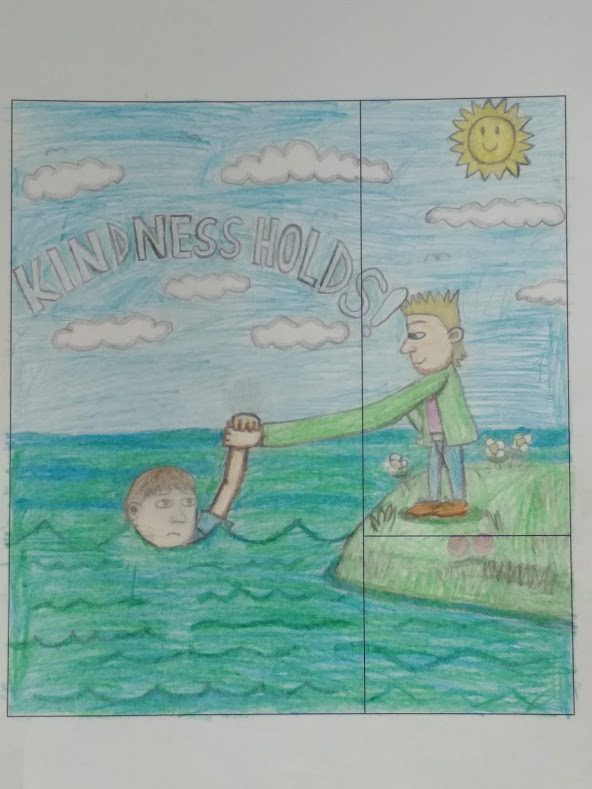
Kindness Holds!
On 19 June 2020, I drew a poster in response to Arts Education Exchange’s Illustration Activity Pack, and coloured it in on 20 June 2020. The poster is named Kindness Holds!, and depicts a man stretching out his arm to help a teenage boy onto the shore from the sea. The poster teaches people how kindness brings people together during the pandemic, and is a ‘Message of Solidarity’ Poster.
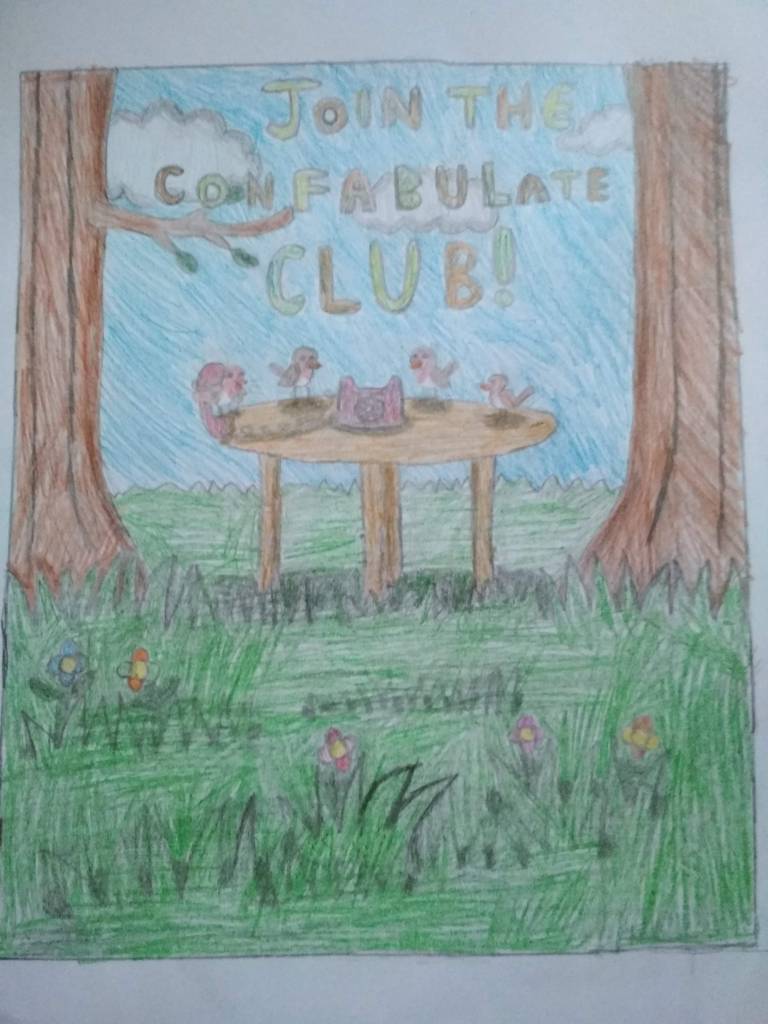
Join the Confabulate Club!
On 9 July 2020, I drew a poster in response to Arts Education Exchange’s Illustration Activity Pack, and coloured it in on 10 July 2020. The poster is named Join the Confabulate Club!, and depicts four robins standing on a small, round table in the middle of a garden. One of the robins is speaking to a friend of his on the telephone. The robins symbolise the renewing of social contact and growth. The poster is about maintaining our mental health during isolation, and is a ‘Mental Health’ Poster.
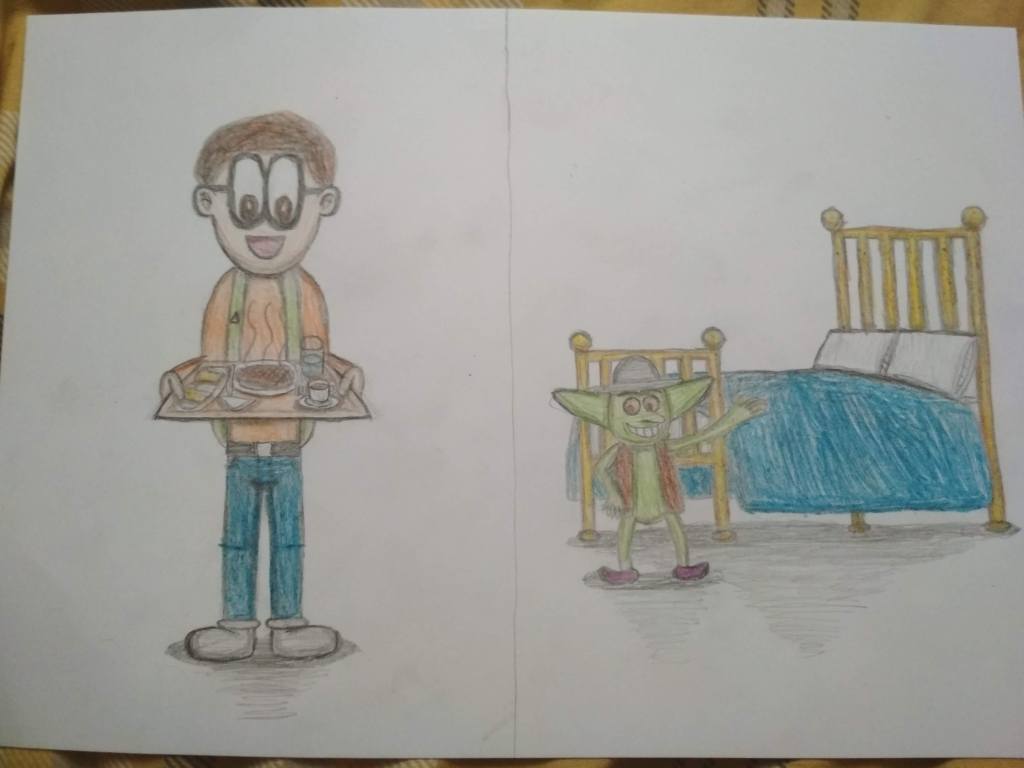
Help for the Homeless.
On 30 August 2020, I drew a picture named Help for the Homeless for a postcard, and coloured it in on 31 August 2020. The idea is to show some of the resources that can be helpful to the homeless people, and there is a charity in Folkestone that actually does this. The character of the young Oliver M. offers the homeless people a breakfast tray to keep them from starving, while Gary Smith offers them a big, nice, comfy bed to relax and sleep in and keep warm. This picture was originally going to be entered in the Secret Postcard Show in 2020, but due to the coronavirus outbreak, it was unlikely that it would happen.
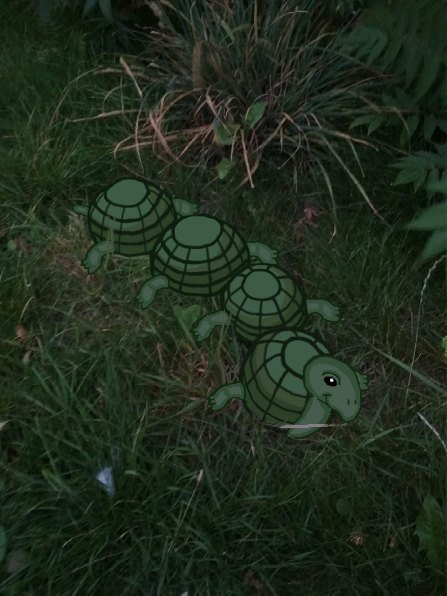
Caterturtle/Quadroshell.
On 18 September 2020, I edited a photograph that I took in the garden using Paint and Adobe Photoshop. The picture is named Caterturtle or Quadroshell. It depicts a turtle with four shells instead of the normal one shell, making it look like a caterpillar. If I were to find the caterturtle in real life, it would be in the wild. It would also be an anomaly in nature, and would be the ancestor of modern-day turtles (Charles Darwin’s theory of evolution by natural selection). The idea is about a creature that has never been heard of or discovered before, but lives in the imagination and is a part of lost natural history. It was intended to be entered in the Lost History exhibition on in September 2020.
Dangers of Smoking.
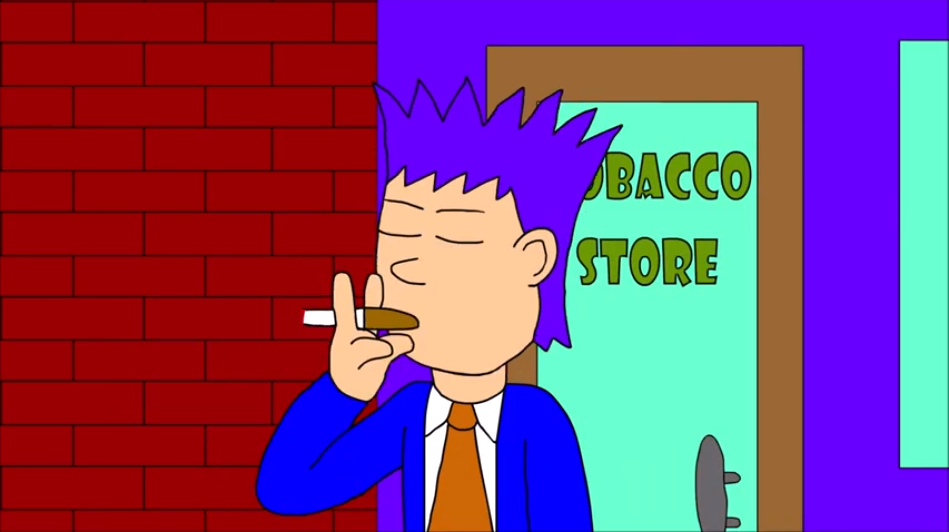
I began production on a 55-second short film titled Dangers of Smoking in September 2020, finished it on 13 April 2021, and uploaded it to YouTube on 24 April 2021. The film was made using Adobe Animate CC as part of an assignment for one of my BTEC Information Technology units at school, and conveys the message to 14-19-year-olds that although people think that smoking relaxes the brain, it actually stimulates it and causes health problems. The film’s plot begins with a man walking into a tobacco store, and coming out holding a cigarette. He smokes the cigarette and blows a cloud of smoke into an old lady’s face. The camera zooms in on the man’s body to reveal his lungs and tranchea. The lungs and tranchea fill with brown-spotted tar with smoke billowing from it, while his heart beats at an alarming rate. The man, feeling the effects of the tar and fast heart-beating, throws the cigarette away and begins to cough (I remember hearing the coughing sound effect in the audiobook version of The World’s Worst Children 2‘s (2017) Humbert the Hungry Baby). Grey, squiggly lines indicating the man’s affected health and bad breath escape his mouth. His affected teeth turn green, and each time the man coughs, his teeth begin to turn brown. The scene cuts to a close-up shot of the coughing man’s mouth, showing his now-brown teeth, flapping tongue and slightly disfigured gums. After this, the man notices a young woman smoking, and takes the cigarette from her, much to her anger. He smokes the cigarette and blows a cloud of smoke, and the camera zooms in on the man’s head to reveal his brain. After a few seconds, the brain is suddenly struck by six lightning bolts, indicating its stimulation, and the man suffers from a stroke and falls to the ground, unconscious. The film ends with an iris out, and white text against a black background saying, ‘The screen of illusion: smoking is dangerous!’, with trails of smoke rising from the ‘d’ and ‘!’ of ‘dangerous!’ “Urgency” by Dylan Sitts is the song that plays throughout the film. The film can be viewed here.
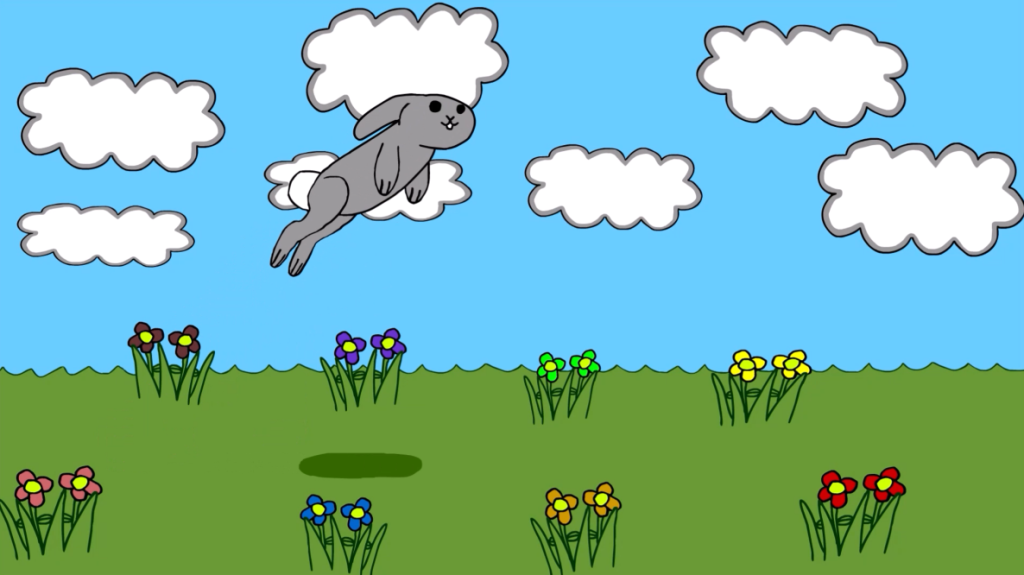
My ease-in and ease-out test animation.
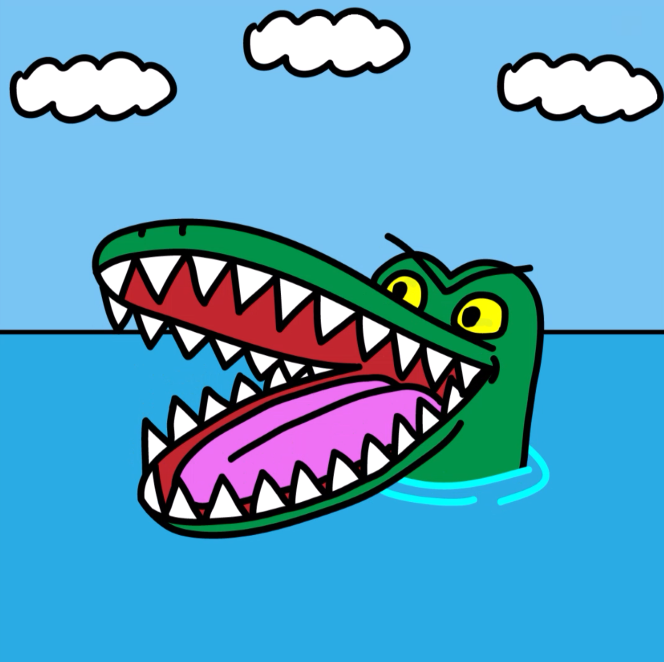
My crocodile GIF animation.
I began production of a 1-second animation of a rabbit jumping on 19 May 2021, finished it on 26 May 2021, and uploaded it to YouTube on 6 June 2021. The animation was made using Adobe Animate CC as a test of the software’s easing techniques/features in my spare time, and can be viewed here. I also produced a 5-second GIF animation of a crocodile snapping his jaws in June, using Adobe Illustrator, Photoshop and After Effects, and uploaded it on 30 August 2021 (video can be viewed here).
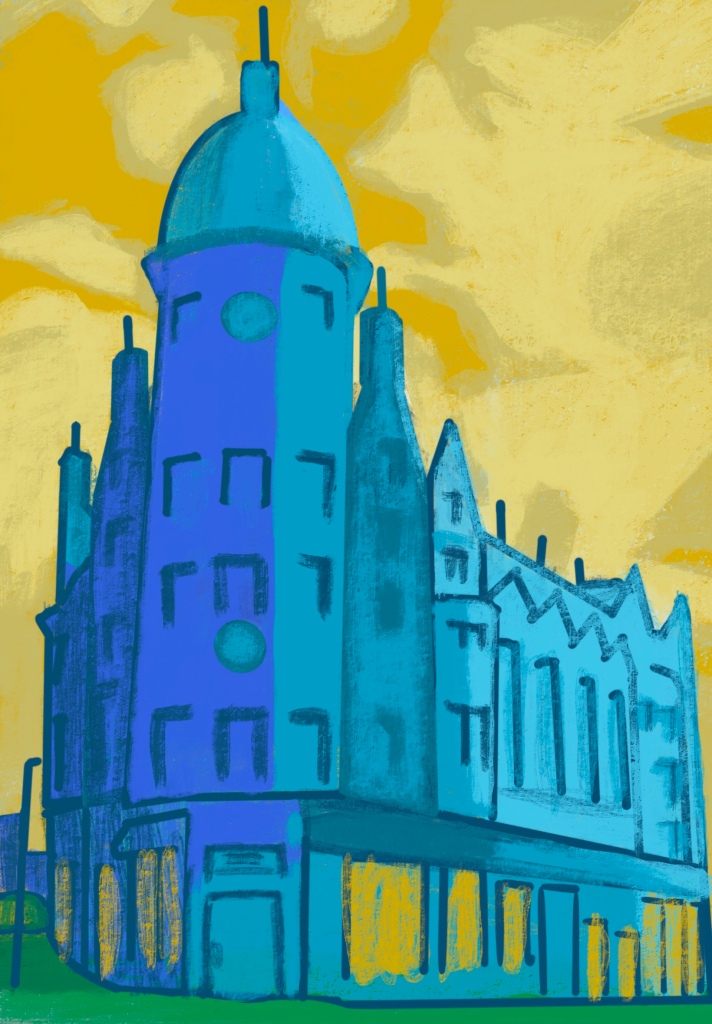
My abstract shape castle-church line drawing.
My watercolour building line drawing.
My Procreate-painted building line drawing.
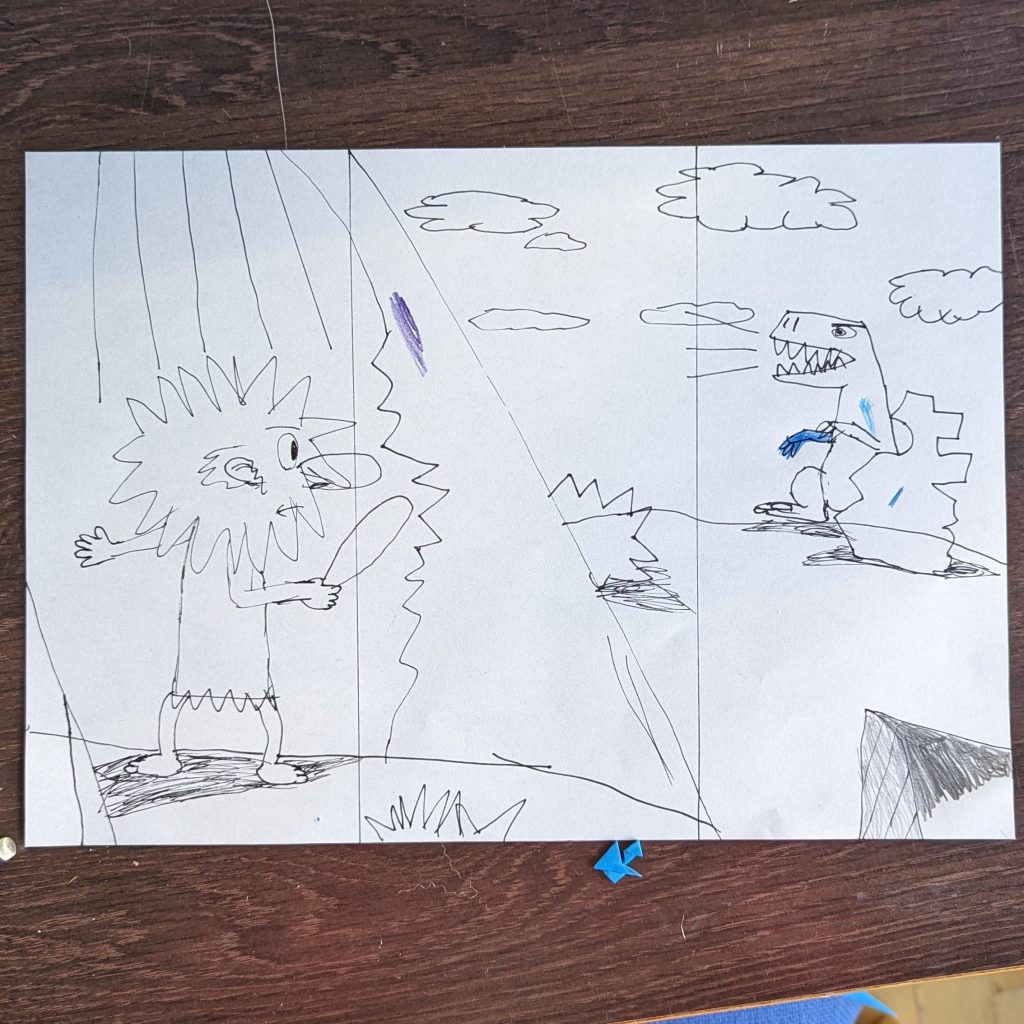
Reference drawing for prehistoric abstract shape paintings, with colour guide markings.
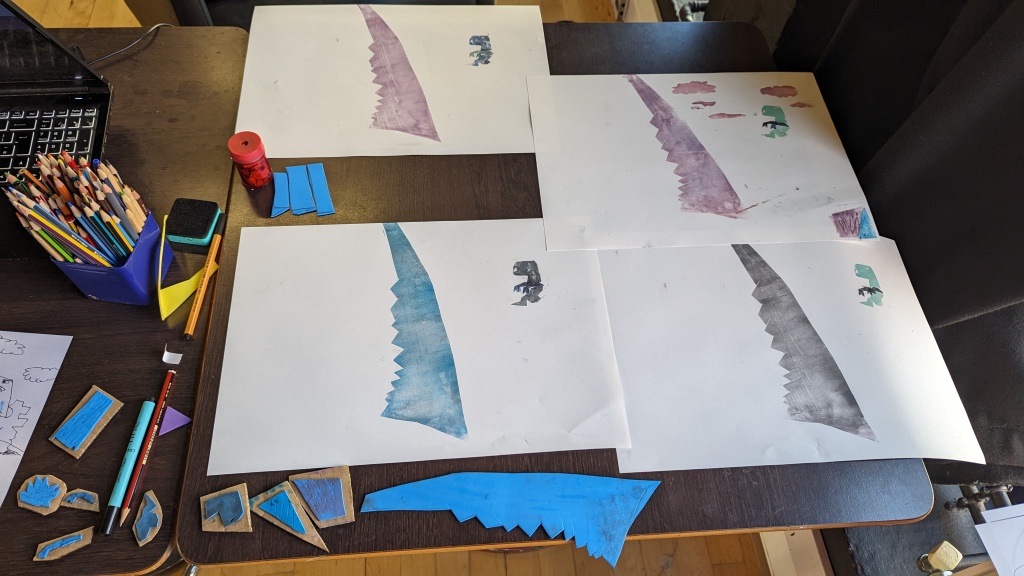
In-progress prehistoric abstract shape paintings and shape cutouts.
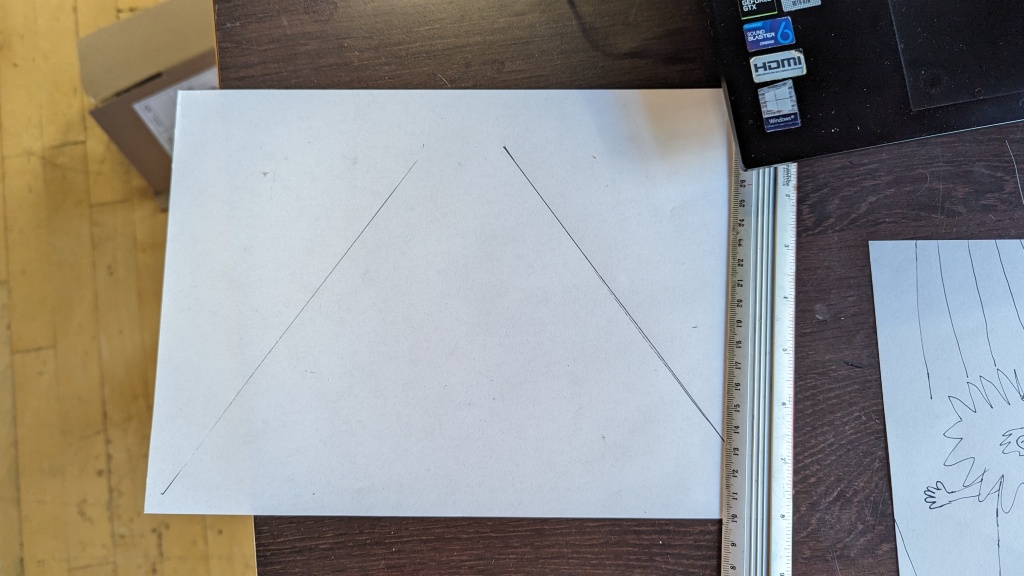
Paper with guide triangle for drawing in.
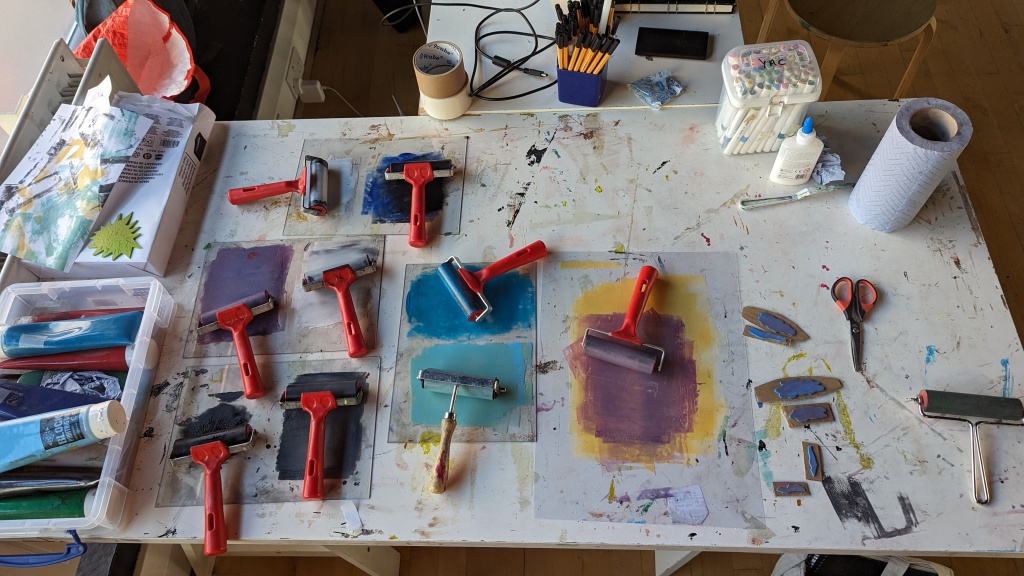
Equipment used for prehistoric abstract shape paintings.
Roller print example by Lydia Hibbert.
Finished first prehistoric abstract shape painting.
Finished second prehistoric abstract shape painting.
Finished third prehistoric abstract shape painting.
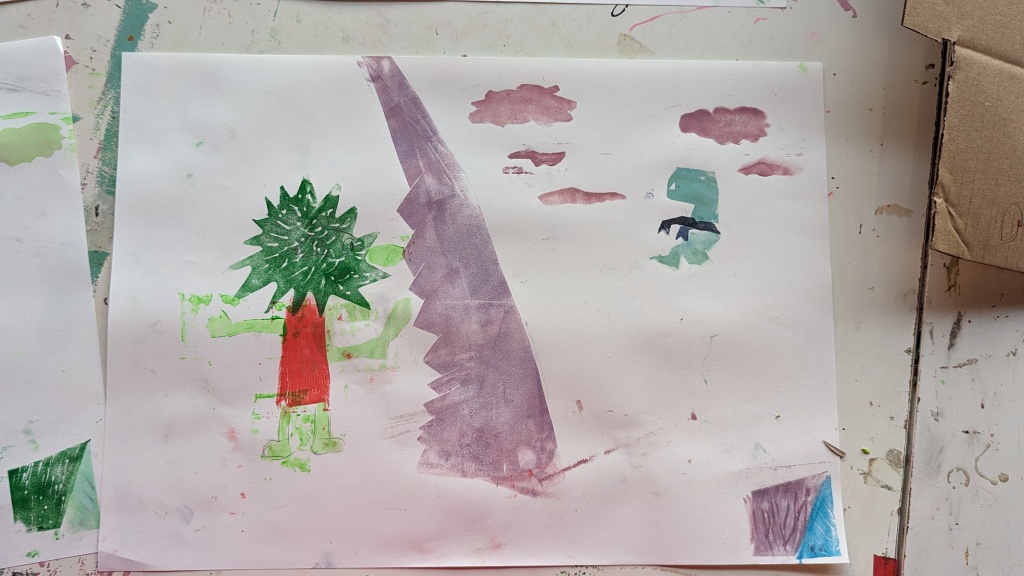
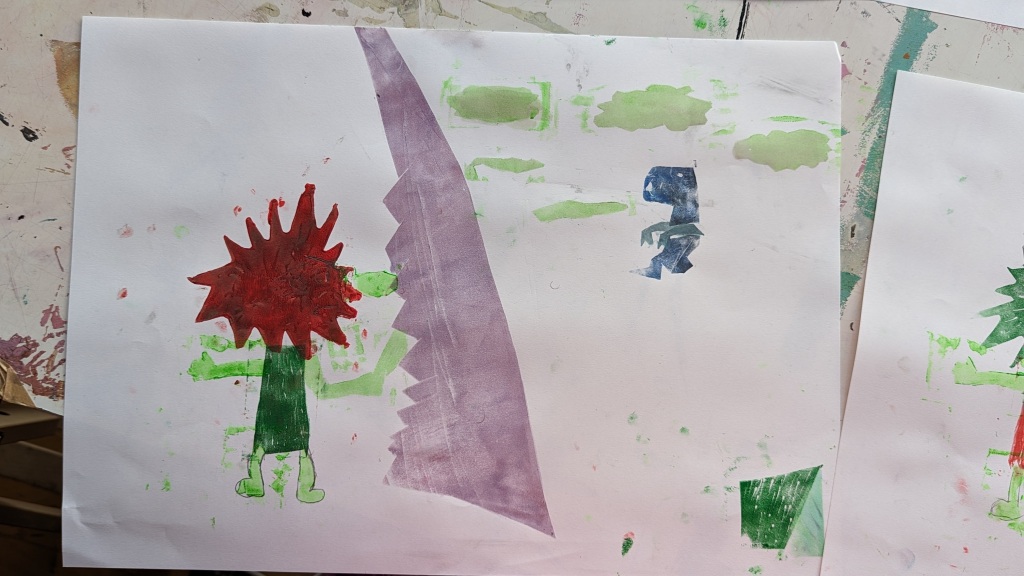
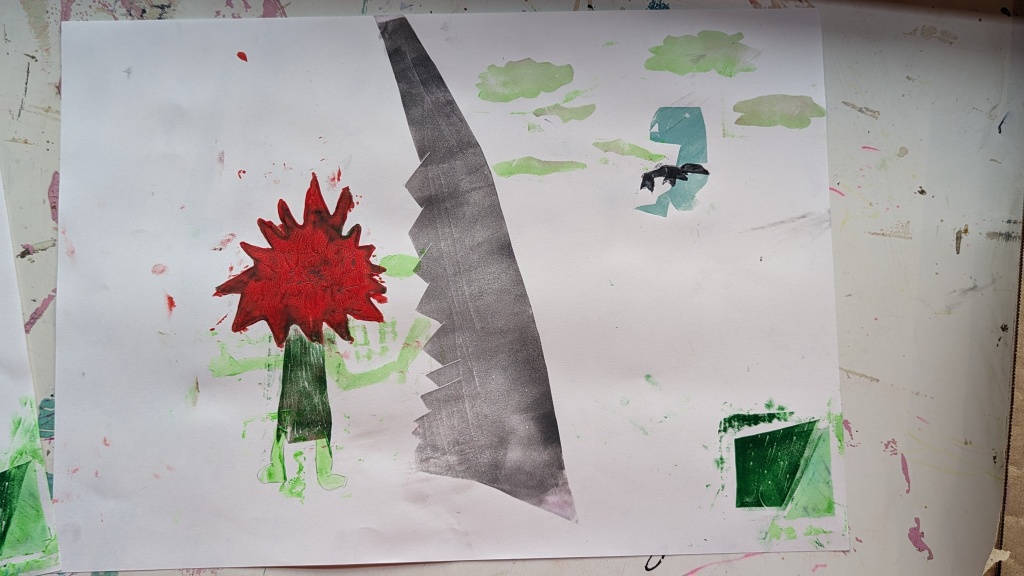
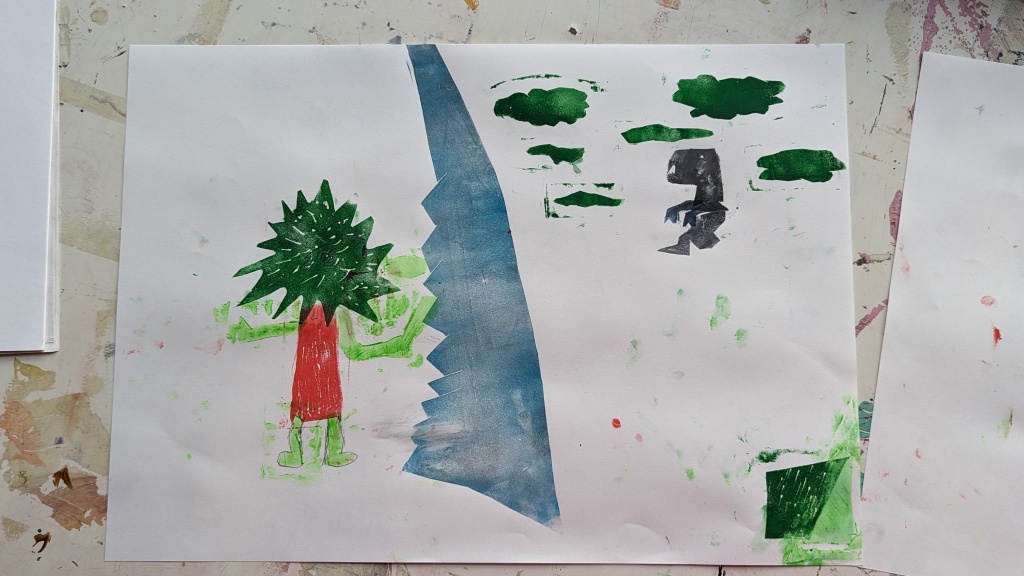
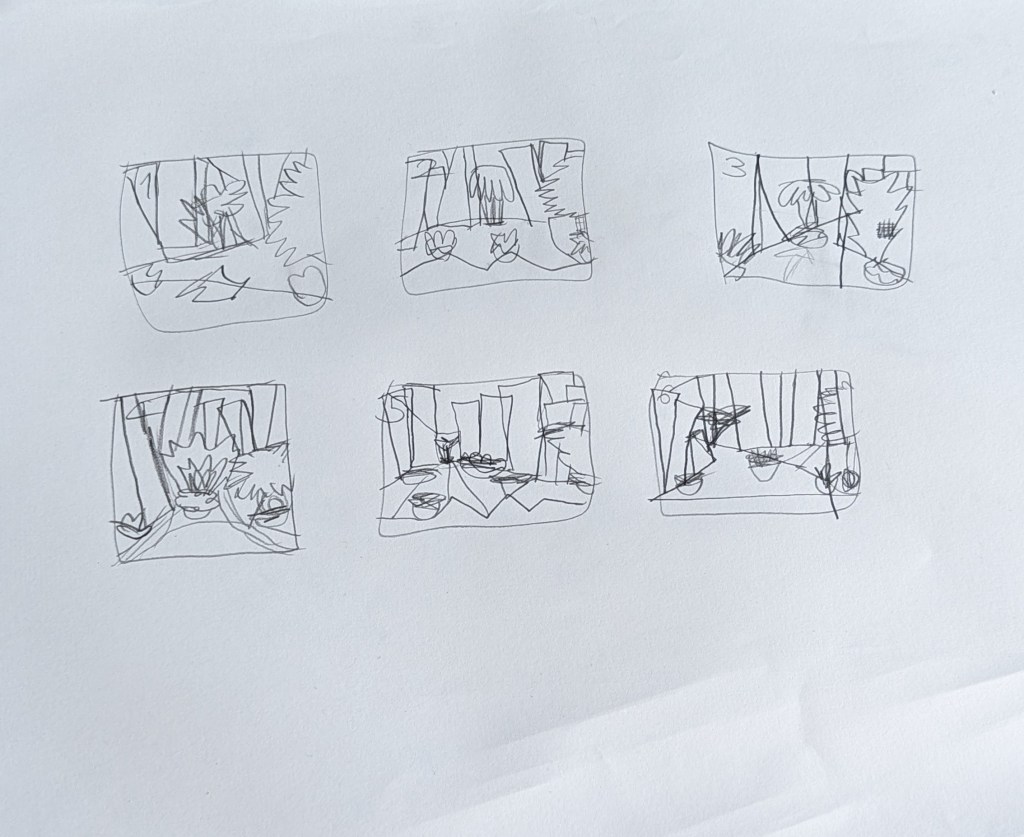
In August 2023, I did a watercolour-painted line drawing of six city buildings in the middle of the desert, with a colour scheme inspired by What’s Opera, Doc? (1957), and an abstract shape line drawing of castle towers and churches in Folkestone, made using Adobe Illustrator. I also did a line drawing of another Folkestone building on Procreate, using different paintbrushes and its Alpha Lock tool to add a What’s Opera, Doc?-inspired colour scheme, shading and detail to the buildings, cars, ground, sky and clouds. From August to September 2023, I used paint rollers and shape cutouts to make four prehistoric abstract shape paintings, in which a caveman lies in wait to beat an approaching dinosaur with his club, and did six city-corridor thumbnail drawings.
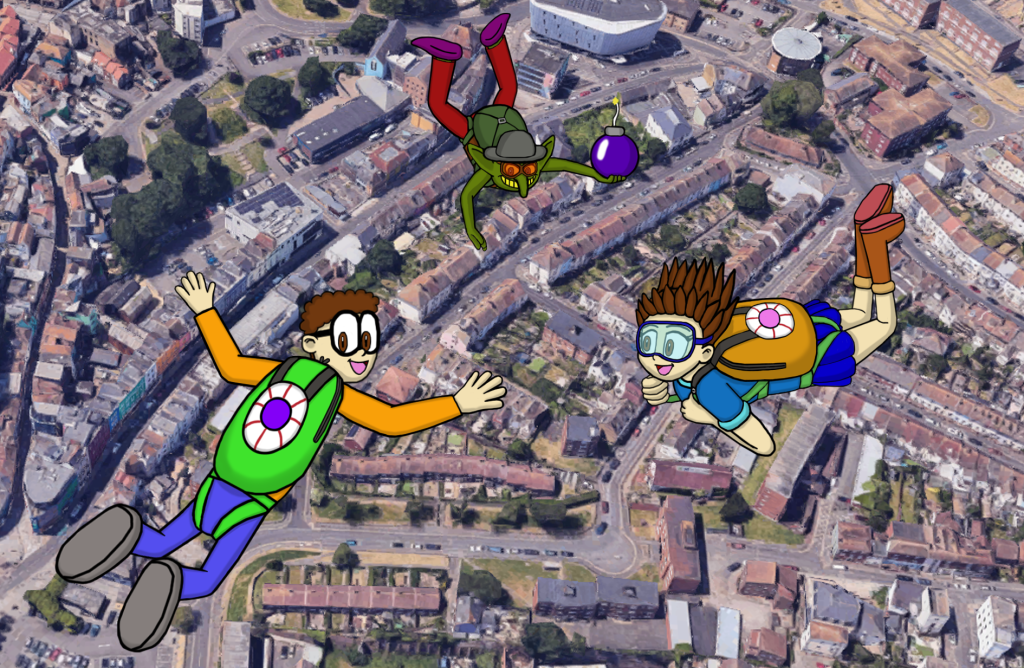
The Skydiving Race.
From November 2023 to December 2023, I drew a picture called The Skydiving Race to enter in the upcoming Secret Postcard Show in 2024. Oliver M. and a girl named Natsuki Marutani soar through the sky above Folkestone, enjoying the thrill of their jump, while the mischievous Gary Smith holds a bomb, scheming to distract them with it and win the race. The postcard can be viewed here.
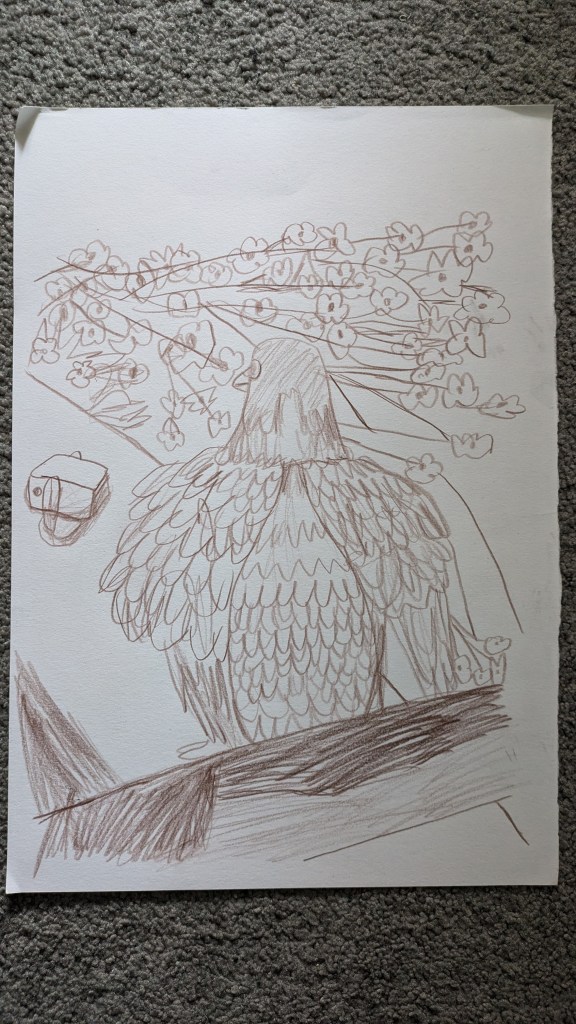
Original sketch for my monoprint pigeon illustration.
My monoprint pigeon illustration.
Markings from my monoprint pigeon illustration.
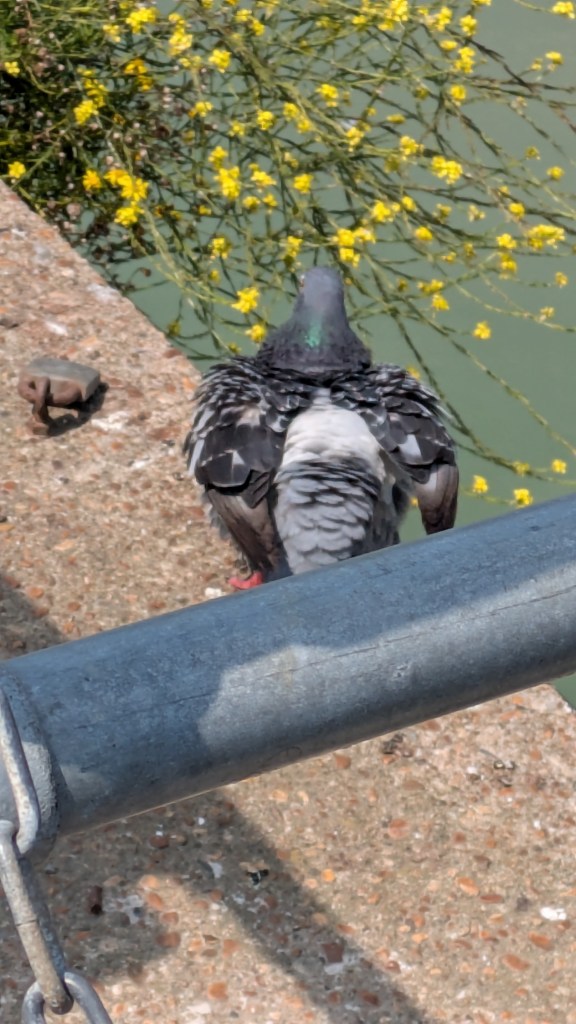
Original photograph of the pigeon ruffling his feathers.
My Procreate seagull paintbrush illustration.
Original photograph of the seagull standing on the boat and calling.
My graphite/acrylic pen crow illustration.
Original photograph of the crow in the churchyard.
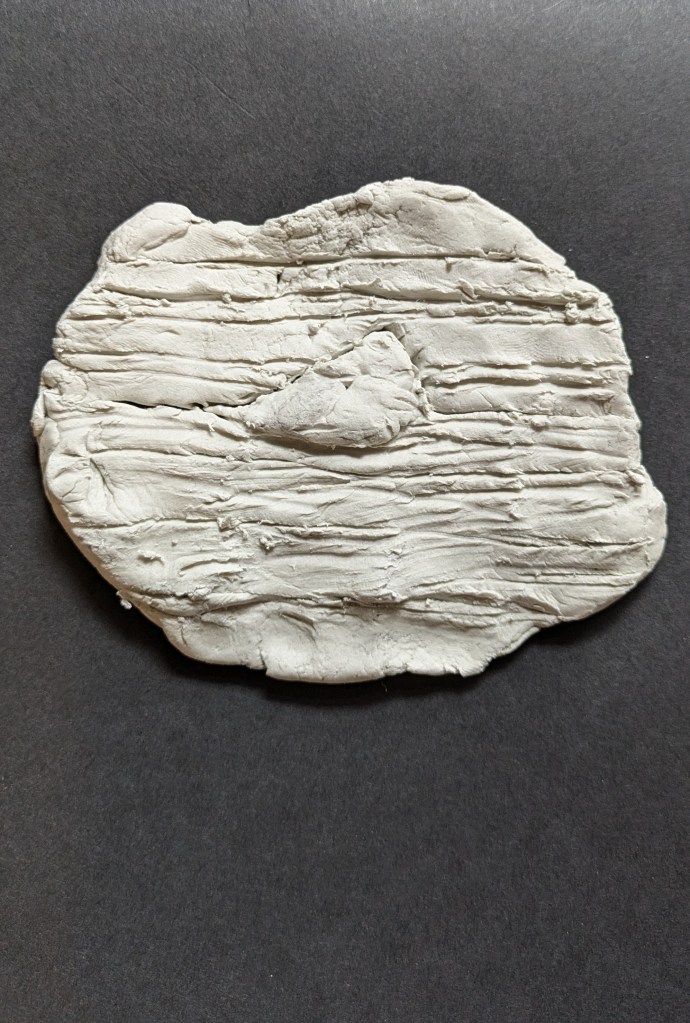
My relief clay seagull illustration.
My painted relief clay seagull illustration.
Original photograph of the seagull sitting on the bench.
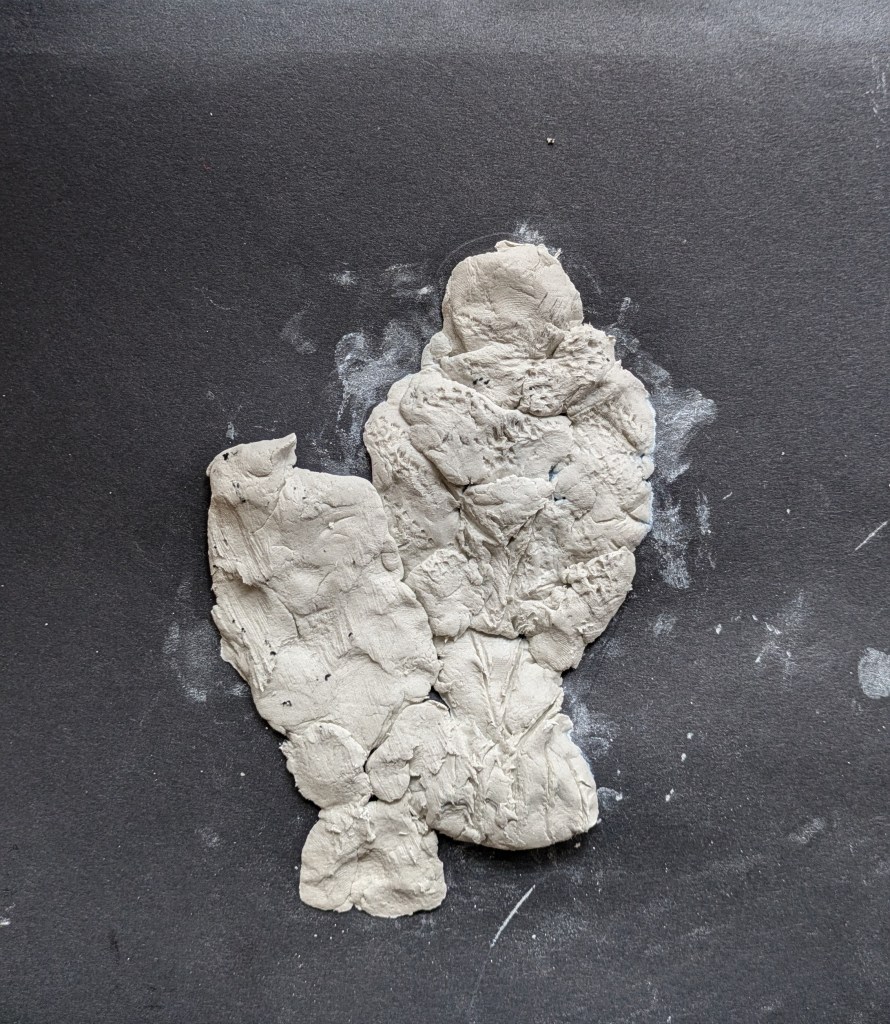
My relief clay pigeon illustration.
My painted relief clay pigeon illustration.
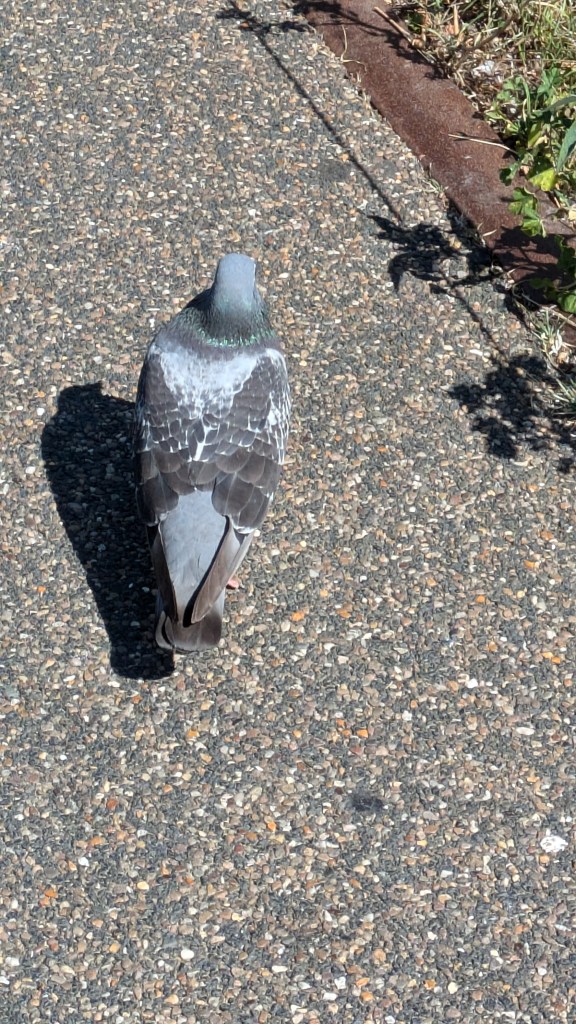
Original photograph of the pigeon and his shadow.
Relief clay duck foot by Kate Clements.
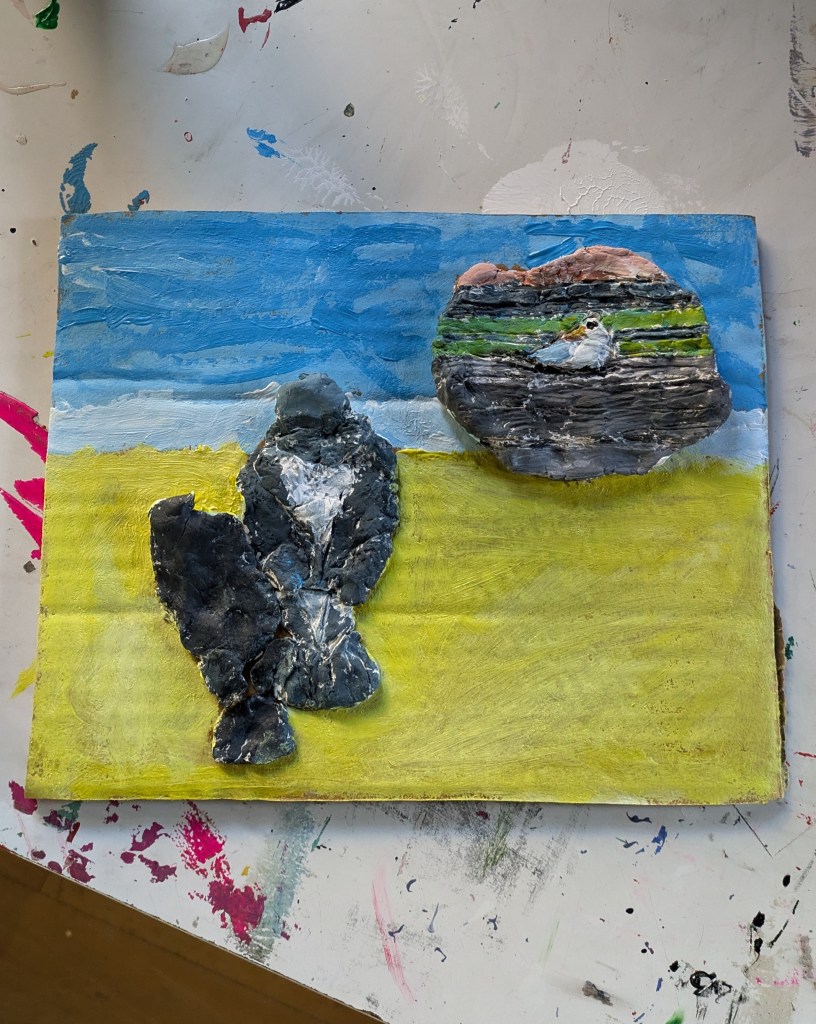
My relief clay illustrations on cardboard.
My relief clay illustrations on beach-painted cardboard.
In July 2024, I began doing art based on photographs taken in Folkestone. One illustration was a monoprint illustration of a pigeon ruffling his feathers, and the other was a paintbrush illustration of a seagull standing on a boat and calling, done in Procreate. At the end of the month, I did a graphite/acrylic pen illustration of a crow in a churchyard. In August 2024, I did some relief clay illustrations of a seagull sitting on a bench and a pigeon and his shadow. In September 2024, I painted the illustrations and glued them to some cardboard, which was painted to look like a beach.
My Neptune beard animation for Animated Histories.
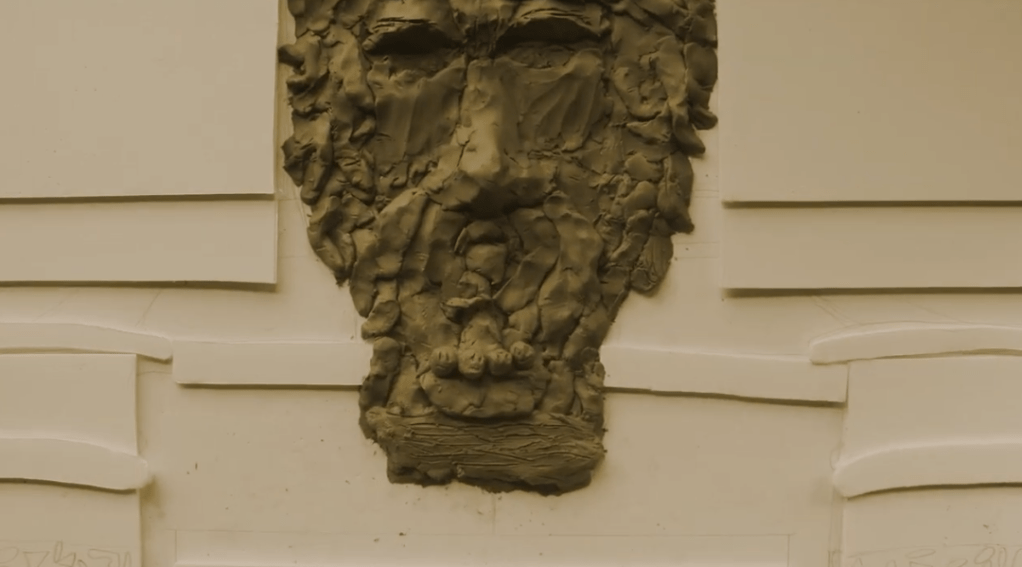
From October to December 2024, I did an animated short film about English history and heritage for the Animated HistoriesFilm Festival, ran in partnership with the Aardman Academy. It tells the story of the Belgian refugees’ arrival in Folkestone through the beard of the statue of Neptune’s head on the Customs House, as well as the building’s bombing in World War Two and Mahatma Gandhi’s arrival. First I recorded footage of myself walking up to the real life Customs House to introduce it, before it transitions to the animation. Next, I took photographs of the building and its statue head of Neptune, and used them as reference for building the exterior using white foam cardboard and making Neptune’s head out of relief clay. Many of the props and models used in the animation were also made of clay. The animation was produced and edited using Dragonframe and Adobe After Effects. I composited animated letters over the video footage at the beginning, reading ‘Customs House’ and cut out from newspapers and magazines. Then I gave the clay animation scene a yellowish hue to match the building’s colours in real life. During the parts where the Belgian refugees and Gandhi arrive, sound clips from British Pathé’s Mahatma Gandhi Arrives in the United Kingdom (1931) were used: “Well, here we are at Folkestone,” and “And just behind her comes Mister Ghandi.” The short ends with the camera zooming out from Neptune’s head and panning down to the doors, which open by themselves to take the viewer inside the building.
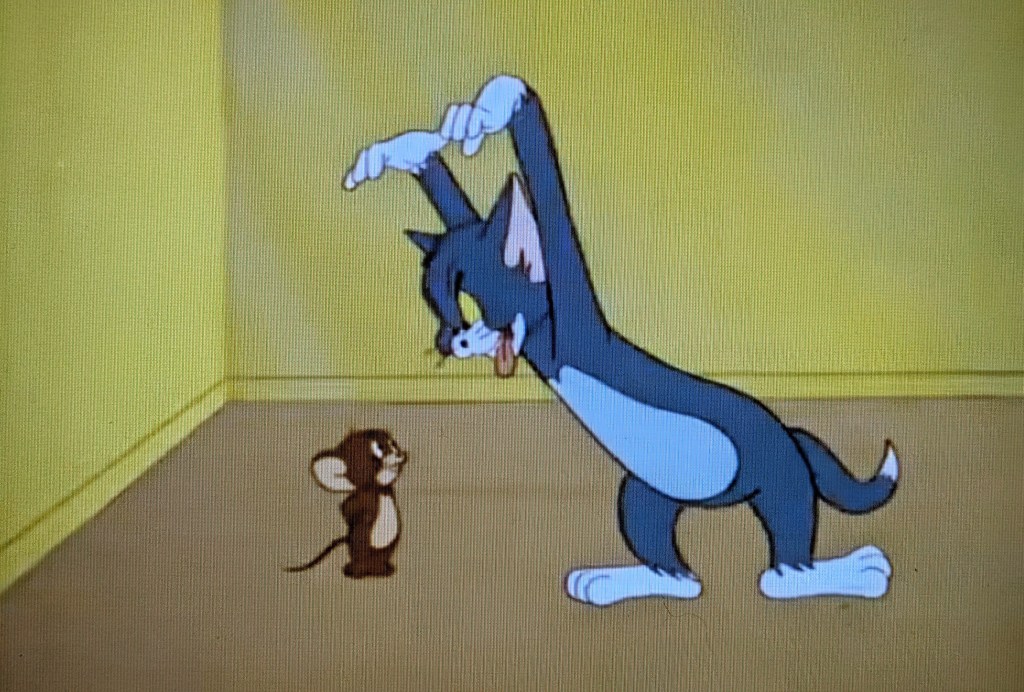
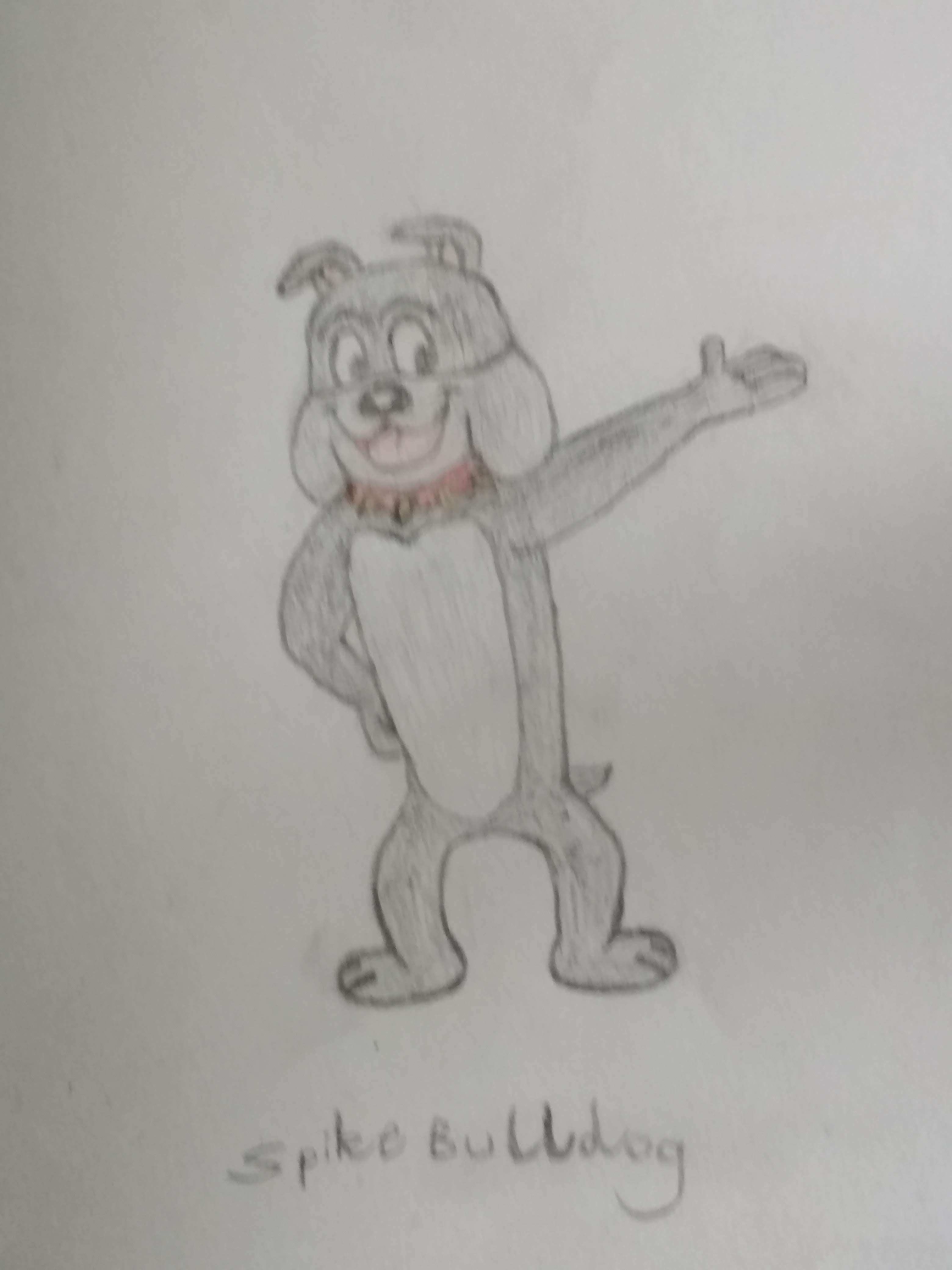
After the original 114 Tom and Jerry cartoons directed by William Hanna and Joseph Barbera, the Metro-Goldwyn-Mayer cartoon studio closed on May 15, 1957, and the cat and mouse duo were leased to Rembrandt Films (run by Gene Deitch) and Sib Tower 12 Productions (directed by Chuck Jones), who changed the designs and eliminated all of the supporting characters.[1][2] In 1975, Hanna and Barbera produced The Tom and Jerry Show under their own studio (with Metro-Goldwyn-Mayer) for the American Broadcasting Company. Due to the network’s Broadcast Standards and Practices and the reaction against violence in cartoons at the time, they made Tom Cat and Jerry Mouse friends in most of the episodes. The series was not well-received due to this change. Despite this, the sports-themed episodes stayed true to the original cat and mouse rivalry, depicted them as competing rivals, and some regular episodes pitted them against each other. The series also reintroduced Spike as a recurring character.[3][4] Metro-Goldwyn-Meyer did not like what Hanna and Barbera had done with the characters, so they approached Filmation Associates (Hanna-Barbera’s leading competitor for television animation at the time) and asked the studio to produce a new series and try to bring some life back to them. Their result was The Tom and Jerry Comedy Show, also known as The New Adventures of Tom and Jerry in other countries or referred as Tom and Jerry in the intro and title cards. The series aired on the Columbia Broadcasting System for Saturday mornings in 1980, and was the first attempt since the Metro-Goldwyn-Mayer cartoon studio’s closure to restore the original format of the cat and mouse team. This series was able to restore the familiar slapstick chase format, albeit with Tom and Jerry as “competing rivals” rather than enemies, similar to the 1975 sports-themed The Tom and Jerry Show episodes, and reintroduced not only Spike, Tyke and Nibbles (here named “Tuffy”), but also some of the other Metro-Goldwyn-Mayer stars, like Droopy Dog, Tex Avery’s villainous wolf and Barney Bear.[5][6] 30-minute episodes would consist of two seven-minute Tom and Jerry episodes, plus one Droopy cartoon in the middle.
Spike from Tom and Jerry was used in many of the Droopy episodes as well, filling in for the other “Spike” bulldog created by Tex Avery for the old Droopy cartoons, who was not used as a separate character here. The wolf was also included, here named “Slick Wolf”. The Droopy episodes usually featured Slick and sometimes Spike as antagonists. Barney had miscellaneous roles, such as being Droopy’s boss at a film studio in Star-Crossed Wolf and a frightful companion in a haunted house in Scared Bear. Due to the series being produced under the “Seal of Good Practice” code, Red from Red Hot Riding Hood (1943) who would not reappear until Tom and Jerry Kids (1990); the only cartoons featuring her that played at the time of the series’ airing were Swing Shift Cinderella (1945) and Little Rural Riding Hood (1949). Characters not seen in this series of Tom and Jerry cartoons are Mammy Two Shoes, Butch, Quacker, Meathead, Topsy, Lightning and Toodles Galore. The show’s intro begins with Tom chasing Jerry through a blank red screen (similar to the title card in the intro for the Tom and Jerry cartoons directed by Chuck Jones). Droopy Dog appears and says, “Hi, folks!”, and the screen collapses, revealing Spike, Slick and Barney building a giant “Tom and Jerry” sign (similar to the building in Tom and Jerry Kids‘ second intro). Tom and Jerry continue chasing, with Jerry eating a banana and throwing it in Tom’s path, causing him to crash into Slick, who lands in a bucket of red paint. This causes Spike to lose his balance and fall with his ladder, crashing into Barney, who gets one of Spike’s buckets of blue paint stuck on his head. Droopy, however, is unharmed. The familiar rotating executive producer credit of Lou Scheimer and Norm Prescott briefly runs as Barney slips on wet paint as he gets Spike’s bucket of blue paint off his head. Everyone except Droopy is chasing Jerry as the sign is ruined. After this, Tyke and Tuffy appear and are playing on the ladder. Tyke pulls a lever on the ladder, extending it and sending Tuffy up to Droopy. The ladder picks Droopy’s bucket of red paint up, and it falls on Tom’s head, and Spike, Slick and Barney fall over him. Jerry whistles and waves at Tom, Spike, Slick and Barney, who angrily arm themselves with paint as Droopy leaves. They throw the paint at Jerry, but they miss and cover the sign in paint, finishing it. An announcer (Scheimer) announces “The Tom and Jerry Comedy Show!”, while Tom and Jerry poke their heads through the sign and smile, and Jerry winks at the end. After the intro, the wraparound segments, hosted by Droopy, would begin. He would paint the whole background with a single large brush stroke (making stylistic use of Filmation Associates’ characteristic “limited animation” technique), and he, Spike, Tyke, Tuffy, Slick and Barney would engage in brief comedic sketches (like Droopy’s opening poem in the first episode, “Roses are red, violets are blue, painting’s my job, that’s what I do; cute and somewhat wet.”). The outro consists of a slightly different version of the opening theme song, with footage from Farewell, Sweet Mouse and Droopy’s Restless Night behind the credits. The Filmation logo appears, coming into focus, followed by the Metro-Goldwyn-Mayer Television logo.
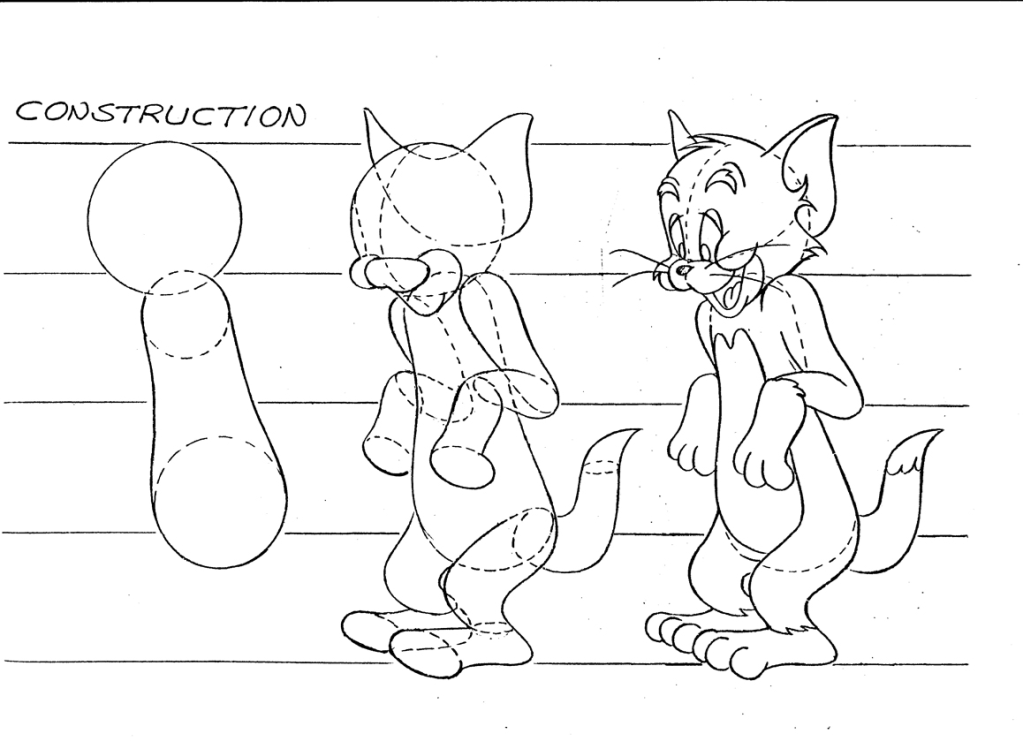
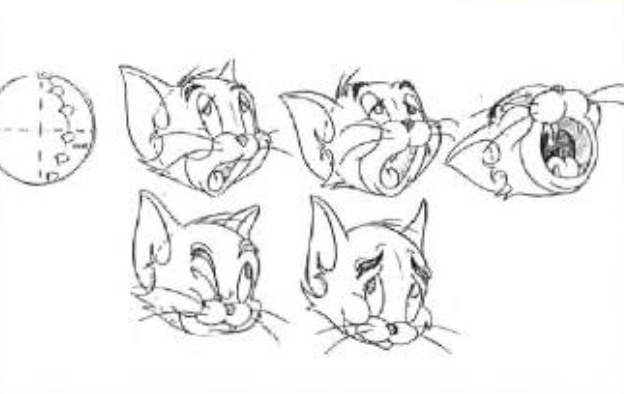
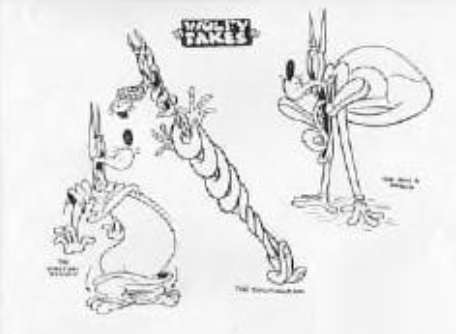
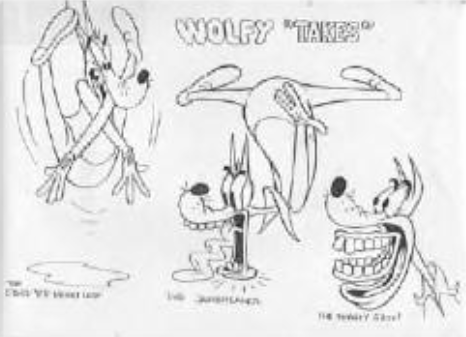
Generally, the animation quality was decent, but not as smooth as the Tom and Jerry cartoons directed by Hanna, Barbera and Chuck Jones. The animation of Tom chasing Jerry toward the screen at the beginning of the intro was reused. This was a common error with Filmation shows as they and DePatie-Freleng Enterprises were strongly against outsourced animation. In 1979, Filmation hired John Kricfalusi in the layout department headed by Franco Cristofani. The layout department was in an annex away from the main offices. There were two layout units, and Kricfalusi was in Cristofani’s working on the Droopy episodes. The studio’s character designer, Alberto De Mello, had recently discovered construction model sheets of classic cartoon characters from the 1940s, which showed artists how to draw the characters by dividing them into their basic shapes, like in Preston Blair’s famous animation instruction books. Eddie Fitzgerald or one of the storyboard artists had shown him the Preston Blair book and some original studio model sheets, much to De Mello’s excitement.[7][8][9] The animators had to draw Alberto De Mello’s model sheets, which Kricfalusi described as “wildly elaborate, yet nonsensical”, with the characters “being made up of frightening balloon-like shapes and sausage fingers and toes”. He refused to draw them this way, keeping the old model sheets at his desk and using those instead.[10][8][9] Working with the high-energy Metro-Goldwyn-Meyer characters seemingly created similar manic energy in Filmation’s staff, for the writers were suddenly able to come up with the laughs needed to make the show work. Coslough Johnson and Jack Hanrahan wrote a lot of the episodes’ scripts, though others such as animators Steve Clark and Jim Mueller contributed to the stories as well, therefore getting their names added to the credits. Due to the series’ low budget, Filmation could not put the same quality of animation that Metro-Goldwyn-Meyer had done for the theatrical shorts, but did try to let animators go wild as much as possible and add a lot of slapstick.[5] Kricfalusi and some of the animators, including classic 1930s-1940s animators Tom Baron, Ed Friedman, Dick Hall, Don Schloat, Larry Silverman, Kay Wright, Lou Zukor, Ed DeMattia, Lee Halpern, Alex Ignatiev, Jack Ozark and Curt Perkins, wanted to rebel against Filmation’s mandates of reusable animation and their strict “on-model” policies where model sheets had to be traced, and sneak in some fluid animation, as seen in episodes such as Scared Bear and Jerry’s Country Cousin. The working environment came to resemble that of the Metro-Goldwyn-Meyer animation studio, as Fitzgerald, Tom Minton and many other storyboard artists drew some funny and lively storyboards as reference for the animators,[10][8][11] developing unscripted sight gags as part of a genial rivalry with the writing staff. This overall sense of euphoria carried over into the cartoons themselves. Though hobbled by stock footage, limited animation and network censorship, The Tom and Jerry Comedy Show was, for Filmation at least, a remarkably fast-moving and funny program. To Kricfalusi, however, he felt that when the animators saw the finished cartoons, they “looked bland, stiff, lifeless and boring”. Kricfalusi found layout work to be much easier than creating storyboards. All the staging was already figured out, and Kricfalusi could draw bigger and concentrate more on the poses and expression of the characters. He always hoped for Fitzgerald’s boards because they were the easiest and most fun to work from, with clear staging, and dynamic, direct, funny poses. He copied Fitzgerald’s poses, making them bigger, drawing them tighter and adding more details to the expressions. He also started to add more poses on his own to break down the actions. Filmation only wanted one pose per scene, but drawing the characters acting was where Kricfalusi could exercise some creativity and have a good time. The other layout artists in the department would come over to see what he was doing because it was so much livelier than the typical television layout drawing. Doing layouts at Filmation gave Kricfalusi the foundation to later build on his own television animation system.[10][8][11] After Kricfalusi did the layouts, Lynne Naylor, who was in the animation department, would animate the Droopy episodes. According to Kricfalusi, this was the way that everything would get through the pipeline without being watered down. At the same time he was still discovering old cartoons that he had never seen before, and tried to put elements of them into his layouts. There was one particular scene in an episode that he was doing a layout for, where a character had to do a fast zip pan from one area to another. Kricfalusi had been studying Chuck Jones’ The Dover Boys at Pimento University, and saw abstract background pans that did not make sense but propelled the movement along, and he thought that was really neat. So he drew a long panning shot where each end of the pan was a normal background, but filled the middle with crazy, abstract shapes and floating eyeballs. A few days later, Cristofani came in and told Kricfalusi that there was a big problem downstairs with one of his scenes. The head of the background department, Erv Kaplan, who painted everything pink-purple-and green, was having a fit. He had discovered Kricfalusi’s eyeball pan and refused to paint it. Cristofani sent Kricfalusi down to speak with him. Not knowing what to say and expecting to get fired, Kricfalusi entered Kaplan’s office and saw him in a huff, sitting there in a pink, purple, and green-stained smock. When asked why he did not want to paint the background, Kaplan answered that he did not like it and it made no sense. Kricfalusi started talking about The Dover Boys to Kaplan, but he did not want any part of it, telling him never to put eyeballs or abstract shapes in the backgrounds again.[10][8] Naylor would never try to offend anyone, but she apparently offended Filmation producer Lou Scheimer one time. He had seen a section of Pest in the West at the Moviola, which was full of “smear frames”. He threatened to fire Naylor over her use of them, but the head of the animation department went to bat for her and managed to calm Scheimer down. Naylor kept her job, but was more cautious after that episode.[10][8][12][13] In addition to the limited animation, the show was characterized by a very limited music score. The particular genre of music used in the show was ragtime, in an attempt to mimic the classic cartoons (which used swing music, big band and funk music, but not ragtime). All of the episodes used the same stock, mostly created for the series, but consisting of only a handful of largely synthesized tunes, either with minor variations or played at different speeds or pitches. This did match the chase scenes, but gave the episodes a very monotonous soundtrack, making these episodes “stand out” to many Tom and Jerry viewers when they aired. Some of the tunes and sound effects were recycled from The Archie Show (1968) and The New Adventures of Mighty Mouse and Heckle and Jeckle (1979). Where the Tom and Jerry cartoons directed by Hanna, Barbera and Jones would have favorable endings for Tom occasionally, this series followed the Tom and Jerry cartoons directed by Gene Deitch in never having definite “wins” for Tom (although he won at the end of Most Wanted Cat (with Jerry) and Superstocker and they ended off mutual in When the Rooster Crows and A Connecticut Mouse In King Arthur’s Cork). Also similar to the Deitch cartoons was the character design, with Tom and Jerry being drawn similar to the original, but still slightly different; Tom’s design resembled his late 1940s-early 1950s Hanna-Barbera design and had thicker eyebrows similar to his design in the Jones cartoons, and the brown color of Jerry’s fur was darker. Spike’s design in the Tom and Jerry episodes and the wraparound segments was somewhat close to his Hanna-Barbera design, whereas his design in the Droopy episodes was more plump and portly in appearance and slightly shorter in height. Droopy was the most noticeable change, although unintentional, as his face was no longer drooping at times. He also had gray eyelids and a white muzzle instead of lavender eyelids and a peach muzzle, respectively.[14]
According to Lou Scheimer, Frank Welker provided voices for the first six episodes, but was unable to continue work when a Screen Actors Guild strike hit, so Scheimer had to fill in as voice actor.[1] Welker voiced Tyke (in The Puppy Sitter; the character was silent in the wraparound segments) and Droopy, and Scheimer voiced Tom and Jerry.[15][16] As a result of the strike, both Welker and Scheimer alternated the voices of Spike, Tuffy, Slick, Barney, Tom’s owner and other characters in the wraparound segments and episodes (Welker voiced Santa Claus in Snowbrawl, the radio announcer in the wraparound segment before Getting the Foot, and P.T. Barnone and Harry in The Great Mousini). Droopy was seemingly the only exception and the character that Scheimer filled in for the least, indicating that A) Welker recorded his voices (including Droopy) for the aforementioned first six episodes and more before the strike (most likely), or B) Scheimer filled in for Welker, and Welker returned to rerecord Droopy after the strike. Whereas Welker’s portrayals of Spike, Tuffy (in the wraparound segments before New Mouse in the House, Heavy Booking and Getting the Foot), Slick, Barney and Tom’s owner were pretty good, Scheimer’s takes on Spike, Tuffy, Slick, Barney and Tom’s owner were poor and rather inconsistent. For example, Scheimer erroneously gave Tuffy an adult voice, although his voice sounded appropriately higher and childlike in the wraparound segments before Droopy’s Restless Night (pitch-shifted), Pest in the West (pitch-shifted), Old Mother Hubbard (pitch-shifted) and The Great Mousini (pitch-shifted inconsistently). Scheimer’s Spike would say, “Ooh!” or “Ooh! Ooh!” (sort of like Joe E. Ross), and episodes and wraparound segments would have Spike speak in his thick New Yorker accent, a normal American accent, or a dumb voice (in Lumber Jerks (when he says, “Good luck, boss!”), No Museum Peace (when he sings) and A Day at the Bakery (when he says, “Come on! Let’s go to work!”)). Additional voices by Scheimer in the first six episodes include the radio announcer in Farewell, Sweet Mouse, Junior and the aliens in Heavy Booking, the speaker announcer in the wraparound segment before Matterhorn Droopy, the bartender in Most Wanted Cat, the sheriff in Pest in the West, the conductor (one pickup line) in Cat in the Fiddle, the narrator in The Incredible Droop, the ringmaster and rooster in When the Rooster Crows, the radio announcer in the wraparound segment before Disco Droopy, and the cheese shop owner in Pied Piper Puss. Additional uncredited voices on the show included Linda Gary as the trick-or-treaters in Farewell, Sweet Mouse (compare to her Alan in Filmation’s Ghostbusters), Hilda in Heavy Booking (compare Hilda’s angry voice to her Queen of the Grass Men in Spectreman and Critterina in Happily Ever After), and the robot maid and the blue robots in Mechanical Failure (compare the robot maid’s “Officially over!” to her Bee-Atrice in Pinocchio and the Emperor of the Night); Jay Scheimer as Junior’s mother in Heavy Booking, Claudia in School for Cats, Save That Mouse and Say What?, Mother Hubbard in Old Mother Hubbard, and Aunt Henrietta in Say What?; Alan Oppenheimer as the the conductor and violin player in Cat in the Fiddle (compare to his Japser Catdaver in Fraidy Cat), Droopy’s “Whoopee!” (either a fill-in or an outtake from the Fraidy Cat episode A Scaredy Fraidy) in The Incredible Droop, the ghost in Scared Bear (compare to his Gentleman Ghost in The All-New Super Friends Hour and Narrator in Hero High) and the city museum owner in The Great Diamond Heist (compare to his Japser Catdaver), Erika Scheimer as the crowd girls in Disco Droopy (compare their “Ooh, what a man!” to her Ellen in Fat Albert and the Cosby Kids and Lady Arvela and Arcadian Woman in He-Man and the Masters of the Universe), and Diane Pershing as Claudia in Mouse Over Miami and Jerry’s Country Cousin, Grandma in Save That Mouse (compare to her audition as Shady for My Little Pony: The Movie), and Little Red Riding Hood and Goldilocks in Old Mother Hubbard. Though Jay, Gary and Pershing provided female voices for the show, Welker voiced three (the remote-controlled female mouse in New Mouse in the House, Miss Kitty in Most Wanted Cat and the female hippopotamus in Disco Droopy) and Lou Scheimer voiced six (Hilda (additional vocal effects) in Heavy Booking, the woman in Getting the Foot, Claudia in Get Along, Little Jerry, Farah Wolfhound in A Day at the Bakery, and Princess Gwen and one of the citizens in A Connecticut Mouse In King Arthur’s Cork). Archive recordings used in the show included Alan Oppenheimer as Tom’s yawn in Farewell, Sweet Mouse and School for Cats (faintly) and Jerry’s yawn in Cat and the Fiddle and The Trojan Dog (Mighty Mouse’s yawn from the The New Adventures of Mighty Mouse and Heckle and Jeckle episode Stop…Pay Troll), Tom, Jerry, Spike and Tuffy’s gulps and the Saint Bernard in Matterhorn Droopy (Fraidy Cat’s gulp from the Fraidy Cat episode Love Is A Many Feathered Thing), Tom’s scream in The Plaid Baron Strikes Again and Slick’s growling in The Great Train Rubbery (Oil Can Harry’s scream from the The New Adventures of Mighty Mouse and Heckle and Jeckle episode The Star Of Cucamonga), and Tom’s sped-up sneeze in No Museum Peace (Oil Can Harry’s sneeze from the The New Adventures of Mighty Mouse and Heckle and Jeckle episode Pheline of the Rock Opera); Frank Welker as Tom’s yawn in When the Rooster Crows and The Great Mousini and Tuffy’s yawn in the wraparound segment before Kitty Hawk Kitty (Theodore H. Bear’s yawn from the The New Adventures of Mighty Mouse and Heckle and Jeckle episode Monster Mash); Lou Scheimer as the mouse group in Invasion of the Mouse Snatchers and mice and cats in School for Cats (the Mice of U-turnian’s gibberish in the The New Adventures of Mighty Mouse and Heckle and Jeckle‘s The Great Space Chase), Diane Pershing and Erika Scheimer as the crowd girls’ cheering and screaming in Disco Droopy (the crowd girls’ cheers and screams from the The New Adventures of Mighty Mouse and Heckle and Jeckle episode Mick Jaguar in Concert), and Hey Hey as Spike’s growling in Gopher It, Tom, Mouse Over Miami and Pie in the Sky and the robot dog’s growling in The Trojan Dog (Lassie’s growling from Lassie’s Rescue Rangers). Not sure who voiced the cow (first moo) in The Plaid Baron Strikes Again, but it is the same moo used for Billy Joe in Disney Discovery Series: Colors and Shapes. Interestingly, archive recordings from the show would be used in Hero High the following year in 1981, particularly Slick’s sneezing in Matterhorn Droopy for Peter Penguin and Jerry’s laugh for Giggler. The show lasted two seasons (with season two consisting of reruns) and the individual episodes were eventually added to syndicated Tom and Jerry packages in 1983, and occasionally appeared on Cartoon Network and Boomerang after Metro-Goldwyn-Mayer’s pre-1986 library was acquired by Turner Entertainment Company. Although it had a 7.6/10 on Internet Movie Database, the show, like its predecessor, received negative reviews from fans for its low budget, limited animation outsourced to Filmation by Metro-Goldwyn-Mayer, poorly drawn characters, lack of returnee characters from the old cartoons, awful writing, slow, awkward pacing, poor voice acting (two examples being Lou Scheimer’s portrayals of Tom, Jerry, Spike, Tuffy, Slick and Barney, and Welker and Scheimer’s portrayals of the female characters), terrible, unfitting, synthesized music, unfitting usage of Hanna-Barbera sound effects (in my opinion, the sound effects kind of fit with the show’s comedic tone, since the studio from which they originate from was founded in 1957 by William Hanna and Joseph Barbera, who created Tom and Jerry), poor usage of slapstick and violence, lack of involvement from William Hanna and Joseph Barbera, and the second season being reruns of the first season. Jerry Beck showed the episode Disco Droopy at one of his Worst Cartoons Ever shows in San Diego.[17] wileyk209zback/Zak Wolf criticized Frank Welker’s female voices and said that the show had “tons of off-model poses, frequent reuse of animation, and corny honky-tonk/synthesizer music”, and commented that Disco Droopy “pretty much showcases the nightmares of Filmation that John Kricfalusi shared on his blog”.[18] Pembroke W. Korgi thought that the show “deserves to be in the garbage”, describing the scenes in Spike’s Birthday in which Tom throws Jerry into the waste container and Spike throws Tom into the container as “a rare picture of this show’s birth”. He also called Jerry a “f*****g d**k, d**k with a capital ‘D’, and an extra ‘k’ on the end just for emphasis”, jokingly referred to Tom’s freakout over his owner and Spike returning from the pet shop in one hour as him having a seizure, and mistook Lou Scheimer’s portrayal of Spike for Frank Welker’s due to the latter being the only credited voice actor.[19] Trevor Thompson, the self-appointed Looney Tunes Critic, called the show “crummy”.[20] Despite this, there were some exceptions. Anime Superhero Forums user Howard said, “The cartoons I liked that no one else seems to would be Filmation’s Tom and Jerry cartoons. The animation is pretty bad, but they had some pretty funny ideas in them. I especially liked Spike’s Birthday where Jerry ruined Spike’s cake and steak, so Tom replaced them with a painted piece of a log and frosted wagon wheels. I always loved the look on Tom’s face when Spike shoved half of the “cake” in Tom’s mouth, and he’s trying to eat it. I wish someone would put them on DVD or something. I also liked the background music in these shorts. Very weird stuff…”[21] Eric B stated, “The last adaptation had been by the original creators, Hanna-Barbera, but they had been made almost completely friends! This fit to some extent, as they would at times team up under certain situations in the old series, but it was seen by many as a total departure from the old series. Filmation would actually bring back the chase, and even some of the side characters like Droopy, Spike and Tyke, not used by any of the other productions after the end of original Metro-Goldwyn-Mayer run in 1958. Unfortunately, like the second series (the Czech one by Gene Deitch with the funny sound effects), Tom never “won” in this one. It seems that Ray Ellis’ talent, or at least that of the studio’s music editors, sort of dried up after 1974, as everything became increasingly synthesized in a gaudy fashion, or simply reused stock. The low point was The Tom and Jerry Comedy Show itself. The score consisted of nice chasing-style tunes, but they were done with piercing, oddly toned or dissonant synthesizer sounds, and basically the same three or so tunes reused over and over (though there were different versions set to different tempos). The music did fit the scenes right, but should have been spread out more with other stock; most of Filmation’s other cartoons weren’t even that bad with the music. Some, such as Lassie’s Rescue Rangers, were better than a lot on television in the 1970s. These episodes, when eventually mixed with other Tom and Jerry cartoons in syndication or cable years later, really stood out, even moreso than the notably odd Czech ones. Fortunately, the show brought back the comedic horn blasts (like when someone gets hit with a pie or something). You also had frequent remakes of such classic Tom and Jerry gags as Tom crashing back and forth into a rake and hoe on the ground. And Tom nodding “no” pleading to Jerry not to do something, while Jerry nods “yes” and proceeds to do it. So Filmation actually seemed to understand the characters, as you have classic Tom and Jerry moments in an episode like Spike’s Birthday, where Tom foolishly teases some fish with Spike’s steak, and later breaks the fourth wall laughing to us at Spike eating the phony steak that he replaced the original one with. That was a very funny one. The limited animation actually made it look all the more funny, and Tom’s frantic rush to recreate the grub is classic, and the way he did it was ingenious. I also liked the episode New Mouse in the House, where a spinning record lands in Tom’s mouth, and Jerry turns one of his whiskers into a needle to play it. The Droopy‘s may have been a far cry from the original, but they had their entertaining moments. Disco Droopy was an interesting idea, and Star-Crossed Wolf was funny. And they rotated Spike and the wolf as Droopy’s adversary (like the original, but unlike Tom and Jerry Kids, where it’s always the wolf). It was interesting that they used the Spike from Tom and Jerry on the Droopy‘s. Not until the recent Magic Ring movie did Avery’s Spike return.”[22][23] YouTuber mightyfan said, “The Tom and Jerry Comedy Show is a strange one. You can clearly tell that some of the animators wanted to rebel against Filmation’s mandates of cheap, reusable animation. They managed to keep the characters in a close approximation of their original cartoons, and every so often you would get something weird. Like the short Most Wanted Cat where they try world building and have a seedy British pub down the street for some reason, and two cockney thugs, Squint and Mouser, steal all the canned goods in Tom’s house after he quits. Then there is Invasion of the Mouse Snatchers, the short where Tom dresses up as an alien and bullies Jerry around. You can tell that Filmation actually let Eddie Fitzgerald loose for him to come up with an episode that’s actually intentionally funny, he had his stamp all over the layout. I would not doubt for a second that Tom’s alien mask was supposed to be a caricature of Tom Minton. I would love to hear the story behind that short some day. There is a story about an episode of Filmation’s Mighty Mouse that one of the animators, Kent Butterworth, actually took a weekend or so and just did an entire wild take sequence because he wanted whoever did the storyboard (I think Eddie again) to see their vision out. Having said that, I do kind of like their Tom and Jerry cartoons, with the Droopy shorts not withstanding. Then again, I do not think anyone really did Droopy justice after his theatrical shorts. They just didn’t “get” him and his cartoons, they’re just freaking awful except for a decent Incredible Hulk parody, The Incredible Droop. There is a lot of nuance that was lost on them. Droopy could be slightly naive in the original shorts (depending on the short), but here he is almost downright stupid and childlike in the worst ways. The Action for Children’s Television era certainly nerfed the character, but even without the short and unexpected bouts of violence, the character could have worked. I am even putting aside the limited animation not being able to capture that Tex Avery wildness. Just a complete lack of detail and humor made these cartoons bad.”[24][25][26] Charles Gardner of Cartoon Research stated, “Although the episode’s title is a complete misnomer, The Plaid Baron Strikes Again tries about as hard as the studio was capable of to mirror a Hanna-Barbera original, within the crew’s limited budget and talent. For a Filmation episode, the chase is quite action-packed, with many decent gags almost killed by flashing past so fast, they do not always register to full effect. Tom encounters various obstacles: crashing into the side of a well, dislodging the foundation so that the structure slides forward several feet, allowing Tom to fall into the hole, then, with no apparent explanation, having Tom emerge from the hole, being snapped at by an alligator. Tom crashes into a loaded wheelbarrow, and is buried under a ton of bricks. And they even repeat Hanna-Barbera’s old rake and shovel gag, having Tom repeatedly step on the ends of the implements, to get whacked in the head by the handles.”[27] YouTuber Big Sky commented, “I think Disco Droopy was actually pretty charming despite being poor in quality. It still has that Hanna-Barbera charm to it. It is clearly trying more to be funny than cool. If it was the other way around, I do not think it would have worked quite as well.”[28] The show’s negative reception is speculated by some to have prevented it from having a complete series Digital Video Disc box set from Warner Brothers (who currently owns the rights to the show), although one episode, Jerry’s Country Cousin, did surface on the Tom and Jerry Deluxe Anniversary Collection in 2010, and all episodes of the show were available to stream on the Boomerang application under Tom and Jerry Classic Collection Volume 3 (bundled with some of the Tom and Jerry cartoons directed by Chuck Jones).[29][30] Here are some additional facts and opinions about the show: The show was referred to as The Cat and Jam Comedy Show in a publicity celluloid.[31] Another celluloid for the show was signed by Joseph Barbera, one of the creators of Tom and Jerry.[32] The show was broadcast on several television networks and channels such as Pop in the United Kingdom,[33] the Sistema Brasileiro de Televisão in Brazil, TV 2 in Denmark, Nippon Television Network Corporation in Japan, and STS in Russia. In the Japanese dub, Tom, Jerry, Tyke and other non-speaking characters were given speaking roles. Tom was voiced by Kazue Takahashi, and Jerry was voiced by Yoshiko Ohta. There was also a narrator for the dub, Hitoshi Ueki. Other voices in the dub included Ryūsei Nakao, Junpei Takiguchi and/or Kenichi Ogata as Droopy, Toshiya Ueda and/or Shun Yashiro as Slick, and Shun Yashiro as Tom’s owner.[34][35] The chase scenes in the Tom and Jerry episodes look like they could have been animated by Irv Spence (April Fools’ joke).[36] In the wraparound segments and some episodes, when Droopy speaks, his head (with his mouth) moves, while his eyes remain still, due to the head and eyes being animated on separate celluloids. Droopy’s animations from The Tom and Jerry Comedy Show were used for Cartoon Network’s bumpers in the 1990s. Part of the theme for Moo Moo Meadows in Mario Kart 64 (1996) sounds similar to part of one of the chase themes, used usually when Tom is chasing Jerry. In New Mouse in the House, the animation of Tom looking up at something with one eye closed and then licking his lips is traced from Flirty Birdy (1945). At the end of the episode, Tom’s crying sounds similar to his crying at the end of Is There a Doctor in the Mouse? (1964). In Heavy Booking, the animation of Jerry waving at Tom and running off is traced from Quiet Please! (1945).[14] Music from the The Archie Comedy Hour (1969) is used in Heavy Booking, Under the Big Top and Kitty Hawk Kitty. Although the human characters’ faces are never shown onscreen, the faces of Junior in Heavy Booking, the skier in Matterhorn Droopy, the French horn player and the crowd outside the Muzichmeister Hall in Cat in the Fiddle, the ringmaster (his eye and nose) and audience members in When the Rooster Crows and Tom’s owner in Gopher It, Tom are still shown onscreen. Tom’s screeches when being woken by Jerry’s celery-chomping in Heavy Booking are reused screeches for the dragons from the Space Sentinels episode Loki (1977). Music from The Brady Kids (1972) is used in Matterhorn Droopy, Most Wanted Cat, Incredible Shrinking Cat, When the Rooster Crows and School for Cats. Music from Fabulous Funnies (1978) is used in The Puppy Sitter, Most Wanted Cat and Stage Struck. In Cat in the Fiddle, the animation of Tom running from the stage entrance (reused in Incredible Shrinking Cat, Spike’s Birthday and Save That Mouse) is traced from Tee for Two (1945).[14] The designs of the aliens and Tom’s alien disguise’s head in Invasion of the Mouse Snatchers are reused from the members of the Brain Trust in the The New Adventures of Mighty Mouse and Heckle and Jeckle episode Return of Star Boars (1979); both are caricatures of Tom Minton. At the end of the episode, when Tom is covered in pies, he resembles Hot Dog from The Archies. The Angry Scientist from Sheep in the Big City was thought to have been inspired by the scientist in The Incredible Droop, as both characters hilariously object to being called “mad scientists”, but that is false since Sheep in the Big City‘s creator, Mo Willems, never worked at Filmation.[37] The animation of Barney falling onto the floor is traced from the Looney Tunes cartoon What’s Brewin, Bruin? (1948).[38] Music from Sabrina and the Groovie Goolies (1970) is used in The Incredible Droop and Scared Bear. In Incredible Shrinking Cat, the scene in which Tom crashes through the drawbridge and slides his way into the castle is a reanimated and shortened version of a scene from the Fraidy Cat episode Feline Fortune (1975). The episode’s plot reuses elements from that of Tex Avery’s King-Size Canary (1947).[39] In When the Rooster Crows, when the ringmaster’s clothes are blown off by the rooster’s crow, he is seen wearing an “Eat at Joes” shirt with a woman in a swimsuit and palm tree obscured by the text. Despite the fact that Disco Droopy aired in 1980, disco was already dead at the time, meaning that the episode takes place in 1978 or early 1979. Lynne Naylor designed the background characters in the episode. John Kricfalusi was believed to have designed them as well, but had left Filmation to work at Hanna-Barbera in 1979, one year before the episode aired. Considering that Kricfalusi mentioned that he worked on the show, this could indicate that he finished his work at Filmation before he left for Hanna-Barbera, and Naylor picked up from where he left off.[17][9][11][40][41] The disco music that Droopy, Slick and their dance partners dance to sounds like “Life on the Fast Lane” by The Eagles. Calamari Inkantation from Splatoon (2015) has a sort of similarity to Droopy’s singing and humming, but was most likely not inspired by it.[42] Music from the The Secret Lives of Waldo Kitty episode Cat Man (1975) is used in Disco Droopy and The Great Mousini. Music from the Fraidy Cat episode A Scaredy Fraidy (1975) is used in Disco Droopy and A Connecticut Mouse In King Arthur’s Cork. At the beginning of Snowbrawl, Jerry is seen playing Pong (1972). This makes The Tom and Jerry Comedy Show the second Filmation show to have an episode with a Pong reference or cameo, the first being The New Adventures of Batman (1977) with the episode The Pest (1977), and the second being The New Adventures of Mighty Mouse and Heckle and Jeckle with the episode Moby Whale (1979). At the end of Spike’s Birthday, Tom and Spike are seen eating Spike’s “birthday cake”, which is made of chocolate and wagon wheels. In real life, chocolate is considered toxic to cats and dogs. The rainbow spiral effect used when Tom is “transported” into his medieval dream in A Connecticut Mouse In King Arthur’s Cork is reused from the Space Sentinels episodes The Sorceress (1977) and Fauna (1977) and The Groovie Goolies and Friends‘ (1977) intro. I used to watch The Tom and Jerry Comedy Show on the computer when I was young. The episodes that I watched were When the Rooster Crows, Spike’s Birthday and Mechanical Failure. Years later in 2017-2019, I would rediscover the series through wileyk209zback/Zak Wolf’s post and BrazilianYouTubePoopvideos, and watch episodes such as Farewell, Sweet Mouse, Droopy’s Restless Night, New Mouse in the House, School for Cats, Disco Droopy and Pied Piper Puss. Here are some links to the episodes: https://kimcartoon.to/Cartoon/The-New-Adventures-of-Tom-and-Jerry https://www.youtube.com/channel/UC7sTBvqZwWDE2HP7d9R9CAg/videos https://www.dailymotion.com/video/x5ex03f (wraparound segments) https://www.youtube.com/watch?v=bDoYr5FfIag& (wraparound segment) https://www.youtube.com/watch?v=sfKIamJca2Q (Farewell, Sweet Mouse; English) https://www.dailymotion.com/video/x3ut0ci (Farewell, Sweet Mouse; English) https://www.dailymotion.com/video/x5h84ym (Droopy’s Restless Night; English) https://www.dailymotion.com/video/x6i6zom (Droopy’s Restless Night; German) https://www.dailymotion.com/video/x3zxyb5 (Droopy’s Restless Night; Brazilian Portuguese) https://www.youtube.com/watch?v=6Z5b46fexIk (Droopy’s Restless Night; Russian) https://www.dailymotion.com/video/x2zsvk2 (New Mouse In the House; Brazilian Portuguese) https://www.dailymotion.com/video/x5etafg (Heavy Booking; English) https://www.aparat.com/v/y4KX3/Tom_and_Jerry_Full_Episodes%3A_Heavy_Booking_%281980%29_%7C_Cartoons (Heavy Booking; English) https://www.dailymotion.com/video/x703mtr (The Puppy Sitter; English) https://www.dailymotion.com/video/x4nqy2h (Invasion of the Mouse Snatchers; English) https://www.dailymotion.com/video/x2env4y (The Plaid Baron Strikes Again; German) https://www.dailymotion.com/video/x5gc2wb (Scared Bear; English) https://www.youtube.com/watch?v=wGGiIf9qAIQ& (Scared Bear; Brazilian Portuguese) https://www.dailymotion.com/video/x2ehql5 (When the Rooster Crows; Brazilian Portuguese) https://ok.ru/video/186411846399 (School for Cats/Disco Droopy/Pied Piper Puss; Russian) https://www.dailymotion.com/video/x6g22ow (School for Cats; Brazilian Portuguese) https://www.youtube.com/watch?v=-0pzis0IKaI (Disco Droopy; English) https://www.dailymotion.com/video/xcsibv (Disco Droopy; English) https://www.dailymotion.com/video/x5xhm8g (Disco Droopy; German) https://www.youtube.com/watch?v=6hzWgHFL9zU (Disco Droopy; Russian) https://www.youtube.com/watch?v=G7clTDUVX78 (Pied Piper Puss; English) https://www.dailymotion.com/video/x3v1k2v (Pied Piper Puss; English) https://www.nicovideo.jp/watch/sm7339049 (Under the Big Top/Lumber Jerks; Japanese) https://www.dailymotion.com/video/x5wazf7 (Lumber Jerks; German) https://www.youtube.com/watch?v=xBP__RF-fgM& (Lumber Jerks; Spanish) https://www.youtube.com/watch?v=fojO6HYWOng& (Lumber Jerks; Spanish) https://www.dailymotion.com/video/x3v1iht (Gopher it, Tom; English) https://www.nicovideo.jp/watch/sm7341140 (Gopher it, Tom; Japanese) https://www.youtube.com/watch?v=nAzLr-5rQSU& (Gopher it, Tom; Brazilian Portuguese) https://www.dailymotion.com/video/x2ehtoy (Gopher it, Tom; Russian) https://www.nicovideo.jp/watch/sm7345040 (Snowbrawl/Getting the Foot; Japanese) https://www.youtube.com/watch?v=sZpHRZq3s2s& (Snowbrawl; Brazilian Portuguese) https://www.youtube.com/watch?v=ZnsHQua42DY (Snowbrawl; Brazilian Portuguese) https://www.youtube.com/watch?v=lkzIkfq0BIM (Kitty Hawk Kitty; English) https://www.dailymotion.com/video/x3uskqh (Kitty Hawk Kitty; English) https://https://www.nicovideo.jp/watch/sm7349916 (Kitty Hawk Kitty; Japanese) https://www.nicovideo.jp/watch/sm7354567 (Get Along, Little Jerry/Star-Crossed Wolf; Japanese) https://www.dailymotion.com/video/x5hdbpl (Spike’s Birthday; English) https://www.nicovideo.jp/watch/sm7358858 (Spike’s Birthday; Japanese) https://www.dailymotion.com/video/x3usiyu (Get Along, Little Jerry; English) https://www.dailymotion.com/video/x6ggb04 (No Museum Peace; Brazilian Portuguese) https://www.youtube.com/watch?v=6Yy9-NFvJuU (Mouse Over Miami; English) https://www.dailymotion.com/video/x3vgqra (Mouse Over Miami; Brazilian Portuguese) https://www.youtube.com/watch?v=LTEwTy6BNeI (Foreign Legion Droopy; Brazilian Portuguese) https://www.dailymotion.com/video/x2ysxua (Foreign Legion Droopy; Brazilian Portuguese) https://www.youtube.com/watch?v=jpbH2D-OIzg (Save That Mouse/Old Mother Hubbard/Say What?; Danish) https://www.dailymotion.com/video/x3wrmj0 (Old Mother Hubbard; Brazilian Portuguese) https://www.nicovideo.jp/watch/sm7367702 (Jerry’s Country Cousin/The Great Diamond Heist; Japanese) https://www.nicovideo.jp/watch/sm7372037 (Mechanical Failure; Japanese) https://www.dailymotion.com/video/x3vgfja (Mechanical Failure; Brazilian Portuguese)




































 mysuperendeavour