Looney Tunes and Groovie Goolies in King Arthur’s Court (feat. The Warners)

Warner Bros. signed a contract with Filmation Associates under which the latter would produce new animated films and programs based on the former’s characters, and Warner Bros. would handle distribution. Image © Future US, Inc.

In February 1971, Jerry Leider, president of Warner Brothers Television, and Lou Scheimer and Norm Prescott, president and chairman of Filmation Associates, announced that Warner Brothers had signed a long-term contract with Filmation under which the latter company would produce new animated films and future programs based on the former company’s existing film and television characters, titles and properties, and Warner Brothers Television would handle distribution exclusively off-networks throughout the world. The transaction also called for production of new theatrical cartoons by Filmation for distribution by Warner Brothers to theatres initially and to television subsequently. In addition, Licensing Corporation of America, a subsidiary of Warner Brothers, would continue to represent exclusively both Filmation and Warner Brothers properties for character licensing and merchandising. The agreement did not cover network properties to be developed by Filmation, which was represented on the Columbia Broadcasting System with Sabrina and the Groovie Goolies and Archie’s Funhouse and on the American Broadcasting Company with The Hardy Boys and Will the Real Jerry Lewis Please Sit Down. Warner Brothers; shows on-network were The Bugs Bunny/Road Runner Hour on CBS and Lancelot Link, Secret Chimp on ABC.[1][2][3] In early November 1971, the trades reported that one of Filmation’s co-ventures with Warner Brothers was going to be an ABC television series based on Wile E. Coyote and the Road Runner, which was unfortunately never produced.[4]
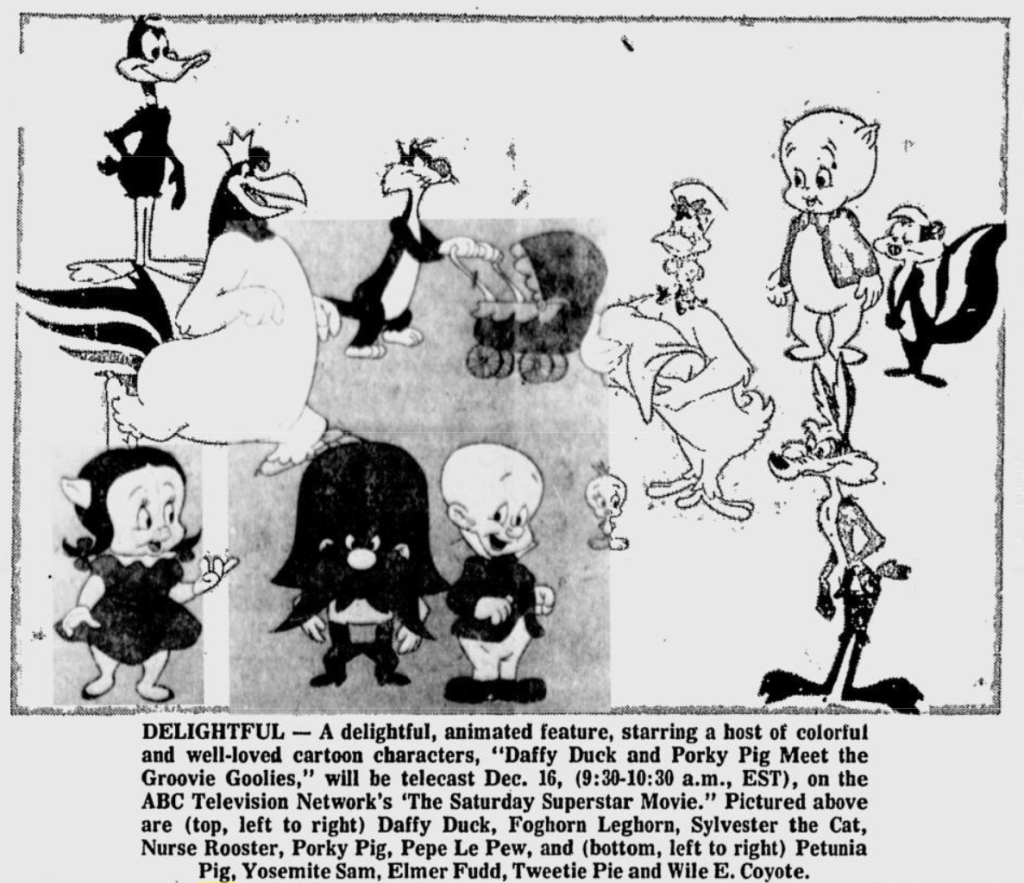
News article for Daffy Duck and Porky Pig Meet the Groovie Goolies on December 9, 1972. Image © The Evening News. Looney Tunes characters © Warner Bros. Entertainment Inc.
Daffy Duck and Porky Pig Meet the Groovie Goolies was broadcast in 1972. Image © DreamWorks Classics/Warner Bros. Entertainment Inc. Color edit © mysuperendeavour@WordPress.

In mid-January 1972, Warner Brothers announced an expansion on the agreement, with 10 animated feature films, each budgeted at $1 million and set at 90 minutes and announced as a co-production. The three-year project was noted in the trades as being the largest deal of its kind in animation history. The tagline for the series of films was Family Classics, with Warner Brothers holding network and syndication rights. Titles announced were: Treasure Island, Oliver Twist, Cyrano De Bergerac, Swiss Family Robinson, Don Quixote, From the Earth to the Moon, Robin Hood, Noah’s Ark, Knights of the Round Table, Arabian Nights, and Jack London’s Call of the Wild. All of the works were based on books or concepts in the public domain, but not animated by any other studio. Warner Brothers was owned at that point by Kinney National Company, and with Filmation owned by the TelePrompTer Corporation, the cable market was being closely eyed for these films as a continual revenue stream. This meant that Filmation could employ an animation team of 400 people year-round.[5] On December 16, 1972, Daffy Duck and Porky Pig Meet the Groovie Goolies was aired at 9:30 as an episode of the anthology series The ABC Saturday Superstar Movie.[6][7][8]
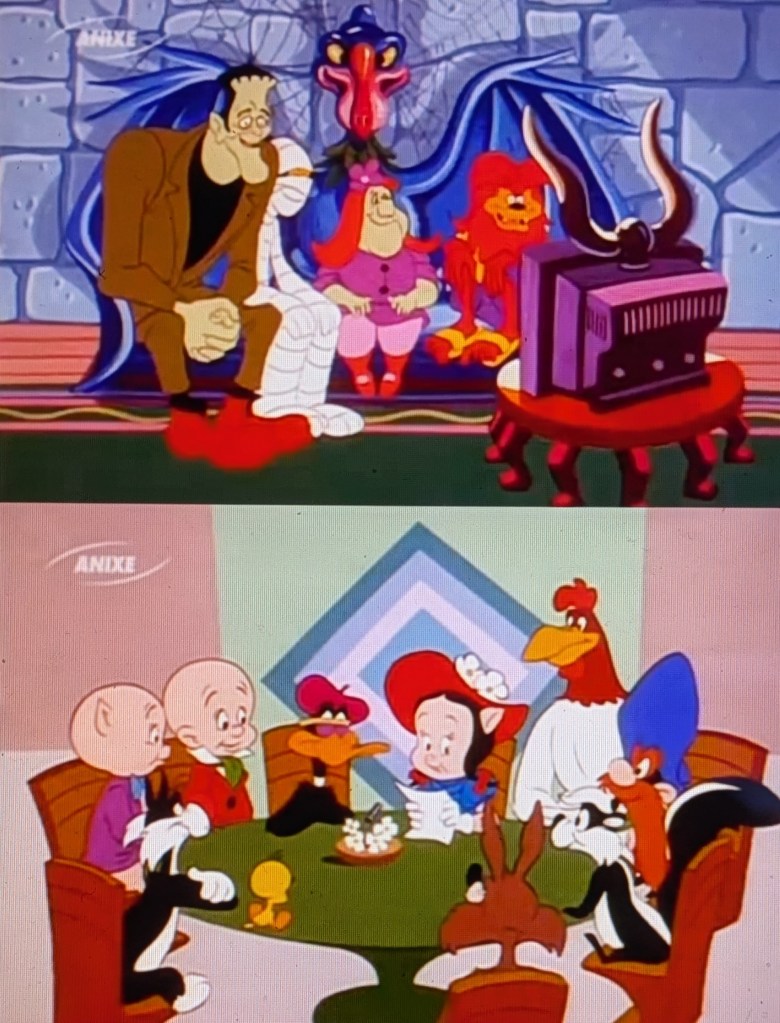
The Groovie Goolies watch the interview, where Daffy Duck talks with Petunia Pig about his King Arthur film. Image © DreamWorks Classics/Warner Bros. Entertainment Inc. Groovie Goolies characters © DreamWorks Classics. Looney Tunes characters © Warner Bros. Entertainment Inc. Anixe logo © ANIXE HD TELEVISION GmbH & Co. KG.

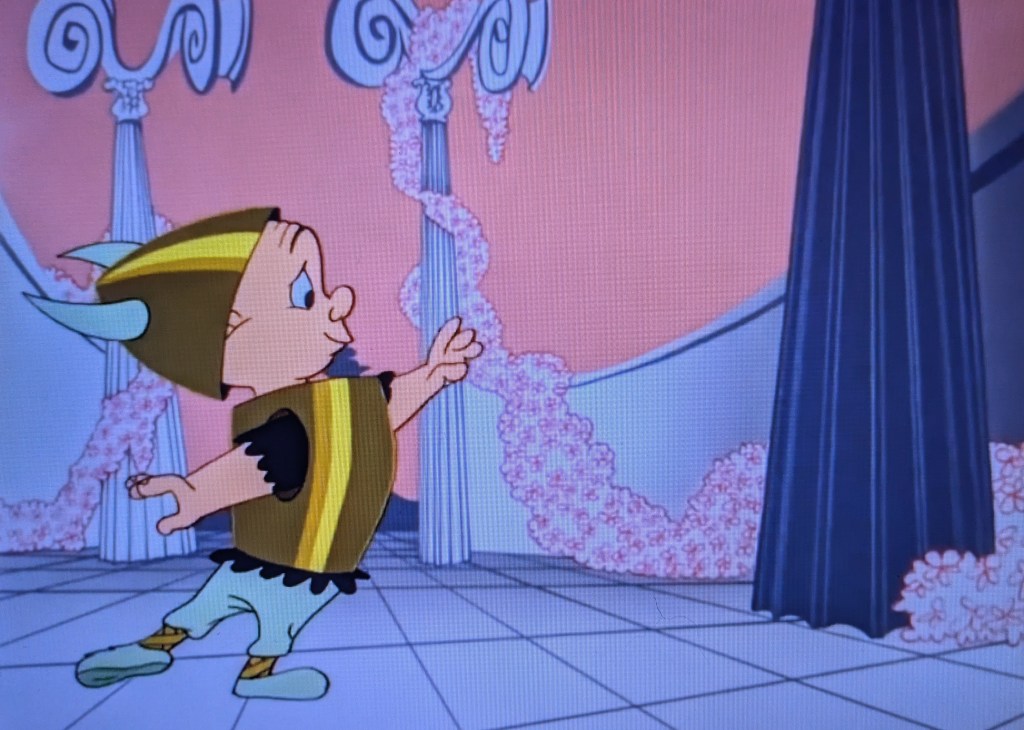
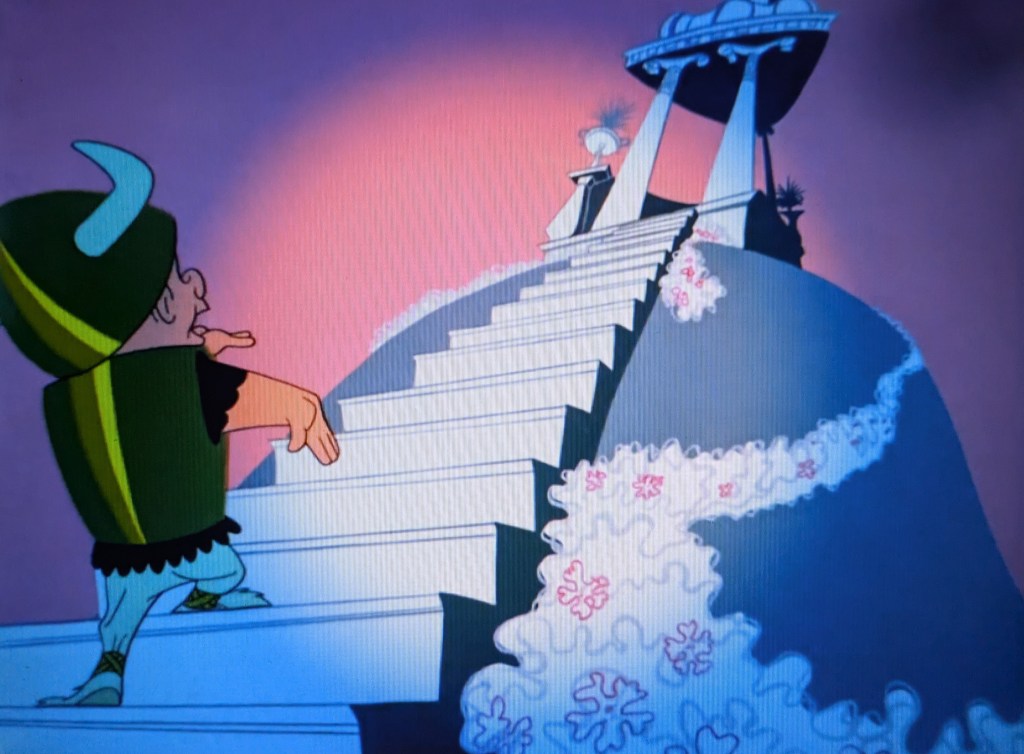
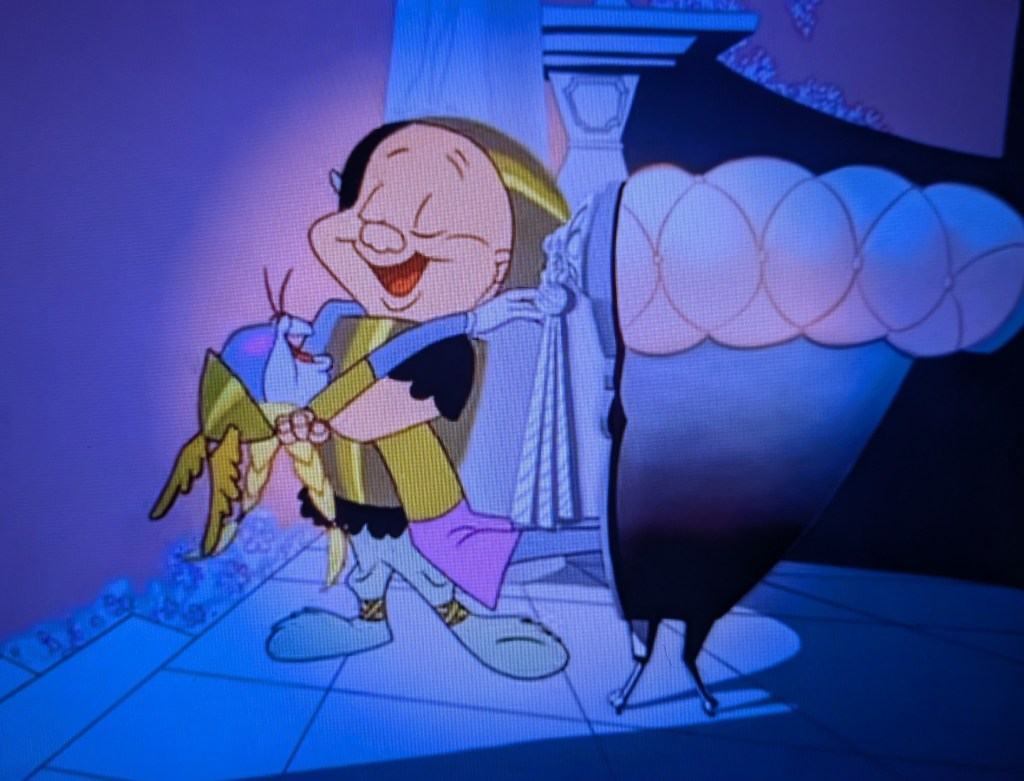
The plot begins at Horrible Hall, where Drac, Frankie, Wolfie, Mummy and Agatha are watching a television interview. In it, Daffy Duck is in Hollywood talking with reporter Petunia Pig about his new film about King Arthur and the Knights of the Round Table, starring himself; also appearing in it are Porky Pig, Petunia, Sylvester the Cat, Tweety Bird, Wile E. Coyote, Pepé Le Pew, Foghorn Leghorn, and Charlie Dog. Petunia also mentions a rumour about a mysterious stranger that has been causing all kinds of trouble on the set, to which Daffy think that it is a fan seeking an autograph. They then show a few scenes from the film: Foghorn, as “King Uther the Chickenhearted”, paces back and forth, until the nurse brings him his new children, a crate full of eggs. One of the eggs, however, is coloured purple. The king calls for the court jester, played by Sylvester. The court jester is awakened by a guard, played by Charlie, and asks the king what he wants to see. He proceeds to try to entertain him by slipping on a banana peel and pole vaulting out the window into a monster-infested moat. The king simply tells him to take the egg for a long walk. The court jester does so, taking the egg out in a baby carriage, and decides to cook and eat it. Tweety watches and stops the court jester from eating the egg, claiming that it might be one of his cousins, then threatens to blow a whistle to call bulldogs. The court jester repeatedly calls the bluff, until he notices seven dogs surrounding him. They chase him off, and the egg hatches, with Arthur (played by Daffy, fully grown but wearing a baby bonnet) emerging from it, and declaring that he is only 3 and a half years old. Taking the role of Ector, Tweety names him “Arthur”, to which Arthur objects, asking Tweety why he can’t call him “Lance”, “Rock” or “Daffy”. The canary tearfully laments that his mother’s name was Arthur. Suddenly, the program is interrupted by a ghoulish being named the Phantom of the Flickers, who announces his intention to destroy every film that Daffy Duck and his studio ever made, including their current King Arthur film. Hagatha can’t help noticing how familiar the Phantom looks, while Frankie, being a huge fan of Daffy, goes to Hollywood to offer his help. The other Horrible Hall residents go along with him, with Mummy bringing his camera.

Drac, Frankie, Wolfie, Mummy and Agatha stand on the balcony of the castle set, dressed in armor. Image © DreamWorks Classics/Warner Bros. Entertainment Inc. Groovie Goolies characters © DreamWorks Classics. Anixe logo © ANIXE HD TELEVISION GmbH & Co. KG.

In Hollywood, Agatha casts a spell to magically stop the Gool Bus so they can ask a movie star for directions to Daffy Duck Studios and get his autograph. Behind their back, he reveals himself to be the Phantom. Upon entering the studio lot, Wolfie and Mummy notice that there is no sign of Daffy, Porky and the others. Agatha uses her crystal ball to find them. Just as Daffy calls for his stuntmen, the Goolies show up, with Frankie telling the duck that they came to help. Thinking that they are the stuntmen, he orders them to get into suits of armor. They begin shooting the next scene, where the Goolies are up on the balcony of the castle set. The Phantom pulls a lever which causes the floor to drop out. They land in the holes of a giant pool table, before the Phantom springs them out. Meanwhile, Sylvester and Petunia observe how scary the Goolies look. They wind up hanging from a chandelier, and Daffy greases it, causing them to fall again. Agatha, casting a spell to stop Frankie’s hands from slipping, only changes the grease to banana peels. The Goolies slide down a banister, which the Phantom causes to propel them back into the air. They land standing on each other’s shoulders, but Daffy asks them to do it again, because they missed the mark on the floor. Drac turns into a bat and flies out of his armour costume, causing the others to collapse, and Daffy gives them a coffee break.
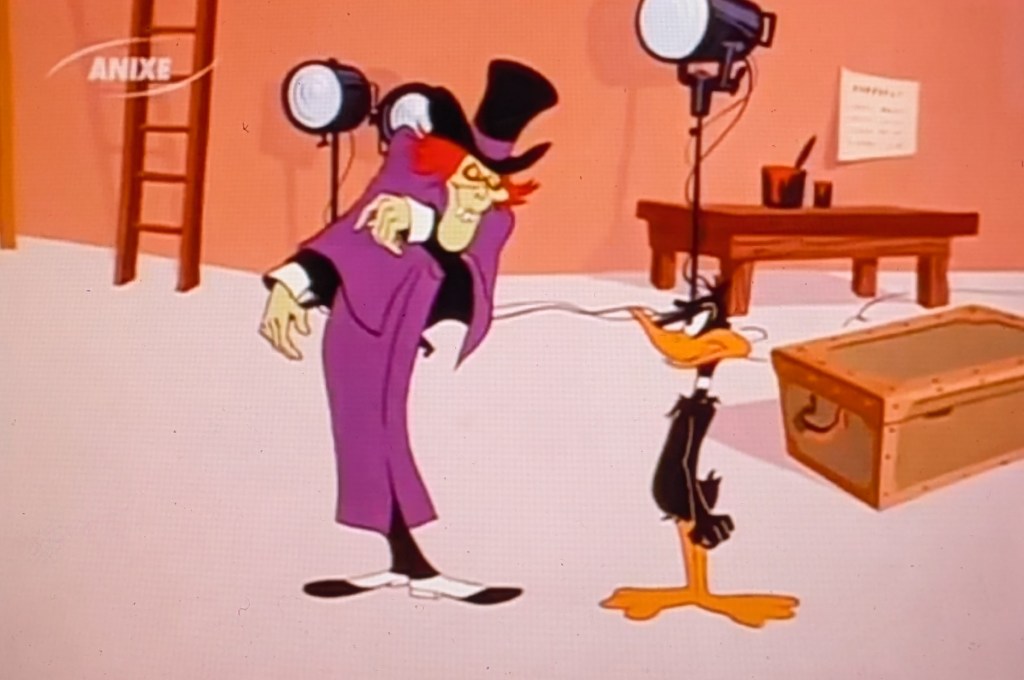
Daffy Duck confronts the Phantom of the Flickers, telling him to stop scaring his actors and take off his makeup. Image © DreamWorks Classics/Warner Bros. Entertainment Inc. Daffy Duck © Warner Bros. Entertainment Inc. Anixe logo © ANIXE HD TELEVISION GmbH & Co. KG.

During the break, the Phantom sneaks along in the dark, which he finds hard for him to cause trouble, and falls, winding up hanging from the sleeping Drac, who, like Agatha, thinks that he “knows him from somewhere”. He drops the Phantom, and Frankie runs to catch him, crashing into a table, sending Daffy flying and getting a blueberry pie in his face. Petunia (wearing her Lady Guinevere costume) is scared by the Phantom’s presence, hiding in a vase. Daffy confronts him, telling him that he is making a film and that he (Phantom) has chased his actors away (this ties into Petunia’s description of the Phantom as a mysterious stranger causing trouble on the set from earlier), and demands that he removes his makeup. He pulls off several masks, including ones of each of the Goolies. This makes Daffy think that the Goolies are costumed actors who are in league with the Phantom. He starts pulling on Frankie’s face. Then when he tries to unravel Mummy’s “costume”, only to see him collapse in a pile of wrappings, Daffy begins to realise that they are real. After this, Drac flies in as a bat, telling everyone to “knock off the noise”, and turns back into a vampire. He asks how they can expect him to get his beauty sleep. This makes Daffy scream in fear and run off, along with the other Looney Tunes except Petunia. Frankie and Wolfie ask the Phantom why he keeps scaring them. He pulls off his face revealing a blank mask reading, “I’LL NEVER TELL”, and escapes down a trap door. Hagatha casts a spell that drops the Goolies through trap doors as well, but they land in the moat.
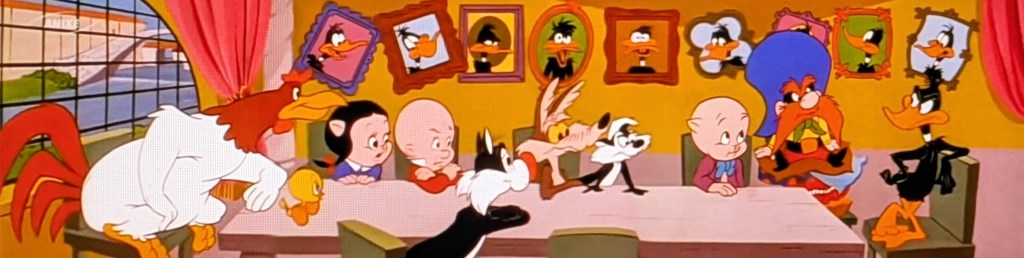
As the Looney Tunes sit at the conference table, Daffy Duck discusses their plan on capturing the Groovie Goolies and the Phantom of the Flickers. Image © DreamWorks Classics/Warner Bros. Entertainment Inc. Looney Tunes characters © Warner Bros. Entertainment Inc. Anixe logo © ANIXE HD TELEVISION GmbH & Co. KG.

Daffy, Sam, Porky, Pepé, Wile E., Sylvester, Elmer, Petunia, Tweety and Foghorn all sit at a conference table. Daffy tells them that the Phantom and the Goolies are trying to stop the production of King Arthur, which has to be finished in time for the annual Ozzie Awards tomorrow night. When he described them to the police, they said that he was insane and hung up. Sam suggests organizing a posse to capture them, unaware that the Phantom is listening to them from outside. Everyone is reluctant, to which Daffy asks them if they are chicken. Foghorn resents that. Sam asks Sylvester if he would like to join the posse, but Sylvester refuses and runs off. Wile E. holds up a sign saying, “I’ll go”, and Porky agrees to go.
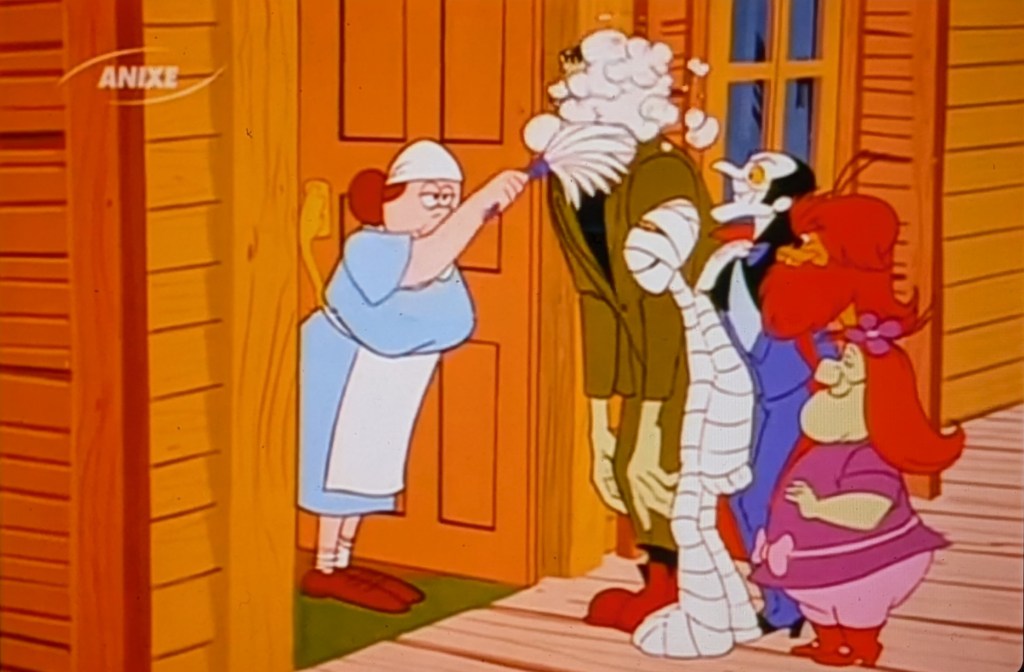
Disguising himself as a maid, the Phantom of the Flickers tickles Frankie’s face, creating a cloud of dust that makes him and the other Goolies sneeze. Image © DreamWorks Classics/Warner Bros. Entertainment Inc. Groovie Goolies characters © DreamWorks Classics. Anixe logo © ANIXE HD TELEVISION GmbH & Co. KG.

On a filming of a Western showdown between a marshal and a bandit, Frankie pops out of a manhole, tossing one of the actors, Lance, onto the ground and making him throw a tantrum. They see the Phantom running into a house set. When Frankie rings the doorbell, the Phantom appears, disguised as a maid, and tickles them with a feather duster, creating a giant cloud of dust that covers the Goolies, making them sneeze. He then changes into a gardener and sprays them with water from a hose, before changing into the “head of the house” (his head is a house), and slamming the door on them. Then the whole prop falls over on the Goolies. They hear the Phantom laugh and chase him into a little shed. Sam, Porky and Wile E. watch them from a bush, thinking that the shed is their hideout. Upon entering the shed, the posse find themselves standing in a large, fancy room. They split up, and right after they leave, the Goolies come out from a wall panel. Hagatha uses her crystal ball to find the Phantom, only for him to freeze it. Frankie worries about Daffy and suggests going to check up on him.
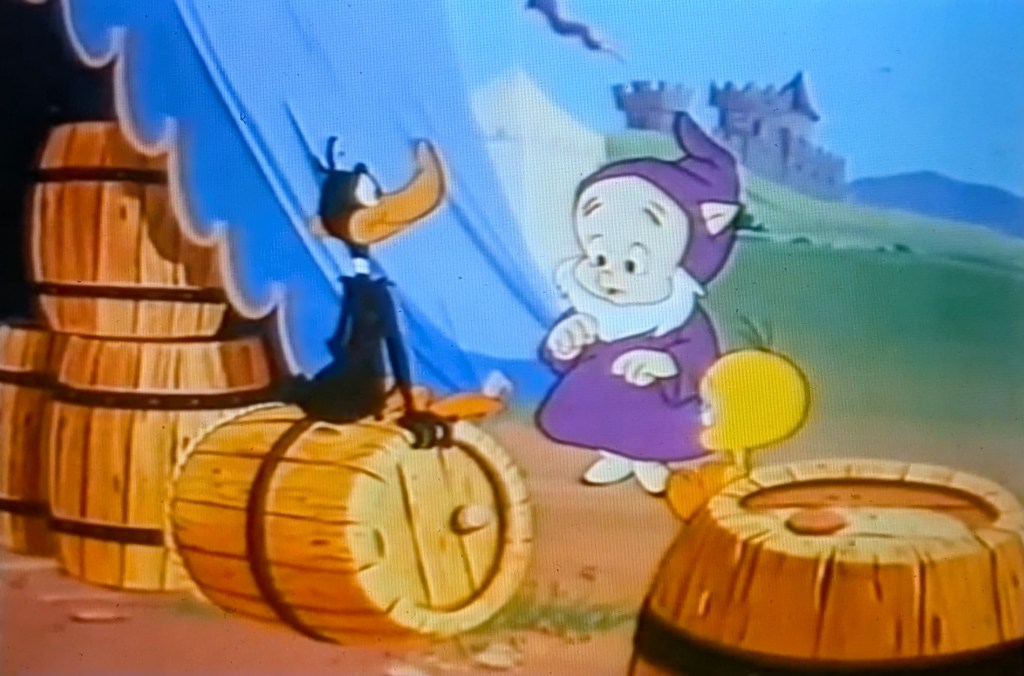
Merlin (Porky Pig) tells Arthur (Daffy Duck) to close his eyes before he begins casting a spell on Lady Guinevere (Petunia Pig). Image © DreamWorks Classics/Warner Bros. Entertainment Inc. Daffy Duck, Porky Pig and Tweety Bird. © Warner Bros. Entertainment Inc.

Later in a screening room, Daffy and the others watch the scenes for the film that they shit yesterday. Arthur, Merlin (played by Porky) and Tweety are walking in a carnival. Arthur sees Lady Guinevere’s (played by Petunia) kissing booth and falls in love, his body turning into a big, thumping heart, and his ice cream into fireworks. He kisses her, and she charges him “$49.95 plus tax”, but won’t marry him. When she says that she would only marry someone of royal blood, he offers to have a transfusion. Arthur gives up his entire life savings (stored in his foot), and then asks Merlin to use his magic to make her fall for him. Merlin is about to do so, but is interrupted by Hagatha, who shows him how to cast the spell. The court jester appears, being chased by one of the dogs. Hagatha casts a spell on the court jester, causing him to fall in love with the dog and kiss him, which makes the canine flee in fear. Merlin casts the spell on Guinevere, but causes her to fall in love with Tweety. Arthur chases Merlin, and afterward spots Mordred (played by Sam) trying to pull the sword out of the stone (another carnival game), accompanied by Drac (as a barker), Frankie, Wolfie, Mummy (as the game’s manager), Pepé and Wile E. (his henchmen). He is not interested in trying the game until Mordred insults him. Mordred tells Arthur that he has to wait his turn, but Wolfie and Mummy tell him that he had 253 tries and only paid once. Arthur is able to pull the sword out, and is crowned king. An angry Mordred says that he laid claim on the crown first and aims to have it. The town crier announces the wedding of Arthur and Guinevere, and then begins the sports report. On Mordred’s behalf, Pepé and Wile E. shoot up to Arthur a typewriter on an arrow, followed by arrows that type out the message challenging him to a joust. Arthur then sends a singing telegram (sung by the horse that the messenger ride on), saying that he will be there. At the jousting match, the announcer says that it is high noon in time for the main event: a 10-round jousting bout for the crown, and the hand of Guinevere in marriage. He then announces, “In this corner, wearing silver armour, with crown trim, and matching helmet with peekaboo visor, King Arthur!” Arthur is shown sitting on a white horse, and waves to the cheering crowd. Then the announcer says, “In this corner, wearing the rusty armour, with the tobacco stains in the front, the dreaded Mordred.” Mordred is shown sitting on a black horse, and has an unusually long lance. He is booed, and Pepé and Wile E. cheer him on, before turning round to look at Arthur and the booing crowd. Just as Mordred and his horse rasp at the crowd, Mordred’s visor falls on his tongue, causing it to swell and him to scream in pain. The announcer rings the bell like a gong, and Round 1 of the match begins. Arthur and Mordred ride toward each other, with Guinevere, Merlin and Tweety cheering Arthur on, and Pepé and Wile E. cheering Mordred on. As the round continues, Guinevere can’t bear to watch but can still handle peeking. Arthur’s horse gets out a red cape and shakes it, before lifting it out of Mordred’s direction as he rushes past. Pepé applauds the horse for his courage and grace and falls in love with him. Just as Round 2 begins, the film is suddenly interrupted and grabbed by the Phantom. Daffy and the others begin to go after him until Frankie, across the screening room, says that he and the other Goolies with help. Porky, Tweety, Sylvester and Wile E. panic and then disappear into the screen.

In Mad Mirror Land, Drac, Frankie and Wolfie drive imaginary cars in pursuit of the Phantom of the Flickers (disguised as Hauntleroy). Image © DreamWorks Classics/Warner Bros. Entertainment Inc. Drac, Frankie and Wolfie © DreamWorks Classics.

Sam and his posse see the Phantom with the film and the Goolies running after him, and give chase. The Goolies chase the Phantom into Sound Stage 3, where the latter causes various weather changes. In Sound Stage 9, they corner him on the gang plank of a ship set, but he jumps off and the Goolies follow him into Shop 7: Maintenance. Sam’s posse are now on the ship, and accidentally crash into its lever. The ship begins to rock, with Porky and Wile E. getting seasick, and Sam tells them not to think of food, but then uses several slangs that involve food, making Porky and Wile E. sicker. They are finally catapulted off into the African jungle set. The Goolies and the Phantom run back into Sound Stage 9, after which the Goolies crash, ending up in a heap. Mummy reveals that his camera is out of film, and asks Hagatha to help him change rolls. The Phantom disguises himself as Hauntleroy and hides the film in a guitar which he plays badly. Wolfie takes it and begins playing, but then it opens up, revealing the film. The Phantom grabs it and tries to escape from the Goolies by running through a magic mirror into “Mad Mirror Land” (where the animation shifts to live-action and stop motion pixilation). Frankie, Drac and Wolfie chase after him, much to Sylvester, Foghorn and Pepé’s amazement, and after a cartoonishly slapstick pursuit involving driving in imaginary cars, chasing around a farm, riding imaginary horses and landing in water, they bring (or more rather sneeze) the Phantom and the film back to the hand-drawn animated world.
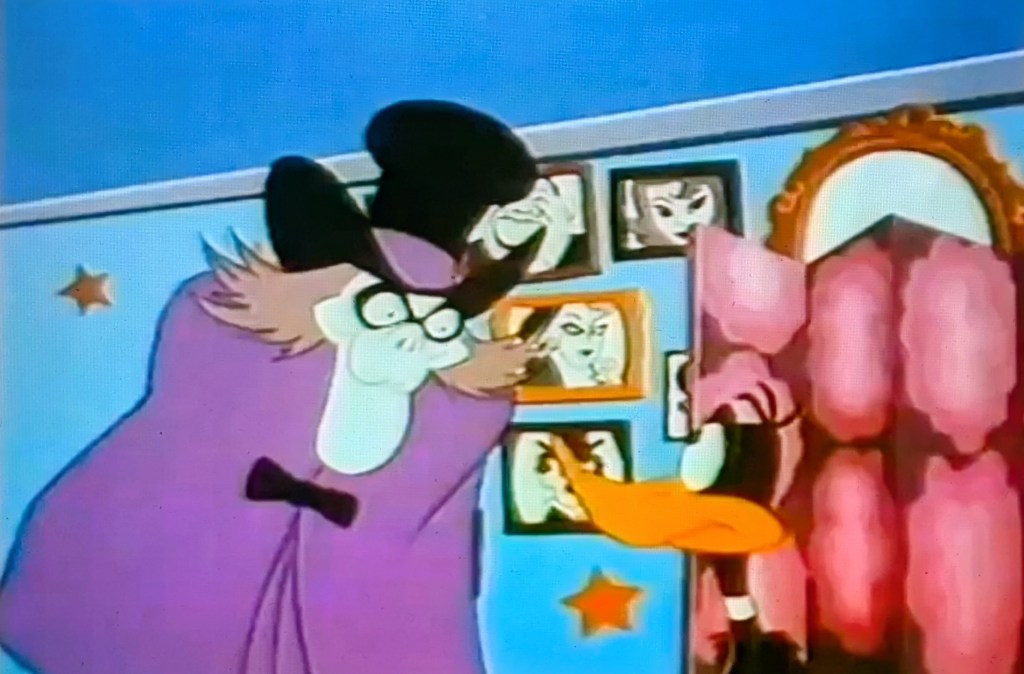
Daffy Duck meets Claude Chaney, who returns the stolen film and impresses him with his disguises. Image © DreamWorks Classics/Warner Bros. Entertainment Inc. Daffy Duck © Warner Bros. Entertainment Inc.
Daffy Duck holds and raises his arms in celebration of King Arthur winning an Ozzie Award. Image © DreamWorks Classics/Warner Bros. Entertainment Inc. Daffy Duck, Foghorn Leghorn and Petunia Pig © Warner Bros. Entertainment Inc.

The Phantom turns out to be Drac’s long-lost uncle Claude Chaney, a formerly famous silent film actor. When they ask him why he stole Daffy’s film, he says that it was out of revenge because his pale, black-and-white complexion left him out of work when cooler films like Daffy’s King Arthur film became popular. Drac suggests that he could return to filmmaking. Mummy has filmed the whole thing with all his disguises, and Drac suggests that they could show it to Daffy, but he and Hagatha hope that he will forgive Chaney for stealing his film. In Daffy’s dressing room, he tries wearing gruesome makeup, with Elmer informing him that there is no word on the Goolies and the Phantom. He discards his makeup and concludes that they would have to find someone else to play the monster, since his face is too handsome. Just then, the Goolies walk in with Chaney to introduce him, apologise and show Daffy all his disguises. Daffy, impressed with Chaney’s disguise skills, gives him a job. At the Ozzie Awards, Foghorn reads the envelope and announces that King Arthur has won. Being the self-centered waterfowl that he is, Daffy thanks only himself, crediting himself as producer, writer, star, et cetera, angering the Goolies and the other Looney Tunes (Tweety and Wile E. are absent for some reason), and is carried away by guards. The Goolies win “Best Stuntwork”, and Chaney is awarded “Comeback of the Year”. After the ceremony, the Goolies drive back home, commenting on what a great time they had, meeting Daffy, Porky and the others and becoming stars. They think that their fame may have been a thing of the past, but see that their past is catching up with them, as Sam’s posse is following them, with Sam being carried in a sedan chair by Sylvester (who has joined the posse), Wile E. and Porky and shouting, “Whoa! Aw, come on, whoa…”

Layout drawings of Drac and Frankie. Image © DreamWorks Classics/Warner Bros. Entertainment Inc. Drac and Frankie © DreamWorks Classics.
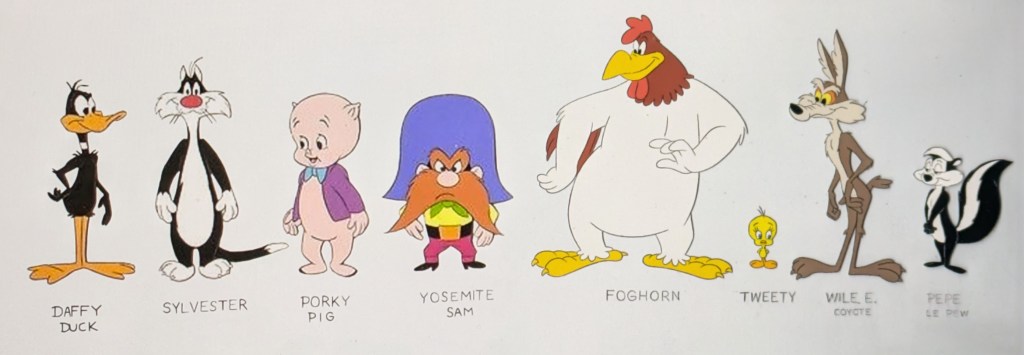
Lineup celluloid of the Looney Tunes characters, except Petunia Pig and Elmer Fudd. Image © DreamWorks Classics/Warner Bros. Entertainment Inc. Looney Tunes characters © Warner Bros. Entertainment Inc.

According to Lou Scheimer, Daffy Duck and Porky Pig Meet the Groovie Goolies was the strangest project for Filmation that came from their deal with Warner Brothers (which somewhat fits the Groovie Goolies’ description in Sabrina and the Groovie Goolies‘ theme song as “kind of strange” and “real funny”), who had shut down their animation department in 1969. They had the rights to use some of Warner Brothers’ characters, so they hired Groovie Goolies writers Chuck Menville and Len Janson to write the special’s story, in which the Groovie Goolies would go to Hollywood to meet the Looney Tunes characters. Janson had previously written the Road Runner cartoon Boulder Wham! in 1965. Filmation used a lot of the main Looney Tunes characters, except Bugs Bunny (who had not been seen since the closure of Warner Brothers’ animation department in 1964), Speedy Gonzales and the Road Runner. The cast seemed to roughly follow that of The Porky Pig Show‘s opening and closing sequences, animated by Hal Seeger and Myron Waldman at Paramount Cartoon Studios. In contrast to the DePatie-Freleng Enterprises, Format Films and Warner Brothers-Seven Arts cartoons from the 1960s, Daffy was not longer a bitter and greedy villain, instead being far more laid-back and in control, if still showing signs of egomania. This film marked the first time that the Looney Tunes characters would make a film together; the second and third times would be in Warner Brothers Movie World’s Looney Tunes River Ride 19 years later in 1991, and Warner Brothers Movie World Germany’s Looney Tunes Adventure 24 years later in 1996, both of which I wrote a blog post about in 2018. Veteran voice actor Mel Blanc provided the voices of Daffy Duck, Porky Pig, Elmer Fudd, Yosemite Sam, Tweety Bird, Sylvester the Cat, Foghorn Leghorn, Wile E. Coyote and Pepé Le Pew, though, they sounded a little different from the classic shorts; Filmation editors Doreen A. Dixon and Joseph Simon incorrectly pitched and sped up Blanc’s voice recordings for Daffy and Tweety higher and faster than normal, to the point that the former sounded a lot like his early “screwball” incarnation by Tex Avery and Bob Clampett or Woody Woodpecker, and forgot to speed up Porky’s voice. Elmer, Sylvester, Foghorn, Wile E. and Pepé’s voices sounded deeper than usual, due to Blanc not being thrilled about working on the special and not doing Elmer’s voice to his satisfaction (Elmer’s normal voice actor, Arthur Q. Bryan, died many years before). Sam was the only character who did not sound different from the classic shorts. Larry Storch reprised his roles as Drac and Hagatha and voiced the Phantom of the Flickers, while Howard Morris reprised his roles as Frankie, Wolfie, Mummy and Hauntleroy. The Phantom of the Flickers was a parody of the titular antagonist of Gaston Leroux’s The Phantom of the Opera, with the “Claude Chaney” derived from Lon Chaney, Senior (who played the title role in the 1925 film) and Claude Rains (who starred in the 1943 film).[9] Additional voices were provided by Scheimer (Director, Lance and Herald), his wife Jay Scheimer (Petunia Pig and Nurse, and probably Sylvester’s panting; Jane Webb’s pseudonym “Joanne Louise” is listed in the credits, yet Petunia and the Nurse sound nothing like Webb, indicating that Webb’s name was listed with her being considered for the roles, or a scratch track was recorded with Jay, and Webb came in to record the roles, but her track got lost or went unused and Jay’s track was used instead), Storch (Charlie Dog, Tweety’s whistling (Storch would voice Bugs Bunny in an ABC promotion the following year in 1973), Marshal Actor, Messenger, Singing Telegram Horse, Announcer and Joust Horses), and archive recordings of Hey Hey as Lassie (Dogs) from Lassie’s Rescue Rangers and Dallas McKennon as Salem Saberhagen (Sylvester’s meowing) from The Archie Comedy Show and Sabrina and the Groovie Goolies. Though the animation was limited as expected from Filmation, even in comparison to the Format Films and Warner Brothers-Seven Arts cartoons, most of the Warner Brothers characters were drawn well and animated to a somewhat higher standard than usual, having more movement and poses than the Groovie Goolies characters,[10][11] since veteran Warner Brothers animator Virgil Ross was working at Filmation at the time,[12][13][14][15][16][17][18][19][20][21] along with Ted Bonnicksen, LaVerne Harding and Ed Solomon, two of whom had worked for Warner Brothers in the late 1960s (only Ross and Harding were credited as animators at the end).[22][23] They even used smear frames and wheels of feet for the characters when running really fast,[14][24] as well as the horses in Daffy’s King Arthur film during the jousting match, and the picture frames during Daffy’s meeting used faces of Daffy lifted straight from a 1960s model sheet.[25] Despite this, Wile E. and Pepé were drawn scruffier than usual. Both characters were created by Chuck Jones, and since Ross was usually in Friz Freleng’s unit at Warner Brothers, he may have had problems drawing them in most shots.[17] He had previously animated Wile E. in 10 of Rudy Larriva’s Road Runner cartoons (Ross’ Wile E. looked somewhat decent in those shorts),[26] and would animate Pepé in Bugs Bunny’s Mad World of Television 10 years later in 1982.[27] Daffy also had a sort of deformed and off-model look at many times in the special, akin to the Warner Brothers-Seven Arts cartoons. Bonnicksen, Harding and Solomon worked on some of those shorts and a 1968 Plymouth Road Runner commercial, so it is likely that Harding (the only credited Warner Brothers-Seven Arts animator) handled a few of Daffy’s scenes where he was off-model, as well as some for Wile E. The special and a 1972 Bugs Bunny Vitamins commercial produced by DePatie-Freleng Enterprises marked Petunia Pig’s first “official” color appearances, since she never appeared in any color cartoons in the “classic” era. Since he was writing the story, Len Janson reused the pole vault gag from Boulder Wham!, specifically for a scene in Daffy’s King Arthur film where the court jester (Sylvester) pole vaults into the monster-infested moat. In the storyboards, Hagatha was going to look at the camera when she says that the Phantom froze her crystal ball, and two celluloids show Arthur’s (Daffy) horse in the jousting match with a black mane instead of a white one.[28][29] As per standard for Filmation, the special generally used low-quality samples of the Hanna-Barbera sound effects and a few classic Disney sounds instead of Treg Brown’s sound effects, sounding pretty similar to the Warner Brothers-Seven Arts cartoons, though this time the selection was not as limited as in those shorts. A laugh track was also used throughout the special; Scheimer stated in a 2007 interview that Filmation started using the laugh track (created by Charles Douglass) on The Archie Show and their other productions because it would make the audience want to laugh with other people watching at home, and made the viewers feel as if they were part of the show rather than just being observers.[30][31] The sound effects were supplied and added by Horta-Mahana Corporation (previously Einfeld-Mahana Corporation). The special had a soundtrack consisting of screechy electronic keyboards, guitars and drums and orchestrated background music; the soundtrack cues were recycled from The Archie Comedy Hour, Sabrina and the Groovie Goolies, Will the Real Jerry Lewis Please Sit Down, Archie’s Funhouse, Archie’s Television Funnies, Fat Albert and the Cosby Kids, The Brady Kids and Lassie’s Rescue Rangers. The live-action segment was filmed in Westlake Village near Thousand Oaks, and used stop motion, pixilation and undercranking to enable actors to move like cartoon characters, such as when the Goolies drive imaginary cars down the road and Drac appears to fly.[9] These techniques had previously been used by Menville and Janson for three short films of their own: Stop Look and Listen in 1968,[32][33] Blaze Glory in 1969, and Sergeant Swell of the Mounties in 1972. Music producer Ed Fournier played Frankie, musician Emory Gordy Junior played “Hauntleroy”, Dick Monda played Drac, and songwriter Jeffrey Thomas played Wolfie.[9] The Goolies’ sneezing during the segment was an archive recording of Storch as the Venus dogtrap and whale from the The Brady Kids episode Jungle Bungle: Part 2. The segment was a modified version of an unused segment for Sabrina and the Groovie Goolies, in which the Goolies chase the real Hauntleroy into Mad Mirror Land after the latter steals Wolfie’s guitar. It was removed from the special’s broadcast in the United Kingdom[34] before its retirement from United States distribution, following reruns on dates such as December 29, 1973[35][36] and July 27, 1974.[37][38][38] It would later air in reruns of the original series in 1975[40] and as part of the syndicated The Groovie Goolies and Friends anthology series in 1978.[41][34] After Filmation produced the special, as well as Oliver Twist and Treasure Island (both of which had been finished by late 1973), Warner Brothers decided to drop the Family Classics line, due to a negative test screening for Oliver Twist.[42]

The special received negative reviews from animation historians and Looney Tunes fans due to its limited animation and weak storyline. Steve Schneider of That’s All Folks: The Art of the Warner Brothers Animation dismissed it as “a low point of Warner’s animation; the less said about this work, the better”.[43] Jerry Beck called the special “the low point in the history of animation” and “an abominable mess, with limited animation, voices sped up incorrectly and an annoying laugh track (not to mention the bland stock background music)”. He stated, “Avoid this stinker at all costs! It is very sad to see our favorite characters this way. If this plot synopsis spares even one of you from ever seeing this cartoon, then I have done my job.[44][25] Michael N. Salda called it “the worst Arthurian cartoon ever”, and stated, “Even an all-star cast could not overcome Daffy Duck and Porky Pig Meet the Groovie Goolies‘s pedestrian draftsmanship, inconsistent voices, humorless gags, stock music loops, and empty characterization. The two segments devoted directly to Daffy’s King Arthur film are no better than the rest of the cartoon that encompasses them. It is painful to watch. If the rest of the cartoon were any better, one could argue that Daffy’s producer/director/actor effort is supposed to be deeply flawed, as it is, for example, in Daffy Duck in HollywoodHollywood Daffy and The Scarlet Pumpernickel. These three earlier cartoons were fine Warner Bros. releases that entertained even as, and because, they underscored Daffy’s arrogance and many foibles. But Daffy’s embedded King Arthur film is as unrelentingly weak as Daffy Duck and Porky Pig Meet the Groovie Goolies itself. There is no joke here. Despite the conclusion that shows Daffy proudly accepting an ‘Ozzie’ for King Arthur and making a speech in which he thanks himself repeatedly as producer, director, star, et cetera, the rest of the world took a dimmer view of Filmation’s cartoon. Although the Phantom of the Flickers was speaking exclusively of Daffy’s Arthurian film when he judged it a ‘full-length flop’, his condemnation could easily be extended to Daffy Duck and Porky Pig Meet the Groovie Goolies and much of Arthurianimation in the 1960s and early 1970s as a whole.”[36] Trevor Thompson, the self-appointed Looney Tunes Critic, gave the special a harsh, negative review, expressing his hatred for Filmation (which began in the 1980s). He criticized the Looney Tunes characters appearing and working together (due to them being “too independent and adversarial” and most of them being “comic losers”), the plot, Daffy, Porky and Tweety’s incorrectly-sped voices, and the addition of a laugh track (which he falsely thought was “how literal-minded the heads of production were at Filmation”), called the writers “literal-minded idiots” and “horrible hacks”, blamed Filmation for animation on television becoming “completely awful” from the late 1960s to the early 1980s (television animation was only awful in terms of writing and quality because of networks and groups like Action for Children’s Television), said that the Phantom destroying Daffy’s films was “a metaphor for Filmation destroying animation’s legacies”, and stated that Chuck Menville and Len Janson wrote a lot of bad Saturday morning cartoons, despite being talented artists themselves.[45][46][47][48] mightyfilm said, “It’s…weird. The Goolies barely share any on-screen time with the Looney Tunes, and it feels wildly disconnected in every aspect. It’s not a good Looney Tunes project BUT oddly, an excellent Groovie Goolies project, giving them a longer story than the usual 3-minute cartoon in between Laugh-In type joke bumpers and a musical numbers. Half the characters’ voices are at the wrong speed, especially Daffy. Yet Lou Scheimer had his wife do the voice of Petunia Pig because she was in one scene, and she has a VERY low pitched voice. Don’t see why they didn’t speed her voice up. Just…all around weird, and then there’s the live action segment which was actually pretty fun. And Bugs somehow has that odd Mickey immunity where they refuse to let him be in a project because it might tarnish his reputation. Which in the case of Bugs, sure, but the times they wanted to use Mickey in a project, it wasn’t exactly Disney’s low points. They wanted to use him in the new DuckTales series, but were denied. They had to go through weird hoops to get him in Bonkers, and he wasn’t mentioned by name and seen only in shadow. Yet Mickey Mouse Clubhouse exists. Just the weirdest crossover I’ve ever seen. Teenage Mutant Ninja Turtles meet Batman four times? Didn’t phase me. Family Guy and The Simpsons, way too late, but appreciated. Like 90% of comic books out there now being some sort of combination between Ghostbusters, Transformers, Power Rangers, Ninja Turtles, and the Justice League. A little too much, but cool. Looney Tunes meets the spinoff of a spinoff that doesn’t even go together by any stretch? Still baffling.”[49] Anthony Kotorac of Anthony’s Animation Talk and FoxInAFix watched the special on October 31, 2020. After they finished watching, they talked about how the special was not as visually interesting as they had hoped, with Fox saying that the dialogue was unfunny, the characters talked a lot and were mostly standing and running, and the Looney Tunes characters mostly had “only two lines or something”, though he liked the scenes with Tweety and Sylvester. They praised the live-action sequence, which Anthony calling it the “best part” of the special and “clearly like a sendup of silent film”. Anthony added that he was “entertained by how terrible the plot was” and would only watch it again if it was remastered as a special feature, and pointed out the errors with Mel Blanc’s voices.[50] Warner Brothers was not satisfied with the results and never had Filmation work with the Looney Tunes characters again. Any time that they would have animation with the Looney Tunes characters outsourced, it would be done by studios that were run by Warner Brothers alumni such as Friz Freleng and Chuck Jones, until they reopened their animation department again in 1980. However, the special does have its fans and defenders. Eric B stated, “Even though it may not be as good as the classics, it was a use of the characters, and to me, the more off-center it is, the more interesting and deserving of discussion it is, though it may have been done poorly. The music is mostly the familiar Ray Ellis Groovie Goolies stock, which is very similar to the regular Fat Albert score. Just a lot of keyboards, which was common at the time. Certainly not “bland muzak” as Beck called it. It is nowhere near as bad as the Tom and Jerry/Droopy score (which consists of gaudy Moog synthesizers with the same three tunes rehashed throughout the episode). There were even a few Archies stock (also used on The Brady Kids and others). Most of the characters are reasonably drawn (Virgil Ross was one of the animators working at Filmation), and Wile E. Coyote and Pepé Le Pew don’t seem to be all that bad most of the time. At first, at the conference table Pepé did look pretty bad, with a smaller, fluffy oval shaped face and a pointy nose almost like a real skunk (resembles a miniature Wile E., with a frown even!), whereas Wile E. looked alright to me at this time. The problem with them seems to be slight distortions of their noses at times. Wile E.’s nose and face looked particularly weird when he was getting sick from the pirate ship set rocking. But at other times they seemed okay. Daffy Duck and Tweety Bird’s voices are sped up too much, sounding like they are on helium. Elmer Fudd’s voice didn’t sound that much different from Dave Barry’s take in Pre-Hysterical Hare and any other instances of Mel Blanc doing the voice. Just a little lower. The biggest problem with him is that he only had one single line toward the end. Porky Pig was a bit too low due to not being sped up, sort of like he was in the late 1980s Looney Tunes films. Petunia Pig actually sounds a lot like Ms. Bellum from The Powerpuff Girls, to give modern viewers an idea of what it sounds like. The voice is obviously the same as Fat Albert’s school teacher, who was Scheimer’s wife Jay. As for the story, it is hard to say. Yosemite Sam seems to be the most prominent character, then Daffy and Petunia. Sylvester the Cat, Tweety and Foghorn Leghorn have their moments. The rest seem to be just along for the ride, and could have easily been omitted. Wile E. only utters three laughs and is otherwise silent (communicating mainly by holding up signs, like in the Road Runner cartoons, even though he talked at other times in the classic series). One big error is that Porky and Wile E. are at one point at two places at the same time (out on the posse with Sam, and screening the rest of the King Arthur film with the others). Then all the concurrent uses of the characters is strange: Petunia is a television announcer, and also apart of the film. Foghorn is apart of the film, and both also are the emcees of the Ozzie Awards, where they hand themselves the award! (Not to mention them finishing the film, submitting and winning the award for it all in 20 minutes!) The closing gag has the Goolies, on the way home and thinking their brief moment of fame was over, being chased by Sam, Porky, Wile E. and Sylvester, but the reason for this was not explained. I wonder if that was originally supposed to be Sam’s posse still trying to catch them, not realizing that the whole story was over, before it was decided to have all of the Looney Tunes characters together at the awards. (Not only that, but Sylvester was not in the posse, anyway). So those aspects of the story were very sloppy. There are also large periods that focus on the Goolies and not the Looney Tunes, and a long drawn out sequence of the Goolies (wearing armor) falling down, and then up and then down again that should have been edited more. But I think that people’s abhorrance of this film stems from treating it as a Looney Tune, and judging it on that high standard. But it is not. It is a Groovie Goolies cartoon, with our beloved classic stars as special guests. The verbal comedy routine is their normal format, and I find it funny, and perhaps one of Filmation’s best non-action/adventure cartoons. The boy that the Phantom disguises as is Hauntleroy, one of the other Groovie Goolies series regulars. He also was otherwise absent. This was another glitch in the story, as the boy was supposed to be someone they didn’t know. They at first appear not to know him, but then do acknowlwdge him as Hauntleroy in the live scene. If it was Hauntleroy, that right there should have been suspicious as he did not travel out there (to Hollywood) with them. Yet another big glitch, is that Bella LaGhostly was one of the Hollywood stars that they hoped to see, yet in the regular series, she was a series regular; the switchboard operator at Horrible Hall! So no; classic Warner animation this is not, but it still has some worth and should not be totally trashed the way that people have done. With computer technology, the voices can easily be fixed.”[51][52] Jim of Jim’s Unofficial Filmation homepage stated, “While Warner Brothers fans have almost universally trashed Daffy Duck and Porky Pig Meet the Groovie Goolies, in my opinion, they have really overstated this nifty little film’s flaws. Granted, the animation is no where NEAR the quality of a Warner Brothers theatrical cartoon, but it was a notch above what had been the norm for early 1970s Saturday morning fare. They also fail to point out that the Looney Tunes are very faithfully animated, and fairly funny in places. Daffy, in particular is just terrific (though his voice is a bit high pitched), and Sylvester is nicely done too. The live-action sequence at the end of the film is incredibly fun, incorporating a great deal of slapstick schtick. The actors (sorry, I don’t think they were credited) did a nice job of portraying believable “real” Groovie Goolies. The plot is something of a mess, but it moves along briskly enough that I didn’t really care. It’s all about lightweight fun, and on that level, it works well enough.”[53] wileyk209zback/Zak Wolf posted, “I find this television special more enjoyable than the later Warner Brothers-Seven Arts cartoons. To me, it’s kind of a ‘so bad it’s good!’ television film. One is apparently left with the impression this may have been ABC’s attempt at competing with The New Scooby-Doo Movies, and may have been an intended series where the Groovie Goolies meet different ‘celebrities’ of sorts. I made up that Bugs Bunny became a hippie in the early 1970s, and he didn’t want anything to do with television animation at all, as he wasn’t fond of Filmation or anything else resembling Hanna-Barbera, feeling that the former company was too ‘square’.”[23] joeblev of Halloween Love stated, “It’s easy to see Daffy Duck and Porky Pig Meet the Groovie Goolies as a career-low for Porky and pals, but it’s also simultaneously a career-high for the Groovie Goolies bunch. Other than some funky 1970s background music (very similar to what Filmation used on Fat Albert and the Cosby Kids) and a lone joke about Elliott Gould, this special has a timeless quality to it. When the characters run onto the sets of other films, we see that Daffy Duck Studios is turning out generic cowboy pictures and swashbuckling adventures that could have been made in the 1930s. This is the kind of place where directors still wear jodhpurs and give orders through megaphones. No traces of ‘the new Hollywood’ here. Though nearly none of the jokes land and the backgrounds loop around endlessly, the film is not a total disgrace or embarrassment to the Looney Tunes legacy. That’s about as much of an endorsement as I’m willing to give it. The characters basically look and sound the way they should, and the animation isn’t that much of a step down from the shorts that Warner Brothers was releasing in the late 1960s, by which time the studio was already outsourcing its animation to other companies. I think, if I had been a kid watching this in 1972, I would have been very excited to see the Goolies and the Looney Tunes together. The special is not really special in any noticeable way, except as an oddity, but it’s basically as harmless as those ads for Bugs Bunny vitamins or, indeed, those latter-day Warner shorts. Ideally, even though it originally aired a few weeks before Christmas, this could be marketed as a Halloween special and shown every October. The problem is that much of the running time is devoted to scenes from the decidedly unspooky film-within-a-film, King Arthur. (Daffy and his cast are supposedly viewing dailies.) It’s almost as if the writers couldn’t decide if they were doing a parody of Phantom of the Opera or a send-up of Arthurian legend, so they decided to alternate between the two. Perhaps, instead of sending the Goolies to Hollywood, it would have been better to have Daffy and Porky visit Horrible Hall instead. Maybe the duck and the pig (with some of their pals) are on a road trip together when their car breaks down and they have to take shelter at the monster boarding house. That may not have resulted in an enduring classic either, but it could have been more fun than what they ended up doing.”[54] YouTuber ToonReel001 commented, “Generally the recurrent joke in Looney Tunes is often the cast are self aware ‘actors’ who know that they are making a cartoon. Not always but a lot of the time they are medium aware they all cast members. This still extends to them being self involved, especially Daffy who even in these cases wants to be the star (especially against Bugs but even against Porky in You Ought to Be in Pictures), but it explains why they’re not as adversarial as they are in some of the cartoons themselves. I mean there are several cartoons like What’s Up, Doc? and A Star Is Bored that make fun of Bugs and Elmer’s feud and plays them off as being on-the-clock enemies only.”[55] Julia Baldwin/Turbotastic Asian stated, “The few existing, die-hard fans of this show can attest to the fact that The Groovie Goolies had their own crossover television special once with the Loony Tunes gang entitled, Daffy Duck and Porky Pig Meet The Groovie Goolies. Most fans absolutely hated this movie and desperately try to forget it ever existed. I personally don’t hate it as much as other fans do. For one thing, I like the fact that a Groovie Goolies show actually had a plot to it. For another, Mummy has a bigger role in this than he does in the actual cartoon. Throughout the events of the film, he is shown wearing a movie camera around his neck, and there are a couple running gags of him fidgeting with it and even using it to film during (seemingly) the most inopportune times. At one incredibly weird moment, the Goolies find themselves in a live-action scene and start playing one of their songs from the cartoon. Notice which Goolie is not shown in this scene. Guess why: it’s because this scene is shot by that aforementioned movie camera! Lastly, at the end of the movie, all of that footage that Mummy caught on his film was beneficial for solving the story’s main problem. That’s probably my favorite part about this otherwise mediocre and forgettable movie: My own little comfort character became the unsung hero of the story!”[56] Amber of Cartoon Research said, “I have a sentimental relationship with the Filmation Looney Tunes special, due to the full black-and-white copy being one of the first things that I traded with my (now) wife. That said, it’s not a good special. It’s entertaining, if you love oddities and/or the Groovie Goolies. But it’s wholly a mess. Filmation probably could have reasonably enough played it straight, and just did a “Daffy Duck as King Arthur” special, which seems to be what they want to focus on instead of just about anything else. The Looney Tunes and the Groovie Goolies hardly interact with each other at that. I do feel there is some merit, or at least intrigue with the special. That background of Daffy’s giant, framed portrait as a director is killer. There’s also a pan background full of some fun Daffy faces lifted straight from a 1960s model sheet. The live action segment is easily the best part of the whole special, and it was absolutely criminal of German distributor Select Video to cut it from their VHS release. All else said: I won’t accept any flak toward Ray Ellis’s music on my watch!”[25] As for myself, I agree more with the fans of this special. It is not as bad as it seems, and is not a complete stain on the Looney Tunes franchise. It is a Groovie Goolies production with the Looney Tunes characters as guest stars, since it has a laugh track, limited animation, low-quality Hanna-Barbera and Disney sound effects, and a twangy-orchestrated soundtrack. All of this was normal for Filmation’s shows, but probably not for Looney Tunes. The live-action segment is pretty hilarious, though.

This special has never been officially released on home video in the United States (due to various rights issues), but traders on the Internet have been recording and selling digital video discs of the special, most of which were originally black-and-white kinescopes of the original broadcast. This is a coincidence considering that in the special, Claude Chaney sabotages Daffy’s work because films were no longer shot in black and white. Unofficial copies of the original color broadcast have also emerged. Distributor Select Video released the film in a number of European countries, including Germany and Denmark.[57][58] The German version of the movie was released in 1983 as Groovie Goolies: Muntere Monster in Hollywood (Groovie Goolies: Groovie Goolies in Hollywood), and re-released in 1986 as Duffy Duck und Co. (Daffy Duck and Company), and again in 1990 as Die Lustige Monster Show: Duffy Duck und Co. in Hollywood (Groovie Goolies: Daffy Duck and Company in Hollywood). The original laugh track from the special was mostly removed for these releases. In January 1985, the movie was released in the United Kingdom as Groovie Ghouls, and was said to have been on sale at Woolworth’s. In those instances, the live-action sequence was replaced by an out-of-shot collision before rejoining the original animated sequence. The sequence in these releases was cut for time, as the German versions contained trailers for other Select Video titles. Another notable feature of the German and United Kingdom releases was that the Select Video ident was shorter, and had no jingle. In addition, the end credits were different, as they had to edit out the names of the actors in the live-action sequence which was not included, and also had other credits, possibly for Europe-based post-production at Select Video.[57] Despite the aforementioned rights issues, the special remains part of the Groovie Goolies syndication package (split into two half-hours) as of the mid-2000s, furthering its status as a Groovie Goolies production,[59] and has been rebroadcast several times on television. The National Broadcasting Company broadcast it as a Halloween special in the late 1970s or early 1980s. On January 1, 1983, the special was broadcast on Antenne 2 in France as Les Croque-monstres à Hollywood (Groovie Goolies in Hollywood).[60] Sky One aired the special in the United Kingdom on July 4, 1992.[61] USA Network broadcast the film as a Halloween special in the mid-to-late 1990s shortly before it stopped broadcasting cartoons altogether.[62] Anime Superhero Forums user SF4Ever/Michael Powell said that Cartoon Network broadcast the special on Mister Spim’s Cartoon Theatre in 1995 and/or 1997.[63][64] The special was broadcast on German television as Monsterparty auf Schloß Blutenburg: Daffy Duck und das Phantom Der Seifenoper (Groovie Goolies: Daffy Duck and the Phantom of the Flickers) in 2002, 2007 and 2013.[65][66] The first part of the Anixe airing used to be available on Dailymotion, but has been taken down. The 1985 Select Video release of the special was uploaded to YouTube on February 23, 2017,[67] only to be replaced by a “2018 restoration” of the film (spliced from the 2013 Anixe broadcast (first part only), the Select Video release, the original 1972 black-and-white broadcast and The Haunted Heist), uploaded by netscapenow on May 5, 2018.[68] A month later on June 8, 2018, wileyk209zback/Zak Wolf uploaded a version of the special with Daffy Daffy, Porky Pig and Tweety Bird’s voices corrected, which would be taken down by Warner Brothers in May 2020, and uploaded to Google Drive and Facebook.[69][49][70] I asked Zak if I could use his version and pitch and speed up Petunia Pig, Elmer Fudd, Tweety (Zak’s version had Tweety speaking at the correct speed but at a slightly lower pitch), Sylvester the Cat, Foghorn Leghorn, Wile E. Coyote, Pepé Le Pew’s voices to sound close to the classic cartoons, and he said, “Not a problem. Go ahead.” My edit was made using Windows Movie Maker, Moho 12 and online pitch shifters in July 2019, and also includes Bugs Bunny, Speedy Gonzales, the Road Runner and other Looney Tunes characters not present in the special (Granny, Marvin the Martian and the Tasmanian Devil), using sprites from Bugs Bunny: Rabbit Rampage (when Bugs is present with the other Looney Tunes in the interview, during filming, running away and at the conference table), and footage from Rabbit Fire (Bugs saying, “Right!”), Zipping Along (the Road Runner scaring Wile E. when he is looking for the Phantom and the Goolies; here the Road Runner is one of the Phantom’s disguises, taunting the coyote and telling him that he can’t catch him), Bugs Bunny’s Easter Special (Bugs, Foghorn and Granny in the screening room, Pepé reacting to the Goolies’ presence in the film and screening room), Mexican Borders (Speedy reacting to the Goolies’ presence in the film and screening room), et cetera. I watch the edit for my enjoyment sometimes.

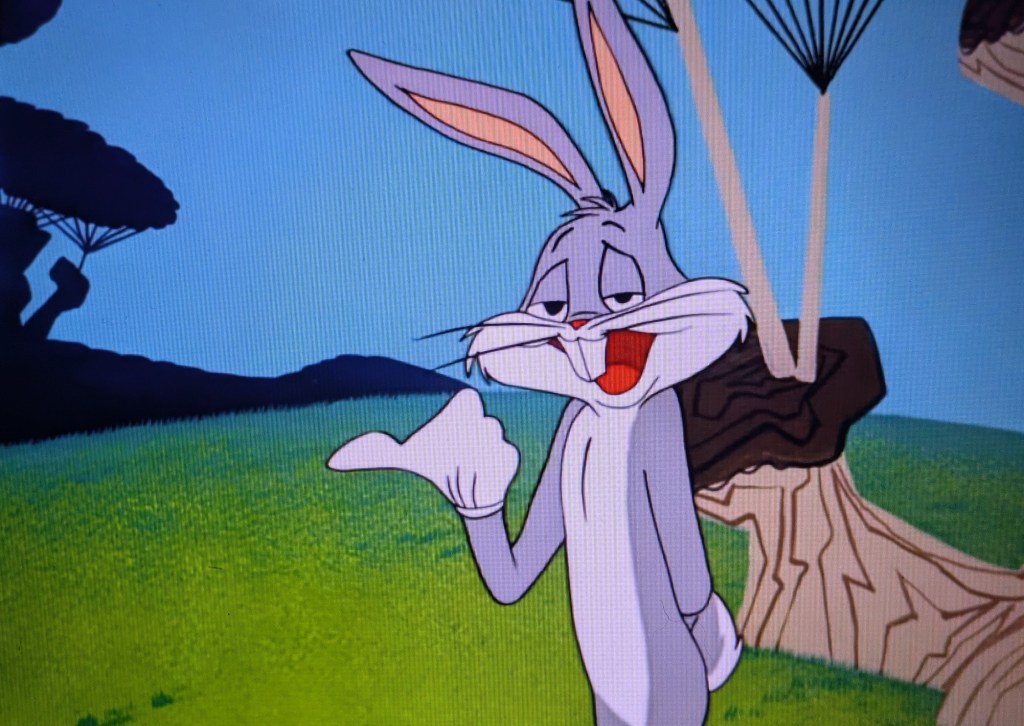
Bugs Bunny in King Arthur’s Court was broadcast in 1978. Image © Warner Bros. Entertainment Inc.

In 1977, Chuck Jones and his team of animators at Chuck Jones Enterprises began working on a much more ambitious project with permission from Warner Brothers: A Connecticut Rabbit in King Arthur’s Court. Aired on CBS on February 23, 1978, the television special was a “plagiarized” retelling of Mark Twain’s A Connecticut Yankee in King Arthur’s Court. It was rebroadcast as Bugs Bunny in King Arthur’s Court on November 22, 1978, due to the executives expecting the combined reputations of Bugs Bunny and King Arthur to be a bigger draw than a title that referenced the rabbit and hinted at an educational (and probably dull) retelling of an American literary classic, since they were more popular than Twain.[71]
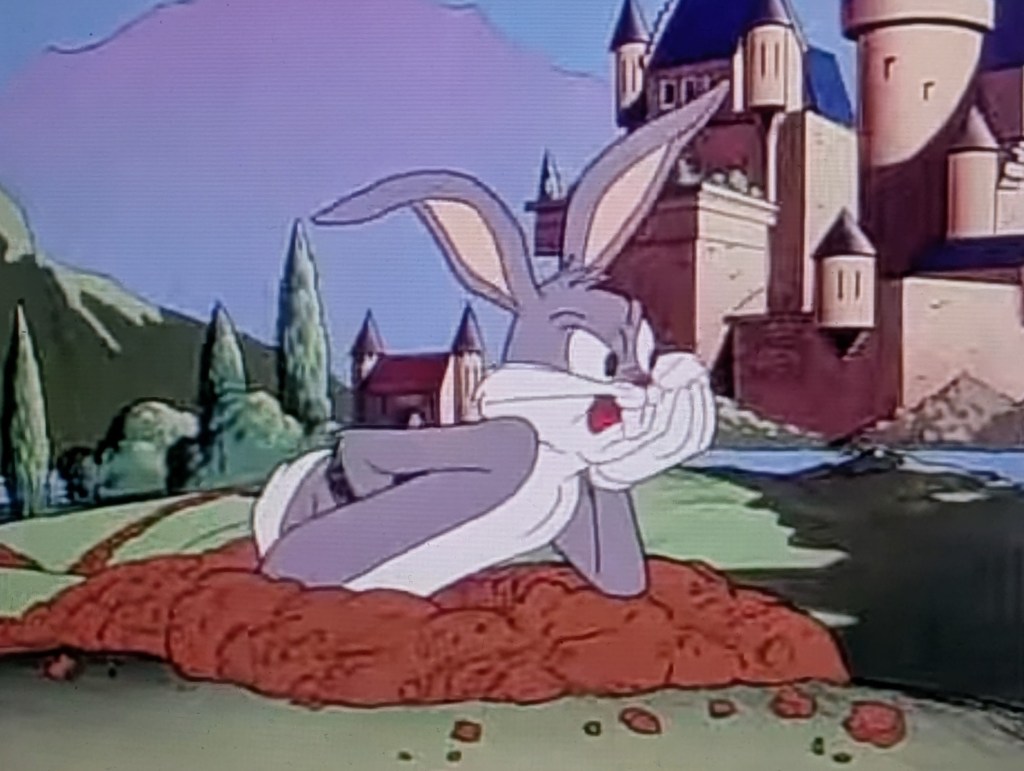
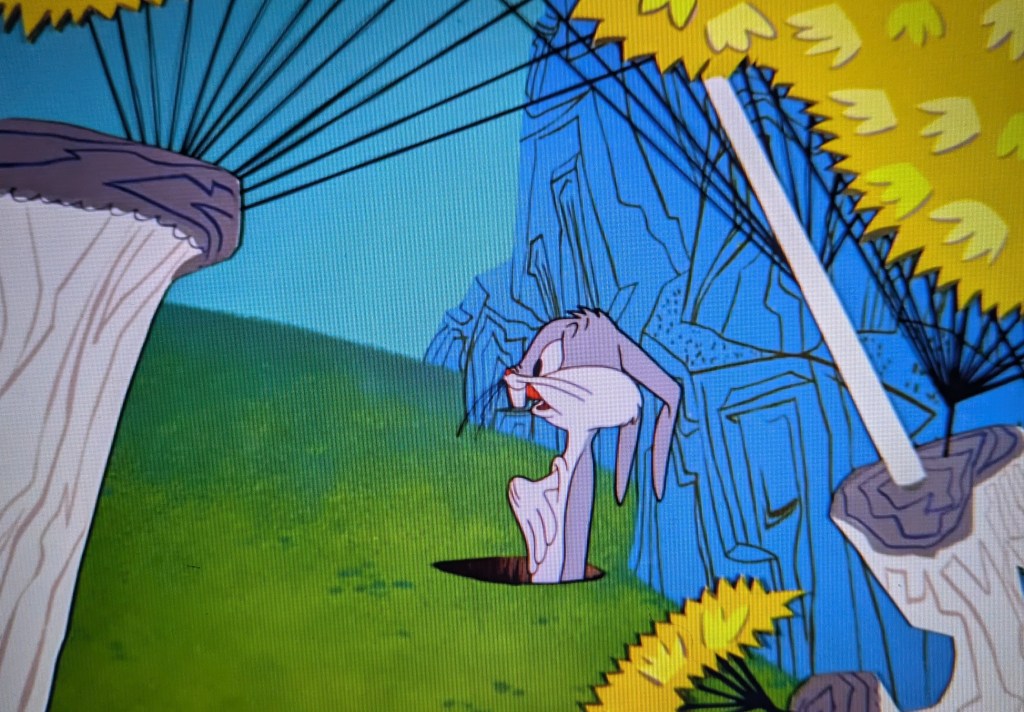
Upon arriving in Camelot, Bugs Bunny realizes that he has not reached the Georgia Peanut Festival. Image © Warner Bros. Entertainment Inc.
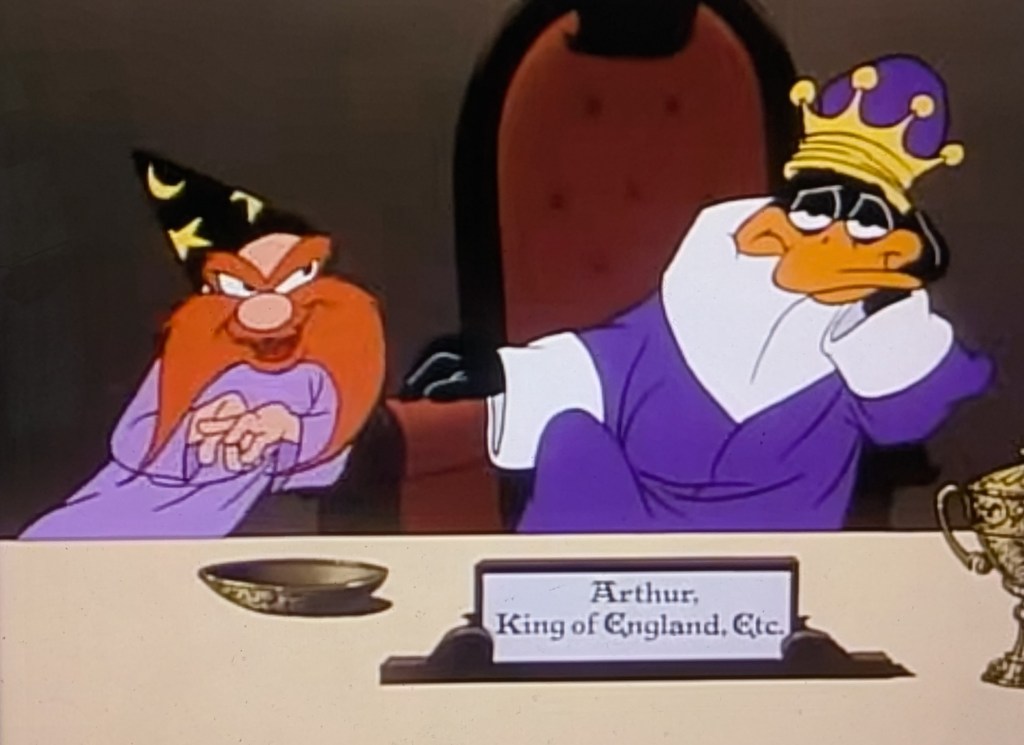
Daffy Duck as Arthur, King of England, Et Cetera, and Yosemite Sam as Merlin of Monroe, Baron of Yosemite. Image © Warner Bros. Entertainment Inc.

Bugs Bunny is trying to reach a peanut festival in Georgia, but thanks to faulty directions from Ray Bradbury, he takes a wrong turn at Albuquerque and time-travels to Camelot in the year 526. He mistakes Cmelot for Pittsburgh at first, but meets a fire-breathing dragon. After hiding in his hole to avoid the beast, Bugs mentions having previously time-traveled to 25th-century Mars thanks to Bradbury. Just then, his carrot is speared by Sir Elmer of Fudde (played by Elmer Fudd), a brave knight. Elmer tells him that he has been hunting for a dragon, and mistakes him for a transformed dragon. He captures Bugs, tells him that he is in Camelot after the latter sings “Barbara Allen”, and takes him to the castle of King Arthur. There Bugs is presented to the disinterested Arthur, King of England, Et Cetera (played by Daffy Duck), and bloodthirsty court magician Yosemite Sam as Merlin of Monroe, Baron of Yosemite (played by Yosemite Sam). Elmer tells everyone about his dragon-hunting skills and capture of Bugs, who calls him a “fibber”. Merlin wants Bugs drawn and quartered; when the rabbit begins talking about being in animated cartoons for years and not being born/literally drawn until 1940 and private quarters with nice views and baths, he tells him to shut up. This makes Bugs shed some tears, and Merlin seems to regret hurting his feelings at first, but then angrily yells for him to be burned at the stake. Bugs uses a solar eclipse to fool the locals into thinking that he can affect the sun’s movements. In spite of Merlin wanting him to be burned and much to Elmer’s chagrin, he is released, and Arthur grants him custody of an actual fire-breathing dragon.

Bugs Bunny takes Sir Loin of Pork/Porkè of Pigge, the Varlet, on a tour in his ACME Armour Factory. Image © Warner Bros. Entertainment Inc.
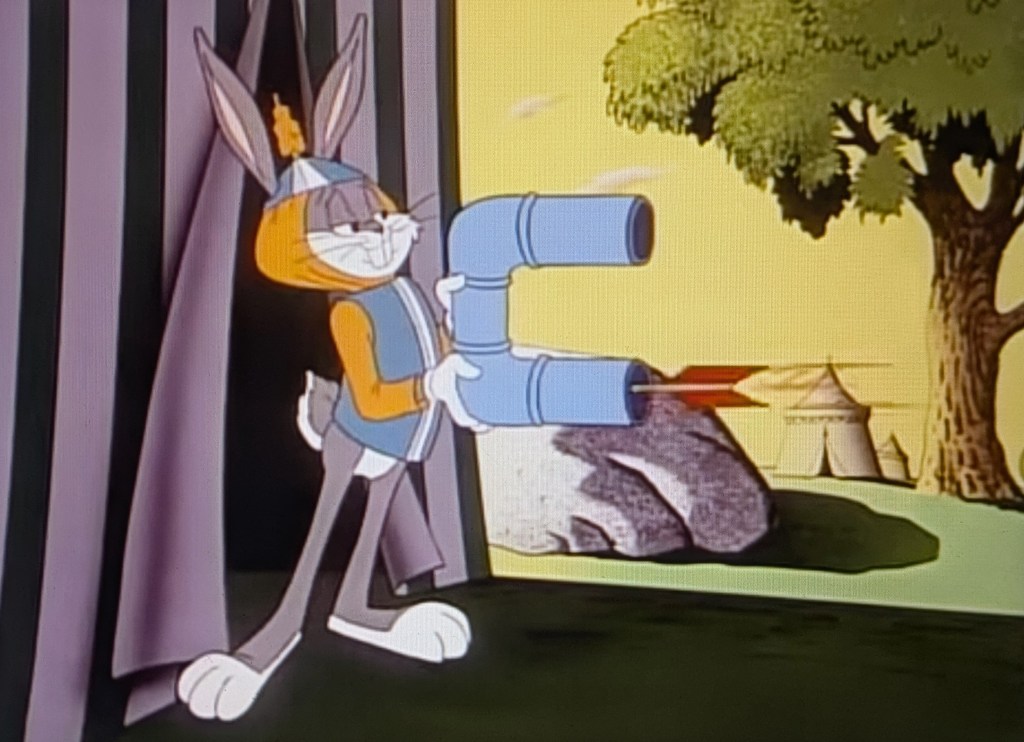
Bugs Bunny redirects Sir Elmer of Fudde’s arrow using a U-shaped pipe. Image © Warner Bros. Entertainment Inc.
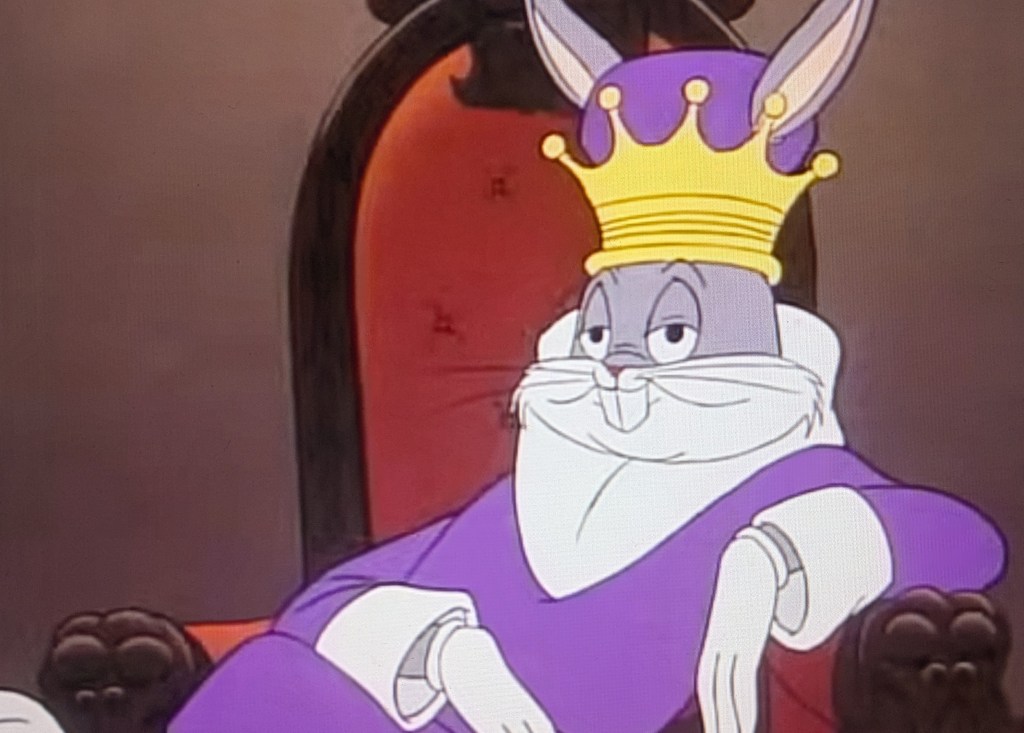
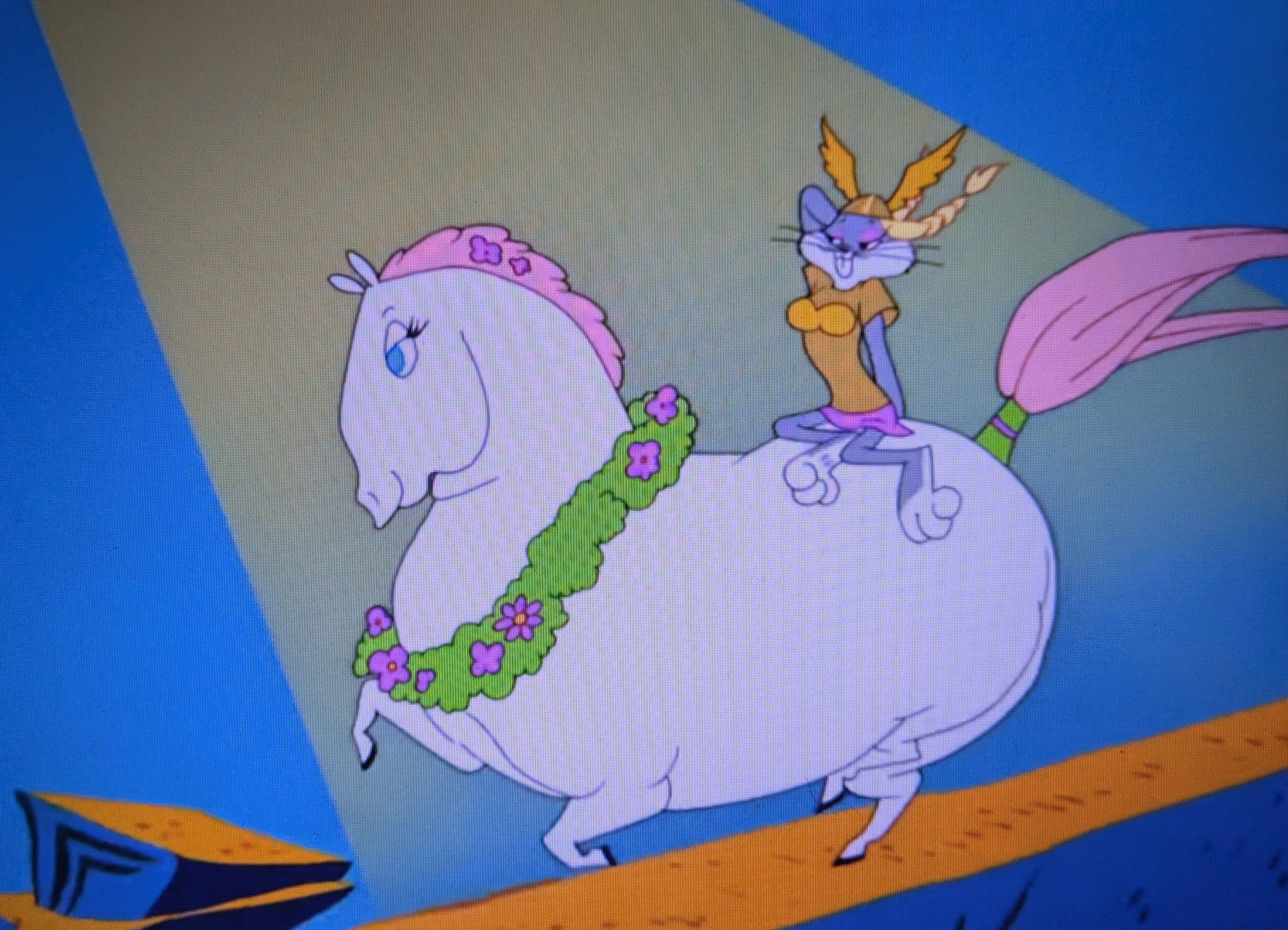
Bugs Bunny as King Arth-Hare. Image © Warner Bros. Entertainment Inc.

Two years later in 528, Bugs takes Sir Loin of Pork/Porkè of Pigge, the Varlet (played by Porky Pig), on a tour in his ACME Armour Factory, showing him inventions to reform medieval society, such as horsepower, dragon power, steam power, electric power, and armour created for endangered species like foxes, squirrels (not shown), deer, moose, elk, antelope, Tweety Birds, mice, cats, dogs, flies, roosters, rattlesnakes and porcupines. However, Elmer stab’s Bugs’ dragon with his lance, making him run away, yelping in pain. Bugs confronts Elmer, who still thinks that the latter is a transformed dragon. He takes off his glove and smacks the rabbit in the face, before challenging him to a duel, to which Bugs then punches Elmer’s face with a boxing glove. During the duel, Bugs uses his extremely long lance to pole vault over Elmer, douses him and Merlin (who has allied with the knight) in the moat, steals his armour using a magnet, and sends Elmer’s arrow and catapulted rock at them using a U-shaped pipe and spring, respectively, much to King Arthur’s amusement. Merlin skids out of a tent to light a cannon to kill Bugs, but Bugs tells him that he can’t use a cannon because gunpowder has not been invented yet. The magician takes a look inside and is blasted, cursing Bugs and calling him a “goldang coniglio lapin dragon” and “rampin’ frampin’ coneho lizard”. Bugs then finds what he thinks is a “neat carrot slicer” in a stone, unaware that Elmer and Merlin are pushing a wooden ax-wielding vehicle toward him. He innocently pulls the “carrot slicer” out of the stone, which is revealed to be Excalibur when a disembodied voice (God) proclaims him as the new king. Elmer and Merlin stop in their tracks as God says that anyone who does not like Bugs being the king will be boiled in baby oil. Porkè, Elmer and Merlin pledge their allegiance to him, and Daffy abdicates and relinquishes the crown to Bugs, the new ruler in “King Arth-Hare’s Court”.

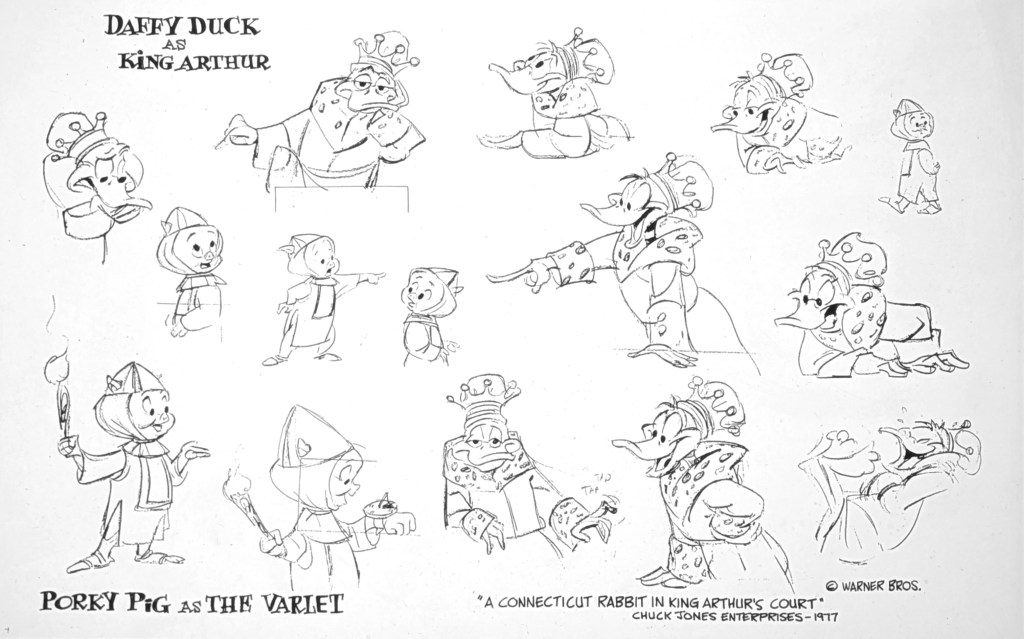
Model sheet for Bugs Bunny. Image © Warner Bros. Entertainment Inc.
Model sheet for King Arthur and Sir Loin of Pork/Porkè of Pigge, the Varlet. Image © Warner Bros. Entertainment Inc.
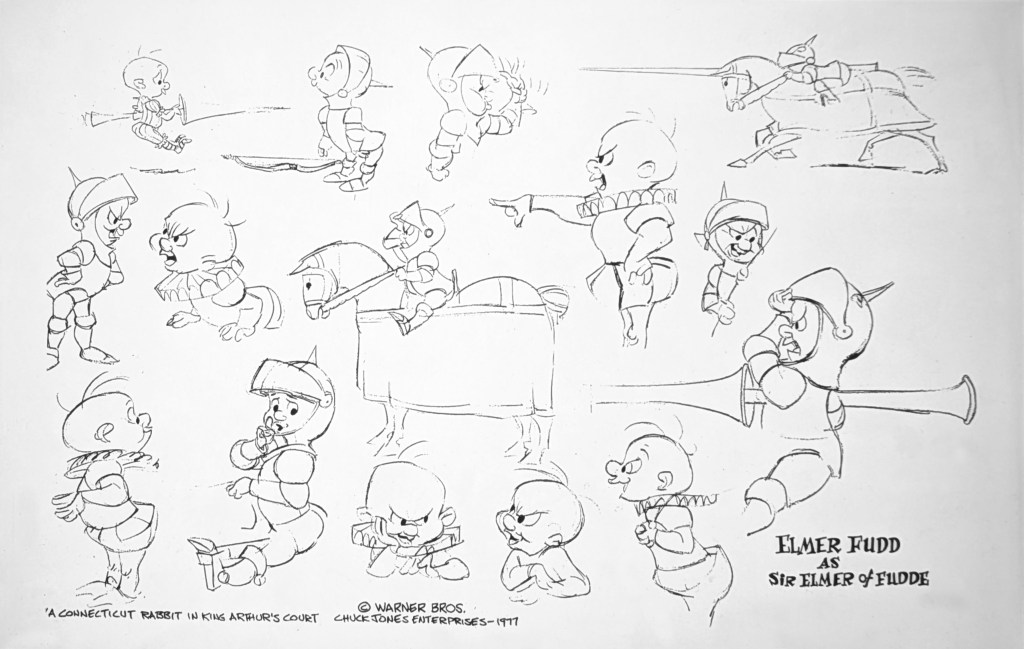
Model sheet for Sir Elmer of Fudde. Image © Warner Bros. Entertainment Inc.
Model sheet for Merlin of Monroe. Image © Warner Bros. Entertainment Inc.
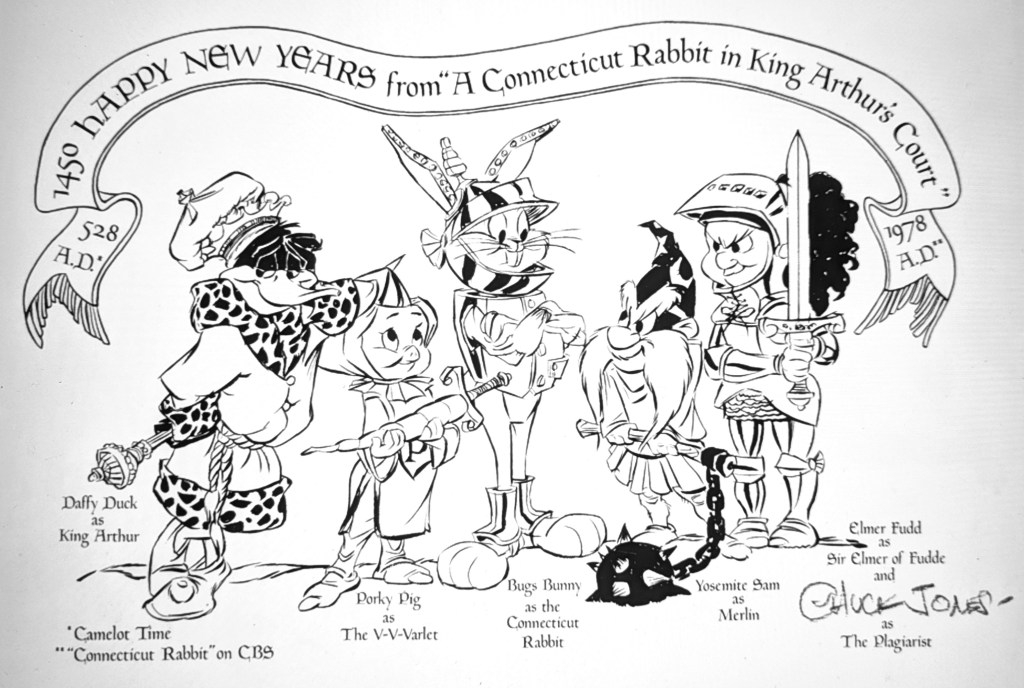
New Year’s card from A Connecticut Rabbit in King Arthur’s Court. Image © Warner Bros. Entertainment Inc.

Prior to Chuck Jones’ firing from Warner Brothers in 1962, Michael Maltese worked with him and wrote stories for many of his Looney Tunes and Merrie Melodies cartoons in the 1950s. Due to Maltese’s absence, Jones wrote the story, dialogue and gags for the special on his own, which only made them (save for the gags during the jousting duel) feel too self-conscious, world-weary and sophisticated.[72][73] Bugs Bunny in King Arthur’s Court marked the first use of Yosemite Sam in a Jones-directed short or special, before From Hare to Eternity 19 years later in 1997. According to Ben Washam, there was a change in Jones’ animation direction in the late 1970s, where he became more lenient with his younger animators, allowing for visual elements that broke his earlier rules, such as trailing smoke or dust instead of dissipating smoke, seen when a character like the Road Runner runs off.[74] Since Murice Noble was not working with Jones at the time, he also drew the layouts for the backgrounds, which were vastly different from the classic cartoons, being much longer, straightforward and larger, and his younger animators were mimicking his later, weaker drawings.[72] Though the animation in the special looked really rough and slow, it was more fluid than the limited animation in Daffy Duck and Porky Pig Meet the Groovie Goolies. Jones also had a dislike of limited animation, which he described as “illustrated radio”.[75][76][77][78][79] Even though there is no official record or evidence of Jones not liking the Groovie Goolies special, his dislike of limited animation could indicate that he at least heard of the special and its reception, and wrote the initially-disinterested King Arthur and Merlin being played by Daffy Duck and Sam, Bugs Bunny’s extremely long lance during the jousting duel, Bugs becoming the new king, and Daffy considering the idea of King Arthur being a duck ridiculous to poke fun at Filmation for their special, since it did not feel much like a Looney Tunes cartoon.[80] Animators and artists included Warner Brothers/Jones animators Ken Champin, Phil Monroe, Manuel Perez, Virgil Ross, Lloyd Vaughan, Irv Wyner, Don Foster (who did the title card artwork), Marlene Robinson May, Joe Roman, Ben Washam and Jean Washam; and Mitch Rochon, Woody Yocum and ink and paint artist Celine Miles, who painted the backgrounds.[81][82] Bugs Bunny in King Arthur’s Court was Yocum’s first time animating. He would later say that Jones had been a great director on the special.[83] Yocum and Robinson would later work at Filmation in 1978 and 1979, respectively. Roman had first worked for Jones on The Adventures of the Road Runner as a “master animator” in 1962, and returned to work on A Very Merry Cricket, Rikki-Tikki-Tavi, A Chosen Cricket, The White Seal and Mowgli’s Brothers before doing animation for the special. His only work for Filmation at the time was The New Archie and Sabrina Hour, The Fat Albert Halloween Special and Space Sentinels. The production assistants were Susan Charron, Linda Jones Clough, Mary Roscoe, Marian Dern and Marjorie Roach.[82] Roach had previously worked at Filmation as a production checker on Journey Back to Oz, Treasure Island and Oliver Twist. Mel Blanc provided the voices of Bugs Bunny, Daffy Duck, Porky Pig, Elmer Fudd, Yosemite Sam, the dragon and God.[81] The soundtrack was composed by Dean Elliot and Louise Di Tullio.[81][84] The special was edited by Sam Horta.[81] Jones had started using Horta-Mahana Corporation, the same post-production company that Filmation used for much of its lifespan, which explains the special’s usage of low-quality Hanna-Barbera and Disney sound effects. Horta was only credited as a film editor/camera operator in Jones’ specials (including Bugs Bunny in King Arthur’s Court) and never in Filmation’s shows (other people did the editing). The rostrum camera equipment was provided by a company called Animagraphics.[85][86][82] Despite not sourcing on the special, Maltese would sign a model sheet of Bugs in November 1979, with a dedication to Alan Hylton, a super-fan.[87] The special would be released on home video in March 1989, 1997 (both on Video Home System),[88] and 2008 (on digital video disc).[89] A merchandise shop themed to the special and named Bugs Bunny in King Arthur’s Court Toy Store (also known as Bugs Bunny Toys and Bugs Bunny Toys and Gift Store) opened with Warner Brothers Movie World in 1991.[90] The shop’s theming was designed by Sanderson Group.[91][92] It closed in 2007 to make room for Looney Tunes Carousel.[93] That same year, the video game Looney Tunes: ACME Arsenal was released. One of the levels “Camelot O’Trouble”, features King Arthur from the special as one of Daffy’s ancestors.[94] Merlin would be added to Looney Tunes: World of Mayhem as Merlin Sam in 2022.[95]

Steve Schneider called the special “one of the more highly regarded Looney Tunes specials”.[96] According to Jerry Beck, “It’s cartoon comedy in Camelot when Bugs Bunny and the Looney Tunes gang retell the classic Mark Twain story A Connecticut Yankee in King Arthur’s Court. The Brooklyn-born bunny burrows back in time to find the famous Round Table made up of some familiar friends and foes: Daffy Duck as King Arthur, mean-tempered Sam as the scheming Merlin of Monroe, the Baron of Yosemite, Porky Pig as Sir Loin of Pork and, of course, the wabbit-hating Sir Elmer of Fudde. Ye laughs come fast and furiously when our carrot-chomping hero duels a fire-breathing dragon, jousts an armor-plated Elmer and douses the hot-headed Sam. Then Bugs beats them all to the punchline when he pulls the sword from the stone and opens an ACME Armor Factory! Academy Award-winning animator/director Chuck Jones, one of the key ‘collaborators’ with the rascally rabbit over the past 50 years, here produces a legendary lineup of lunacy, making Bugs Bunny in King Arthur’s Court one of the funniest ‘knights’ in history.”[97] Kevin McCorry and Jon Cooke wrote an article titled The Looney Tunes Television Specials, in which they covered the special and referred to it as “Chuck Jones’ newly animated and rather bland return to the days of knights and roundtables, a premise far more entertainingly lampooned in Jones’ Knight-Mare Hare and Friz Freleng’s Knights Must Fall and Knighty Knight Bugs“.[98] Ben Olton stated, “For aficionados, this is not one of the better Bugs Bunny cartoons. In spite of the occaisional adult joke, it lacks the energy, visual detail and sophistication of earlier incarnations of these classic characters. Even Mel Blanc’s famous voice sounds tired and unenthusiastic throughout, approaching its old verve only with some of Porky Pig’s incredible stuttering. But, for all of its slapstick nonsense, Bugs Bunny in King Arthur’s Court is a fairly good children’s version of Mark Twain’s original.”[82] Michael Sporn called the special “a not-so-good television film”, and Ray Kosarin commented, “It is really sad (and maybe one of those elephant-in-the-living-room truths) how shoddily, in his television work, Chuck Jones handled the same Looney Tunes characters that he had directed so brilliantly at Warner Brothers. Whether it is having to write the films without Michael Maltese, or working with younger animators who, without the chops and familiar working relationship of Ken Harris or Ben Washam, were stuck mimicking his later, and weaker, drawings, these shows simply did not have the same grip on what made his Warner Brothers shorts so funny and good. The characters mug the camera with the same befuddled expressions that made sense (and were hilarious) in cartoons that he made 25 years earlier, but it is as if Jones, like his many imitators, had slipped into aping his own work, without quite knowing any more what made it so good.”[72] Michael N. Salda reviewd the special, stating, “A Connecticut Rabbit in King Arthur’s Court is an all-star special, casting familiar Warner Bros. properties in prominent Arthurian roles: Daffy Duck as a disinterested, world-weary ‘Arthur, King of England, Et Cetera’ (from his nameplate); Yosemite Sam as the king’s bloodthirsty magician, Merlin of Monroe, Baron of Yosemite; Sir Elmer of Fudde as the splenetic knight who captures the Yankee; Porkè of Pigge as the helpful varlet; and Bugges Bunnye of Carrot Patchville, U. S. A., once again playing the Yankee as he had in Friz Freleng’s 1947 Knights Must Fall and Chuck Jones’ own 1955 Knight-Mare Hare. Jones follows Twain’s basic plot with departures including: capture of the Yankee; conflict with a troublesome knight and Merlin; the newcomer gaining the king’s favor by ‘ending’ the eclipse; the Yankee’s factory-building and his inventions to reform medieval society; battle and defeat of Merlin and his allies; and end of story through some means other than the violent, sad one that Twain had described. Jones packs time-honored Arthurian references into his bright and cheerful cartoon; there are a Round Table at this Camelot, pavilions flying the pennons of Lancelot and Galahad, and Merlin of Monroe’s mailbox and tower from Knight-Mare Hare. Jones introduces a charmed sword at the end to complete the story, as Bugs innocently pulls a ‘neat carrot slicer’ from a stone. A disembodied, stately voice proclaims Bugs the ‘rightful king’. Daffy quickly abdicates and relinquishes the crown to Bugs, the new ruler in ‘King Arth-Hare’s Court’ (nameplate). “The pun is mightier,” Bugs quips, “than the sword.” With Daffy unseated, Bugs ruling the realm, and all Camelot’s subjects pledging their allegiance to the new king, Jones slyly rebukes Filmation for its dreadful Daffy Duck and Porky Pig Meet the Groovie Goolies. Jones’s long history with the Warner Bros. menagerie had taught him what fans also knew: only Bugs could ever be king. “It is sort of ridiculous for King Arthur to be a duck,” Daffy concedes as A Connecticut Rabbit in King Arthur’s Court comes to a close. After the relatively dry spell of the 1960s and early 1970s, creative Arthurianimation was on the rise again.”[80] Doctor Grob of Doctor Grob’s Animation Review gave the special 1 out of 5 stars, saying, “Although Chuck Jones’ mastery shines through at times, the episode is a sad caricature of the old cartoons. Just nothing seems right. The designs are weak, especially that of Yosemite Sam (not a Jones character), who is too small compared to the others. Moreover, the timing is remarkably slow, and there’s way too much dialogue, slowing down the animation. The gags are further hampered by Dean Elliott’s terrible, partly electronic music. Even Mel Blanc’s voices are poor: his imitation of Arthur Q. Bryan’s voice of Elmer Fudd is nothing like the real thing, and Porky Pig simply stutters too much. The episode’s trite story is expanded over 24 minutes, while, considering its flaws, it would already have been difficult to remain interesting within seven minutes. The result is a 24 minute long bore. The 1970s were the middle ages of animation, indeed…”[99] In 2018, Trevor Thompson uploaded hisn review of the special. In it, he called the special “a too late attempt to bring quality animation back to cartoons”, edited an advertisement for the special by CBS in TV Guide from November 1979 to say, “Filmation didn’t make this, so it might actually entertain!”, criticized the Looney Tunes characters appearing together in the story, called Bugs’ “Barbara Allen” song “a boring ballad that will make the audience agree that the Looney Tunes characters are in Arthurian times and England”, pointed out some “blatant, negative influence-giving Filmationisms” in the special, such as Bugs’ extremely long lance during the jousting duel (a confused Porkè wonders, “Filmation?”), “terrible, literal-minded, self-embarrassing (literal meaning of “self-conscious”) dialogue” (Bugs and Elmer’s dialogue when the latter captures the former, the “drawn and quartered” joke, Daffy considering the idea of King Arthur being a duck ridiculous, and Bugs calling his title as King Arth-Hare a “pun” that is “mightier than the sword”) due to the absence of Michael Maltese, King Arthur and Merlin as villains due to being played by Daffy and Sam, and “long establishing shots” (Elmer telling everyone about his dragon-hunting skills and capture of Bugs, the signs leading to the ACME Armour Factory, Bugs and Porkè’s tour in the Factory, and Porkè reading the jousting duel from a paper; as a joke, Trevor announces, “Watch Bugs Bunny in King Arthur’s Court, and see Chuck Jones bring back full animation. Dialogue and still pictures. That’s what it’s all about, kids!”, followed by Bugs saying, “Fibber.”), and gave a quick, angry analysis of the scene where Bugs is about to be burned at the stake, where only his head is animated on the stake, a painted background.[100] He also revealed himself to be a fan of the infamous John Kricfalusi (who worked at Filmation from 1979-1984 and disliked working there) when discussing and comparing the Looney Tunes shorts’ negative continuity with the episodic continuity of shows like The Ren and Stimpy Show,[101][102][103][104] reacted sarcastically to FIlmation’s “dry” humor, called the writers at Filmation “hacks”, did not understand Bugs’ mention of Joan of Arc, criticized the physical gags during the duel as “drawn-out” and having “straightforward layouts”, and angrily ranted about Jones including Ray Bradbury’s name in the credits to make their friendship clear. He also incorrectly said that there is no online source for Jones’ claims of Bob Clampett trying to take sole credit for creating Bugs, and that Mel Blanc first voiced Elmer in a 1976 Hustler Magazine record named The Gay Ballad of Saturday Morning. Near the end of the review, he attributed Filmation’s alleged “influence” to more than a few people who worked there also working on the special, like Woody Yocum, Marlene Robinson May, editor Sam Horta, animator Joe Roman and production assistant Marjorie Roach. The artists were not bad at drawing, but Trevor could not figure out the reason behind the “peculiar shots” (“still pictures”, Bugs’ head in the stake-burning scene, and Bugs’ long lance during the duel) in the special, and said that this was “the earliest evidence that Jones was slipping”, before talking about the lenient change in his animation direction.[100] YouTuber Abdullahi Bouraleh commented, “Not to insult Mel Blanc, but I personally think his voice acting in the 1970s and 1980s, especially in this special, was horrendous. The animation and character designs aren’t much better either. I’ve never seen a Chuck Jones cartoon with animation this bad.”[105] Filmation was never a negative influence on this special. The dialogue and gags for the special (such as Bugs and Elmer’s dialogue at the beginning, the “drawn and quartered” joke and Bugs’ “pun is mightier than the sword” line) were only “terrible, unfunny, literal-minded and self-embarrassing” because Jones wrote the script instead of Maltese. The only elements of the special that feel like Jones, in Salda’s words, “slyly rebuk[ing] Filmation for its dreadful Daffy Duck and Porky Pig Meet the Groovie Goolies” are King Arthur and Merlin being played by Daffy and Sam, Arthur’s initial disinterest, Bugs’ long lance during the duel, Bugs becoming the new king, and Daffy considering the idea of King Arthur being a duck ridiculous. “Barbara Allen” was never a “boring ballad that will make the audience agree that the Looney Tunes characters are in Arthurian times and England”, and Bugs only sings one verse from the song. The term “England” as a specific political and geographical entity did not exist during the time of King Arthur, as he is a legendary figure from the early medieval period. The name “England” comes from the old English name “Engaland”, which means “land of the Angles”.[106] Only Merlin is a villain, as he was against Bugs and tried to turn King Arthur against him. Bugs and Merlin’s “Shut up shuttin’ up!” dialogue originates from The Fair-Haired Hare, which was directed by Friz Freleng and written by Warren Foster. Bugs’ head and upper part of his body were actually the only animated parts in the stake-burning scene, storyboarded by Jones and animated by Ben Washam, with the background painted by Celine Miles; both Washam and Miles never worked at Filmation. Joan of Arc was a patron saint of France, honored as a defender of the French nation for her role in the siege of Orléans and her insistence on the coronation of Charles VII of France during the Hundred Years’ War. She was put on trial by Bishop Pierre Cauchon on accusations of heresy, which included blaspheming by wearing men’s clothes, acting upon visions that were demonic, and refusing to submit her words and deeds to the judgment of the church. She was declared guilty and burned at the stake on 30 May 1431.[107] Considering that none of the animators and artists were bad at drawing and some of them would go on to work at Filmation afterward, they were definitely not responsible for the “peculiar shots” and were never bad influences on the special or indications that Jones was “slipping” in that sense. He was “slipping” soley because he was writing the script instead of Michael Maltese and doing the unusual layouts for the backgrounds, therefore being responsible for the “peculiar shots” and being lenient with his younger animators, who were mimicking his weaker drawings. The effect for the “still pictures” is called the Ken Burns effect, a type of panning and zooming effect used in film and video production from non-consecutive still images by other people and companies, not just Filmation.[108] The “still pictures” are likely another jab at Filmation by Jones for their frequent use of the effect. Although the special uses a lot of shortcuts like the “still pictures” and Bugs’ head in the stake-burning scene, it does have some scenes with full animation. A lot of the criticisms of Bob Clampett “taking credit for other’s work” stem from the documentary Bugs Bunny: Superstar. Blanc actually first voiced Elmer in Good Night Elmer in 1940, and would continue to fill in during Arthur Q. Bryan’s lifetime, before taking over in the 1960s and 1970s after his death in 1959. The Gay Ballad of Saturday Morning is actually a censored edit of The New Adventures of Bugs Bunny‘s Getting the Bugs Out in 1973. Trevor did correctly say that the special spawned a famous Internet meme with Bugs as the king, though. On February 22, 2024, YouTuber Mister Fox Enterprises uploaded a YouTube Poop of Daffy Duck and Porky Pig Meet the Groovie Goolies, named YouTube Poop: Bugs Bunny Meets The Groovie Goolies and influenced by wileyk209zback/Zak Wolf, with the addition of Bugs (making the video the second version to include the rabbit after my 2019 edit). The YouTube Poop focuses on him, Daffy and the other Looney Tunes characters making a film about King Arthur, only that this time they are producing Bugs Bunny in King Arthur’s Court at Warner Brothers instead of King Arthur and the Knights of the Round Table at Daffy Duck Studios. When the Phantom of the Flickers threatens to destroy all of the Looney Tunes master tapes (including their King Arthur film), the Groovie Goolies go to Hollywood and step in to save the day.[109] Anthony Kotorac gave a shorter, much satisfactory review of the special in his video Chuck Jones: The Later Years – After The Looney Tunes, saying, ‘This special is very uneven with very long sections of dialogue and a lack of focus. The gags from the joust and last third of the special are quite funny, and do make the special worth watching at least once, and there are some great moments of wordplay here and there in the otherwise overlong dialogue scenes, and for an animated special at the time, the animation is actually quite decent.’[110]

Back in Style was aired in September 1997. Image © Warner Bros. Entertainment Inc.
Calhoun Capybara finds the Warners in his lunch box. Image © Warner Bros. Entertainment Inc.

On September 8, 1997, the first episode of Animaniacs‘ fifth season premiered, Message in a Bottle/Back in Style/Bones in the Body.[101][102][103] Back in Style begins in a documentary-style sequence taking place in 1962, where Warner Brothers closes its animation department and hives their Looney Tunes stars and animators their walking papers. With no more cartoons to make, Yakko Warner, Wakko Warner and Dot Warner are permanently sealed in the Water Tower. Thaddeus Plotz bets the studio’s future on a high-budget, live-action film named Young Blood Squawk, starring Tab Boo (Chicken Boo). The film receives negative reviews because of the actor, causing a riot at the theater, and it turns out to be a box office bomb, leaving Warner Brothers’ profits dangerously low and in need of quick cash. To keep the studio afloat, Plotz loans the Warners out to Phil and Schmoe, a pair of producers working in the field of limited television animation. At their studio, the Warners first star in Hoo Hoo Hooey, where Calhoun Capybara is on a search to steal lunch boxes, but instead is pestered by them; they steal his opportunities to eat food and eventually march him off a cliff and into a geyser, causing his head to smell like cooked cauliflower, and they burn the script. Next, the trio star in Uhuru, Where Are You?, where they ride the show’s canine star like a horse and play a “cheesy fake rock song”, injuring the cast, with Uhuru ending up in the vet for 16 weeks. They also cause trouble on Phil and Schmoe’s other shows, resulting in dropping ratings: Riddsville, Penelope Pit-a-Pat Stop, Chun-King Fooey, Scare Bare Crunch and Spunky Phantom. After that, Phil and Schmoe return the Warners to the lot due to the chaos that they caused, who are off-model for months due to their time at the producers’ studio.
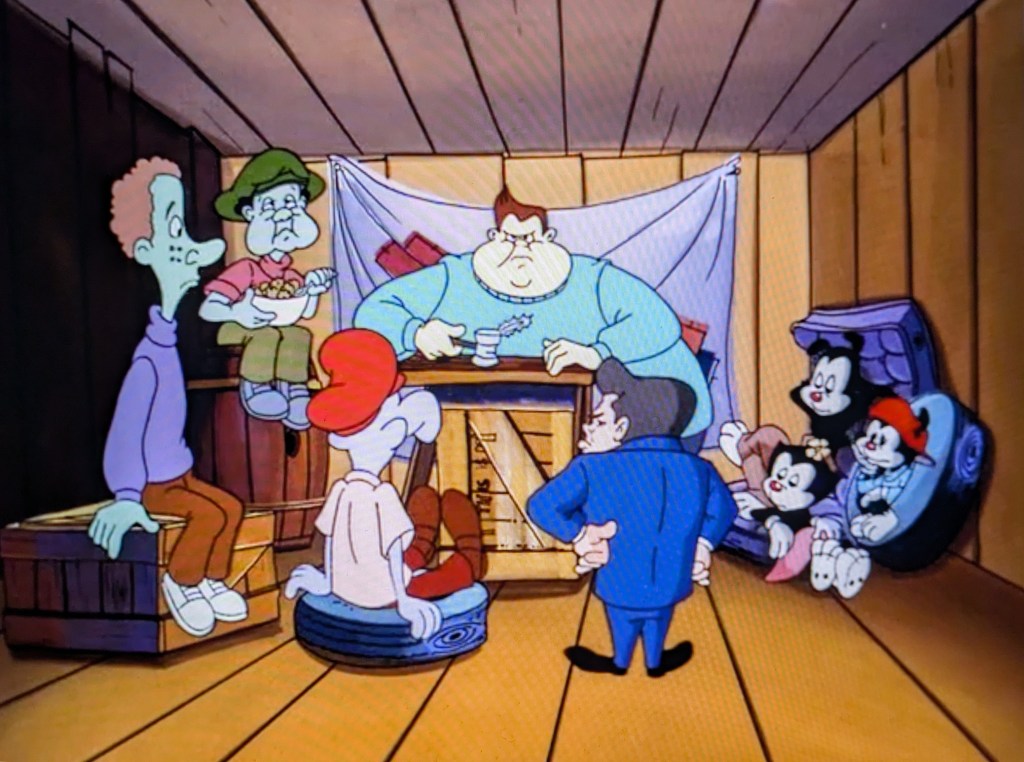
The Warners sit in boredom with Obese Orson and his unmoving gang (and Todd A-O) in their clubhouse. Image © Warner Bros. Entertainment Inc.

Plotz loses a costly gamble on another film starring Chicken Boo. Desperate for cash, Plotz has the Warners guest star on an episode of Thunderdogg, which has been sinking in ratings. They change up the show by stealing Thunderdogg’s magic feather and laminating it using the Gammalaminator, leaving him crushed by a heavy weight with a flattened lower body and legs after the show, while Sweet Polly Dognose is dropped into a tank of seawater and fed to a hungry seal by Simon Sam Simeon. After that, the Warners are loaned out to Phlegmation. Plegmation supervisor Lem Botchitt explains that they never did cartoons like the Warners usually did, and that the Warners fouled up that studio’s stock animation system something awful. The Warners find themselves in a “vast video wasteland” in an episode of Obese Orson, where they meet a morbidly obese boy named Orson, who says that he is going to chant a message to them. They prevent him from doing so, with Dot saying that they have suffered enough on Saturday mornings, and Wakko saying that they want to have fun. Orson takes them to a clubhouse, where he organizes a meeting with his friends: Gerald, Hooknose Harold (who chokes on his nose), Muttermouth and Todd A-O (who is in the show because of his funny name). Upon hearing that the Warners want to have fun, Muttermouth and Gerald reveal that they do not have fun. Instead, they prefer to preach pro-social values until they spew out of everyone’s ears and all over the ground. Orson bans the Warners from their territory, much to their delight. They bring in fun by rapidly kissing all the characters, who can’t move because of their limited animation. By this time, Warner Brothers eventually regains their profits, but Plotz neglects to inform the Warners about this, continuing to loan them out to other cartoons such as The Tro**kes. When the Warners learn of this, they return to the studio and beg Plotz to stop loaning them out. The CEO then explains that he intends to use the studio’s renewed profits to produce a follow-up film called Shamboo. Realizing that this is the same actor that starred in the box-office bomb Young Blood Squawk, the Warners destroy their loan-out contract and return to the Water Tower, kicking Shamboo out. They demand to not be called again until they can have their own network. As they play a game of cards, Yakko assures that they will be good for about 20 years.

Back in Style was written by Tom Minton and directed by Liz Holzman, the former of whom had worked as a storyboard artist at Filmation, Hanna-Barbera and Ruby-Spears. The main plot of this episode was loosely based off the time when Warner Brothers licensed several of their Looney Tunes stars (except Bugs Bunny, Speedy Gonzales and the Road Runner) to Filmation in 1972 for Daffy Duck and Porky Pig Meet the Groovie Goolies. Minton had also co-written the Mighty Mouse: The New Adventures episode Don’t Touch That Dial with Jim Reardon in 1988, which also involves a main character, Mighty Mouse, getting stuck in different television shows with limited animation.[104][105][101][102][106] Warner Brothers actually closed their animation department in 1963, but continued to release their last shorts until 1964. Chuck Jones was fired for working on Gay Puree at UPA before Warner Brothers’ animation department was closed in real life, and he spread a slightly inaccurate rumor that the animation department was closed in 1962 instead of 1963.[107][108] When Bugs Bunny and Daffy Daffy leave the studio, Bugs says that there is a flavored drink commercial waiting for them, to which Daffy says, “Wait up, Texth!” The Looney Tunes characters did, in fact, star in commercials for flavored drinks like Kool-Aid and Tang after the Warner Brothers animation department closed, with Tex Avery returning briefly to direct them. Friz Freleng erases Bugs’ head on a drawing and replaces it with that of a panther. Speaking in a voice exactly like Yosemite Sam, he tells Chuck Jones that he has an idea and Jones does not, then rushes off to turn the drawing into a cartoon of his own, titled The Gray Panther, leaving a frustrated Jones in the dust. Sam walks out, happy to point out that Freleng sounds like him. Freleng drawing the Gray Panther is a reference to him co-creating the Pink Panther character alongside Hawley Pratt, initially for the opening credits of the 1963 Blake Edwards film of the same name, but the Panther would then star in a series of short films produced at DePatie-Freleng Enterprises, which Freleng co-founded with David H. DePatie. As mentioned some minutes ago, Jones was fired before Warner Brothers’ animation department closed in real life. Freleng’s Sam-like voice and the latter pointing it out is a reference to many people who worked with Freleng finding him to be rather similar to Sam. Treg Green’s name is a reference to Treg Brown, the sound editor for Looney Tunes and Merrie Melodies. Malice Ovey’s name is a reference to animator Alex Lovy, who worked at Hanna-Barbera and Warner Brothers-Seven Arts. This episode features parodies of Hanna-Barbera (Phil and Schmoe), Yogi Bear (Calhoun Capybara), Scooby-Doo, Where Are You! (Uhuru, Where Are You?), Underdog (Thunderdogg), Gamma Productions (the Gammalaminator), Filmation (Phlegmation), Lou Scheimer (Lem Botchitt), Fat Albert and the Cosby Kids (Obese Orson), Mike Todd of post-production company Todd-AO (Todd A-O), The Beatles television show (The Tro**kes), “Day Tripper” (“Night Traveler”) and Beatles impersonators Bay City Rollers (the Tro**kes wearing kilts).[101][102][109][110][103] In Calhoun Capybara and Uhuru, Where Are You?, Hanna-Barbera sound effects are used to a moderate extent, as Yogi Bear and Scooby-Doo! were originally created by the latter studio. Also by that time, Hanna-Barbera officially became part of Time Warner, as its parent company Turner Broadcasting had merged with the latter nearly a year ago in 1996, in turn leading to its various properties becoming part of Warner Brothers in 2001. Additionally, Warner Brothers would assume production of new Scooby-Doo! material in 1999, beginning with Scooby-Doo on Zombie Island.[101][102][103] On the Variety newspaper saying, “Plotz’ Profits Thru Roof!” shown at the end of the Obese Orson scene, Microsoft Interactive is mentioned in one of the articles. Voices were provided by Rob Paulsen (Yakko Warner, Bristly (Shaggy Rogers) and Hooknose Harold (Old Weird Harold)), Jess Harnell (Wakko WarnerLew-Lew (Boo-Boo Bear), Ed Meisker the Third, Muttermouth (Mushmouth) and Tro**kes), Tress MacNeille (Dot Warner and Blanche Sewer), Frank Welker (Thaddeus PlotzChicken Boo, Ralph T. Guard, Narrator, Uhuru (Welker’s Scooby-Doo impression), Ted (Welker’s Fred Jones voice) and Lem Botchitt (Welker’s impression of Lou Scheimer)), Jim Cummings (Yosemite Sam, Malice Ovey, Calhoun Capybara, Simon San Simeon (Simon Bar Sinister) and Obese Orson), Greg Burson (Daffy DuckBugs Bunny and Friz Freleng), Jeff Bennett (Chuck Jones, Treg Green, ThunderdoggGerald (Bill Cosby (character)) and Todd A-O) and Gail Matthius (Phoebe (Daphne Blake and Velma Dinkley) and Sweet Polly Dognose (Sweet Polly Purebread)).[102][109][110] The episode was animated by Animation KOrea Movie Productions. It was originally supposed to air during Season 4, but it kept going through retakes because, ironically, AKOM kept making the animation too good when most of the parodies called for deliberately limited animation. This was also the last episode that AKOM animated for Animaniacs; Warner Brothers also never used them again for any series after this.[101][102][109][111][105][103]

Eric B stated, “All the spoofs were very good. They did good remakes of Ray Ellis’ Fat Albert score and Hoyt Curtin’s early 1960s score for the Yogi spoof and his The New Scooby-Doo Movies score for the Scooby spoof. DePatie-Freleng Enterprises was in there too, briefly, when the caricature of Freleng changes Bugs Bunny into the “Grey Panther”. This truly was the “Silver Age” of Warner Brothers cartoons; exactly what made the Golden Age so great! Too bad it was so quickly yanked away from the home of the golden age cartoons. And with the current policy of Warner Brothers making a not-so-integrated Turner company pay to air Warner Brothers properties, it probably won’t make any sense to try to get the rights to it back. I think that the racial swap in Obese Orson was just to support the spoof, and not for any sensibility or anything. If they made Orson and the others black, it would be too close to Fat Albert and take away from the humor of it. (And then the other characters; two of which are very close to original Cosby Kids, they just made racially neutral with green or purple skin). Also, I too didn’t understand the gag with the guy with the “funny name”. I at first thought that was the other guy in control of everything (Plotz) since he was short and had on the same blue suit, but the voice was completely different (Plotz was Frank Welker). So I looked up “Todd A-O” and it’s actually the name of a post-production company founded in 1953, providing sound-related services to the motion picture and television industries, and also the name of the widescreen, 70 millimeter film format that the company was developed to promote and distribute. However, I still don’t quite get the joke, and why this guy named after this was suddenly stuck in the story there in the clubhouse. Was it a service that Filmation used often? I don’t remember seeing the name in any credits. Or was he really an Animaniacs supporting character? That’s what I was looking to see when I looked it up.”[109] Lou Scheimer himself mentioned the episode in his book Creating the Filmation Generation, and he seemed to have “had the power” (He-Man reference) to accept and handle the episode’s jab at Filmation and Minton’s criticism.[112] Tumblr user legion1979 of Hello, Nice Warners! said, “Back in Style is generally considered one of the highlights from the later period of the series. It’s easy to see why, since it gleefully stomps all over the limited animation style that became prevalent in the 1960s and 1970s. The cartoon is stuffed full of references animation aficionados would recognize, from the closure of Termite Terrace (Bugs and Daffy head off to star in a flavored beverage commercial) to parodies of shows like Underdog and Fat Albert and the Cosby Kids. Much like The Warners’ 65th Anniversary Special, the cartoon is treated like a documentary. We get several interviews with people who worked behind the scenes at the studios the Warners were loaned out to, many of them well past the point of senility. One animator at a nursing home proceeds to draw all over the walls with his feet, while another ends his interview by asking who the current president is. The clips are remarkably true to the shows that they are riffing on, and it’s been said that even AKOM (of all studios) had trouble to keeping the animation limited enough to mimic what Hanna-Barbera and Filmation used to do. The Calhoun Capybara cartoon has the appropriate simplistic backgrounds (which Wakko eats) and nonstop stock library music, while the Thunderdogg clip is particularly choppy and nonsensical. But the best is easily the Obese Orson sequence, which is a scathing commentary on just how terrible Filmation was as an animation studio. The entire segment is nothing but Orson and a group of Cosby Kid parodies sitting around a clubhouse talking, without moving anything but their eyes and mouths. None of the characters can do anything to stop the annoying Warners, since they have used up all the new animation (all three shots of it) just to get Orson to the clubhouse in the first place. A running gag involves someone named Hooked-Nose Harold, who is constantly choking on his own nose in a tight close-up. It is all unbelievably random and cheap, but that’s true of just about everything Filmation did. Writer Tom Minton had worked as a storyboard artist at Filmation (not to mention Hanna-Barbera and Ruby Spears) in the 1970s and 1980s, so all of this material must not only have been easy for him to write, but cathartic as well. But unfortunately, there is one element that, at least to me, does not work all that well. While the joke is that the Warners do not belong in any of these low-budget cartoons, they appear incredibly bored and lifeless throughout the whole thing. Very little of what they do is actually funny; Wakko eats some background overlays, they steal Thunderdogg’s magic feather and laminate it (why?) and bring Todd A-O into Orson’s clubhouse because he has a funny name. While the writing for the Warners definitely seems weak, what really hurts them is the animation. AKOM does a great job on the parodies, but their Warners are as bland as they usually are, when they really should be full of life and energy in order to contrast against the limited animation of the other characters. Instead, they tend to come off as flat as everything else that they are interacting with. Even a lot of their dialogue seems phoned in. Just imagine what this cartoon would have looked like if Wang had animated it, treating the parodies the same way that they are handled here, but working with the Warners in their usual snappy, fuller style. Fortunately, this cartoon is also the very last one animated by AKOM, and even with its faults, it’s still miles ahead of their previous batch of awful Warners cartoons. Despite how the Warners look, the studio really went the extra mile to make the limited animation parodies as authentic as possible. It’s nice that the studio was able to go out on a decent cartoon like this, as a good chunk of their work on this show usually ranged from average to terrible.”[101] DeviantArt user SofiaBlythe2014 stated, “If there’s one thing that can be said about television, corporate meddling can be problematic sometimes. I mean, you poor in all that hard work and sweat into the show only to be given the boot, or told to extend your show, because some people are too greedy. That’s not right. But we’re not alone in that. The Warner siblings feel the same. In this episode, the Warner siblings get temporarily sent to different television shows when the studio is closed down. We have a lot of funny, over the top moments from Yakko, Wakko and Dot. This cartoon features parodies of Yogi BearScooby-Doo!UnderdogFat Albert and the Cosby Kids and The Beatles television show, which are all awesome. It was cool to see the Warners play off the other characters. You definitely feel bad for them, and want to see them succeed. That ending was top notch. It’s a good episode.”[113] LuciferTheShort gave the episode a negative review, calling it “the absolute worst short from Animaniacs“. He said, “I understand that the Warners being annoying tricksters who are not above inflicting cartoonish injuries on other people is pretty much the point of their cartoons, but it only works if the people they annoy or harm did something to justify their actions. And the only conceivable offense that the unflattering parodies of Yogi BearScooby-Doo!Fat Albert and the Cosby Kids and Underdog could have possibly committed would be the simple fact that they are cartoons that were not made by Warner Brothers, and I consider it very petty to make digs at the competition (I know that the rights to Yogi Bear and Scooby-Doo! both belong to Warner Brothers now, but Hanna-Barbera was still a separate entity from Warner Brothers at the time). The absolute worst moment of the episode for me, however, was in the Underdog spoof, especially since I saw some Underdog cartoons when I was a child. Thunderdogg sees the equivalent of Sweet Polly Purebred about to be dunked into a tub by a parody of Simon Bar Sinister, but the Warners interfere and take away his magic feather before he can use it to regain his strength, resulting in the Polly ersatz being eaten alive by some manatee-like creature and Thunderdogg being squashed flat by the weight he was carrying. Now, one might at first assume that this was only how it happened in the filming of the episode and that Thunderdogg and Sweet Polly Dognose were none the worse for wear after their encounter with the Warners (after all, being crushed by weights and eaten alive were both things that already happened regularly on the show before), but in the present day Thunderdogg is shown to have never recovered from the injury when he opens his bathrobe to reveal his lower body still squashed and perched upon a stool. This gives the horrific implication that in bungling Thunderdogg’s rescue attempt, the Warners did not just cripple the canine hero for life, but also indirectly killed his significant other. I’d be a lot happier if cartoon parodies were not always slipshod potshots.” Anthone795 commented, “After seeing the Back in Style cartoon, I quite agree. I mean, look how sad all the characters from Looney Tunes (Porky, Daffy and Bugs) are when have lost their jobs after Warner Brothers had closed down their cartoon studio for good. That episode was the worst I’ve ever seen in my entire life. It made me think about my mom’s restaurant, the Safari Dining Room in Atlantic City, which closed its doors forever on October 27, 2012.”[114] wileyk209zback/Zak Wolf gave the episode a positive review, saying, “Really funny stuff, I will say. For the most part, the Warners are quite bored being in these television cartoons, so they don’t get to do much of their usual schtick, but what makes it funny is how the cheesy animation and writing are parodied. The overseas animation was done by AKOM, whom did a pretty good job for the most part at mimicking each cartoon’s style. Though I think it may have been better if they got Wang Film Productions to animate it. Seeing as Wang originally started out in the late 1970s as a satellite animation house for Hanna-Barbera (very much like the ones they had in Australia and the Philippines), I that bet Wang could have nailed Hanna-Barbera’s limited animation style very easily. Though ironically by the 1990s, Hanna-Barbera’s animation was often getting less and less limited and cheesy (with a few exceptions, like Scooby-Doo! in Arabian Nights and its wonky animation), as they were getting bigger budgets to work with, and had to step up its game due to their competition improving in animation quality as well (it was Disney’s Gummi Bears and DuckTales that helped make way for high-quality television animation). Now I will point out that Warner Brothers Animation did briefly reopen in 1967, but their cartoons focused much less on their popular stars and more on new characters like Cool Cat, and also looked more like Filmation or Hanna-Barbera cartoons than classic Warner Brothers animation (kind of ironic here, huh?). As for loaning out the Warner siblings, this obviously appears to be inspired by the time when Warner Brothers “loaned out” their Looney Tunes stars (sans Bugs Bunny) to Filmation for Daffy Duck and Porky Pig Meet the Groovie Goolies in 1972. The Tunes had to be adapted to limited animation (Daffy already had experience in the 1967-1968 Speedy Gonzales cartoons Warner Brothers Animation produced at that time), and for the most part it was a mess, but I find it to be a “so bad it’s good” kind of deal. Maybe that was why this Animaniacs episode really bashed Filmation here? Whatever; it was still really funny!”[102] JCFanfictions gave the episode a negative review, saying, “Animaniacs is a good show, but there are shorts that I hate, like this one, which is part of the first episode of the final season. Done in the form of a documentary, the short tells of a time when Warner Brothers closed its animation studio. As the beloved characters are fired, Mister Plotz decides to release a film called Young Blood Squawk starring Chicken Boo, but when it bombs (resulting in a riot), and the studio is in financial crisis, Plotz starts lending the Warners (who were locked in the Water Tower ever since the studio closed) to other companies, and this is where it gets bad, as the short basically shows the trio causing chaos on the sets of cartoons that are blatant parodies of other cartoons (and this was before the Warner Brothers-Hanna-Barbera merger). The parody characters get hurt by their antics, with Thunderdogg being permanently disfigured and Sweet Polly Dognose being eaten alive, which is very out of character for the Warners, since their chaos is not supposed to be mean-spirited. And all the while, Plotz makes money off their chaos, with no consequence to the damage that they did (possibly because of a clause in the contract). The bashing of other cartoons is uncalled for. Also, Thunderdogg’s voice sounds too close to Gogo Dodo, which makes his line annoying for my ears to tolerate.”[114][115] Michaelsar commented, “While I do not hate this short, I agree that the ‘Warners keep the Underdog parody from saving the day’ scene is pretty mean-spirited.”[116] Mike Clemente of MC ‘Toon Reviews gave the episode an A-, saying, “In addition to poking fun at how limited and low-budget early 1960s and 1970s animated shows were, this cartoon is also an inventive way of building the Warners’ background. It is all an interesting way of incorporating real life animation history, but part of it also takes out a lot of the animated fun that defines this series. Regarding the Warners’ role, I feel mixed. First, there are a few contradictions of established facts about them. It has been constantly said that their cartoon careers ended long before this period with them sealed in the Water Tower in the 1930s. Also, despite taking being locked in the Tower well and enjoying the few times they were let out for fumigation, here they act tortured through the loaning process. In addition, it was shown not long ago that they were loaned out before to star with a parody of Fleischer cartoons and they took that reasonably well too. At the same time, they do succeed in pulling off hilarious riffs on how cheap cartoon production values were in this period, showing that they still have comedic strengths. They first go after easy 1960s animation targets in spoofs on Hanna-Barbera shows. In a Yogi Bear parody, Calhoun Capybara, they mock the simplistic dialogue and flat background overlays as they go after Calhoun for trying to poach picnic baskets lunchboxes. In a Scooby-Doo! parody, Uruhu, Where Are You?, they ignore the boring talk of a mystery at hand to ride the dog. Going beyond Hanna-Barbera, the Warners are loaned out to other cheap cartoons. An Underdog parody is stripped of his McGuffin which gets him crushed and his bland girlfriend eaten. A Fat Albert parody is mocked for characters saying that they are going to have fun, but they just sit around and talk about boring stuff. These are all clever honest jabs at corny and cheap styles, but there are a few things holding it back. In addition to the Warners looking truly pained by the loan-outs, there are realistic repercussions to their antics. There is a mention of Uruhu being sent to the vet because of them, and the Underdog parody getting seriously injured after they let him get crushed. If they are cartoon stars, shouldn’t they easily be able to shake off any pain and not be dismembered for life like this? Things like this make the cheapness gags harder to enjoy than they need to be. For that it is practically refreshing when the Warners hear about Warner Brothers’ profits being through the roof and stop the process completely. All they have to do is tear up the contract and kick Chicken Boo out of their tower, and soon they will have their own network, the Warner Brothers channel as we know it. If you can’t get into cheap 1960s shows for their half-hearted scripts and lame production values, this is a solid watch. However, for how real it frequently makes the physical and emotional pain of others, its way of doing so is fine, but not the best way it could be pulled off.”[117] Kevin Johnson of The A.V. Club stated, “Back in Style sees the Warner siblings loaned out to a variety of animation studios, letting the writers poke fun at the limited animated television programs from the 1950s through the 1970s. The reach of the shows parodied is impressive. Sure, they do the obvious ones like Yogi Bear and Scooby-Doo!, but they also get at UnderdogThe Pink Panther, and Fat Albert and the Cosby Kids, while also showing caricatures of creators like Friz Freleng and Chuck Jones. The broad jokes toward that era of animation were nothing new in 1997, but the visuals and funky narratives were effective, and even the Warners themselves are unable throw off these classic animated worlds. The bit still dips into lazy humor at times (the Fat Albert kids talk very explicitly about how limited they are in animation), but overall, it stays on the right side of mean. The loan-out documentary format adds some historical winking cleverness as well. Even at this point, when the show had a target in its sights that it really grasped, it went all out.”[118] TetsuKnife reviewed the episode, saying, “I honestly hated this segment in Animaniacs. Yeah, it’s technically funny, but given how all the Amblin amimated shows from the 1990s used OUTSOURCED animation on Spielberg’s company’s dime, where the heck do they get off making fun of television-budgeted cartoons from yesteryears? This entire episode, whether it’s making fun of Yogi BearUnderdog or Fat Albert, just came off as a bunch of rich kids making fun of destitute children for not having wealthy parents like they did, while flaunting their animation quality. It all just seems hateful, and for what? It’s like the Saturday Night Live parody episode of Tiny Toon Adventures where they have Tress MacNeille voice a caricature of Bart Simpson, imitating his voice actress Nancy Cartwright, and the entire episode is just the toons beating him up, and THAT’S the joke. (And to be clear I’m not saying you CAN’T make fun of these shows, just don’t aim below the belt.)”[110] Dinobolt1 commented, “To me it was not that they were making fun of themselves but more of a series of bitter jabs at Hanna-Barbera, Filmation and Total Television. I thought that this sounded like a great episode, but when I watched it, for the most part I found the parodies to be too mean for me to enjoy. I did like the animation styles, but this is not what I thought it would be. I was expecting that we would just cut between the Warner siblings’ exploits in various other cartoons going along with the script but making jokes about the animation and the writing, not tormenting the characters for no good reason from the audience’s perspective. The Warner siblings are supposed to only be annoying characters who deserve it, like Dracula or the devil. The episodes with Mister Director worked for me as a kid even before I knew who Jerry Lewis was, because he sounded so pretentious that it was hilarious to see him get smacked around. Here Warner Brothers was like, “These shows are so lame, our characters are so much better!”, and just focused on the superficialities of them making these seem like cheap caricatures. The Underdog parody was the worst, because it made no sense why they took away his feather and Thunderdogg should NOT have been permanently crippled after that. He is a cartoon character, so shouldn’t he go back to normal eventually? Brain has been literally reduced to ashes, but he recovered instantly, so why the heck wouldn’t somebody merely squashed flat recover too? It is pretty bad when a cartoon is very selective about who cartoon logic applies to. Obese Orson was my favorite because it was exactly like what I thought the episode would be like, and the jokes were not that mean. But as a whole, this just came across as wasted potential. There were so many other ways they could have made it funny; I am especially disappointed that they did not even face a monster in the Scooby-Doo! parody. They could have annoyed the monster or commented that it’s obviously a guy in a costume. I like Scooby-Doo! but my favorite series are the later ones like The 13 Ghosts of Scooby-Doo (which Tom Ruegger worked on), Scooby-Doo! Mystery Incorporated and Be Cool, Scooby-Doo! These all bring something new to the table, and the episodes stand out more from another, especially 13 Ghosts, which is more than I can admittedly say for the original series. The Power Rangers parody Super Strong Warner Siblings was vastly superior to this episode because it does what the best parodies should do. It did not exaggerate the flaws of what it was making fun of, it merely held up a mirror to them.”[119] That Dude commented, “I do not really agree to that Animaniacs episode since they were bashing Hanna-Barbera and even Gamma Productions for no real reason other than to say, ‘Look, cheap cartoons, therefore, bad! Aren’t we relevant?’ I mean, if the whole episode was to trash on Filmation, then it is whatever since they are a nobody studio compared to Hanna-Barbera.”[120] While Back in Style has some funny moments, in terms of story I do not like the fact that the limited animation parodies are not particularly affectionate, instead feeling more like bitter jabs. The Warners are usually karmic tricksters, but in this episode, even though they are loaned out against their will to the other studios by Plotz and confront and beg him not to do it again at the end, they are mean-spirited and do nothing but insult, humiliate and injure the cartoons’ main characters unprovoked. The worst offender would be in the Underdog parody, Thunderdogg, where they prevent Thunderdogg from rescuing Sweet Polly Dognose and cause him to suffer an injury that leaves his lower body deformed for life. Filmation (Phlegmation) and Fat Albert and the Cosby Kids (Obese Orson) also seem to particularly get the worst of the parodying, due to Warner Brothers licensing the Looney Tunes to Filmation for Daffy Duck and Porky Pig Meet the Groovie Goolies, and the Lou Scheimer parody’s (Lem Botchitt) surname is clearly a harsh play on “botch it” as in “producing bad television animation”. As a result, Filmation would eventually be sometimes mimicked as “Phlegmation” by people like wileyk209zback/Zak Wolf. The Joseph Barbera parody’s name (Schmoe) is a pejorative term meaning “stupid” or “foolish”. The only known recollections of the real Barbera acting this way during his lifetime are when he was being a braggart and criticized Ed Benedict’s character designs for not looking cute enough at Hanna-Barbera,[121] agreed with and shared John Kricfalusi’s dislike of Scooby-Doo! and other modern cartoons of the time (he actually pretended to agree just to be on Kricfalusi’s good side),[122] agreed with the executives at Universal Pictures to replace Judy Jetson’s voice actress Janet Waldo with Tiffany for Jetsons: The Movie (though he did apologize for it at Don Messick’s retirement party),[123][124][125] and Dennis Marks and other writers taking dictation from Barbera every day.[126][127] The Alex Lovy parody’s (Malice Ovey) first name is a noun meaning “a desire to cause pain, injury, or distress to another, or the intent to commit an unlawful act without justification”, with the gag where he draws on the wall with his feet unfairly poking fun at Lovy’s work at Hanna-Barbera. It does not help that Don’t Touch That Dial, which was co-written by Minton, makes fun of The FlintstonesThe JetsonsScooby-Doo, Where Are You! and The Real Ghostbusters through widely inaccurate parodies. It also comes across as preachy because it ends with the message that Mighty Mouse: The New Adventures is good and all the other cartoons (and to a lesser extent, television in general) are bad.[128] Not all limited television animation is bad, and it has gotten better during the Renaissance age. To quote John of the Central Rappahannock Regional Library, “High-quality writing could make up for low-quality production. For example, The Adventures of Rocky and Bullwinkle and Friends was noted for clever humor and subversive writing that made it popular with teenagers as well as kids. Filmation’s Star Trek: The Animated Series employed many talented writers, including Larry Niven, to create its scripts. However, shows such as these tended to be the exception rather than the rule, as many television cartoons from the Dark Age tried to be as inoffensive and bland as possible to avoid angering parents’ groups.”[129] Ralph Bakshi rose to prominence during the 1970s and 1980s thanks to his breakout adult comedy hit Fritz the Cat, followed by The Lord of the RingsHeavy TrafficAmerican PopFire and Ice and Heavy Metal. All these films, along with Watership Down, proved that cartoons were and are not always for children. Fortunately, the Warners are shown to get along with the Beatles parodies, the Tro**kes, and do not insult, humiliate or injure them (interestingly, Wakko’s Scouse accent was inspired by The Beatles drummer Ringo Starr). There was a series of 1997-1998 Cartoon Network bumpers where the Warners run through various programs and interact with the characters within, including Hanna-Barbera’s Scooby-Doo, Where Are You!The FlintstonesThe SmurfsThe Snorks, and The Jetsons. In Scooby-Doo!, they disguise themselves as the Zombie and Witch (from the episode Which Witch is Which?) and exclaim, “Hello, Daphne!” upon being unmasked by Velma Dinkley, much to Daphne Blake’s confusion. Scooby-Doo runs away from Wakko, who says that he just wanted some Scooby Snacks. During his search for the snacks, he finds Velma’s glasses, to which Dot emerges from behind a door saying, “Jinkies!”[130][131][132] One of the bumpers features Slappy Squirrel interacting with Jonny Quest.[133] The Animaniacs reboot episode Suffragette City contains cameo appearances of actual Hanna-Barbera characters like Yogi Bear, Boo-Boo Bear, Huckleberry Hound, Snagglepuss, Auggie Doggie, Doggie Daddy, Yakky Doodle, Ricochet Rabbit, Magilla Gorilla, Secret Squirrel, Fred Flintstone, Barney Rubble, Wilma Flintstone, Betty Rubble, Pebbles Flintstone, Bamm-Bamm Rubble, the Great Gazoo, George Jetson, Penelope Pitstop, Speed Buggy, Mark, Tinker and Debbie.[133] Considering that the Warners do not injure Mystery Inc. when showing up in Scooby-Doo! in the bumpers, and Dot rallies the Looney Tunes and Hanna-Barbera characters to march for their cartoony rights to vote in the episode, she and her brothers seem to be nicer toward them than the parodies.

With all that said, what happened to Filmation in the end? Well, the studio was closed and sold to L’Oréal’s Paravision International by Westinghouse on February 3, 1989, nine years prior to Back in Style‘s airing.[134] Filmation may have given creative job titles and produced shows with limited animation, but that does not mean that they mocked animation or destroyed its legacy. According to Brian Camp of Cartoon Research, Lou Scheimer ran Filmation like a family and encouraged collaboration and sharing of ideas.[135] In the documentaries The Magic of Filmation (2006) and Animation Maverick: The Lou Scheimer Story (2008), Scheimer, director Hal Sutherland and numerous animators and writers who used to work for Filmation speak eloquently and enthusiastically about their tenure there. Filmation had a somewhat small staff, and tried to make the best programs they could for the budgets they were afforded, keeping all the work in the United States of America, whereas other studios would increasingly outsource the work off to Asia and a few other places. Not all of Filmation’s dialogue, jokes and gags were literal-minded, and even if they were, the writers genuinely made an effort to try to entertain the children watching back in the day. They even made a number of attempts to rise above the standard animated fare and produce good shows such as The Archie ShowSabrina and the Groovie GooliesFat Albert and the Cosby KidsStar Trek: The Animated SeriesThe New Adventures of Flash GordonHe-Man and the Masters of the UniverseShe-Ra: Princess of Power and BraveStarr. Chuck Menville and Len Janson wrote episodes for some of these shows, as well as ones not made by Filmation and considered the best Saturday morning cartoons, such as The Flintstones Comedy HourHong Kong PhooeyThe Smurfs and Sonic the Hedgehog (SatAM). Filmation also included “pro-social values” and post-episode public service announcements in most of their shows, just as a matter of principle, because Scheimer and company took their jobs as children’s entertainers seriously, not just to deflect criticism of shows like He-Man and Bravestarr being half-hour toy commercials. Their richer backgrounds made up for the limited animation and, in Eric B’s words, “are part of what made the shows memorable”. Despite the limited quality of their output and their strict “on-model” policies, there were a few animators who tried to do better, including Tom Sito and Eddie Fitzgerald. In their later years (1979-1989), Filmation made usage of smooth and fluid animation in their work, such as The New Adventures of Flash GordonFlash Gordon: The Greatest Adventure of AllPinocchio and the Emperor of the NightBraveStarr and Bravo! In Flash Gordon‘s case, this proved that given the chance and the budget, the studio really could deliver animation worthy of the big screen. The studio also utilized new techniques, such as rotoscoping athletes for running, jumping and swimming scenes, and moire backlighting effects for lasers and energy fields. It is just sad to me that the studio is continuously bashed and dismissed solely as one with subpar animation and sanitized stories to this day, and its productions were in limbo in the early-to-mid 2000s, even after its closure in 1989 and Prescott and Scheimer’s deaths in 2005 and 2013, respectively.[136][137][138][139] Such examples of criticism include Trevor Thompson confusing the writers with the animators and calling them “hacks”; the studio sometimes being referred to as “Phlegmation”,[136] Don M. Yowp calling The Archie Show “wretched”[140] and refusing to watch cartoons on Saturday mornings because of the studio,[141] Mark Kausler calling the studio’s work “utter junk that doesn’t deserve preservation”, with Thad Komorowski of Cartoon Research agreeing and calling the studio “evil”;[142] Pembroke W. Korgi angrily shouting, “SCHEIMER!!!” in some of his videos focusing on Filmation’s shows,[143] criticizing Frank Welker’s female voices in The New Adventures of Mighty Mouse and Heckle and Jeckle and The Tom and Jerry Comedy Show, unkindly and jokingly calling the late producer’s son Lane Scheimer “LAME Scheimer” for his poor voice acting for Sport Billy and seeing that as nepotism (Pembroke would later admit in 2024 that Lou Scheimer would hire his family members, including Lane, to do voices in Filmation’s shows mostly on the cheap and not entirely due to nepotism;[144] he would also apologize to Lane for calling him “LAME Scheimer” and say that he does not deserve that, and remember that Lane’s Billy voice was sped up slightly to sound like a kid in the first Sport Billy episode Joust in Time, then the editor, Joe Gall or Robert Waxman, forgot to speed up the voice for the rest of the episodes;[145] Corinne Orr did a somewhat better job at voicing Billy in the Peter Fernandez feature film/redub),[146] and childishly overreacting to the idea of Hal Sutherland’s son Keith Sutherland, Lou’s daughter Erika Scheimer and Lane voicing Ben Turner Junior, Susan Turner, Jackie Turner and Gene Fox in Lassie’s Rescue Rangers, seeing that as nepotism as well and Lane’s voicework as a “trigger” for his “bad memory” of Sport Billy (to be fair, the child actors’ voice acting in Lassie’s Rescue Rangers is not that bad, and Lane was a teenager when voicing Jackie and Gene Fox at the time, who are teenagers themselves);[147] Jarmel Rudd commenting that Sport Billy is “the only show from Filmation that makes [him] run, RUN very far away from Lou’s wrath”, James Irish making a cruel knock knock joke about the Lassie’s Rescue Rangers episode Deadly Cargo (“Car go beep beep and almost run Lassie over!”) to give Pembroke an idea of the mood that he is in (anger), screaming about using “dodgems” instead of “bumper cars” to keep his sanity, and indicating that Frank Welker’s female voices make him and Pembroke lose their sanity by saying, “Mercifully for us…” when talking about Joyce Bulifant’s roles in Sport Billy; and both preparing for war against Lassie’s Rescue Rangers before being told that they are covering Chip ‘n’ Dale: Rescue Rangers.[148] No offence, but Trevor, Yowp, Kausler, Thad, Pembroke, Jarmel and James’ dislike (love-hate for Pembroke) of Filmation and reactions just scream Hyde and Go Tweet Sylvester levels of cowardice to me.

*Written in Notepad.

A Political Cartoon

Peter President at his first press conference. Image © Odradek Productions/The Creative Film Society.

In the 1960s, three young filmmakers, James K. Morrow, Joe Adamson and David E. Stone, attended Abington High School in suburban Philadelphia, where they collaborated on each other’s films and films made by other students, some of which won awards.[1] Their films included In the Mist of Life (rated by the Los Angeles Free Pass as “film poetry of the highest order”),[2] It’s an Out of its Mind World,[3] The Man Who Owned America,[4] The Revenge of the Monster Maker, Cagliostro the Sorcerer,[5] and adaptations of Edgar Allen Poe’s The Tell-Tale Heart, August Derleth and Mark Schorer’s The Return of Andrew Bentley, and Samuel Taylor Coleridge’s The Rime of the Ancient Mariner,[3][6][5] which received an Honorable Mention in the 1964 Kodak Movie News Teen-Age Movie Contest.[3] In 1972-1973, they reunited to produce a 22-minute 16 millimeter short film, under the name “Odradek Productions”. They called it A Political Cartoon.[7] Morrow stated that the film was “another satiric sally against the American republic”, and saw it as “a ritualized attempt to rekindle [their] old The Man Who Owned America collaboration and maybe get it right this time”.[4]

Lance Mungo meets Bernie Wibble. Image © Odradek Productions/The Creative Film Society.

The short begins with Bugs Bunny campaigning on behalf of equal rights for cartoon characters everywhere, saying that fantasy is everybody’s business. At night, a political campaign manager named Lance Mungo enters a laundromat and meets an unemployed cartoonist named Bernie Wibble. Lance enlists Bernie’s aid in creating a vague-talking, innocuous cartoon character named Peter President and running him for President of the United States of America. After Peter’s election, people begin to have negative reactions to cartoon characters because of him, which includes Bambi being put in a zoo in Yonkers, Farmer Al Falfa being found on the street corner selling the Sunday Funnies, Betty Boop running a brothel in Levvitown, Krazy Kat being made into a tennis racket, and Bugs being put on sale at a pet store as an Easter Rabbit. Lance, Bernie and Peter attend a meeting with the Consolidated Commerce Conglomeration, who presents them their products, Panacea and Bubonics. The CCC CEO asks Peter to endorse their products and offers to use his likeness on them, but he firmly refuses. The CCC responds by selling all the India Ink back to India, rendering Peter catatonic. Lance enters the room with some ink, and he and Bernie attempt to revive Peter by transporting ink through a tube, only for the result to turn out unsuccessful. Bernie literally stares daggers at Lance, and takes his anger out on him by firing his guns and throwing a stick of dynamite. Lance has an idea just as the dynamite explodes, and decides that he and Bernie can reuse the latter’s animation of Peter for his next press conference. Later, the CCC hires two 1930s gangsters to kill Bernie. Bernie is taking a walk, eating ice cream, but notices the gangsters approaching him. He runs into a printing factory in order to escape them, and ends up getting turned into a comic book named The Wonderful World of Wibble, so Lance replaces him with a puppet master.[8][9][10]

Bugs Bunny campaigns on behalf of equal rights for cartoon characters everywhere, and declares that fantasy is everybody’s business. Image © Odradek Productions/The Creative Film Society. Bugs Bunny © Warner Bros. Entertainment Inc.

A Political Cartoon was written, produced and directed by James K. Morrow, Joe Adamson and David E. Stone, and was minimally financed and made on a shoestring budget in the Boston suburbs during Richard Nixon’s second inauguration.[7][1] The short starred Alex Krakower (as Bernie Wibble), Liam Smith (as Lance Mungo), Marshall Anker (as the Consolidated Commerce Conglomeration CEO), Allen Lieb (as the first Consolidated Commerce Conglomeration member), George Stapleford, Bob Kingsley (as the second Consolidated Commerce Conglomeration member),[1] Adamson (as one of the astronauts from Alpha Centuri, a news reporter, a mailman and the second gangster (voice)), assistant director Lindsay Doran (as a waitress), and Morrow (as the narrator, Bingo, Bongo, Peter President and other cartoon characters).[11] Morrow, Adamson and Stone shot principal photograph (all the Lance and Bernie scenes and the Consolidated Commerce Conglomeration) and the Panacea commercial on the campus of Drew University and around town in Madison, New Jersey. The living marionette at the end and the news conference were the only scenes shot in Boston environments (actually closer to Nashua, New Hampshire).[1] According to Bob Kingsley, the marionette was played by a 12-years-old girl, with a giant pinewood chair abetting the illusion where it manipulates its own strings.[12] Other pickups (aerial image animation, et cetera) were done in New York City and in State College, Pennsylvania (where Adamson was teaching at the time).[1] Stone designed and animated Peter President, as well as Bingo, Bongo, the astronauts and the other cartoon characters.[7] The astronauts were stop motion models filmed against a blue screen in a video transmission.[13] The original version of the script had Bugs Bunny as an old, withered, weathered rabbit with wrinkled eyes in a retirement home for cartoon characters, wheezing in an old chair, similar to Jedediah Leland in Citizen Kane. He would peer over his dark glasses and prod his febrile memory for recollections of tranquillity, saying, “Sometimes, I like ta see our old films on da television. I like ta see us, so young and everyt’ing. It’s hard ta remember back dat far.” For his parting shot, he would say to the interviewer, “On your way out, stop at da vegetable stand, will ya? And send me up a couple of good carrots. And tell ’em ta wrap ’em up ta look like cigars or somet’ing, or dey’ll stop ’em at da desk.”[12][14][15][16] Morrow, Adamson and Stone contacted Mark Kausler, an animator in Hollywood, to work on the scene.[12][17] He was the winner of the first Bobe Cannon scholarship to Chouinard Art School in 1968.[14] Mel Blanc was also willing to record Bugs’ voice for the scene.[12][7] However, Warner Brothers did not want Bugs to be shown as old. Morrow, Adamson and Stone protested that Bob Clampett had directed the 1944 Merrie Melodies cartoon The Old Grey Hare, which featured Bugs as an elderly rabbit, but Warner Brothers had not heard of Clampett or the short.[12][14][15][16] Because of this, a new scene had to be written, in which Bugs was painting Easter eggs at the Bugs Bunny Easter Egg Factory. He would say, “How about dis, huh?” while creating a beautiful, intricate design on an egg with only three strokes of the brush. He then added, “Only a cartoon character can do dat, ya know. You’d t’ink dat would be worth $1.75 an hour, wouldn’t ya? Oh, no! £93 a day and a pat on da nose. Tops!” Bugs would finally sigh, “It’s a rough life doc. I was talkin’ ta Daffy about it de other day. Ya t’ink it’s tough being a cartoon character. What do ya t’ink it’s like being a black cartoon character?”[12] Warner Brothers was finally agreeable to this scene, but now Kausler kicked. “You had a good scene,” he said. “It made me laugh and cry at the same time. It fit with your whole concept. This just makes me cry. It’s silly. I won’t do it.”[12][18] The scenes in which Bugs campaigns on behalf of equal rights for cartoon characters everywhere and is interviewed at the pet store were written and submitted to Warner Brothers, and were included in the final version of the short.[18] Blanc recorded Bugs’ voice for the scenes while in hospital with a broken leg. He propped himself up in bed and made about $300.00 for two minutes of work.[7][14] Kausler animated the scenes using an old model sheet by Robert McKimson, and painted the backgrounds as well, while Manon Washburn inked the celluloids. Kausler was only paid around $400.00 for the work.[16][14] The short also features cameo appearances from Mickey Mouse and Minnie Mouse (in a picture), Clarabelle Cow, Porky Pig, the Big Bad Wolf from the 1943 Merrie Melodies cartoon Pigs in a Polka, George from George and Junior, and Koko the Clown (as the cartoon characters revolting outside the White House); mentions of Dumbo (name suggestion), Bambi, Bosko (name suggestion), Betty Boop, Farmer Al Falfa, and Krazy Kat; and references to Sylvester the Cat (Narrator: “Paid for by Suffering (Sufferin’) Succotash, Washington, District of Columbia.”), “That’s all Folks!” and Snoopy (“Joe Cool” as a name suggestion). The short’s electronic soundtrack was composed by Harry Buch, and the basic sound effects were created by David Helpern.[7] At one point Stone and Adamson were in the editing room when the time came to cut the sound effects track for the scene in which Peter has lost his vital India ink, and Lance and Bernie desperately improvise an ink transfusion to save him. It was Stone’s idea to begin the process simply, by dropping in existing sound from outtakes, adding that to the sync production sound, which, according to Adamson, never would have occurred to him.[19] The scenes with the 1930s gangsters were achieved using a black-and-white reversal original, a scratched and violated dupe negative, a positive copy with printed dust slugged into the A-and-B rolls, a carefully filtered voice track, and a hissing, thumping crackle supplied by an elderly 78 record having its last fling in its final groove.[13][12]

A Political Cartoon was released on Video Home System by Kino Video as part of Cartoongate! in 1996. Image © Kino Video.

A Political Cartoon was distributed by The Creative Film Society on October 1, 1974.[18][2] It was exhibited at the Orson Welles Cinema in Cambridge, Massachusetts, was nominated for a Gold Hugo for Best Short Film at the Chicago International Film Festival,[20] and won the Francis Scott Key Award at the Baltimore Film Festival,[18][21] the Judge’s Prize at the Santa Barbara Film Festival, the Jury’s Prize at the Columbus Film Festival,[22] and the Audience Prize at the Midwest Film Festival.[18][22] Chuck Jones and Robert McKimson criticized Mark Kausler’s Bugs Bunny scenes, despite the fact that Kausler used McKimson’s Bugs model sheet.[14] The short was also broadcast on television in the 1980s. On September 24, 1996, it was released on Video Home System by Kino Video as part of Cartoongate!, a compilation reel of politics-themed animated shorts.[8][4][1] A rare Video Home System release of the short, signed by James K. Morrow and David E. Stone, was put up on eBay years later.[23] In 2017, Trevor Thompson, the self-appointed Looney Tunes Critic, reviewed the film and stated, “Toward the end of the film, Peter President gets too costly to keep animating, so Lance Mungo and Bernie Wibble reuse old drawings in an attempt to make a jab at crappy animation studios of the day, like Filmation. Apart from the two Bugs Bunny scenes animated by the brilliant Mark Kausler, the animation is pretty terrible. So when it gets to the part of the movie where they have to reuse drawings and the animation is supposed to be s****y, they have to hold on the drawings longer just to make it register visually that it’s deliberately s****y now.”[24] No offence to Trevor, but Lance and Bernie reuse Peter’s drawings for his next press conference because of his death from ink loss. The reused Peter drawings and the “crippled ventriloquists” scene are actually jabs at limited animation in general, not at “crappy animation studios like Filmation”, and the animation is “pretty terrible” because the short was an independent film made by three young filmmakers (Morrow, Joe Adamson and Stone) on a low budget.

*Written in Notepad.
**To be liked by TheEnlightenedMind622.

Cubitus Chronicles: The History of Dupa’s Big White Dog

Dupa. Image © Le Lombard.

Born in Montignies-sur-Sambre Luc to painter André Dupanloup on 12 February 1945,[1][2] Luc Dupanloup became interested in comics during his late teenage years in 1963.[3] He studied at the Academy of Fine Arts in Brussels between 1964 and 1967.[4] After graduation, Dupa met Michel “Greg” Régnier, who was working as a chief editor of the weekly comics magazine Tintin, published by Le Lombard.[5] At first he arrived with a folder under his arm, but was turned down. He returned a week later with a folder full of new drawings,[6] and became Greg’s assistant, working as a background artist on Zig et Puce and Achille Talon, as well as Fifi, Fleurette, Luc Junior, Tootsy, and Constant Souci.[5] He also worked with Daniel “Dany” Henrotin on Quentin Gentil and Les As.[7] In 1968, Dupa, aged 23, was asked by Greg to create a character to fill an empty page in the April 16 issue of Tintin. He drew a large ball of white fur with four legs, hair covering a pair of eyes, a black nose, and a yellow pom-pom-like tail, eventually creating a bobtail dog. Since dogs were known to love bones, he named the character after the “cubitus”, an old anatomical term for the ulna bone in the forearm. And thus, Dupa’s most famous creation, Cubitus, was born.[16][5][6][8]

Cubitus on his first Tintin cover on May 21, 1968. Image © Le Lombard. Cubitus © Dupa/Le Lombard. Tintin and Snowy © Hergé/Le Lombard.
Cubitus strip from issue 16 of Tintin. Image © Dupa/Le Lombard.
Sémaphore’s debut in Cubitus strip 57. Image © Dupa/Le Lombard.
Dupa poses with a mascot costume of Cubitus. Image © BELGA.

Cubitus immediately gained popularity upon its debut.[9] It was a surreal gag comic strip, showing Dupa’s talent for wordplay, with each strip consisting of one page. The titular character was a clumsy dog who initially lived in a suburban house with a young boy named Marcellin as his master.[10][11][12][13] In the first strip, Cubitus sleeps and only utters a grunt (“Gnorf!”) in response to children speaking to him, like Marcellin and his neighbor Dorothée.[14][13] The pessimistic Dorothée tries to give orders to Cubitus, such as “run”, “bark”, “jump” and “attack”, but none of them work. Marcellin optimistically describes him as “an intelligent and very up-to-date dog” and asserts that he (Cubitus) responds normally and a dog has only one master. He gives Cubitus the order “sleep”, the only one that he wants to hear and obey. The strip essentially depicts a struggle for authority between master and slave, posing the dialectical question of “Who dominates whom?” The question would always be left unanswered since Cubitus would retain a large element of animality, explaining both his taste for chewing bones and the great outdoors, as well as his dislike of cats,[14] like Sénéchal, a mischievous black-and-white tomcat and his arch-enemy who lived next door.[10][15][16] However, he would never completely be a normal dog, as he would speak human language (beginning in the second strip) and stand on two legs (already on his first Tintin cover on May 21, 1968).[14] He would also sometimes be accompanied by a little yellow canary.[17] On June 17, 1969, Sémaphore, a retired sailor, was introduced in the 57th strip as Cubitus’ master, although the relationship of master and dog would sometimes be reversed. The strip begins with Sémaphore leaving a dental office, holding Cubitus on a leash. The master, having received medical instructions not to open his mouth, therefore only emits muffled sounds (“Grompf!”). A police officer appears to chat with the pair, but he gets no articulate response from them. Annoyed, he reproduces a sequence of imperatives similar to Dorothée, except that his orders of “You, stand,” and “You, sit,” are immediately obeyed. This reversal of the roles of master and dog illustrates the theme of the physical resemblance between the two protagonists with big white mustaches. The officer concludes, “There you go! I like it when the logic of things is respected! They don’t know what else to invent to annoy the police! The master who plays the dog and vice versa! I’ve seen it all! With a mustache like that, he is a griffin!” As Dupa would later state, “The master and his dog form a pair of matching companions where it is not clear which one is ultimately the most animal. Cubitus is obviously the strongest, but he leaves Sémaphore with the illusion of being the boss.”[18] Sémaphore’s role in the comic is mainly to create inventions intended to be functional and aid Cubitus and others, but this leads to trouble in the end. He also has a passion for vintage cars and motorcycles, inspired by that of Dupa, and has his own motorcycle, Titine. It would later be revealed that Sémaphore gave Cubitus his name in reference to the ulna bone that he used to urinate on when he was just a few days old. He is also supposedly Marcellin’s uncle, as Marcellin calls him “Tonton” (“Uncle”) in one strip.[6][15] Cubitus and Sénéchal became more “human” and anthropomorphic, gaining the ability to walk on two legs, have hands instead of paws, and being able to perform any human action, although Cubitus would retain his love of bones. The hair covering Cubitus’ eyes would also disappear, revealing his now-good-natured yet mischievous personality. His favorite hobbies are eating, sleeping and boxing, using Sénéchal as a punching bag. Cubitus can also be very scrupulous and snobbish, especially when it comes to food, and will sometimes wear glasses and read novels. Running gags in the comic include not only Cubitus and Sénéchal’s rivalry, but also Sémaphore trying to make Cubitus behave more like a normal dog or get into the bath tub, and Cubitus trying to steal food.[6][10][15] One of Cubitus’ interesting characteristics in the series is his awareness of being a character in a comic, or rather a “comic book hero”. He also knows his creator, Dupa, very well, whom he often reproaches for all the setbacks that he suffers during his adventures, with expressions such as “Dupa, tu me paieras ça!” (“Dupa, you’ll pay for this!”) or “On me dupa!” (“I’ve been duped!”). Dupa himself even makes appearances in the comic, sometimes participating in the gags and providing explanations to the story. The humor, art style, and universe of Cubitus were inspired and influenced by that of Greg’s Achille Talon; both have the same setting, suburban house, and antagonistic relationships, with the trio of Cubitus (the hero without a quest), Sénéchal (the unpleasant villain) and Sémaphore (the liberal authority figure benevolently watching over the hero) being reminiscent of Achille Talon, Hilarion Lefuneste and Papa Talon.[14][10] Dupa also made references in his comic to history, old films and other comic strips, including The Beatles, the Marx Brothers, Tintin, The Adventures of Blake and Mortimer, Popeye, Bécassine, Georges Méliès, and King Kong. When asked about his references, Dupa admitted to doing very little research, despite his adoration for collecting cars, motorcycles, scale models, and “anything to do with the Second World War” (he also had a dislike for traveling, flying, vacations, and free time[5]). He appreciated Pierre Perret, Marcel Pagnol, the Marx Brothers, Walt Disney, and Tex Avery, as well as stories by the Countess of Ségur and about science fiction, citing them as additional influences. Dupa stated that when he would begin writing and drawing a Cubitus strip, he would structure the gags in a way similar to how the Marx Brothers structured theirs. He was also inspired by his reading skills and love for comic strips. Most journalists who interviewed Dupa were surprised not to find any physical resemblance between the artist and his character, and so began seeking moral similarities. Christian Sonon described his visit to Dupa’s home in an article in the Belgian daily newspaper Le Soir, “Beware, strange dog!” Many journalists and historians were overcome with doubt, wondering if Dupa had fooled them, and if he and Cubitus were one and the same. Dupa himself willingly lent himself to the game of assimilation (being likened) to his character, convinced that a comic character is a parody of a real, exaggerated physical type. According to Dupa, “I suppose it’s a projection of me, morally if not physically. For Cubitus, the simplest things take on the magnitude of problems, and that’s my case. He’s naive, and so am I. He likes good things, and I’m greedy. Voilà!” Dupa did not pose as a master for the character of Cubitus, but preferred to see him as an alter ego, naturally chosen from the domestic species of man’s best friend. He stated, “Cubitus, he’s a great friend, I imagined him as I wanted a friend to be.” This relationship of equals raised a philosophical questioning that did not escape him. Interviewer Yves Duval summarized the artist’s explanation that Cubitus therefore has a double identity, man and dog, that could be used according to the circumstances.[19]

Other recurring characters in the comic include Médor l’escargot, a snail who follows Cubitus practically everywhere and is said to secretly have a crush on him; Ventenpoupe, an old friend of Sémaphore and an intruding crook and swindler; Victor, a highly sophisticated and omniscient computer with caterpillar tracks and an antenna, who can speak and has an extraordinary capacity for analysis and prediction; Manuel de Cotalos Y Mucho Gusto, the friendly yet bothersome ghost of a former racing driver of whom Sémaphore was a huge fan as a child, driving the Douze litres DeValpo (Twelve-Litre DeValpo), who falls in love with Titine and decides to settle in its sidecar; and Isidore, a mysterious person known and adored by everyone, but is never actually seen by Cubitus (or the reader).[17][6] Marcellin, Dorothée and the canary would disappear completely from the comic, with the former being gradually replaced by his uncle Sémaphore.[6][10] The series would begin album publication in 1972.[20] Even though most of the comics and albums consisted of separate one-page gags, there were also some with shorter stories or, in rare cases, one long story throughout the entire album. Characters from other comics from the Tintin magazine, such as Olivier Rameau, The Adventures of Tintin, Platon, Torloche et Coquinette, Monsieur Edouard and Clifton, would make cameo appearances in the series.[21][22][23] The series was published in other countries; Cubitus is known as Dommel in Flanders and the Netherlands, Alkalb Lubu (Lobo the Dog) in the Arab world, Muppelo or Pom Pom in Finland, Hannibal (initially) or Charlie in Germany,[24] Teodoro in Italy, Copito, Felpudo, Lanitas or Peluche in Spain,[6] Zıpır in Turkey, and Доммель in Russia. Cubitus appeared in various German magazines, including Felix, Zack, and Rate mal Comics, as well as in 12 issues of Piccolo. Between 1988 and 1994, 14 albums were published by Carlsen Comics, and the series has been continued by Phoenix Verlag since 2000. Despite all this, only a fraction of the 39 albums published in France have been published in Germany.[25][26][27][24]

Cubitus and Sémaphore kneed the dough for the cake. Image © Belvision Studios. Cubitus and Sémaphore © Dupa/Le Lombard.

In 1977, the strip was adapted into an animated short film pilot, named Cubitus: Le gâteau d’anniversaire (Cubitus: The Birthday Cake). In the short, Cubitus and Sémaphore awake to see that it is the former’s birthday, so they decide to organize a party and bake a cake. Sénéchal attempts to play dirty tricks on the pair and ruin Cubitus’ birthday, only for his tricks to backfire, resulting in him getting injured. The short was produced by Le Lombard’s Belgian animation studio Belvision, directed and written by Jos Marissen and Dupa, animated by Nic Broca, Christiane Segers and Paulette Smets-Melloul, and edited by Michèle Maquet and François Leonard.[28] The backgrounds were painted by Michel Leloup.[29] The short’s synthesized music and sound effects were composed and designed by Yvan Delporte and Frédéric Jannin.[28][30] The voices were recorded at Studio L’Equipe.[28] André Gevrey and Guy Pion are both listed in the credits, but are not heard in the short. It is likely they were brought in to do voices and their audio tracks were never heard, their names were listed with them being considered for roles, or they were just credited to make Belvision Studios appear bigger than it was. The only credited actor who is actually heard in the short is Georges Pradez. Pradez had provided the voices of Bill in Boule et Bill and the King in Belvision’s The Smurfs and the Magic Flute (1976), so it is very likely that he provided all the voices in the short. He voiced Cubitus (compare to Bill (1:07, 18:07, 20:35) and the Old Man in Belvision’s Clifton: Un pépin pour Clifton (1984)), Sémaphore (compare to the King), Sénéchal (compare to Bill (27:32, 28:17) and the Tall Drug Trafficker in Clifton), a fly, a statue (compare to Cubitus) and the Pilot (compare to Sénéchal, particularly on the second line). Additional evidence to somewhat support this exists in the form of a drawing of Cubitus created for Pradez’s birthday on 30 April 1979 (“4 dessins originaux en hommage à Georges Pradez 1979 > Hermann”).[31] Cubitus: Le gâteau d’anniversaire was released on Video Home System by Regie Cassette Video in the 1980s as a part of Les héros du journal de Tintin (The Heroes of Tintin), a compilation of animated short pilots adapted from comics from the Tintin magazine by Belvision,[32] and broadcast on Radio-Québec’s Ciné-cadeau on December 29, 1984 and January 1, 1986, and Télétoon in 2000.[28]

A disgruntled Sénéchal appears next to Cubitus as he dances and sings about cats. Image © Antenne 2. Cubitus and Sénéchal © Dupa/Le Lombard.

On November 28, 1984, Cubitus was adapted for an episode of La bande à Bédé (The Comic Strip of Bédé), a television series dedicated to comics. The series debuted on January 8, 1981, airing on Thursday afternoons as part of Récré A2 on Antenne 2. It later aired on Wednesday afternoons until 1986. It was hosted by Dominique Rocher and Toussaint Lucciani, and the theme song was written and performed by Pierre Perret. Each episode featured a guest comic strip artist invited to the show, who presented their work. Animated shorts based on the different artists’ comics were produced for each episode, immersing the artist in the show through motion graphics and video effects by Fred Berton and allowing them to communicate with their own characters. The Cubitus episode started with the hosts and the series’ dog mascot Bédé interviewing Dupa, who had arrived from Belgium in a barrel. This was followed by animated adaptations of the Cubitus strips, as well as sequences where Cubitus would dance and sing, accompanied by motion graphics in the background. While some of the shorts used illustrations from the strips, others were produced in limited animation.[33][28] The episode featured the voices of Vincent Grass (Dupa, Cubitus (compare to his Flotsam and Jetsam in The Little Mermaid)), Michel Mella (Librarian (compare to his Hercules in Spiff and Hercules), Sénéchal (compare to Hercules)), Yves-Marie Maurin (W.A.F. Voice (compare to his dubbing for David Hasslehoff)), Robert Blanchet (Sémaphore) and an unknown voice actress (Médor), either Brigitte Damiens, Veronique Riviere, Christine Ryf, Veronique Valmont or Claude Lombard.

In 1988, Dondon: Domeru to Ron was broadcast on TV Tokyo. Image © Dupa/Le Lombard/Telecable Belenux/TV Tokyo.
Dommel/Wowser (Cubitus) and Ron/Professor Dinghy (Sémaphore) drive down the road in Titine. Image © Dupa/Le Lombard/Telecable Belenux/TV Tokyo.
Cherry/Linda Lovely tests out Ron’s/Professor Dinghy’s hyperthermal body pillow suit, which suddenly begins to overinflate. Image © Dupa/Le Lombard/Telecable Belenux/TV Tokyo.
Dondon: Domeru to Ron received an English dub, named Wowser, in 1989. Image © Dupa/Le Lombard/Telecable Belenux/TV Tokyo.

In 1988, Cubitus was adapted into an anime series, named Dondon: Domeru to Ron (Bigger and Better: Dommel and Ron). Airing from April 5, 1988 to March 27, 1989, the series consisted of 52 two-part episodes the running time of 25 minutes in total. It was a co-production between Telecable Benelux B.V. and TV Tokyo, with co-operation from Japan Creative Staff and Wako Production; Dommel to Ron was the first anime to be produced by the former studio.[2][34] It was directed by Hiroshi Sasagawa and produced by Kazuo Tabata and Sumio Takahashi, with music written and composed by Takanori Arisawa and sound design by Yasufumi Yoda of Fizz Sound Creation.[35] Cubitus, Sémaphore and Sénéchal were renamed Dommel, Ron and Blackie, respectively. In contrast to the comic strip’s eccentric and surreal gag format, the series had a comedic, slapstick tone. Four new characters were added to the series: Cherry, an attractive young blonde teenager who seems to take quite a fancy interest toward Dommel, who, along with Ron, also seems to have a crush on her; Bob, Cherry’s younger brother, who bears a slight resemblance to Marcellin from the early comic strips; Beatrix, a bossy, middle-aged woman who is often rude and condescending to Dommel and has a crush on Ron; and a police officer who keeps a whistle in his mouth and uses it to tell people off when there is trouble about; Cherry also has a crush on him. The voice cast included Naoki Tatsuta as Dommel, Kaneta Kimotsuki as Ron, Rica Matsumoto as Blackie, Mīna Tominaga as Cherry, Tarako Isono as Bob, Kazuko Sugiyama as Beatrix, and Kōichi Yamadera as the police officer.[35] The opening and ending theme songs, “Fly Away – Yume no Hikouki” and “GO! GO! My Friend”, were sung by Mitsuko Horie, and released by Nippon Columbia on April 21, 1988.[36] Although the anime had an excellent lineup that was only possible during the Japanese asset price bubble era, it had poor ratings for its first six months (April to September 1988), even though it was broadcast every Tuesday from 6:00 pm to 6:25 pm. Japanese viewers praised its production and voice acting, but criticized the heartwarming Franco-Belgian comic-inspired art style. During the program reorganization in the fall of 1988, it was moved to Monday from 5:00 pm to 5:30 pm, which led to some TV Tokyo-affiliated networks like TV Aichi, TV Osaka and TV Setouchi canceling the show. It was also broadcast on Saturdays from 5:45 am on Iwate Broadcasting Company and on Saturdays from 8:00 am on Nagano Broadcasting Systems.[34] An English dub of the anime, renamed Wowser, was produced by Saban Entertainment and directed by Tom Wyner. The dub changed the names of the characters; Dommel was renamed Wowser, Ron was renamed Professor Dinghy, Blackie was renamed Ratso Catso, Cherry was renamed Linda Lovely, Bob was renamed Bob Lovely, Beatrix was renamed Beatrice, and the police officer was given the name Officer Whistle. The dub also replaced the original music by Takanori Arisawa with a new score written and composed by Haim Saban and Shuki Levy, with the series opening with the theme song “Wow-Wow Wowser”. The sound editing was done by Gary Jane, Scott Page and John Valentino, which replaced most of the anime sound effects with Hanna-Barbera sound effects.[35] The voices were recorded at Intersound Incorporated.[37] A promotional pilot trailer was made by Saban to sell the series, with Doug Lee as the narrator, Jeff Winkless as Wowser and Ratso, Robert V. Barron as Dinghy, and Iona Morris as Beatrice.[38] In the final version, Simon Prescott voiced Dinghy, Robert Axelrod took over the role of Ratso, Wendee Lee voiced Linda, Barbara Goodson voiced Bob (though Lee would fill in for Goodson in some episodes), and Melanie McQueen voiced Beatrice.[37][35] Some scenes were removed or edited due to their violent or sexual nature, such as Linda’s clothes flying out the window and landing in parts of town in Self-Cleaning Machine, a chicken attacking Beatrice and making her ruin her dress in Slap Happy Birthday, and Dinghy beating Wowser in Hippo Dance Party. Wowser aired on the Family Channel in the United States of America from September 1989 to 1991.[39][40][35] The series was also broadcast as Dommel on the Vlaamse Radio- en Televisieomroeporganisatie in Belgium and Omroepvereniging VARA in the Netherlands from September 24, 1989 to May 4, 1991, featuring the voices of Hans Hoekman (Wowser/Dommel), Jan Anne Drenth (Dinghy/Semafoor), Hans Pauwels (Ratso/Balthasar), Beatrijs Sluijter (Linda/Cherry), Trudy Libosan (Bob/Bobby), Maria Lindes (Beatrice/Mevrouw Beatrix), and Fred Butter (various characters).[41][42] It also aired as Teodoro e L’Invenzione Che Non Va (Theodore and the Wrong Invention) on Italia 1 in Italy (with its theme song sung by Christina D’Avena),[43][44] and IQ Língdàn Duōmáo Gǒu (IQ Zero Egg Hairy Dog) on TVB Jade and Astro Wah Lai Toi in Hong Kong (with its opening and ending theme songs strangely taken from Alan Silvestri’s arrangement of Franz Liszt’s “Hungarian Rhapsody Number 2” in Who Framed Roger Rabbit).[45][46] It is currently distributed by Mediatoon Distribution.[47][48] The anime increased the original Cubitus comic strip’s notability and popularity; after several years of gags and album publications, Cubitus became the title strip for a magazine of its own, first published by Le Lombard in December 1989.[2][49] The series was in line with the anime, and featured Beatrice and Linda in larger roles. Ray Nicholson was a cover and comic artist for the magazine.[50] The magazine was short-lived, lasting only six issues and ending in October 1990.[51]

On January 5, 1990, a French dub of Wowser, named Cubitus, was featured on the programme Avant l’école on TF1, and started airing on Super Écran in Quebec on April 2, 1990.[52] United States-based distributor Celebrity Home Entertainment released the series on video in four volumes through their Just for Kids Home Video imprint between 1990 and 1991, with episodes running for 30 minutes and 60 minutes.[53][37][54] The series aired on RTLplus in Germany (as Cubitus, der Wuschelhund (Cubitus, the Fluffy Dog)),[55] TV2 in New Zealand, M-Net’s K-T.V. in South Africa,[56] and YTV in Canada between 1990 and 1993. In the United Kingdom, the series aired on ITV from 1990 to 1993 and Channel 4 from 1993 to 1996.[57][58][59][60] It was also broadcast on The Children’s Channel. Stylus Video released the series on video in two volumes.[61] In Australia, Wowser aired on the Nine Network and Fox Kids from 1990 to 1995. The series was dubbed in Arabic in Jordan as Ka’abool at Al-Sharq Al-Adnaa Studios, and broadcast on Qatar Television in February 1990, Kuwait Television in March 1990, and Saudi Television,[35] though it would later be redubbed in Lebanon as Wowser around 2005. In Spain, the series was dubbed into Spanish, Basque and Catalan, renamed Gordi, Dommel Artzain Txakurra (Dommel the Shepherd Dog) and Dommel respectively.[62] The Catalan dub aired on Televisió de Catalunya.[35] On February 16, 1991, the series began airing as Dommel on the Wieczorynce block on TVP1 in Poland.[63] Reruns of the series aired on Kindernet in the Netherlands from June 12, 1991 to December 13, 2002.[41] In Singapore, the series was broadcast on Channel 5.[64] In Malaysia, the series was broadcast on TV1 and TV3 between 1991 and 1994.[65][66][64][67] From October 23, 1993 to March 1994, the German dub aired on RTL Television. Between 1996 and 1997, it aired on Nickelodeon in Germany.[55] In 1998, the French dub began airing on Télétoon. The German dub was broadcast on Super RTL from July 31, 1998 to October 2, 2000.[55] Wowser was planned to air on the Fox Family Channel in the United States that year, but was scrapped.[68] A redub of the series was broadcast on Fox Kids in Italy from April 1, 2000 to March 1, 2005, with a new theme song performed by Rachelle Cano.[69] From October 2, 2000 to July 2, 2004, the German dub was broadcast on Fox Kids in Germany. From March 11, 2002 to August 2, 2003, it aired on tv.nrw. The series is also said to have aired on RTL Zwei and Toon Disney.[55] When Kindernet relaunched as Nickelodeon Kindernet on Comedy Central in the Netherlands, Dommel was briefly rerun on the Dutch feed of Nickelodeon during late May 2003.[70] It also aired on Direct 8 in France from 2006 to 2007, and on the Nickelodeon Kindernet block from May 4, 2011 to 31 October 2013.[71] The series began airing on Pebble TV in 2015.[72]

In Brussels’ Comic Book Route, Cubitus dethrones Mannekin Pis and urinates in his fountain. Image © Georgios Oreopoulos/David Vandegeerde. Cubitus © Dupa/Le Lombard.
Cubitus’ statue in Limal. Image © Luc Cauwenberghs. Cubitus © Dupa/Le Lombard.

Cubitus became one of the most popular comic book characters in advertising. In addition to comics and animation, a wide range of merchandise was produced in the form of figurines, stamps, plush toys and Pogs. In July 1992, Hello Bédé celebrated the 1000th Cubitus gag strip.[73] In October 1994, La Poste Belgique (the Belgian Post Group) issued a Cubitus stamp as part of its annual “Philatélie de la Jeunesse” issue.[74][4][5] In the same month, Georgios Oreopoulos and David Vandegeerde designed a mural painting featuring Cubitus as part of the Brussels’ Comic Book Route, adorning the gable end of 109 Rue de Flandre, Brussels, where Cubitus takes Manneken Pis’ place and urinates into the fountain’s basin, much to the latter’s anger as he observes from below.[5][75][2][76] Dupa spent the last 30 years of his life in Limal.[77][2] In 2000, Cubitus received a mural painting in the Rue de Montmoreau as part of the Comic Book Route in Angoulême, France.[2] On 8 November 2000, Dupa died at the age of 55, following a cerebral haemorrhage.[2][5][78] He was buried in the Limal cemetery.[79] In June 2002, Le Lombard published a posthumous album named Cubitus: Tu te la coules douce… (Cubitus: You’re Having a Great Time…), the 39th volume in the series, which featured 46 previously unpublished or little-known gag strips.[77] On 3 October 2002, a statue of Cubitus, sculpted by Luc Cauwenberghs, was unveiled at the Albert I Square in Limal.[80][77][2]

In 2005, Cubitus was relaunched as Les Nouvelles Aventures de Cubitus. Image © Dupa/Michel Rodrigue/Pierre Aucaigne/Le Lombard.
In 2011, Cubitus’ nephew Bidule was introduced. Image © Dupa/Michel Rodrigue/Pierre Aucaigne/Le Lombard.
La Poste stamp featuring Cubitus, Sémaphore, Sénéchal, Médor l’escargot and Bidule. Image © La Poste. Cubitus characters © Dupa/Michel Rodrigue/Pierre Aucaigne/Le Lombard.
Cubitus dances around his garden with Bidule. Image © Dupa/Le Lombard/Ellipsanime/Storimages.

In 2005, five years after Dupa’s death, Michel Rodrigue and Le Lombard scriptwriter Pierre Aucaigne relaunched the series as Les Nouvelles Aventures de Cubitus (The New Adventures of Cubitus).[2][81][15][82][83] The series introduced new characters, including Helmut, a grumpy dwarf/gnome in Cubitus’ garden who looks for a garden gnome his size; Ursula, a discreet, romantic, slightly silly garden gnome who Helmut loves, though she often argues with him; Miss Badmington, a woman who desperately tries to keep her date at the pool, without much success; Polo and Jean-Marie, two friends of Sémaphore who have been hunting together for 20 years; and a woman that Sémaphore meets online, with whom he chats for 18 months. Due to Aucaigne’s busy work between his shows and theatre, Gilles “Erroc” Corre took over writing duties from Volume 7 onward.[83] Together with Adeline Blondieau, Rodrigue created a spin-off series in 2011, starring Cubitus’ baby nephew, Bidule.[15][82][83][84][85] According to Rodrigue, the idea for Bidule came from a gag in the first album of Les Nouvelles Aventures de Cubitus, where Cubitus sees his whole life flash before his eyes; at the beginning, he is small.[85] Additional characters in the Bidule strips included Max and his wife, a young veterinarian couple and Bidule’s adoptive owners who try their best to cope with the young puppy’s mischief and boundless energy; Câline, a black-and-white neighborhood kitten and Sénéchal’s niece; Pupuce, a big, grey vegetarian mastiff; a trio of birds who fall from their nest and cannot fly, and the refrigerator, which Bidule regularly takes pleasure in raiding.[86][87][88] Between October 7, 2005 and October 16, 2005, Cubitus post-it notes and magnets were sold as part of the Radio Télévision Belge Francophone’s CAP48 campaign.[89][90] In September 2006, Cubitus and Sénéchal appeared on 10 self-adhesive stamps launched by La Poste.[91][15] In 2011, there were plans to adapt the strip into a new three-dimensional computer-animated series. The series was produced by Ellipsanime and Storimages.[92][93]

The Case of the Forgotten Quackers

Detective Donald Duck is puzzled to learn that he was voiced by actors other than Clarence Nash and Tony Anselmo. Image © mysuperendeavour@WordPress. Donald Duck © The Walt Disney Company.

First appearing in the 1934 Silly Symphonies short The Wise Little Hen, Donald Duck became The Walt Disney Company’s second most famous star after Mickey Mouse. He is known for his partly intelligible speech, mischievous and pompous personality, and quacking temper tantrums. The character’s voice was provided by impressionist Clarence Nash. Nash achieved the voice through buccal speech, in which the inner cheek is used to produce sound rather than the larynx.[1] He got the role of Donald when Walt Disney heard his animal imitations (particularly his duck) and his recitation of “Mary Had a Little Lamb”.[2] Nash would go on to voice Donald for 50 years, doing the voice for commercials, promotions and other miscellaneous material. In the 1980s, Nash mentored and trained Disney animator Tony Anselmo for the role of the character. He died of leukemia in February 1985, with Anselmo officially inheriting the role. Anselmo first performed Donald’s voice in DTV Valentine the following year in 1986, and continues to voice him to this day.[3]

Disney on Parade‘s 1971 cast list, which credits Sam Kwasman in “Male Chorus” as one of the costumed dancers and actors. Image © The Walt Disney Company/NAWAL Productions/Toy-Addict.

However, Nash and Anselmo are not the only people known to have voiced the sailor suit-wearing waterfowl. In the 1948 short Donald’s Dream Voice, Donald takes a voice pill that gives him an intelligible voice, provided by Leslie Denison. The Goofy Holler, provided by Hannes Schroll and recorded for the 1941 Goofy short The Art of Skiing, was used for Donald in the shorts Three for Breakfast, Honey Harvester, and All in a Nutshell. In the Walt Disney’s Wonderful World of Color episode Inside Donald Duck, he and Daisy Duck come to Ludwig Von Drake’s office to thank him for his help. During this instance, Donald has a deeper, intelligible voice until he loses his temper over a 1000 dollar bill. The voice kind of sounds like Paul Frees, but the credits do not list any voice actors. Walt Disney insisted on character consistency and integrity, meaning that during Nash’s lifetime, no one else was allowed to provide Donald’s voice. However, there were some who ignored this rule and broke it. In 1971-1972, actor and comedian Sam Kwasman’s career began as a lead dancer in units such as Snow White, Three Caballeros and Mary Poppins for the touring show Disney on Parade, hired at the age of 19 by choreographer Onna White, and credited in one of the show’s 1971 souvenir books under “The Ensemble” in “Male Chorus” as “Samuel Kwasman”.[4][5][6][7][8] He played Ben Ali Gator,[8][9] and worked with other dancers and actors, such as Patrick Swayze (who was hired for the show’s performance in Kansas City during May 16-21, 1972, and played Prince Charming), Yvonne Green (who played Snow White and Mary Poppins), Roger Seward (who played the Big Bad Wolf), Valerie Smith (who played Snow White), Cathy Rigby (who played Peter Pan), Michelle Randell (who played Alice), Carolyn Stahl (who played Snow White), David Atkins (who played Pinocchio), Kenny Rogers (who played Donald Duck), Peter (who played the White Rabbit), and Suzanne, Ree and Andre Smith/Schweizer,[10][5][11][6][12][13] as recalled in Patrick Swayze: One Last Dance.[6] Clarence Nash provided Donald’s voice for the show (he even recites “Mary Had a Little Lamb”, the song performed by Nash which led to the creation of Donald). However, Kwasman appeared on What’s My Line? to promote the show in August 1971, voicing Donald in his appearance as the Mystery Guest.[8][9] A clip of Kwasman as Donald on What’s My Line? is heard in his Donald Duck demonstration reel (00:17), but Internet Movie Database attributes Kwasman’s credit to What’s My Line? at 25 (1975), which does not seem to feature him at all. After Disney on Parade, Kwasman appeared as a professional dancer in Mame in 1974, and At Long Last Love in 1975. He also acted in stage musicals such as Hello Dolly and Music Man, where he transitioned into acting. He played a Beach Comic imitating Jimmy Durante in Lifeguard, and made guest appearances on Season 6 of The Bob Newhart Show, Family Ties, Lou Grant, Airwolf and MADtv. His appearance on The Bob Newhart Show earned the episode an Emmy Nomination. Kwasman performed stand-up comedy at various comedy clubs and venues, including the Comedy Store, the Riviera, Caesars Palace Lake Tahoe, the Aladdin Hotel, the Improv, Rodneys Place, and the Ice House.[14][15] One of his impressions during the performances was Donald Duck. Meanwhile at Disney, it was customary to cast additional actors for the characters (except Donald) depending on the project and the creative team.[16][17] In 1974-1975, the album Dickens’ Christmas Carol Presented by the Walt Disney Players featured Alan Young, Janet Waldo, Hal Smith, Walker Edmiston and Alan Dinehart, and kept Clarence Nash in the role of Donald.[18] In 1976, Jim Tadevic, a location spotter at Disney, provided Donald’s voice for some freelance educational filmstrips, such as Goofy Goes to Work. According to Mouse Tracks: The Story of Walt Disney Records, a 2006 book by Tim Hollis and Greg Ehrbar of Cartoon Research, Nash produced the Donald voice in his mouth, while Tadevic generated it in his throat.[19][20] That same year, The Son of Football Follies was broadcast, with the credit “Voice Characterizations by Mel Blanc” at the beginning. Amongst the voices that Blanc did (including his Looney Tunes characters) was a low-pitched Donald Duck impression for a referee and two football players, sometimes mistaken as a cameo role by Nash. Interestingly the following year in 1977, Nash unhappily told Jim Korkis, “Everybody thinks Mel Blanc is Donald Duck! He’s not. I’m Donald Duck. We’ve had some problems with people who say they’re the ‘original Donald Duck’ and we’ve even had some problems with them at the Disney Studios in the past.”[21] Around this time, an unknown actor began working as part of a team at Disney, consisting of himself, Peter Renaday (as Mickey Mouse) and Tony Pope (as Goofy).[16] The first project that they worked on was a Fisher-Price Talk-To-Me Book written and produced by Jymn Magon, Ghost Chasers, released in 1978.[22][23] From 1978 to 1980, Tadevic provided Donald’s voice for The Quiet Cowboy, Dumbo’s Day At the Circus, The Clock Cleaners, Mickey Mouse Disco‘s “Macho Duck” (written by Thomas Worrall and produced by Jymn Magon), Mother Goose Rhymes and a Donald Duck Orange Juice commercial.[19][20] In 1980, Clarence Nash returned to the role of Donald on the album Goin’ Quackers! by Will Ryan and Phil Baron. Upon learning that someone else (Tadevic) voiced Donald in the records and commercial, Nash was upset and went to Ron Miller to discuss the issue. Miller apologized for not knowing about it, admonished Tadevic for voicing Donald, and issued a letter saying, “Only Clarence Nash will be used as Donald and no one else.”[24] Anselmo revealed that Tadevic lied in interviews that Nash let him fill in for him. (I initially thought that Donald’s voice in the records and commercial was Corey Burton; Burton was hired by Jymn Magon in 1976 around the age of 20-21 to do character voices for Disney Read-Along titles.[25] He recorded Captain Hook and Mister Smee’s voices for the 1983 update of Peter Pan’s Flight in 1978,[26] is listed on English Voice Over Wikia as doing voices on Dumbo’s Day At the Circus and Mother Goose Rhymes, and has a wide vocal range from baritone to falsetto, so I thought that it was possible that somewhere in that range, he could have done the Donald voice, but that is unlikely. He would use a deeper voice for Robo-Donald in House of Mouse after all.) Nash would also voice Donald in Yankee Doodle Mickey,[27] Pardners,[16] A Family Christmas, Disney’s Merry Christmas Carols,[28] Mousercise‘s “Ducks Dance, Too” in 1982,[29] Mickey Mouse Splashdance‘s “Digital Duck” in 1983[30] (Nash was credited on these albums except Yankee Doodle Mickey and Merry Christmas Carols) and Disney Discovery Series: Counting Fun in 1984. During this time in the 1980s, Jack Wagner was voicing various Disney characters, including Donald, for live entertainment offerings in the parks, Disney on Ice, and live-action clips for television.[31] As mentioned previously, Nash passed away in 1985, with Tony Anselmo taking over the role of Donald in general. For the records, Jim Tadevic disrespectfully voiced Donald again in Mickey Mouse and Friends: Double Birthday Surprise and Disney’s Donald and Daisy: Astro Ducks (which still used some archive recordings of Nash), but Walt Disney’s nephew Roy E. Disney stopped him. Around that time, Good Humor released Disney Frozen Treats.[32][33][34] A commercial for the product was broadcast on television (there are also two uploads of the commercial airing in 1987), with Peter Renaday as Mickey and Tony Pope as Goofy. Donald speaks around 0:11. Anselmo said that the voice in the commercial was Nash,[35] but Donald’s slightly strained “Hiya, Toots!” and quacking, particularly the second, sound nothing like Nash’s elderly take in Donald Duck’s 50th Birthday (1984) to me. In 1986, Worlds of Wonder created the Talking Mickey Mouse, an animatronic character toy that could play cassette tapes in his back. Mickey would move his eyes, nose and mouth to the tape, as he told stories of his travels to foreign countries with Goofy.[17] Two stories, The Impossible Journey and The Magic Boomerang, featured the unknown actor from the Disney Frozen Treats commercial as Donald, who was stopped by Roy E. Disney. (I thought that this actor could have possibly been Frank Welker; Welker had done a bit with singing ducks during his old stand-up comedy routine, and was one of the actors in the Disney Read-Along adaptations of films like Gremlins (1984, as Gizmo, Stripe and other Mogwai and Gremlins) and The Great Mouse Detective (1986, as Fidget), and Donald’s voice in the stories sounds like Welker’s confirmed role as Hanna-Barbera’s Yakky Doodle (17:32, 19:36, 19:42, 19:59) in Laff-A-Lympics in 1977. However, there does not seem to be any proof, so I doubt that it was him.) During this time, Sam Kwasman voiced Donald in “Dear Daisy” on the album Totally Minnie (produced by Chris Montan, Bambi Moé and Jai Winding, a clip from the song is heard in his Donald Duck demonstration reel (01:07)).[7] Archive recordings of Nash would still be used in Disney Discovery Series: Colors and Shapes and Disney Discovery Series: Telling Time the following year in 1987. During this time, impressionist and animation historian Keith Scott would begin doing Donald’s voice in Australian commercials, including Pascall, McDonald’s, Peters Ice Cream and World of Illusion Starring Mickey Mouse and Donald Duck, using his impression of the character on television shows like The Daryl Somers Show and Hey Hey It’s Saturday.[36] Tony Anselmo would voice Donald in the Talking Mickey Mouse stories The Great Kite Caper and Secret of the Silver Mine (rightfully taking over from the unknown actor in The Impossible Journey and The Magic Boomerang), and projects like Mickey’s Rock Around the Mouse‘s “Love Struck Duck”, “Quackety-Quack” and “Everything Is Ducky with Donald”, Totally Minnie (the television special), Mickey Mouse: Donald’s Pooch Parlor and Who Framed Roger Rabbit.[37] In January 1988, Imagineer Les Perkins and Roy E. Disney created the department of Disney Character Voices to ensure continuation of character integrity, consistency and quality in recording methods. Anselmo said that Jim Tadevic “was also one of the examples Roy E. Disney used when he established Disney Character Voices”.[38] In Mickey’s 60th Birthday Surprise, Jack Wagner voiced Donald, giving him a higher, slightly rough voice, which sounded different from his usual, deeper take. The same voice was also heard in Rap ‘n’ Roll in 1989. In 2011-2021, Kwasman provided the voices of Cogsworth, DonaldLouie Duck, a B.A.G. Pipes Customer and the Narrator in Robot Chicken, the only known official confirmation of him voicing Donald at the time.[14][15] In 2013, Steve Blum provided Donald’s voice in the MAD sketch McDuck Dynasty, using his impression of the character from a series of outtakes for the video game Vanquish (Blum had also previously done the voice of Yakky Doodle in Harvey Birdman, Attorney at Law).[39] Kwasman also reused his Donald voice for Quacker in The Tom and Jerry Show (2014-2021) and Tom and Jerry in New York (2021) (funnily enough, Quacker’s voice in the original Tom and Jerry shorts was done by Red Coffey imitating Clarence Nash’s Donald[21]), and appeared as the product placement guy on Jerry Seinfeld’s Comedians in Cars Getting Coffee.[14][15] Continuing to expand his repertoire, Kwasman starred in the play Letters From A Nut and its 2019 film adaptation as Pagliacci and The Messenger as a Barfly.[14][15][40]

In 2015, Kwasman started doing interviews where he would tell interviewers about his career, including working with Bob Newhart and Patrick Swayze. However, in these interviews he mentioned that he did Donald’s voice “live” for Disney on Parade (having begun doing this since January 28, 2006[5]), and also said that he voiced Donald in Ghost Chasers, the Disney Frozen Treats commercial, the Talking Mickey Mouse stories and the Totally Minnie album.[41][7][42][43] Understandably, Disney’s legal team sent Kwasman letters telling him to stop promoting himself as the voice of Donald,[44] since only Clarence Nash and Tony Anselmo were Donald’s official voices at the time. Anselmo stated that no one, including Kwasman, was allowed to do Donald’s voice as long as Nash was still alive.[45] What is confusing to me is that Mark Silverman, the voice actor for Rod Serling in The Twilight Zone Tower of Terror, stated in an October 2006 interview that Kwasman was “at one time the voice of Donald Duck for Disney”, meaning that Kwasman must have told him this.[46] There is also this post by Jymn Magon that has a photograph of himself having lunch with Kwasman and other Disney actors, and states that Kwasman was “Donald Duck from … Fisher-Price Toys”, indicating that the latter did indeed voice Donald in Ghost Chasers, the Fisher-Price Talk-To-Me Book. If that is the case and we were to take what Kwasman says in his interviews as truth (minus Donald’s voice on Disney on Parade), then it sadly means that he must have broken Disney’s rule of no one else other than Nash voicing Donald, and that he was the unknown Donald actor from 1977-1978 (Ghost Chasers) and 1985-1986 (Disney Frozen Treats and Talking Mickey Mouse stories). Kwasman’s frequent self-promotion sort of reminds me of a time in the 1980s, where Warner Brothers was splitting up the Looney Tunes voice actors to prevent one of them from being a singular successor to Mel Blanc. They hired someone (not Jeff Bergman) who was given the chance to do Blanc’s character’s voices when required while he was still alive. Unfortunately, after Blanc died in 1989, that someone broke the rules and promoted himself as “the new Mel Blanc”, and he was fired.[47] There is also a comment by Anselmo on The Nostalgia Spot’s A Quiet Change for a Loud Duck in 2017, where he said that in 2015, he was looking forward to voicing Donald on Mickey Mouse Mixed-Up Adventures (then known as Mickey and the Roadster Racers), but showrunners Rob LaDuca and Mark Seidenberg ignored his letters and those from Nash’s daughter, and quietly cast Daniel Ross as Donald (Ross’ mother Michel Sadur taught him the voice when he was a child, and it would always be requested from friends or at parties[48][49][50]), taking the role away from Anselmo. Anselmo found this disrespectful to Nash’s legacy as he never took over the role while Nash was still alive, and had not met Ross. He stated, “There is an unwritten law in our voice over community that you never take a character away from a character veteran.”[51] Ross also voiced Donald in Chip ‘n’ Dale’s Nutty Tales, Mickey’s Tale of Two Witches and Mickey and Minnie Wish Upon a Christmas.[48][49][50] Anselmo would fortunately reprise his role as Donald for the DuckTales reboot,[52] and return to the role full time in Mickey Mouse Funhouse. In the reboot episode The Shadow War!, Donald is fed a pill that gives him an artificially intelligible voice, provided by Don Cheadle. This voice returned in the episode Quack Pack![53] Russi Taylor voiced a young Donald in the episode Last Christmas!, using the same voice that she used for Huey, Dewey, and Louie in various Disney media. Cristina Vee took over for The First Adventure! after Taylor died in 2019.[54] Sylvain Caruso, Donald’s French dub voice actor since 1989, provided his vocal effects in Chip ‘n’ Dale: Park Life.[55] In The Simpsons in Plusaversary, Donald appears as one of the many Disney characters at Moe’s Tavern. Dan Castellaneta and Hank Azaria are the only credited male voice actors for the short. Listening to Donald’s voice when he says, “I’m not choking! Leave me alone!” and “He’s here!”, I am leaning more towards Castellaneta. It sounds like Krusty the Clown doing a duck voice, as well as Megavolt in Darkwing Duck, the Guard in Hey Arnold!, and Flux Wildly in Toonstruck.

R.I.P. Rachael Lillis

James, disguised as a nurse, takes care of Jessie and takes her for a long walk, while Ash Ketchum and Brock take Misty to the beach, thinking and hoping that her being near water would help her feel better and recover. Daisy, Violet and Lillie show support for Misty. Following Rachael Lillis’ death, Jessie reunites with Meowth in Heaven. Image © Stardust-Phantom. Pokémon characters © The Pokémon Company/Nintendo Company, Limited/Game Freak/Creatures/TV Tokyo/ShoPro/JR Kikaku. Edit © mysuperendeavour@WordPress.
A crying Togepi holds a Cascade Badge, its tears having formed a puddle with a reflection of Misty holding it. Image © Boss Logic. Misty, Jessie and Togepi © The Pokémon Company/Nintendo Company, Limited/Game Freak/Creatures/TV Tokyo/ShoPro/JR Kikaku.
Misty and Jessie’s souls watch their grieving friends from Heaven. Image © ShortyDante. Pokémon characters © The Pokémon Company/Nintendo Company, Limited/Game Freak/Creatures/TV Tokyo/ShoPro/JR Kikaku.

In May 2024, Rachael Lillis, best known for voicing Misty, Jessie, Jigglypuff and other characters in the original English dub of Pokémon, was announced by her sister, Laurie Orr, to have been diagnosed with breast cancer. The cancer had spread to her spine, which left her barely able to walk. Her insurance company put her in a hospital to receive care in January, but the noise in the hospital made it difficult for her to rest, and she was placed in a nursing home. Not helping was that at one point her doctor discontinued her treatment without explanation. Orr set up a GoFundMe campaign to help raise money for the cost of treatment. Several of Lillis’ fellow actors shared the campaign to help raise money for her care, and people around the world donated toward the cause, even just a few dollars. In a very short amount of time, the campaign had raised over $67,000. Orr would forward emails and comments to Lillis. When she saw the GoFundMe page with the comments and kind thoughts, she was moved to tears, comparing the response to the fund to It’s A Wonderful Life, when George Bailey learns just how much he is loved by his caring friends. She remembered many of the fans that she met at conventions, and related stories to them about the experience and all the people that she appreciated meeting. Plans were made to give Lillis better care and get her into rehabilitation to help regain muscle that was lost while she was in the nursing home due to the neglect that she experienced.[1][2] People on Twitter and DeviantArt did “Get Well” fanart in hope that Lillis would make a full recovery in future; some artists like Stardust-Phantom, Steamerthesteamtrain (a fan of Misty since 2008[3]) and Taipu556 depicted Misty and Jessie as suffering from cancer like her,[4][5][6][7][8] whereas _fairybees, Ultra-Shounen-Kai-Z, NintendoStar28 and streetgals9000 did art of Misty and Jessie posing and holding cancer awareness ribbon badges,[9] Jigglypuff giving a message to help Lillis,[10] Misty and her friends praying for Lillis’ recovery,[11] and Misty fighting Lillis’ cancer to save her life.[12] Unfortunately, on the night of August 10, 2024, shortly after moving out of the nursing home, Lillis passed away “peacefully, without pain” at the age of 55. The sad news was revealed by Orr and Veronica Taylor (the voice of Ash Ketchum in the original English dub) two days later on August 12, 2024. As news of Lillis’ passing spread online, Pokémon fans and other voice actors paid tribute to her with posts of their own, recounting how her work contributed to their childhood memories of watching the early seasons of the anime. Eric Stuart (the voice of Brock and second voice of James in the original English dub), called Lillis “his comedic partner in crime”, and told people to watch the original dub to celebrate her life. The Pokémon Twitter account posted a memorial message, which stated that her talent and work in the anime brought the characters to life, and that people will remember her for generations to come. It ended with thoughts and condolences for her friends and family. The campaign raised $98,000 by the time that Lillis died, with the money going toward her remaining bills, a memorial service and cancer research.[13][14][15][16][17] Lillis’ passing led to fans revisiting the ending of the English dub of Gotta Catch Ya Later! (which focused on Ash and Misty instead of the latter’s accomplishments as a Pokémon Trainer and friend in the original Japanese),[18][19] “Misty’s Song” from Pokémon 2.B.A. Master, “Under the Mistletoe” from Pokémon Christmas Bash, and Pokémon Ruby and Sapphire‘s promotional “It Takes Two” cover; ScorbunnyDream and MASTEROFEVIL commented, “This episode hits harder now that Misty’s original English voice is no longer with us,”[20][21] while Myles Wesley Kent posted, “Ash’s true love…is finally gone.” (As explained here by Zactoshi, the Japanese version had hints to PokéShipping, the romantic pairing of Ash and Misty, but 4Kids Entertainment made it a lot more obvious, sometimes adding suggestive shipping dialogue when there was not any to begin with. Former head writer Takeshi Shudo stated that there was never any “romance” intended in the anime, as Misty does not have romantic feelings for Ash and Shudo felt that it would be too distracting, but the other writers could not resist adding it anyway.[22][23][24][25][26] James Dorn of Expert Beacon stated that even though Ash and Misty have a close friendship with signs of mutual affection, their relationship remains strictly within friend territory.[27]) Several fans, including Kisaramoon,[28] SkylanderGuy2005,[29] Fre4k4life,[30] BunnyHeadproductions,[31] Boss Logic,[32][33][16][34] MysteryArt901,[35] Lapisfan2055,[36] Stardust-Phantom,[37] StuAnimeArt,[38][39] Elfilinfan,[40] thebestmlTBM,[41] DoraeArtDreams-Aspy,[42] Rakuneuro40,[43] Umbramatic,[44][45] TheAppleWing,[46] danielwartist,[47] still-a-fan,[48] NoahTigerDragon,[49] ShortyDante,[50] TheDborden,[51] CanyonCoyote/Gullfriend31,[52][53] MarioStrikerMurphy,[54][55] Miss-Barker,[56] ArtisticalManiac,[57] Rawshaw,[58] PSYLOD V and FlareVortex_,[59] TheMrRamonlle,[60] Diamond Dubs/ToniVA,[61] ImNotAllieZ,[62] FrankiLew,[63] PokeSonikkugirl12,[64][65] professoroak,[66] Lontoon22,[67] nijakingofhearts,[68] DojoAceFox,[69] Chris-theKid,[70] AelitaPandaZ,[71] ElijahDMGZ,[72] and Supersonia[73] did tribute art and animations in memory of Lillis, which depicted Misty, Jessie and Jigglypuff (and sometimes Utena Tenjou from Revolutionary Girl Utena[74][75][76]) as having passed away, with Steamerthesteamtrain commenting, “I’m sorry, but… Michele Knotz is #NotMyMisty. I know there is nothing we can do about Rachael, but Misty sadly died with her.”[77][78] On September 27, 2024, a memorial send off with Lillis’ sisters Brenda and Laurie and trumpet player Chris Tedesco was uploaded to YouTube,[79] in which her ashes were scattered in the ocean in Los Angeles. The video feels a lot like two scenes in Pokémon Shipwrecked; one where Ash and his friends (including Misty) and Team Rocket (including Jessie) are presumed by Officer Jenny to have died and “Taps” is played, and another where they find Team Rocket’s “drowned corpses” and, out of respect, decide to bury them at sea. On March 15, 2025, Lillis was posthumously included by the Children’s and Family Emmy Awards in its “In Memoriam” section.[80] On June 25, 2025, Taylor posted on Twitter that she, Tara Jayne Sands and Lisa Ortiz had been working with the Central Park Conservancy to dedicate a bench in Lillis’ honor in New York City.[81] On October 8, Taylor shared a closer look at the tribute and its inscription, “In honor of Rachael Lillis, whose iconic voice filled Saturday mornings, inspiring generations to come,” on Instagram.[82] On October 10, 2025, Steamerthesteamtrain said that when the bench was placed in Central Park, he received a thank-you letter from the American Cancer Society for a gift that he made in memory of Lillis in 2024.[83]

Ash Ketchum and Misty hug each other as the latter grieves the loss of Rachael Lillis. Image © BeeWinter55. Ash Ketchum, Pikachu, Misty, Brock and Togetic © The Pokémon Company/Nintendo Company, Limited/Game Freak/Creatures/TV Tokyo/ShoPro/JR Kikaku.
Rachael Lillis’s soul stands in the foreground, while Misty, Jessie and Jigglypuff look on in the background, seeing her off. Image © AwesomeCraft. Misty, Jessie and Jigglypuff © The Pokémon Company/Nintendo Company, Limited/Game Freak/Creatures/TV Tokyo/ShoPro/JR Kikaku.
Misty and Jessie lay a small bouquet of flowers at Rachael Lillis’ grave. Image © StarMVenus. Misty and Jessie © The Pokémon Company/Nintendo Company, Limited/Game Freak/Creatures/TV Tokyo/ShoPro/JR Kikaku.
Misty, Jessie, Jigglypuff, Utena Tenjou and Maylene come together to sing in memory of Rachael Lillis. Image © AfroOtaku917. Misty, Jessie, Jigglypuff and Maylene © The Pokémon Company/Nintendo Company, Limited/Game Freak/Creatures/TV Tokyo/ShoPro/JR Kikaku. Utena Tenjou © Be-Papas/Chiho Saito/Shogakukan/Shokaku/TV Tokyo.
Misty, Jessie and Jigglypuff hug each other as they grieve over Rachael Lillis’ passing. Image © SmashArtPG. Misty, Jessie and Jigglypuff © The Pokémon Company/Nintendo Company, Limited/Game Freak/Creatures/TV Tokyo/ShoPro/JR Kikaku.
Rachael Lillis’ smiling soul is surrounded by her characters, all of whom bow their heads in memory of her. Image © JeenTheDrawing. Misty, Jessie, Jigglypuff, Torchic and Maylene © The Pokémon Company/Nintendo Company, Limited/Game Freak/Creatures/TV Tokyo/ShoPro/JR Kikaku. Utena Tenjou © Be-Papas/Chiho Saito/Shogakukan/Shokaku/TV Tokyo. Danny © SONIC Project. Ursula © SEGA Corporation. Tomoe Ame © Stan Sakai/Dark Horse Comics. Micott Bartsch © Sotsu/Sunrise. Amy © Tsugumi Ohba/Takeshi Obata/Shueisha/NHK/NEP/ShoPro.

On the other hand, there were some people who did not like the tributes, with Redditor MetaGear005 commenting on Boss Logic’s tribute, “No hate to the artist, but I really don’t like the art coming out that makes Misty (and Jessie) dead…”[34] otnesse commented, “Rachael Lillis falling to cancer was definitely a terrible thing to happen. Well, at least Misty got a dang good send-off ultimately by being allowed to resume her goal prior to Rachael falling to cancer, much less dying.”[84] BeeWinter55 said, “Just because Rachael is gone doesn’t mean the character Misty will fade away. Like when Robin Williams passed away years ago, people still remember him and continued making fanart of the characters he voiced like the Genie from Disney’s Aladdin.”[85] That said, there was also fanart showing Misty, Jessie and Jigglypuff (and Utena) alive and well and cancer-free, grieving the loss of their former voice actress, done by artists like JAH99,[86] BeeWinter55,[87][88] Soraheartsforme,[89] RamosArtStation,[90][91][92][93] BenevolentBlonde,[94] animoatku85jr,[95] DarkEclipticHeART,[96] REDTAILS-97,[97] Tedster7800,[98] MSlash67-Production,[99] SidabaTheToonLord,[100] WebWalker756,[101] 2K11CiNCo,[102] ArellArtChannel,[103] VoreyUD,[104] ariannagirlfanatic14,[105] ardoplasma41,[106] AwesomeCraft,[107] bradders16,[108] NickyVendetta,[109] Toongirl18,[110] AmyandLuigifan,[111] rosolinio/Commander_Steel,[112][113] ChunkyLappy,[114] BellatrixETAoyama,[115] Ecreau,[116] TheFlittleOne,[117] MrNintMan,[118] vanillawaffer3000,[119] Sincity2100,[120] StarMVenus,[121] MaddiiCake,[122] SmashArtPG,[123] MirzaDoesArt2,[124] and Kswimmer93.[125] Some of the art had Lillis’ Pokémon characters losing their voices due to her death, in a manner similar to Ariel from The Little Mermaid (one could argue that the “dead” tribute art represents the characters’ voices dying with the actress and not the characters themselves),[126][127][128][129][130] while a few were based on Speechless, the lithograph done in tribute to Mel Blanc (whom Lillis cited along with June Foray as one of her influences[131]).[132][133][134] Other tributes saw the characters engaging in activities such as carrying MysteryArt901’s Lucas on their shoulders,[135] swapping attire and swimming,[136] having dinner together,[137] and listening to James’ rambling about bottle caps.[138] Two tributes by OcaRockaRina and BeeWinter55 have them thanking Lillis for giving them (and other Pokémon) a voice.[139][140] While I understand why the “dead” tribute art was made, I personally lean towards the “grieving” tribute art. This is because 1) Misty, Jessie and Jigglypuff are seen alive in their final appearances in the anime, and Mayumi Iizuka, Megumi Hayashibara (their Japanese voice actresses), Michele Knotz (their current English voice actress), Ayane Sakura and Reba Buhr (Misty’s voice actresses in Pokémon Masters) could always reprise their roles, should the characters return; 2) they (and Utena) are accompanied in the “grieving” tribute art by other characters voiced by Lillis who are not shown dead, such as Maylene, Natalie from Ape Escape, Danny from Sonic X, and Tomoe Ame from Usagi Yojimbo and Teenage Mutant Ninja Turtles,[141][142][143] and 3) they still appear in fanart and fan comics to this day (done by artists like the aforementioned BeeWinter55,[144][145][146][147][148] TheBerryVoid,[149] Danthe25Man,[150][151][152] Monocromia01,[153] and vanillawaffer3000[154]), as well as fan animations and videos, including X-Rockets by ImNotAllieZ (voiced by her),[155][156][157] comic dubs by Diamond Dubs/ToniVA (voiced by her; Toni also did a cover of the Pokémon theme song as Misty and Jessie in tribute to Lillis[158])[159][160][161][162] Team Rocket is Blasting Back by Flaavii (voiced by Hannah Chapin),[163] Night of the Wild Gongachu by TheStupidHour (mentioned in the introduction as part of Team Rocket (Jessie only) and by James and Brock respectively, implying that they are alive within the video’s narrative),[164] How 4Kids Censored Pokémon by ChikoCheez (voiced by KittyHateMachineVA),[165] Ash Learns the Pokémon Leaks by Solid JJ (voiced by ValentinebabeVA),[166] and 2Snacks.[167] Some artists who previously did tribute art of Misty and Jessie suffering from cancer and/or dying would go on to do art where they are fine, portraying them as having gotten better and survived and/or been revived (something similar occurred when Dave Alvarez did tribute art of Granny rising to Heaven following the passing of June Foray in 2017,[168] yet in typical cartoon fashion she appeared fine two months later in New Looney Tunes, voiced by Candi Milo). For example, MysteryArt901 did art of Jigglypuff and Togetic mourning Lillis, Misty and Jessie while the former is comforted by Meowth and Pikachu,[35] and posted art of himself as a Majin from Dragon Ball comforting Misty and Jessie in September.[169] ImNotAllieZ did art of Misty, Jessie and Meowth in Heaven,[62] but would still upload X-Rocket episodes where they are alive. HollyLu uploaded an old drawing of Misty as an angel (made for McWizardX in 2002) after Lillis’ passing,[170] and did art and comics of her as an adult in the following months,[171][172] including the ongoing Christmas in Kanto.[173] After feeling that Misty died with Lillis, Steamerthesteamtrain posted art of his Pokésona Dennis and Misty as peasants in ancient Greece (although he would post art in 2025 of Dennis grieving Misty while imprisoned, the latter implied to have died trying to free him from the Roman tax collectors[174]),[175] being chased by Huggy Wuggy from Poppy Playtime during Halloween,[176] and on a date at McDonald’s to cope with the loss.[177] He would later post a Game Boy remake of MiyaToriyaka’s Returning on October 19, 2025, where Gary Oak finds Ash and Pikachu mourning Misty and comforts the former.[178][179] Taipu556 drew Ash tending to Misty and helping her recover,[8] then in the months following Lillis’ passing posted art of them surrounded by Ghost-type Pokémon during Halloween,[180] having a leaf fight during autumn,[181] and kissing each other during Christmas.[182] Flaavii did art of Jessie and Meowth walking to Heaven during the production of Team Rocket is Blasting Back, which was uploaded on August 29, 2024,[183][184] followed by art where Jessie is alive.[185] In an inversion of this, WumpaWebHead did art of Misty’s (accompanied by Togepi) “Get Well” card for Lillis,[186] but after Lillis died did art of his Spider-AU of the character, Aquatic Spinarak, mourning the original Misty.[187] Chris-theKid posted Poke Balls on November 20, 2024, where Team Rocket (including Jessie) meet Momo Ayase, Ken Takakura/Okarun and Turbo Granny from Dandadan,[188] and included Misty, Jessie and Jigglypuff in Media Memorial (2014-2024) the following month in December.[70] Bruedance uploaded an image named Silence, where Misty tearfully looks up at the sky, having lost her voice.[128] In December 2024, he posted Cerulean Winter Holidays Show, where Misty performs with Ash during the show, and Team Rocket (including Jessie) work on the lights and special effects from behind the stage; Misty performing and holding a microphone indicates that she got her voice back, albeit not done by Lillis.[189][190]

It is really tragic that Rachael Lillis had to go, having her life claimed by cancer at a young age. She may be gone, but her legacy and the characters that she voiced will live on. May she rest in peace.

Real Take

In his first sketch, Greg, accompanied by a barking Franky, nervously faces his ex-girlfriend, who criticises him for his inability to face conflict. Image © Oliver Mariager.
Greg reacts in response to the woman looking at him, before dropping his sketchbook. Image © Oliver Mariager.

Real Take is an animated short film about a young autistic adult who struggles with communication.

What is Real Take about?
The setting takes place in the park, in Greg’s sketchbook, outside the flower shop, and in his house. The characters in the film are Greg, his support dog Franky, his ex-girlfriend, the woman, the monster in Greg’s sketchbook, and the mugger.

Greg is a young man with autism. He lives alone with his support dog Franky. He uses a sketchbook to document moments and experiences in his life, as well as a calming tool. He looks back at sketches depicting his previous relationship with his girlfriend, the first of which has her telling Greg about his inability to face conflict. Responding to the ‘human’ call to be ‘better’, Greg tries to fit in with life around him. When meeting a woman in the park, he tries and tries again to navigate the moments and experiences of conflict and other strong emotions. He also confronts his difficulties regarding getting to know a new person. Can he be successful?

The film is about struggling to communicate and overcoming fear of conflict, and exposes misconceptions to do with neurodiversity. The main themes in Real Take are conflict, understanding, communication, empowerment, overcoming one’s fears, and standing up for others.

Realist elements:
Park.
Greg’s dislike of noise.
Greg’s fear of conflict.
Franky, the support dog.
Sketches depicting bad memories.
Greg’s ex-girlfriend.
Greg wanting things (such as a tub of soya spread in the refrigerator) to be in order.
Greg’s struggles to communicate.
Woman smiling and giving Greg’s dropped sketchbook to him.
Closed flower shop.
Greg’s house.
The mugger following and attacking the woman.
Franky’s confusion on whether to protect Greg or save the woman.
Franky biting the mugger’s leg.
Greg remembering his ex-girlfriend telling him about his inability to face conflict.
Greg gathering the courage to stand up to the mugger and take his knife away.
Greg’s sympathy towards the traumatised woman.

Greg draws a monster kicking a tree to express his anger over the closed flower shop. Image © Oliver Mariager.

Formalist elements:
Greg having a blue border outline around himself when having negative thoughts (fantasy).
Point-of-view shots with Greg looking at his sketchbook and the woman and walking towards the mugger.
Animated sketches playing through Greg’s mind (fantasy).
Point-of-view close-up shot of Greg’s ex-girlfriend’s mouth (fantasy).
Text saying, ‘Nervous’ and ‘Say something!’ forming in Greg’s head (fantasy).
Knot forming over Greg’s stomach to represent his fear and agitation (fantasy).
Monster sketch to represent Greg’s anger (fantasy).

Perspective:
The film uses a subjective perspective as it mainly focuses on Greg and not on the other characters. Examples include his animated sketches, the blue outline enclosing him, his various expressions, point-of-view shots where he looks at his ex-girlfriend’s mouth and the woman, and loud foley sound effects (such as turning a page, Greg’s stomach rumbling or building, emotional drum noises), all of which make the viewer feel close to him.

Colour:
At the beginning, the film mostly uses cold, less saturated colours for the park scenes and the animated sketches, fitting with Greg;s somber mood and giving the sketches the appearance of a distant memory and a dark past. As the film progresses, the interior of Greg’s house and the park scenes during the afternoon use warm, brighter, more saturated colours. This represents the rise of Greg gathering the courage and determination to face conflict and stand up to the mugger, and his sympathy towards the woman in a happy open ending.

Editing:
Camera zooms and pans are used throughout the film, such as the first scene with Greg and Franky on the bench (the focal point), Greg looking at his sketches before and after they play in his mind, the mugger following the woman outside Greg’s house, which he does not notice (mise-en-scène); Franky’s confusion on whether to protect Greg or save the woman, et cetera. Fades are used between scenes to show the passage of time and change in tone, such as when the film fades from Greg’s angry monster sketch to Franky sleeping peacefully in his basket in Greg’s house.

Greg draws a bouquet of flowers in his sketchbook, unaware of sinister activity from outside… Image © Oliver Mariager.
Franky rushes over to save the woman from the mugger. Image © Oliver Mariager.

Action scene:
Greg is safe in his home, drawing in his sketchbook.
But he is unaware of the mugger, whom Franky notices.
Therefore, he walks out of his house to the park without worry.
But he hears the woman scream.
Therefore, he looks around and sees the mugger attacking her.
But Greg is apprehensive.
Therefore, Franky is confused on whether to protect his master or save the woman.
But he sees Greg panicking.
Therefore, he springs into action, biting the mugger’s leg.
But meanwhile. the shocked Greg does not know what to do.
Therefore, he remembers his ex-girlfriend telling him about his inability to face conflict.
But rather than acting scared, he gets more determined to face his fears.
Therefore, he takes the mugger’s knife away, and the mugger runs off.
But the woman is left traumatised by the event.
Therefore, Greg sympathetically shows her his sketches.

Test images, sketches and digital drawings of Greg and Franky on the bench. Image © Oliver Mariager.
Model sheet for Greg and Franky. Image © Oliver Mariager.
Concept art of Greg and Franky on the bench. Image © Oliver Mariager.
Concept art of Greg’s ex-girlfriend. Image © Oliver Mariager.
Model sheet, sketches and walk cycle for the woman. Image © Oliver Mariager.
Test colours for the woman (third one chosen). Image © Oliver Mariager.
Test images, sketches and digital drawings of the monster in Greg’s sketchbook. Image © Oliver Mariager.
Concept art of the woman and the mugger. Image © Oliver Mariager.
Storyboard for in-between shot of Franky biting the mugger. Image © Oliver Mariager.
Moodboard of colour images representing autism. Images © The Walt Disney Company/Pixar Animation Studios/Cartoon Network/The Jim Henson Company/Xploshi/SEGA Corporation/Paramount Pictures/Dr. Suess/Universal Pictures/Illumination/Marvel Comics/The Pokémon Company/Nintendo Company, Limited/Game Freak/Creatures/TV Tokyo/ShoPro/JR Kikaku.

Why and how was the film made?:
Real Take was conceived in 2022 as an entry for Screen South’s Estuary on Film event. I did moodboards, concept art, the script and a schedule, and submitted them to Screen South. However, the idea was not chosen by the event, but I still wanted to make the film, so I continued. Production was part-time and lasted until this month. The film was made using Adobe Photoshop, Animate, After Effects and Premiere Pro.

Original photograph of the park bench used in the film.
Original photograph used when Greg stands up to the mugger.
Original photograph used as a background in the film (the trees and some houses).
Original photograph used when the woman hands Greg’s sketchbook to him.
Test images and colours for Greg’s sofa (fifth one chosen). Images © Adobe Inc.
Test/mockup images for the exterior of Greg’s house (fifth one chosen). Image © Oliver Mariager.
Test/mockup image for the exterior of Greg’s house, with adjusted afternoon lighting and shadow colours and a colour swatch for said exterior. Image © Oliver Mariager.

Inspired by live action-animation films such as Who Framed Roger Rabbit and a real life roller coaster scene from Wandaland by Richard Noble,
I took photographs in a park in Ramsgate and used them as background, experimenting with them to represent the contrast between Greg’s world and the outside world. Adobe Stock images were also used as backgrounds for the park the flower shop and Greg’s house, with some being used as props in the latter. I watched other films for inspiration. Feeling My Way by Jonathan Hodgson had scenes with coloured outlines around rubbish bins and a square order around a man sitting in a laundromat, which inspired me to give Greg is blue outline to represent his nervousness, sadness, loneliness, restrictiveness and separation from his surroundings. Scenes from Mary and Max in which Mx wants logic and order I his life were used as inspiration for Greg pushing down a crease on his trouser leg at the beginning, and his reactions to the misplaced tub of soya spread in one of his sketches and the closed flower shop. His internal struggles to communicate were based on Louis’ nervous introduction in Louis’ Shoes. I took inspiration from Lambert the Sheepish Lion for Greg’s ex-girlfriend’s criticism of his inability to face conflict, and his initial cautiousness and bravery when standing up to the mugger. The knot forming over Greg’s stomach when he struggles to communicate with the woman was inspired by a scene in Utopia Portals by Jessica Ashman.

The idea of using animated pencil sketch scenes to show Greg’s bad experiences with conflict came from a scene in Feeling My Way with a pencil-drawn bicycle and Louis’ Mind Palace in Louis’ Shoes. The look of the sketches was also inspired by Musical Traumas by Miloš Tomić. Greg’s point-of-view shots when looking back at his sketches were initially going to depict bordered eyes, inspired by Riley Andersen’s emotions watching her father feed her broccoli in Inside Out. The sketches were originally planned to be done in Photoshop, but were done in Procreate instead, and edited in After Effects. For the sketch were Greg’s ex-girlfriend misplaces a tub of soya spread in the refrigerator, I added text saying, ’15 minutes later…’ This was inspired by the “dialogue text” scenes from The Man With Beautiful Eyes by Jonathan Hodgson, as were the ‘Nervous’ and ‘Say something!’ texts that appear in Greg’s head when he struggles to communicate.

Test sketches of Greg’s nervous facial expressions and reference tracings of shocked, disbelieved, nervous and worried faces from films. Images © Oliver Mariager/Paramount Pictures/Warner Bros. Entertainment Inc./Focus Features.
Natural walk cycle for Greg. Image © Oliver Mariager.
Confident walk cycle for Greg. Image © Oliver Mariager.
Cautious walk cycle for Greg (unused). Image © Oliver Mariager.
Test/reference sketches for Franky’s poses. Image © Oliver Mariager.
Model sheet for Franky, showing different expressions and poses for the character. Image © Oliver Mariager.

To create Greg’s nervous facial expressions in close-up shots, I traced shocked, disbelieved, nervous and worried faces from films such as Forrest Gump, Harry Potter and the Philospher’s Stone, Eternal Sunshine of the Spotless Mind and The Hobbit: An Unexpected Journey to use as reference. I used Richard Williams’ The Animator’s Survival Kit to creat neutral, calm/confident and cautious walk cycles for him. For Franky, I was inspired by Dug’s emotions from Up to depict Franky’s loyalty and care with wide eyes and a tilted head for his master Greg, and his uncertainty of whether to protect him or save the woman’ Carl’s sleeping pose in Despicable Me to fade from Greg’s monster sketch and animate Franky sleeping in his basket in Greg’s house; and Max’s confronting and shocked poses from The Secret Life of Pets and The Secret Life of Pets 2 to depict Franky’s alert when hearing the woman scream and deciding whether to protect Greg or save the woman, and his aggressive defence pose before charging over. When Franky bites the mugger’s leg, I used a scene from Animal Planet: Dog Bites Host as a reference when animating Franky moving his body forwards and around and wriggling his bottom. I also included the model sheet for Franky (based on reference sketches in the film’s title sequence. The music for the film was composed by Kate Wintie in Logic Pro X, with the addition of stock music provided by Randolph Matthews. I looked t film scenes where the music and sound effects build to add to the tension, like Anxiety by Mayshan Kelishadi and Joker. The technique of rotoscoping was used for three scenes that were difficult to animate: the woman’s arm handing Greg’s sketchbook to him, the mugger running away, and Greg kneeling down before calling Franky.

Genres:
The genres used in Real Take are realist-fiction (Greg’s dislike of noise and fear of conflict, Franky being Greg’s support dog, the sketchbook drawings showing Greg’s bad relationship with his ex-girlfriend, his struggles to communicate with the woman, et cetera) and fantasy (the sketches being animated, the monster sketch representing Greg’s anger).

Release:
The film was submitted to the Oska Bright Film Festival to be screened in 2026, but was not selected. It was selected as a finalist at the French Duck Film Festival. As of 6 November 2025, the film is available on the Creative Foundation’s website.

*Written in Notepad.

Breathe

The film’s title card.

From December 2023 to 2024, I was producing animated sequences for a short film named Breath or Breathe. I downloaded and installed Blender, where I started to familiarise myself with the layout of the software. First, I learned how to add an object and move it around, modify objects, and render a scene, and tried some modelling and sculpting tools. Next, I loaded my reference artwork in a new window, and used “Sculpt Mode” to create a sculpted fox head to animate at a later date. I then looked at some processes to help refine the features on the fox character. I added colour and material behaviours to the head and face, and briefly looked at the “Node” editing space. I learnt how to unwrap my model and was ready to paint, but there were problems with the addition of textures. Because of this, I decided to move on to making stop motion breath animations, using sand-on-glass, ink, chalk and watercolour paint. During walks in Folkestone, I took photographs of surfaces with relaxing, calm textures to use in my sequences, and recorded the tide in Folkestone Beach coming in. I worked on timing ‘in’, ‘hold’ and ‘out’, and repeated the breathing sequences for 10 breaths, each one treated slightly differently with effects such as “Bulge”. After that, I watched some footage of murmurations. For the tide, I created “Time Remap” keyframes for it coming in for 2 seconds, held for 4 seconds and out again for 2 seconds, and applied different colours to it using “Hue/Saturation”. Next, I created some particle swarms by using motion paths, inspired by the murmuration footage. I used bubbles and flying fish textures for mine. I even did an animation where I used the Geometry Options “Curvature” and “Segments” to make the texture background bulge out and in to simulate breathing, gave a “3D Text” animation effect to ‘Breathe’, and made it three-dimensional by extending the “Extrusion Depth”.

My first scene render in Blender. Blender © Blender Foundation.
Reference artwork for my fox head. Blender © Blender Foundation.
Sculpting the fox head. Blender © Blender Foundation.
My fox head in “Object Mode”. Blender © Blender Foundation.
My sand-on-glass breath animation.
My ink breath footage.
My watercolour paint breath animation.
My chalk breath animation.
One of my surfaces with relaxing, calm textures.
Another of my surfaces with relaxing, calm textures.
My breathing background, which made use of the “Bulge” effect.
My breathing montbretia petal animation.
Botanical montbretia illustration used in my animation.
My test particle effect with bubbles.
My test particle swarm and motion path with flying fish.
Flying fish textures used in my particle swarm.
My first coloured breathing tide footage.
My second coloured breathing tide footage.
My third coloured breathing tide footage.
My three-dimensional ‘Breathe’ title animation.
My three-dimensional breathing texture background, which made use of the Geometry Options “Curvature” and “Segments”.

In late February, Lydia Hibbert and I began coming with ideas for the breath film’s introduction: narration, text, diagrams, a growing and shaking animated brain with eyes (visual representation of tension building), multiple layers and colours. We watched I Am Here by Eoin Duffy, Detention by Elle-Máijá Tailfeathers and David Seitz, Focus by Alex Boya, and The Fake Calendar by Meky Ottawa as research, and I made a moodboard of brain images in different art styles (illustrations, vector graphics, abstract, lineart, et cetera). Then I used different brush techniques in Photoshop (“Roundness”, “Hardness”, “Opacity”, “Flow”, “Spacing”, “Size”, “Angle”) to create early sketch designs for the brain. We returned to my Blender fox head, where I unwrapped the textures of the eyes, mouth and the head itself, added shading and experimented with “Noise”, “Voronoi” and “Gradient Textures” and the “Color Ramp”, and painted the model in “Texture Paint”. The next day, I experimented with some advanced brush settings, “Shape Dymanics”, “Scattering” and “Texture”, and did some drawings focusing on the shape of the object (brain) rather than the outline, using the “Layer Mask”.

In I Am Here, an abstract explorer realizes that ultimate meaning does not exist. Image © National Film Board of Canada.
In Detention, the camera zooms out to reveal a young boy locked behind the real walls of the Immigration Holding Centre and its imaginary borders, represented by different layers such as a slide and a fence, and thus gradually building the tension. Image © National Film Board of Canada.
In Focus, strange intestinal creatures slither toward each other in the mind of a girl, whose ordinary narration of her time at the shopping mall juxtaposes the surreal action occuring within, and, along with it, visually represents her attention deficit hyperactivity disorder. Image © National Film Board of Canada.
Reference diagram of brain. Image © BestChapter.com.
My brain reference moodboard.
Concept sketches for my brain, made using different brush techniques.
My shape-focused-instead-of-outline brain drawing, using the “Layer Mask”.
My fox head in “Viewport Shading Method/Material Preview Mode”. Blender © Blender Foundation.
First texture experiment on my fox head. Blender © Blender Foundation.
Second texture experiment on my fox head. Blender © Blender Foundation.
Third texture experiment on my fox head. Blender © Blender Foundation.
Fourth texture experiment on my fox head. Blender © Blender Foundation.
Unwrapping the fox head’s textures. Blender © Blender Foundation.
My fox head with painted textures (except for the mouth). Blender © Blender Foundation.

Between March and April, I looked at texture and colour. I experimented with “Color Dynamics”, “Shape Dynamics”, “Foreground Colors”, “Background Colors”, “Shading”, “Lighting”, the “Mixed Brush” (“Wet”, “Load” “Mix” and “Flow”), the “Paint Bucket”, “Gradients” and “Brush Modes”, using them to create some more designs for the brain. Next, I made notes on how the brains would be animated to convey emotion. For example, the blue brain in my “Color Dynamics” drawing would be for sadness and shake and wobble as if it were crying, and the “Shading and Lighting” brain would slowly grow and shrink to simulate breathing. Later in March, I added armatures to my Blender fox head’s ears, eyes, mouth and nose, and came up with the idea of having the brain fade into the background just before the breath sequences begin. I started creating and adding effects for the introduction’s poem, using “Particle Systems”, “Expressions” and “Linear Wipe”. The poem is:

‘I breathe to help calm my mind.
It dissipates stress and tension.
I fill my lungs through my nose to the count of four,
hold for the count of eight,
and release to the count of four.
As I release my breath, it liberates me from my fears.
It evaporates stress,
defuses anger,
decomposes sadness,
and resolves the frustration of being unable to solve a problem.’

We watched War Is Over! Inspired by the Music of John and Yoko by Dave Mullins and Brad Booker, Letter to a Pig by Tal Kantor and Amit R. Gicelter, Ninety-Five Senses by Jerusha Hess and Jared Hess, Our Uniform by Yegane Moghaddam, Pachyderme by Stéphanie Clément and Marc Rius, Kindness by Naomi Shihab Nye, Singularity by Marissa Davis, Un Corpo/A Body by Milena Tipaldo, Afterimages by Mackenzie Duan, Crossing to Ireland by Jean Maskell, The World by Jalal ad-Din Rumi, and If You Feel Terrible by Rebecca Wadlinger as research to get ideas for the introduction, such as isolating irrelevant parts, moving poems, dialogue, lip-syncing an animated mouth to dialogue (made using the “Slider Control” effect), transitions from text to imagery, filling the screen, repetition, morphing and deconstructing, overlays, and reversing footage. I made two breath sequences in Procreate to use in the film, one of which is used in the introduction.

My “Color Dynamics” drawings.
First “Color-Shape Dynamics” drawing.
Second “Color-Shape Dynamics” drawing.
My “Shading and Lighting” drawing.
My “Mixed Brush” and “Paint Bucket” drawing.
My gradient drawings.
My “Brush Mode” drawing.
My fox head in “Viewport Shading Method/Material Preview Mode” with painted textures. Blender © Blender Foundation.
My fox head in “Wireframe Mode” with armatures. Blender © Blender Foundation.
Opening verse of my introduction poem with fading text.
Animation frames for my lip-sync mouth.
A grey cloud floats in front of a shrinking turquoise triangle before turning brown.
The triangle turns into a sea to simulate breathing.
An abstract yellow and brown circle is squashed by a shrinking room.
The circle turns into a revolving breath cloud to simulate breathing, accompanied by the walls’ orange, waving lines.
Fourth verse of my introduction poem with scattered text.

In May, I included my ink breath animation in my film’s introduction, where I used the “Posterize” effect and scattered text. Next, I made a sequence in Procreate where the text ‘evaporates’, changing brushes between frames, and gave it a “Shatter” effect on the second to last frame. Behind the text is a transparent boiling animated texture background, inspired by watching How to Be Alone by Pádraig Ó Tuama and My Mother’s Coat by Marie-Margaux Tsakiri-Scanatovits. I designed a red grass background with a large hole in Photoshop and added footage of the fire in Lydia’s wood stove in After Effects, making a sequence where the fire shrinks into the hole. The shrinking fire represents defusing anger. Then I did a sequence where my botanical montbretia illustration’s petals shrivel up and the plant’s colour changes to blue, and the petals fall off as the plant withers and dies before they decompose. This represents decomposing sadness. Finally, I animated a sequence in Procreate and After Effects, with the three-dimensional camera zooming and passing through saturated, dissipating, layered clouds, which represents resolving the frustration of being unable to solve a problem. Near the end of the month, I learned how to rig the armature’s bones to the parts of my fox head with ‘Ctrl+P’, had a look at “Weight Paint” where the amount of different coloured paint depended on the weight influence on the bone, and pressed the ‘I’ key to add keyframes for moving, rotating, squashing and stretching the head in the timeline. We then went to record sound effects for my film, such as fans, outside ambience, birdsong and running tap water, and played around with them in Adobe Audition, giving them effects such as filters, pitch-shifting and reverbs.

My “Posterized” ink breath animation with scattered text.
My ‘evaporating’ text and transparent boiling animated texture background.
My ‘defusing anger’ fire animation.
My ‘decomposing sadness’ plant animation.
My ‘resolving frustration’ cloud animation.
My fox head’s armature in front of it in “Shaded Mode”. Blender © Blender Foundation.
My fox head in “Weight Paint” mode with blue and green paint. Blender © Blender Foundation.
Adding keyframes for my fox head’s movements. Blender © Blender Foundation.
Playing around with squash-and-stretch physics. Blender © Blender Foundation.

In June, I worked with Randolph Matthews, composing music for my film. I also added inhaling and exhaling keyframes to my fox head and exported the rendered animation as a PNG sequence. Next, I animated the fox’s eyes and mouth closing and opening when he inhales and exhales in Photoshop, and also began doing the end credits. The fox animation and end credits were finished in July. At the end of the month, Breathe was submitted to the Folkestone Documentary Festival. The film can be watched here.

Rendering my fox head animation.
My finished breathing fox head animation.

In August, we designed nine different posters for the film in Adobe Illustrator. Breathe was submitted to the Margate Film Festival, along with Sensory Chaos.

My first poster for Breathe.
My second poster for Breathe.
My third poster for Breathe.
My fourth poster for Breathe.
My fifth poster for Breathe.
My sixth poster for Breathe.
My seventh poster for Breathe.
My eighth poster for Breathe.
My chosen ninth poster for Breathe.

Folkestone Living Advent Calendars 2022-2023

The Folkestone Living Advent Calendar’s logo. Image © JimJam Arts.

In November 2022, I did some animations for the Folkestone Living Advent Calendar. They include: a boy putting tinsel over Cornelia Parker’s Folkestone Mermaid’s neck like a scarf to invite her to the festive holiday fun and keep her from feeling left out; the Crowned Death skull’s crown changing into a Santa Claus hat with Christmas lights as children (named Jimmy, Joanne, Robert and Kimiko) run past him; Mark Dion’s Giant Seagull on Wheels parking near a street art seagull on a house to keep his company, before they watch a fireworks display and the children celebrate; and Jimmy giving Sophie Ryder’s Standing Lady-Hare and Dog a present, which brightens up their colours. The animations were made using Adobe After Effects, Photoshop and Character Animator (children walking and running).

Robert runs past the Folkestone Mermaid, who sits alone staring at the sea.
A boy gives the Folkestone Mermaid some tinsel to wear as a scarf, turning her frown upside down.
Jimmy runs past the rotating Crowned Death skull.
The Crowned Death skull’s crown changes into a Santa Claus hat with Christmas lights.
The Giant Seagull on Wheels parks near the surprised street art seagull as Joanne skips across the car park.
Jimmy, Joanne, Robert and Kimiko celebrate the fireworks display.
Jimmy, Joanne and Kimiko walk and run past an old brick building.
The Standing Lady-Hare and Dog gloomily hang their heads as they watch the children from the shadows.
Jimmy kindly gives the Standing Lady-Hare and Dog a present…
…brightening their spirits and colours!

In November 2023, I produced three animations for an exhibition/live performance for the Folkestone Living Advent Calendar, named The Trial of Jack Frost. I used Procreate to make a mugshot turnaround of four characters (a grumpy alien picking his nose, a goofy mummy with vampire fangs, a Boris Johnson-caricatured Frankenstein’s monster and a robot rabbit), and did a stop motion laser cutout silhouette segment of Jack Frost stealing a stocking full of presents. The cutouts were drawn in Procreate and edited in Adobe Illustrator. They were then exported separately as a layered rig with labeled layers from Photoshop to be used in a title sequence for the exhibition, made using After Effects. In it, Jack drops down from above, bouncing on the spot when he lands. He points at his name, ‘Jack Frost’, in the title, its cutout-style letters flying and rolling into place. Then his name moves down a little to make way for ‘The Trial of’, much to Jack’s displeasure. I was given instructions on how to animate Jack and the letters. First, I set the anchor point for each body part in After Effects using the “Pan Behind Tool”. Next, I made an image sequence for the head positions and Time Remapped them. After that, I arranged and imported all the assets (including the letters). We downloaded Duik and installed the plugin to After Effects, and learned how to create arms and set up the armature for both arms, set up and saved workspaces that best suited the task. Then, I used the “Shy” switches to clean up my timeline and keyframed my “C” layers. I animated the rigged two-dimensional puppet, added the animated letters and used the “Posterize Time” effect to give the effect of a stop motion sequence, before exporting the film and uploading it to Dropbox. The exhibition opened today at 5:30pm, and was open between 6pm-7pm.

Concept art/designs for my mugshot turnaround characters.
First mugshot turnaround frame.
Second mugshot turnaround frame.
Third mugshot turnaround frame.
Fourth mugshot turnaround frame.
Fifth mugshot turnaround frame.
Jack Frost steals a stocking full of Christmas presents and sneaks away.
Jack Frost grins and points at his name in the exhibition’s title card…
…only to become cross upon learning that the title says that he is on trial!

Haunted House Experience

The exhibition’s title card.

From September 2023 to October 2023, I was at Young Animators Club doing projected animations for use in a walkthrough exhibition named Haunted House Experience. Using Adobe After Effects, Photoshop and Procreate, I produced Grincha Lisa, in which Lisa del Giocondo (the Mona Lisa) does a Grinch smile for a few seconds after sporting her usual calm expression; a William Kentridge-style stop motion chalk animation of a shadowy, Tasmanian Devil-like monster, known as the Psyclone Ghoul, who grows and leaps out at the viewer before disappearing; a dancing stop motion Irish spider and a brown claymation spider, the confused ghost of Boris Johnson (a satirical symbolisation of the end of his position as Prime Minister of the United Kingdom), and spiders, skulls, ghosts (voiced by pitch-shifted archive recordings of Miranda Richardson as the mummy from the audiobook version of Horrid Henry and the Mummy’s Curse) and Johnson bursting through the doors, accompanied with smoke and lightning and followed by the claws of a growling werewolf. I also made a golden decorated picture frame using cardboard, spray paint, cutouts and small objects, and produced an advert for the exhibition in which someone approaches Block 67 as lightning flashes and thunderclaps are heard, and waits outside the doors before the werewolf’s claws appear.

Grincha Lisa. Image © Leonardo da Vinci. Edit © mysuperendeavour@WordPress.
In-progress Psyclone Ghoul drawing.
Behind-the-scenes work on the Psyclone Ghoul.
My Psyclone Ghoul emerges from behind the Grincha Lisa.
My dancing stop motion Irish spider puppet.
Concept art for my ghost, skull and spider decorations for my picture frame.
In-progress decorated picture frame.
Nearly completed decorated picture frame.
Finished decorated picture frame.
In-progress claymation spider.
Finished claymotion spider.
Boris Johnson rises from his grave outside Block 67, confused about his ghostly appearance, how he died and how he ended up here.
A person approaches Block 67 during a dark, stormy night…
…and is greeted by the hairy, razor-sharp claws of a werewolf!
Projection test with four spiders entering the haunted house.
Seven spiders, a chattering skull, two wailing ghosts and Boris Johnson make their smoky entrance in the haunted house…
…followed by the ferocious werewolf!

I attended the exhibition today between 2pm and 6pm. There I saw most of my animations, except my Psyclone Ghoul and claymation spider and Grincha Lisa, due to time and problems with setting up the laptops and projectors.

A white-outlined ghost with magic powers pokes his head round the door.
A green, hostile ghost appears, lunging towards the attendees.
A chilling message, ‘You will be terminated,’ flashes on the doors.
A hand washes the blood on the floor away with a hose.
A tall, swirling ghost floats around for the attendees.
The spiders and wailing ghosts emerge from the doors…
…followed by the chattering skull and Boris Johnson.
The werewolf snarls and shows his claws from behind the door.
A red-eyed mummy pokes his head round the door before vanishing.
A creepy, green owl with black, bleeding eyes gives a disturbing message on the television, “Hola, mi chicos. Beg for your life in Spanish.” Image © Harry Markwell.
Luigi appears in the darkness, holding his hands on his cheeks in horror. Luigi © Nintendo Company, Limited.
A fallen wardrobe distracts Luigi (with a blue-and-green color scheme), before a ghost laughs (like the Skull Kid) and captures him, dragging the screaming plumber away. Luigi © Nintendo Company, Limited.
Projected haunted painting animation of American Gothic in my decorated picture frame. Image © Grant Wood.
Projected haunted painting animation of Mary, Princess Royal and Princess of Orange (before).
Projected haunted painting animation of Mary, Princess Royal and Princess of Orange with a creepy smile (after).
Projected haunted painting animation of Juan de Pareja (before).
Projected haunted painting animation of Juan de Pareja with no face (after).
Pepper’s ghost projection of Boris Johnson.
The Mouth, as viewed from a peephole. Image © Oliver (different person).
A peephole jumpscare from a vampire rat.
Black and brown spiders scuttle across the floor.
More spiders emerge from the shadows to join in.
Three spiders dance around in a circle, while a red spider arrives on the scene.

The Wascawwy Wagnewian: An Analysis of What’s Opera, Doc?

Bugs Bunny gestures toward Elmer Fudd as he talks to the audience about the latter’s magic helmet. Image © Warner Bros. Entertainment Inc.

The Success of Bugs Bunny
Since his debut in Tex Avery’s A Wild Hare in 1940, Bugs Bunny has entertained audiences with his clever trickery and ability to take the moral high ground and stand up for himself against whoever antagonizes him. The rabbit’s foes include Daffy Duck, Elmer Fudd, Yosemite Sam, Marvin the Martian, the Tasmanian Devil, Wile E. Coyote, et cetera. He has become less of a bully and more of a smart confident hero with superhuman strength who outsmarts his enemies.

Poster for Jailhouse Rock. Image © Metro-Goldwyn-Mayer Studios, Inc.

Satire Season, Tragedy Season: The Historical Context of What’s Opera, Doc?
The United States of America and Britain were still recovering from World War II, the former country being full of political unrest. The Civil Rights Act of 1957 came into force that year. The most popular films of the 1950s that people saw were The Ten Commandments (an epic religious drama directed by Cecil B. DeMille and starring Charlton Heston), Around the World in Eighty Days (a light-hearted adventure film directed by Michael Anderson), 12 Angry Men, Jailhouse Rock (an underdog film based on the song of the same name by and starring Elvis Presley), The Bridge on the River Kwai and The Three Faces of Eve. These films are relevant and contextualize What’s Opera, Doc? as the audience would be going to see the cartoon’s screening before these feature films, in which we recognize a recurring theme of the underdog triumphing over the more controlling figures. This reflected the mindset of Americans at the time.

At Warner Brothers, Chuck Jones (who had been working at the studio since the 1930s) was directing a lot of Looney Tunes and Merrie Melodies cartoons around 1957, including Scrambled Aches, Ali Baba Bunny, Go Fly a Kit and Boyhood Daze, most of which involved underdog characters taking the mickey out of the people supposedly in charge and making them look like fools. This is relevant today, because political figures, such as Donald Trump and Boris Johnson, are vulnerable to being satirized by comedians and artists.

Scene from Siegfried. Image © Seattle Opera.

Humor has been used in narrative-based, sequential cartoons since the invention of the printing press. Thanks to artistic processes such as engraving and carving, the printing process was exposed to the masses, For example, William Hogarth used engraving and printing in his work to tell stories and make un of the upper class and politics. The Walt Disney Company’s Fantasia is a 1940 musical anthology film in which different animated segments are set to classical tunes, with the actions in sync to the music. In response to this, Warner Brothers decided to compete with them, producing and releasing shorts like Bunny of Seville and What’s Opera, Doc? to focus more on parody than pomp, with Jones as the director. During the six minutes of What’s Opera, Doc?, Jones also satirizes the contemporary style of ballet, Richard Wagner’s ponderous operatic style, and the standard Bugs-and-Elmer formula, which was clichéd at the time.

Michael Maltese wrote the cartoon’s story and the lyrics to Wagner’s music to create Bugs and Elmer’s song “Return My Love”, while Maurice Noble devised the stylized backgrounds. The voices were provided by Mel Blanc (Bugs Bunny, Elmer Fudd yelling, “SMOOOOOG!!!”) and Arthur Q. Bryan (Elmer Fudd).

Jones’ production staff spent six times the amount of labor working on the cartoon, with him telling them to cheat on their time cards in order to convince the higher-ups that they were making Road Runner cartoons.[1]

What’s Opera, Doc? was released on July 6, 1957, and has been praised by many animation historians as one of Warner Brothers’ best animated short films and one of The 50 Greatest Cartoons of all time.[2]

A Labor of Love
“This 1957 epic satirizes the grand tradition of Viking opera and also manages to rib an entire century of ballet in the process.” – quote from Warner Brothers Animation Art by Jerry Beck and Will Friedwald.

“In 1943, while the classical music and animation communities were still buzzing about Walt Disney’s Fantasia, Warner Brothers decided to tilt that conversation in their favor; they began to release animated shorts parodying Fantasia‘s use of classical music.”[3]

Fantasia is serious, beautiful and artistic, in contrast to What’s Opera, Doc?, which is comedic, stylized and exaggerated.

Themes:
Music: Action synchronized to music.
Conflict: Elmer hunting Bugs.
Power: Elmer controlling the weather, Bugs’ power to stop Elmer in his tracks.
Control: Elmer controlling the weather.
Slapstick
Topical satire
Love: Elmer’s weakness to Bugs’ mock lust.
Color: Action (Elmer’s demigod powers) and emotion (example: Elmer’s rage when controlling the weather to kill Bugs and his grief and regret when he thinks that has done so).

A Romantic Tragicomedy
The genres used in What’s Opera, Doc? are drama (Elmer’s demigod powers and Bugs’ “death”), comedy (Siegfried’s gigantic, strong silhouette being revealed to be that of the underwhelming Elmer, Bugs and Elmer’s rhymes and “spear and magic helmet” repetitions, Bugs’ reaction to Elmer singing, “Kiww da wabbit!” and his demigod power demonstration, Valkyrie disguise, and revelation at the end that he is playing dead, et cetera), romance (Elmer falling for Bugs’ Valkyrie disguise and dancing with him) and horror (Elmer’s “Siegfried” silhouette when controlling the weather and his furious wrath).

In the Eyes of the Hunter
The cartoon uses an objective perspective since it shows the action happening onscreen and does not have a narrator or the characters telling the story. It also uses a subjective perspective for some scenes, such as Elmer (as Siegfried) and Bugs breaking the fourth wall (looking at the camera, Bugs’ “Magic helmet!” and “Well, what did you expect in an opera, a happy ending?”, Elmer’s “Dat was da wabbit!”), point-of-view shots of the Brünhilde-disguised Bugs following a zooming medium shot of Elmer feeling dumbfounded upon seeing him, a zooming shot of Bugs singing their duet, and some zooming medium shots of Elmer during his wrath. The backgrounds and foregrounds are also warped and exaggerated in appearance and height to create unrealistic spaces that “play” with perspective and space, depending on the importance of the subject, such as Elmer standing atop a cliff when demonstrating his demigod powers, or Bugs’ appearance in his Valkyrie disguise.

Friend or Foe?
The narrative is about conflict, with one side winning over another, and regretting it immediately after. This is funny because Bugs is revealed to have faked his death, thus making him a champion underdog. Elmer lost because he had been tricked and made to look foolish all along.

Bugs and Elmer’s relationship draws parallels with the Civil Rights Movement. African-American people wanted to have equal rights because without them, America would be weak. Elmer thinks that he has killed Bugs and feels like he loses his purpose to pursue him.

Dark Humor/Light Humor
Exaggerated scale and control is used for Elmer’s huge demigod shadow and himself defying the law of physics by putting his strength into controlling the weather. It takes a jab at inflated egos in politics and authoritative people thinking that they are in the right.

Elmer stabbing his spear into Bugs’ hole and singing, “Kiww da wabbit, kiww da wabbit, kiww da wabbit!” is an exaggerated emotion, since he is singing to the tune of “Ride of the Valkyries”, while Bugs emerges from another hole.

Bugs is a rabbit who reacts to Elmer’s “kiwwing” of him and sings to him, speaking in rhyme. This is an exaggerated emotion since he is generally a trickster underdog character in a series of comedic animated shorts, in contrast to the authoritative Elmer, and rabbits do not speak in real life.

Elmer uses his strength to control the thundercloud, using their rain and lightning to strike the tree that Bugs stands under. An exaggerated perspective is used for the dark colors of the sky and the warped clouds to symbolize Elmer’s authority-centered dominance over Bugs, whose shocked expression after the attack before running away is an exaggerated emotion.

The Valkyrie-disguised Bugs rides down toward Elmer on a horse. This is an exaggerated scale because the path that the horse is riding on is small, whereas the horse is huge. The horse’s height is ridiculous since he would be too big to run on the small path. It is also a reference to “It ain’t over till the fat lady sings,” and a subversion of the stereotypical “fat opera lady on a horse”.

Exaggerated perspective is used for the backgrounds during Bugs and Elmer’s love dance and duet, which is an exaggerated emotion.

Elmer becomes enraged and controls the weather in order to kill Bugs, and he also at one point screams, “SMOOOOOG!!!” This is exaggerated emotion because color is used to symbolize Elmer’s overactive, childish rage, poking fun at the fact that authoritative people can be immature.

When Elmer thinks that he has killed Bugs, he grieves and carries him to Valhalla, unaware that Bugs faked his death and breaks the fourth wall. This is an exaggerated emotion, due to Elmer instantly switching from anger to sadness once he sees Bugs’ seemingly dead body.

Kiww da Wabbit, Kiww da Wabbit, Kiww da Wabbit!
“Chuck had always intended that those plates fell, inverted, fell on Elmer Fudd’s skirt. That they would go ‘dink, dink, dink, dink, dink, dink, dink, dink, dink’, but Treg Brown, the sound editor responsible for the short, forgot to put the sound effects in. He would watch it, and every time he would watch it, he’d give a ‘hurgh’. Sort of like, ‘ Darn it. I can’t believe that happened.’ It was quite remarkable.”[4]

“The surreal masterpiece, which pokes fun at Fantasia, ballet. Wagner, as well as opera…”[1]

“We are assaulted with a lexicon of timbres suddenly freed from the customary requirements of cohesion and climax: percussive outbursts, lightning glissandi, momentary dissonance, frenzied scales, and a host of other musical figures that verge on the avant-garde.”[5]

Lights, Shading, Color, Action!
“Maurice Noble contrived a unique color scheme for the cartoon, dousing Elmer in bright shades. Ken Moore developed a technique to highlight the meeting on the top of the tower by cutting holes in specialty set-design materials.” – quote from The 50 Greatest Cartoons: As Selected by 1,000 Animation Professionals by Jerry Beck.

“Siegfried’s” huge, muscular shadow controls the weather, posing to the dramatic music and lightning clashes. Image © Warner Bros. Entertainment Inc.

The rule of third composition, vertical lines and a contrasting, dramatic tonal range with strong, saturated, depressing, domineering bright green and blue analogous colors and pink flowers are used to focus on and symbolize Elmer’s mighty demigod shadow (the focal point) and powers.

Bugs Bunny emerges from his hole, surprised about Elmer Fudd’s singing about killing him. Image © Warner Bros. Entertainment Inc.

Curved and diagonal lines and a small tonal range with saturated yellow, bright green and blue analogous colors and a less saturated dark green color are used to emphasize Bugs’ heroic trickster, with Bugs framed in a lead room/rule of third composition as the focal point.

Elmer Fudd stands at the top of a cliff to give Bugs Bunny a display of his demigod powers. Image © Warner Bros. Entertainment Inc.

Vertical lines and a strong, saturated, dramatic, depressing, domineering bright green and blue analogous colors and pink clouds are used to symbolize Elmer’s demonstration of his mighty powers, in a wide lead room shot with leading lines pointing on him (the focal point).

Elmer Fudd controls the thunderclouds, using their rain and lightning to strike Bugs Bunny. Image © Warner Bros. Entertainment Inc.

Negative space, a golden triangle and a contrasting, dramatic tonal range with domineering, dark blue and purple analogous colors and hues and white raindrops are used to symbolize the strength that Elmer puts into the weather to strike Bugs and indicate the thunderclouds’ direction.

Disguised as Brünhilde, Bugs Bunny rides down the path toward Elmer Fudd on a large horse. Image © Warner Bros. Entertainment Inc.

A lead room composition consisting of a golden triangle, diagonal lines and a small tonal range with saturated orange, blue and yellow triadic colours and playful pink and green colors is used to symbolize Bugs’ (the focal point) mock lust and innocence, and indicate the direction that his horse is going (toward the lovestruck Elmer).

Elmer Fudd follows and searches for Bugs Bunny during their ballet dance. Image © Warner Bros. Entertainment Inc.

A lead room shot with vertical and curved lines in the background and a small tonal range with a saturated pink hue are used to emphasize Bugs’ mock lust and innocence and the dumbfounded Elmer losing his domineering power and falling for Bugs’ disguise.

Elmer Fudd climbs the staircase as he proclaims his love for Brünhilde (Bugs Bunny). Image © Warner Bros. Entertainment Inc.

Curved lines are used to give the background a graceful appearance, while horizontal, vertical and diagonal lines are used for the staircase that Elmer walks up to draw the viewer’s attention to where Bugs is lying in the chair (the focal point). The shot uses a contrasting tonal range with dramatic, saturated blue, purple and pink analogous colors and yellow-brown colors.

Bugs Bunny and Elmer Fudd embrace each other as they sing their love duet. Image © Warner Bros. Entertainment Inc.

Curved lines are used to give the background a graceful appearance, while a contrasting tonal range with dramatic, saturated blue, purple and pink analogous colors and yellow-brown colors is used to focus on Bugs and Elmer’s love duet (the focal point), framed in a lead room/rule of third composition.

Upon discovering Bugs Bunny’s true identity, Elmer Fudd becomes enraged and screams that he will “kiww da wabbit”. Image © Warner Bros. Entertainment Inc.

A rule of third composition, mostly vertical lines and contrasting tonal range with dramatic dark blue and red complementary colors are used to emphasize Elmer’s rage and incoming wrath.

Elmer Fudd screams in rage, “SMOOOOOG!!!” as he controls storms, winds, typhoons, hurricanes, earthquakes and lightning to kill Bugs Bunny. Image © Warner Bros. Entertainment Inc.

A head room composition and small tonal range with dramatic, saturated red and purple analogous colours are used to symbolize Elmer’s rage and wrath.

A heavenly light from Valhalla is shone on Bugs Bunny’s dead body, which lies in the middle of the torn-apart mountains. Image © Warner Bros. Entertainment Inc.

A lead room composition, vertical lines and a contrasting dramatic tonal range with strong, saturated dark blue and yellow complementary colors are used to focus on Bugs’ seemingly dead body (the focal point) as if he were on stage.

Regretting his wrath, a grieving Elmer Fudd carries Bugs Bunny off to Valhalla. Image © Warner Bros. Entertainment Inc.

Vertical lines and a small tonal range of black, dark blue, brown and yellow complementary colors are used to give a harmonious appearance and emphasize entering the afterlife as the grieving Elmer carries Bugs’ body to Valhalla. The characters and Valhalla are framed in a lead room/rule of third composition as the focal point.

*Written in Notepad.