
In February 1971, Jerry Leider, president of Warner Brothers Television, and Lou Scheimer and Norm Prescott, president and chairman of Filmation Associates, announced that Warner Brothers had signed a long-term contract with Filmation under which the latter company would produce new animated films and future programs based on the former company’s existing film and television characters, titles and properties, and Warner Brothers Television would handle distribution exclusively off-networks throughout the world. The transaction also called for production of new theatrical cartoons by Filmation for distribution by Warner Brothers to theatres initially and to television subsequently. In addition, Licensing Corporation of America, a subsidiary of Warner Brothers, would continue to represent exclusively both Filmation and Warner Brothers properties for character licensing and merchandising. The agreement did not cover network properties to be developed by Filmation, which was represented on the Columbia Broadcasting System with Sabrina and the Groovie Goolies and Archie’s Funhouse and on the American Broadcasting Company with The Hardy Boys and Will the Real Jerry Lewis Please Sit Down. Warner Brothers shows on-network were The Bugs Bunny/Road Runner Hour on CBS and Lancelot Link, Secret Chimp on ABC.[1][2][3] In early November 1971, the trades reported that one of Filmation’s co-ventures with Warner Brothers was going to be an ABC television series based on Wile E. Coyote and the Road Runner, which was unfortunately never produced.[4]
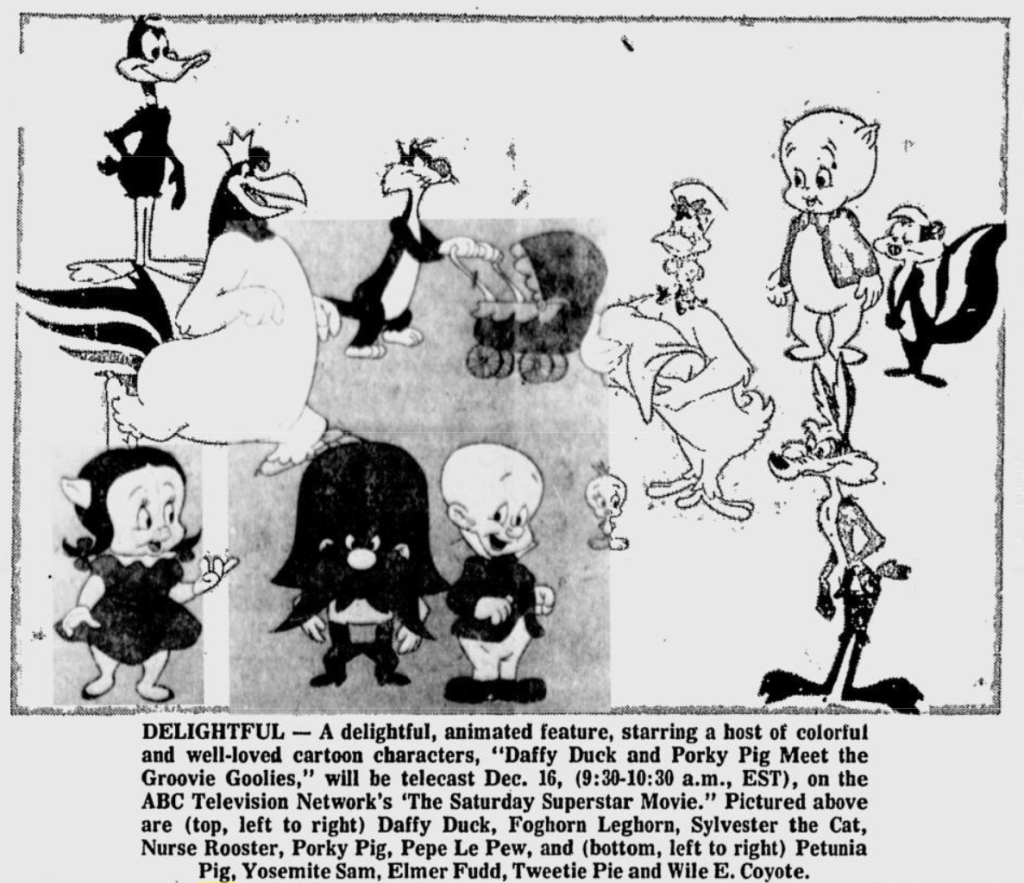

In mid-January 1972, Warner Brothers announced an expansion on the agreement, with 10 animated feature films, each budgeted at $1 million and set at 90 minutes and announced as a co-production. The three-year project was noted in the trades as being the largest deal of its kind in animation history. The tagline for the series of films was Family Classics, with Warner Brothers holding network and syndication rights. Titles announced were: Treasure Island, Oliver Twist, Cyrano De Bergerac, Swiss Family Robinson, Don Quixote, From the Earth to the Moon, Robin Hood, Noah’s Ark, Knights of the Round Table, Arabian Nights, and Jack London’s Call of the Wild. All of the works were based on books or concepts in the public domain, but not animated by any other studio. Warner Brothers was owned at that point by Kinney National Company, and with Filmation owned by the TelePrompTer Corporation, the cable market was being closely eyed for these films as a continual revenue stream. This meant that Filmation could employ an animation team of 400 people year-round.[5] On December 16, 1972, Daffy Duck and Porky Pig Meet the Groovie Goolies was aired at 9:30 as an episode of the anthology series The ABC Saturday Superstar Movie.[6][7][8]
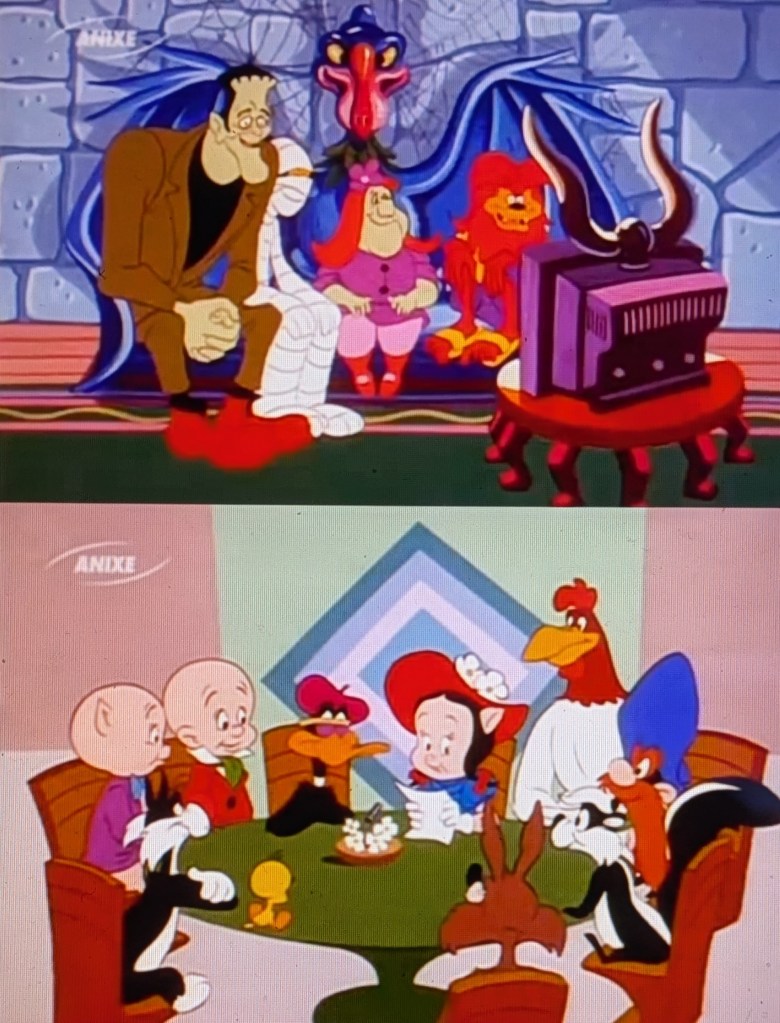
The plot begins at Horrible Hall, where Drac, Frankie, Wolfie, Mummy and Agatha are watching a television interview. In it, Daffy Duck is in Hollywood talking with reporter Petunia Pig about his new film about King Arthur and the Knights of the Round Table, starring himself; also appearing in it are Porky Pig, Petunia, Sylvester the Cat, Tweety Bird, Wile E. Coyote, Pepé Le Pew, Foghorn Leghorn, and Charlie Dog. Petunia also mentions a rumor about a mysterious stranger that has been causing all kinds of trouble on the set, to which Daffy think that it is a fan seeking an autograph. They then show a few scenes from the film: Foghorn, as “King Uther the Chickenhearted”, paces back and forth, until the nurse brings him his new children, a crate full of eggs. One of the eggs, however, is colored purple. The king calls for the court jester, played by Sylvester. The court jester is awakened by a guard, played by Charlie, and asks the king what he wants to see. He proceeds to try to entertain him by slipping on a banana peel and pole vaulting out the window into a monster-infested moat. The king simply tells him to take the egg for a long walk. The court jester does so, taking the egg out in a baby carriage, and decides to cook and eat it. Tweety watches and stops the court jester from eating the egg, claiming that it might be one of his cousins, then threatens to blow a whistle to call bulldogs. The court jester repeatedly calls the bluff, until he notices seven dogs surrounding him. They chase him off, and the egg hatches, with Arthur (played by Daffy, fully grown but wearing a baby bonnet) emerging from it, and declaring that he is only 3 and a half years old. Taking the role of Ector, Tweety names him “Arthur”, to which Arthur objects, asking Tweety why he can’t call him “Lance”, “Rock” or “Daffy”. The canary tearfully laments that his mother’s name was Arthur. Suddenly, the program is interrupted by a ghoulish being named the Phantom of the Flickers, who announces his intention to destroy every film that Daffy Duck and his studio ever made, including their current King Arthur film. Hagatha can’t help noticing how familiar the Phantom looks, while Frankie, being a huge fan of Daffy, goes to Hollywood to offer his help. The other Horrible Hall residents go along with him, with Mummy bringing his camera.

In Hollywood, Agatha casts a spell to magically stop the Gool Bus so they can ask a movie star for directions to Daffy Duck Studios and get his autograph. Behind their back, he reveals himself to be the Phantom. Upon entering the studio lot, Wolfie and Mummy notice that there is no sign of Daffy, Porky and the others. Agatha uses her crystal ball to find them. Just as Daffy calls for his stuntmen, the Goolies show up, with Frankie telling the duck that they came to help. Thinking that they are the stuntmen, he orders them to get into suits of armor. They begin shooting the next scene, where the Goolies are up on the balcony of the castle set. The Phantom pulls a lever which causes the floor to drop out. They land in the holes of a giant pool table, before the Phantom springs them out. Meanwhile, Sylvester and Petunia observe how scary the Goolies look. They wind up hanging from a chandelier, and Daffy greases it, causing them to fall again. Agatha, casting a spell to stop Frankie’s hands from slipping, only changes the grease to banana peels. The Goolies slide down a banister, which the Phantom causes to propel them back into the air. They land standing on each other’s shoulders, but Daffy asks them to do it again, because they missed the mark on the floor. Drac turns into a bat and flies out of his armour costume, causing the others to collapse, and Daffy gives them a coffee break.
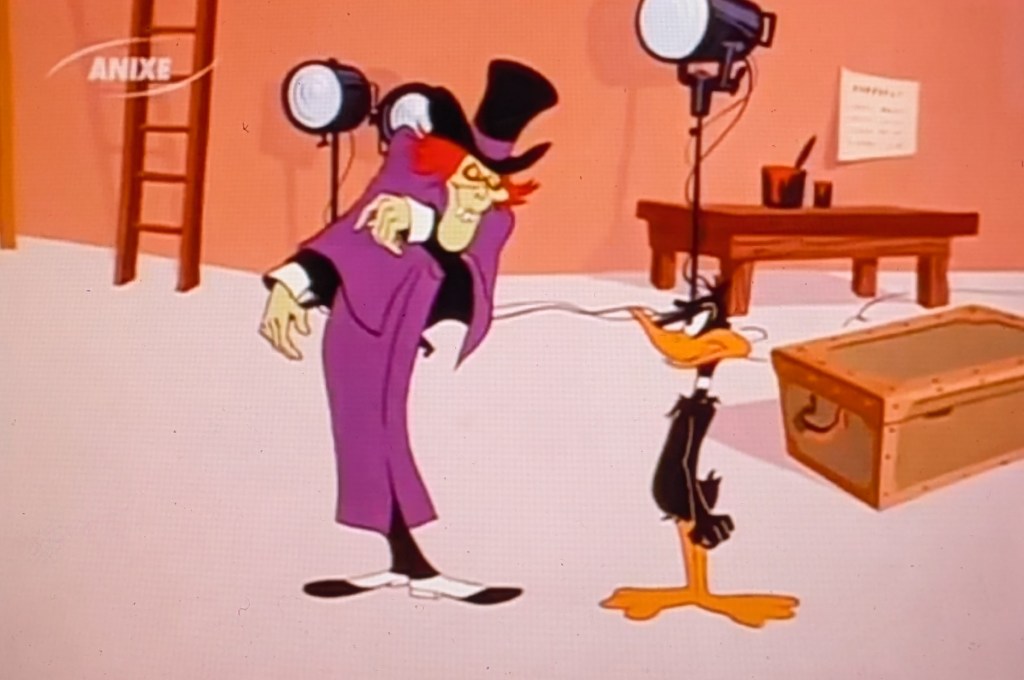
During the break, the Phantom sneaks along in the dark, which he finds hard for him to cause trouble, and falls, winding up hanging from the sleeping Drac, who, like Hagatha, thinks that he “knows him from somewhere”. He drops the Phantom, and Frankie runs to catch him, crashing into a table, sending Daffy flying and getting a blueberry pie in his face. Petunia (wearing her Lady Guinevere costume) is scared by the Phantom’s presence, hiding in a vase. Daffy confronts him, telling him that he is making a film and that he (Phantom) has chased his actors away (this ties into Petunia’s description of the Phantom as a mysterious stranger causing trouble on the set from earlier), and demands that he removes his makeup. He pulls off several masks, including ones of each of the Goolies. This makes Daffy think that the Goolies are costumed actors who are in league with the Phantom. He starts pulling on Frankie’s face. Then when he tries to unravel Mummy’s “costume”, only to see him collapse in a pile of wrappings, Daffy begins to realise that they are real. After this, Drac flies in as a bat, telling everyone to “knock off the noise”, and turns back into a vampire. He asks how they can expect him to get his beauty sleep. This makes Daffy scream in fear and run off, along with the other Looney Tunes except Petunia. Frankie and Wolfie ask the Phantom why he keeps scaring them. He pulls off his face revealing a blank mask reading, “I’LL NEVER TELL”, and escapes down a trap door. Hagatha casts a spell that drops the Goolies through trap doors as well, but they land in the moat.
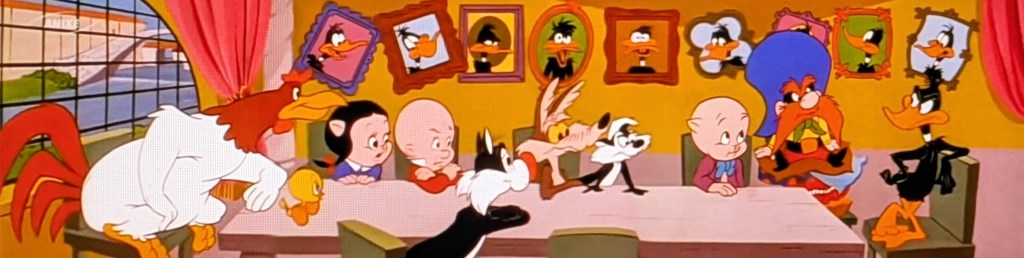
Daffy, Sam, Porky, Pepé, Wile E., Sylvester, Elmer, Petunia, Tweety and Foghorn all sit at a conference table. Daffy tells them that the Phantom and the Goolies are trying to stop the production of King Arthur, which has to be finished in time for the annual Ozzie Awards tomorrow night. When he described them to the police, they said that he was insane and hung up. Sam suggests organizing a posse to capture them, unaware that the Phantom is listening to them from outside. Everyone is reluctant, to which Daffy asks them if they are chicken. Foghorn resents that. Sam asks Sylvester if he would like to join the posse, but Sylvester refuses and runs off. Wile E. holds up a sign saying, “I’ll go”, and Porky agrees to go.
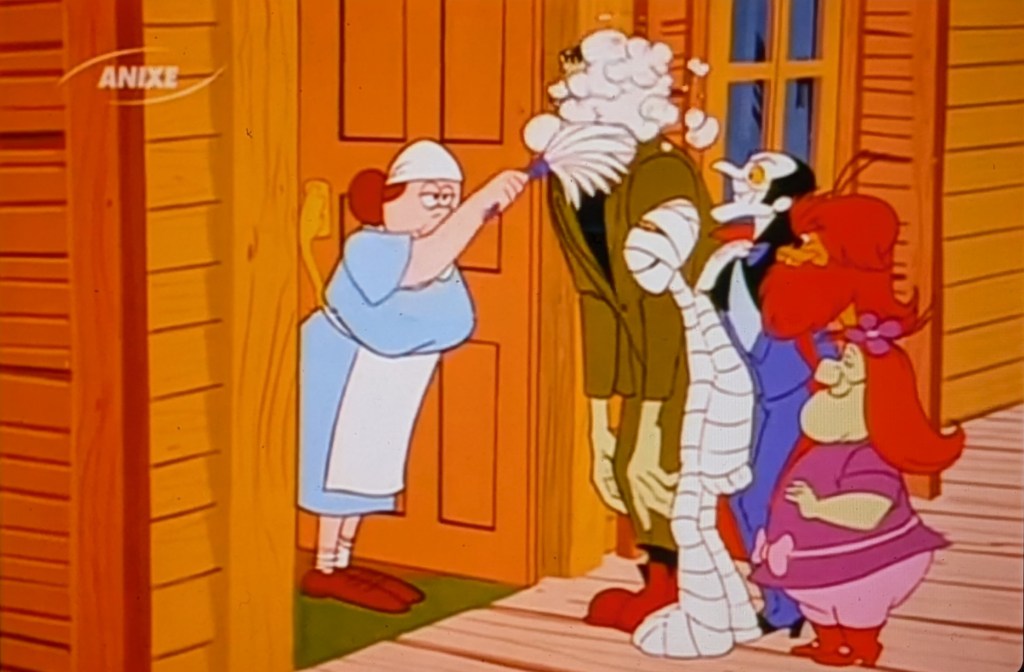
On a filming of a Western showdown between a marshal and a bandit, Frankie pops out of a manhole, tossing one of the actors, Lance, onto the ground and making him throw a tantrum. They see the Phantom running into a house set. When Frankie rings the doorbell, the Phantom appears, disguised as a maid, and tickles them with a feather duster, creating a giant cloud of dust that covers the Goolies, making them sneeze. He then changes into a gardener and sprays them with water from a hose, before changing into the “head of the house” (his head is a house), and slamming the door on them. Then the whole prop falls over on the Goolies. They hear the Phantom laugh and chase him into a little shed. Sam, Porky and Wile E. watch them from a bush, thinking that the shed is their hideout. Upon entering the shed, the posse find themselves standing in a large, fancy room. They split up, and right after they leave, the Goolies come out from a wall panel. Hagatha uses her crystal ball to find the Phantom, only for him to freeze it. Frankie worries about Daffy and suggests going to check up on him.
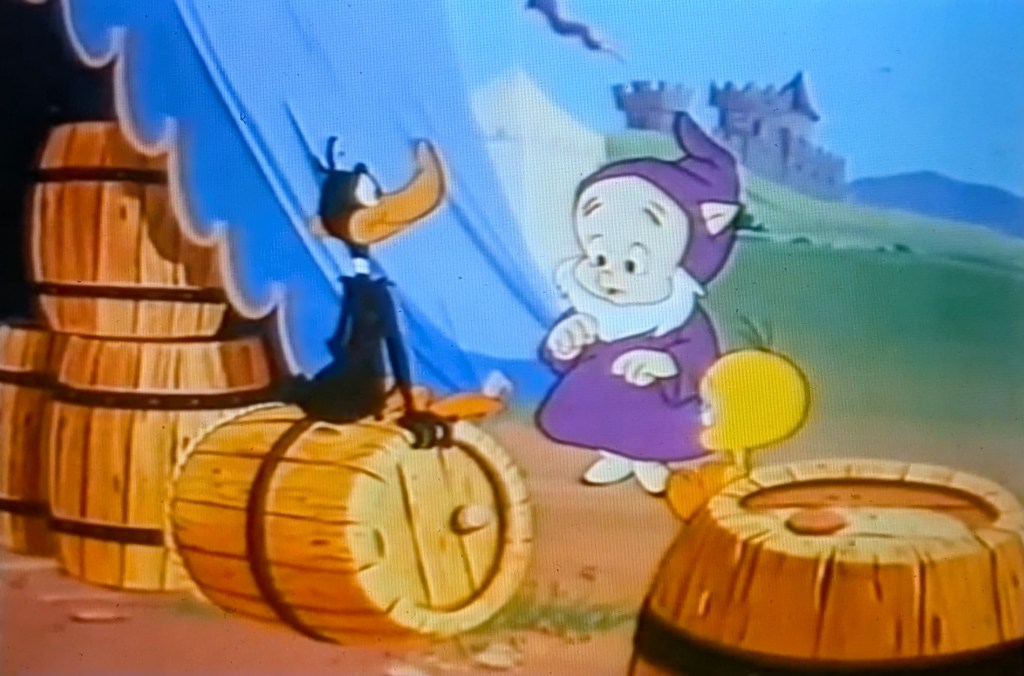
Later in a screening room, Daffy and the others watch the scenes for the film that they shit yesterday. Arthur, Merlin (played by Porky) and Tweety are walking in a carnival. Arthur sees Lady Guinevere’s (played by Petunia) kissing booth and falls in love, his body turning into a big, thumping heart, and his ice cream into fireworks. He kisses her, and she charges him “$49.95 plus tax”, but won’t marry him. When she says that she would only marry someone of royal blood, he offers to have a transfusion. Arthur gives up his entire life savings (stored in his foot), and then asks Merlin to use his magic to make her fall for him. Merlin is about to do so, but is interrupted by Hagatha, who shows him how to cast the spell. The court jester appears, being chased by one of the dogs. Hagatha casts a spell on the court jester, causing him to fall in love with the dog and kiss him, which makes the canine flee in fear. Merlin casts the spell on Guinevere, but causes her to fall in love with Tweety. Arthur chases Merlin, and afterward spots Mordred (played by Sam) trying to pull the sword out of the stone (another carnival game), accompanied by Drac (as a barker), Frankie, Wolfie, Mummy (as the game’s manager), Pepé and Wile E. (his henchmen). He is not interested in trying the game until Mordred insults him. Mordred tells Arthur that he has to wait his turn, but Wolfie and Mummy tell him that he had 253 tries and only paid once. Arthur is able to pull the sword out, and is crowned king. An angry Mordred says that he laid claim on the crown first and aims to have it. The town crier announces the wedding of Arthur and Guinevere, and then begins the sports report. On Mordred’s behalf, Pepé and Wile E. shoot up to Arthur a typewriter on an arrow, followed by arrows that type out the message challenging him to a joust. Arthur then sends a singing telegram (sung by the horse that the messenger ride on), saying that he will be there. At the jousting match, the announcer says that it is high noon in time for the main event: a 10-round jousting bout for the crown, and the hand of Guinevere in marriage. He then announces, “In this corner, wearing silver armour, with crown trim, and matching helmet with peekaboo visor, King Arthur!” Arthur is shown sitting on a white horse, and waves to the cheering crowd. Then the announcer says, “In this corner, wearing the rusty armour, with the tobacco stains in the front, the dreaded Mordred.” Mordred is shown sitting on a black horse, and has an unusually long lance. He is booed, and Pepé and Wile E. cheer him on, before turning round to look at Arthur and the booing crowd. Just as Mordred and his horse rasp at the crowd, Mordred’s visor falls on his tongue, causing it to swell and him to scream in pain. The announcer rings the bell like a gong, and Round 1 of the match begins. Arthur and Mordred ride toward each other, with Guinevere, Merlin and Tweety cheering Arthur on, and Pepé and Wile E. cheering Mordred on. As the round continues, Guinevere can’t bear to watch but can still handle peeking. Arthur’s horse gets out a red cape and shakes it, before lifting it out of Mordred’s direction as he rushes past. Pepé applauds the horse for his courage and grace and falls in love with him. Just as Round 2 begins, the film is suddenly interrupted and grabbed by the Phantom. Daffy and the others begin to go after him until Frankie, across the screening room, says that he and the other Goolies with help. Porky, Tweety, Sylvester and Wile E. panic and then disappear into the screen.

Sam and his posse see the Phantom with the film and the Goolies running after him, and give chase. The Goolies chase the Phantom into Sound Stage 3, where the latter causes various weather changes. In Sound Stage 9, they corner him on the gang plank of a ship set, but he jumps off and the Goolies follow him into Shop 7: Maintenance. Sam’s posse are now on the ship, and accidentally crash into its lever. The ship begins to rock, with Porky and Wile E. getting seasick, and Sam tells them not to think of food, but then uses several slangs that involve food, making Porky and Wile E. sicker. They are finally catapulted off into the African jungle set. The Goolies and the Phantom run back into Sound Stage 9, after which the Goolies crash, ending up in a heap. Mummy reveals that his camera is out of film, and asks Hagatha to help him change rolls. The Phantom disguises himself as Hauntleroy and hides the film in a guitar which he plays badly. Wolfie takes it and begins playing, but then it opens up, revealing the film. The Phantom grabs it and tries to escape from the Goolies by running through a magic mirror into “Mad Mirror Land” (where the animation shifts to live-action and stop motion pixilation). Frankie, Drac and Wolfie chase after him, much to Sylvester, Foghorn and Pepé’s amazement, and after a cartoonishly slapstick pursuit involving driving in imaginary cars, chasing around a farm, riding imaginary horses and landing in water, they bring (or more rather sneeze) the Phantom and the film back to the hand-drawn animated world.
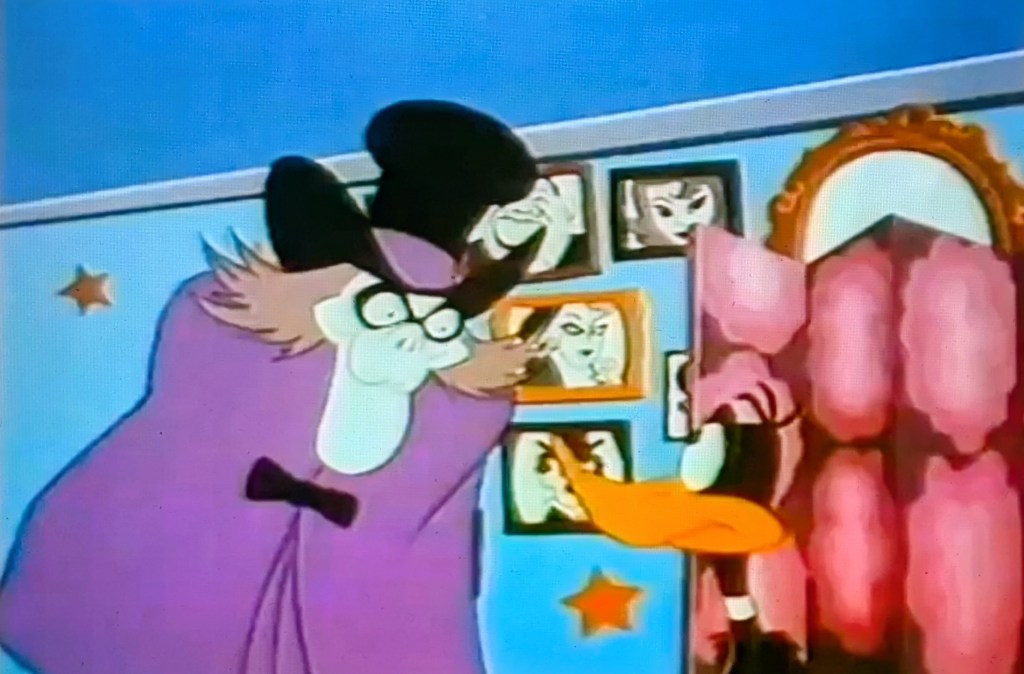

The Phantom turns out to be Drac’s long-lost uncle Claude Chaney, a formerly famous silent film actor. When they ask him why he stole Daffy’s film, he says that it was out of revenge because his pale, black-and-white complexion left him out of work when cooler films like Daffy’s King Arthur film became popular. Drac suggests that he could return to filmmaking. Mummy has filmed the whole thing with all his disguises, and Drac suggests that they could show it to Daffy, but he and Hagatha hope that he will forgive Chaney for stealing his film. In Daffy’s dressing room, he tries wearing gruesome makeup, with Elmer informing him that there is no word on the Goolies and the Phantom. He discards his makeup and concludes that they would have to find someone else to play the monster, since his face is too handsome. Just then, the Goolies walk in with Chaney to introduce him, apologise and show Daffy all his disguises. Daffy, impressed with Chaney’s disguise skills, gives him a job. At the Ozzie Awards, Foghorn reads the envelope and announces that King Arthur has won. Being the self-centered waterfowl that he is, Daffy thanks only himself, crediting himself as producer, writer, star, et cetera, angering the Goolies and the other Looney Tunes (Tweety and Wile E. are absent for some reason), and is carried away by guards. The Goolies win “Best Stuntwork”, and Chaney is awarded “Comeback of the Year”. After the ceremony, the Goolies drive back home, commenting on what a great time they had, meeting Daffy, Porky and the others and becoming stars. They think that their fame may have been a thing of the past, but see that their past is catching up with them, as Sam’s posse is following them, with Sam being carried in a sedan chair by Sylvester (who has joined the posse), Wile E. and Porky and shouting, “Whoa! Aw, come on, whoa…”

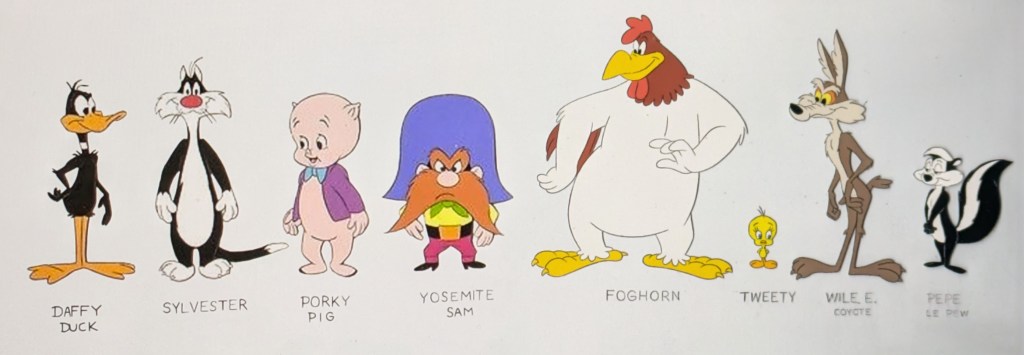
According to Lou Scheimer, Daffy Duck and Porky Pig Meet the Groovie Goolies was the strangest project for Filmation that came from their deal with Warner Brothers (which somewhat fits the Groovie Goolies’ description in Sabrina and the Groovie Goolies‘ theme song as “kind of strange” and “real funny”), who had shut down their animation department in 1969. They had the rights to use some of Warner Brothers’ characters, so they hired Groovie Goolies writers Chuck Menville and Len Janson to write the special’s story, in which the Groovie Goolies would go to Hollywood to meet the Looney Tunes characters. Janson had previously written the Road Runner cartoon Boulder Wham! in 1965. Filmation used a lot of the main Looney Tunes characters, except Bugs Bunny (who had not been seen since the closure of Warner Brothers’ animation department in 1964), Speedy Gonzales and the Road Runner. The cast seemed to roughly follow that of The Porky Pig Show‘s opening and closing sequences, animated by Hal Seeger and Myron Waldman at Paramount Cartoon Studios. In contrast to the DePatie-Freleng Enterprises, Format Films and Warner Brothers-Seven Arts cartoons from the 1960s, Daffy was not longer a bitter and greedy villain, instead being far more laid-back and in control, if still showing signs of egomania. This film marked the first time that the Looney Tunes characters would make a film together; the second and third times would be in Warner Brothers Movie World’s Looney Tunes River Ride 19 years later in 1991, and Warner Brothers Movie World Germany’s Looney Tunes Adventure 24 years later in 1996, both of which I wrote a blog post about in 2018. Veteran voice actor Mel Blanc provided the voices of Daffy Duck, Porky Pig, Elmer Fudd, Yosemite Sam, Tweety Bird, Sylvester the Cat, Foghorn Leghorn, Wile E. Coyote and Pepé Le Pew, though, they sounded a little different from the classic shorts; Filmation editors Doreen A. Dixon and Joseph Simon incorrectly pitched and sped up Blanc’s voice recordings for Daffy and Tweety higher and faster than normal, to the point that the former sounded a lot like his early “screwball” incarnation by Tex Avery and Bob Clampett or Woody Woodpecker, and forgot to speed up Porky’s voice. Elmer, Sylvester, Foghorn, Wile E. and Pepé’s voices sounded deeper than usual, due to Blanc not being thrilled about working on the special and not doing Elmer’s voice to his satisfaction (Elmer’s normal voice actor, Arthur Q. Bryan, died many years before). Sam was the only character who did not sound different from the classic shorts. Larry Storch reprised his roles as Drac and Hagatha and voiced the Phantom of the Flickers, while Howard Morris reprised his roles as Frankie, Wolfie, Mummy and Hauntleroy. The Phantom of the Flickers was a parody of the titular antagonist of Gaston Leroux’s The Phantom of the Opera, with the “Claude Chaney” derived from Lon Chaney, Senior (who played the title role in the 1925 film) and Claude Rains (who starred in the 1943 film).[9] Additional voices were provided by Scheimer (Director, Lance and Herald), his wife Jay Scheimer (Petunia Pig and Nurse, and probably Sylvester’s panting; Jane Webb’s pseudonym “Joanne Louise” is listed in the credits, yet Petunia and the Nurse sound nothing like Webb, indicating that Webb’s name was listed with her being considered for the roles, or a scratch track was recorded with Jay, and Webb came in to record the roles, but her track got lost or went unused and Jay’s track was used instead), Storch (Charlie Dog, Tweety’s whistling (Storch would voice Bugs Bunny in an ABC promotion the following year in 1973), Marshal Actor, Messenger, Singing Telegram Horse, Announcer and Joust Horses), and archive recordings of Hey Hey as Lassie (Dogs) from Lassie’s Rescue Rangers and Dallas McKennon as Salem Saberhagen (Sylvester’s meowing) from The Archie Comedy Show and Sabrina and the Groovie Goolies. Though the animation was limited as expected from Filmation, even in comparison to the Format Films and Warner Brothers-Seven Arts cartoons, most of the Warner Brothers characters were drawn well and animated to a somewhat higher standard than usual, having more movement and poses than the Groovie Goolies characters,[10][11] since veteran Warner Brothers animator Virgil Ross was working at Filmation at the time,[12][13][14][15][16][17][18][19][20][21] along with Ted Bonnicksen, LaVerne Harding and Ed Solomon, two of whom had worked for Warner Brothers in the late 1960s (only Ross and Harding were credited as animators at the end).[22][23] They even used smear frames and wheels of feet for the characters when running really fast,[14][24] as well as the horses in Daffy’s King Arthur film during the jousting match, and the picture frames during Daffy’s meeting used faces of Daffy lifted straight from a 1960s model sheet.[25] Despite this, Wile E. and Pepé were drawn scruffier than usual. Both characters were created by Chuck Jones, and since Ross was usually in Friz Freleng’s unit at Warner Brothers, he may have had problems drawing them in most shots.[17] He had previously animated Wile E. in 10 of Rudy Larriva’s Road Runner cartoons (Ross’ Wile E. looked somewhat decent in those shorts),[26] and would animate Pepé in Bugs Bunny’s Mad World of Television 10 years later in 1982.[27] Daffy also had a sort of deformed and off-model look at many times in the special, akin to the Warner Brothers-Seven Arts cartoons. Bonnicksen, Harding and Solomon worked on some of those shorts and a 1968 Plymouth Road Runner commercial, so it is likely that Harding (the only credited Warner Brothers-Seven Arts animator) handled a few of Daffy’s scenes where he was off-model, as well as some for Wile E. The special and a 1972 Bugs Bunny Vitamins commercial produced by DePatie-Freleng Enterprises marked Petunia Pig’s first “official” color appearances, since she never appeared in any color cartoons in the “classic” era. Since he was writing the story, Len Janson reused the pole vault gag from Boulder Wham!, specifically for a scene in Daffy’s King Arthur film where the court jester (Sylvester) pole vaults into the monster-infested moat. In the storyboards, Hagatha was going to look at the camera when she says that the Phantom froze her crystal ball, and two celluloids show Arthur’s (Daffy) horse in the jousting match with a black mane instead of a white one.[28][29] As per standard for Filmation, the special generally used low-quality samples of the Hanna-Barbera sound effects and a few classic Disney sounds instead of Treg Brown’s sound effects, sounding pretty similar to the Warner Brothers-Seven Arts cartoons, though this time the selection was not as limited as in those shorts. A laugh track was also used throughout the special; Scheimer stated in a 2007 interview that Filmation started using the laugh track (created by Charles Douglass) on The Archie Show and their other productions because it would make the audience want to laugh with other people watching at home, and made the viewers feel as if they were part of the show rather than just being observers.[30][31] The sound effects were supplied and added by Horta-Mahana Corporation (previously Einfeld-Mahana Corporation). The special had a soundtrack consisting of screechy electronic keyboards, guitars and drums and orchestrated background music; the soundtrack cues were recycled from The Archie Comedy Hour, Sabrina and the Groovie Goolies, Will the Real Jerry Lewis Please Sit Down, Archie’s Funhouse, Archie’s Television Funnies, Fat Albert and the Cosby Kids, The Brady Kids and Lassie’s Rescue Rangers. The live-action segment was filmed in Westlake Village near Thousand Oaks, and used stop motion, pixilation and undercranking to enable actors to move like cartoon characters, such as when the Goolies drive imaginary cars down the road and Drac appears to fly.[9] These techniques had previously been used by Menville and Janson for three short films of their own: Stop Look and Listen in 1968,[32][33] Blaze Glory in 1969, and Sergeant Swell of the Mounties in 1972. Music producer Ed Fournier played Frankie, musician Emory Gordy Junior played “Hauntleroy”, Dick Monda played Drac, and songwriter Jeffrey Thomas played Wolfie.[9] The Goolies’ sneezing during the segment was an archive recording of Storch as the Venus dogtrap and whale from the The Brady Kids episode Jungle Bungle: Part 2. The segment was a modified version of an unused segment for Sabrina and the Groovie Goolies, in which the Goolies chase the real Hauntleroy into Mad Mirror Land after the latter steals Wolfie’s guitar. It was removed from the special’s broadcast in the United Kingdom[34] before its retirement from United States distribution, following reruns on dates such as December 29, 1973[35][36] and July 27, 1974.[37][38][38] It would later air in reruns of the original series in 1975[40] and as part of the syndicated The Groovie Goolies and Friends anthology series in 1978.[41][34] After Filmation produced the special, as well as Oliver Twist and Treasure Island (both of which had been finished by late 1973), Warner Brothers decided to drop the Family Classics line, due to a negative test screening for Oliver Twist.[42]
The special received negative reviews from animation historians and Looney Tunes fans due to its limited animation and weak storyline. Steve Schneider of That’s All Folks: The Art of the Warner Brothers Animation dismissed it as “a low point of Warner’s animation; the less said about this work, the better”.[43] Jerry Beck called the special “the low point in the history of animation” and “an abominable mess, with limited animation, voices sped up incorrectly and an annoying laugh track (not to mention the bland stock background music)”. He stated, “Avoid this stinker at all costs! It is very sad to see our favorite characters this way. If this plot synopsis spares even one of you from ever seeing this cartoon, then I have done my job.[44][25] Michael N. Salda called it “the worst Arthurian cartoon ever”, and stated, “Even an all-star cast could not overcome Daffy Duck and Porky Pig Meet the Groovie Goolies‘s pedestrian draftsmanship, inconsistent voices, humorless gags, stock music loops, and empty characterization. The two segments devoted directly to Daffy’s King Arthur film are no better than the rest of the cartoon that encompasses them. It is painful to watch. If the rest of the cartoon were any better, one could argue that Daffy’s producer/director/actor effort is supposed to be deeply flawed, as it is, for example, in Daffy Duck in Hollywood, Hollywood Daffy and The Scarlet Pumpernickel. These three earlier cartoons were fine Warner Brothers releases that entertained even as, and because, they underscored Daffy’s arrogance and many foibles. But Daffy’s embedded King Arthur film is as unrelentingly weak as Daffy Duck and Porky Pig Meet the Groovie Goolies itself. There is no joke here. Despite the conclusion that shows Daffy proudly accepting an ‘Ozzie’ for King Arthur and making a speech in which he thanks himself repeatedly as producer, director, star, et cetera, the rest of the world took a dimmer view of Filmation’s cartoon. Although the Phantom of the Flickers was speaking exclusively of Daffy’s Arthurian film when he judged it a ‘full-length flop’, his condemnation could easily be extended to Daffy Duck and Porky Pig Meet the Groovie Goolies and much of Arthurianimation in the 1960s and early 1970s as a whole.”[36] Trevor Thompson, the self-appointed Looney Tunes Critic, gave the special a harsh, negative review, expressing his hatred for Filmation (which began in the 1980s). He criticized the Looney Tunes characters appearing and working together (due to them being “too independent and adversarial” and most of them being “comic losers”), the plot, Daffy, Porky and Tweety’s incorrectly-sped voices, and the addition of a laugh track (which he falsely thought was “how literal-minded the heads of production were at Filmation”), called the writers “literal-minded idiots” and “horrible hacks”, blamed Filmation for animation on television becoming “completely awful” from the late 1960s to the early 1980s (television animation was only awful in terms of writing and quality because of networks and groups like Action for Children’s Television), said that the Phantom destroying Daffy’s films was “a metaphor for Filmation destroying animation’s legacies”, and stated that Chuck Menville and Len Janson wrote a lot of bad Saturday morning cartoons, despite being talented artists themselves.[45][46][47][48] mightyfilm said, “It’s…weird. The Goolies barely share any on-screen time with the Looney Tunes, and it feels wildly disconnected in every aspect. It’s not a good Looney Tunes project BUT oddly, an excellent Groovie Goolies project, giving them a longer story than the usual 3-minute cartoon in between Laugh-In type joke bumpers and a musical numbers. Half the characters’ voices are at the wrong speed, especially Daffy. Yet Lou Scheimer had his wife do the voice of Petunia Pig because she was in one scene, and she has a VERY low pitched voice. Don’t see why they didn’t speed her voice up. Just…all around weird, and then there’s the live action segment which was actually pretty fun. And Bugs somehow has that odd Mickey immunity where they refuse to let him be in a project because it might tarnish his reputation. Which in the case of Bugs, sure, but the times they wanted to use Mickey in a project, it wasn’t exactly Disney’s low points. They wanted to use him in the new DuckTales series, but were denied. They had to go through weird hoops to get him in Bonkers, and he wasn’t mentioned by name and seen only in shadow. Yet Mickey Mouse Clubhouse exists. Just the weirdest crossover I’ve ever seen. Teenage Mutant Ninja Turtles meet Batman four times? Didn’t phase me. Family Guy and The Simpsons, way too late, but appreciated. Like 90% of comic books out there now being some sort of combination between Ghostbusters, Transformers, Power Rangers, Ninja Turtles, and the Justice League. A little too much, but cool. Looney Tunes meets the spinoff of a spinoff that doesn’t even go together by any stretch? Still baffling.”[49] Anthony Kotorac of Anthony’s Animation Talk and FoxInAFix watched the special on October 31, 2020. After they finished watching, they talked about how the special was not as visually interesting as they had hoped, with Fox saying that the dialogue was unfunny, the characters talked a lot and were mostly standing and running, and the Looney Tunes characters mostly had “only two lines or something”, though he liked the scenes with Tweety and Sylvester. They praised the live-action sequence, which Anthony calling it the “best part” of the special and “clearly like a sendup of silent film”. Anthony added that he was “entertained by how terrible the plot was” and would only watch it again if it was remastered as a special feature, and pointed out the errors with Mel Blanc’s voices.[50] Warner Brothers was not satisfied with the results and never had Filmation work with the Looney Tunes characters again. Any time that they would have animation with the Looney Tunes characters outsourced, it would be done by studios that were run by Warner Brothers alumni such as Friz Freleng and Chuck Jones, until they reopened their animation department again in 1980. However, the special does have its fans and defenders. Eric B stated, “Even though it may not be as good as the classics, it was a use of the characters, and to me, the more off-center it is, the more interesting and deserving of discussion it is, though it may have been done poorly. The music is mostly the familiar Ray Ellis Groovie Goolies stock, which is very similar to the regular Fat Albert score. Just a lot of keyboards, which was common at the time. Certainly not “bland muzak” as Beck called it. It is nowhere near as bad as the Tom and Jerry/Droopy score (which consists of gaudy Moog synthesizers with the same three tunes rehashed throughout the episode). There were even a few Archies stock (also used on The Brady Kids and others). Most of the characters are reasonably drawn (Virgil Ross was one of the animators working at Filmation), and Wile E. Coyote and Pepé Le Pew don’t seem to be all that bad most of the time. At first, at the conference table Pepé did look pretty bad, with a smaller, fluffy oval shaped face and a pointy nose almost like a real skunk (resembles a miniature Wile E., with a frown even!), whereas Wile E. looked alright to me at this time. The problem with them seems to be slight distortions of their noses at times. Wile E.’s nose and face looked particularly weird when he was getting sick from the pirate ship set rocking. But at other times they seemed okay. Daffy Duck and Tweety Bird’s voices are sped up too much, sounding like they are on helium. Elmer Fudd’s voice didn’t sound that much different from Dave Barry’s take in Pre-Hysterical Hare and any other instances of Mel Blanc doing the voice. Just a little lower. The biggest problem with him is that he only had one single line toward the end. Porky Pig was a bit too low due to not being sped up, sort of like he was in the late 1980s Looney Tunes films. Petunia Pig actually sounds a lot like Ms. Bellum from The Powerpuff Girls, to give modern viewers an idea of what it sounds like. The voice is obviously the same as Fat Albert’s school teacher, who was Scheimer’s wife Jay. As for the story, it is hard to say. Yosemite Sam seems to be the most prominent character, then Daffy and Petunia. Sylvester the Cat, Tweety and Foghorn Leghorn have their moments. The rest seem to be just along for the ride, and could have easily been omitted. Wile E. only utters three laughs and is otherwise silent (communicating mainly by holding up signs, like in the Road Runner cartoons, even though he talked at other times in the classic series). One big error is that Porky and Wile E. are at one point at two places at the same time (out on the posse with Sam, and screening the rest of the King Arthur film with the others). Then all the concurrent uses of the characters is strange: Petunia is a television announcer, and also apart of the film. Foghorn is apart of the film, and both also are the emcees of the Ozzie Awards, where they hand themselves the award! (Not to mention them finishing the film, submitting and winning the award for it all in 20 minutes!) The closing gag has the Goolies, on the way home and thinking their brief moment of fame was over, being chased by Sam, Porky, Wile E. and Sylvester, but the reason for this was not explained. I wonder if that was originally supposed to be Sam’s posse still trying to catch them, not realizing that the whole story was over, before it was decided to have all of the Looney Tunes characters together at the awards. (Not only that, but Sylvester was not in the posse, anyway). So those aspects of the story were very sloppy. There are also large periods that focus on the Goolies and not the Looney Tunes, and a long drawn out sequence of the Goolies (wearing armor) falling down, and then up and then down again that should have been edited more. But I think that people’s abhorrance of this film stems from treating it as a Looney Tune, and judging it on that high standard. But it is not. It is a Groovie Goolies cartoon, with our beloved classic stars as special guests. The verbal comedy routine is their normal format, and I find it funny, and perhaps one of Filmation’s best non-action/adventure cartoons. The boy that the Phantom disguises as is Hauntleroy, one of the other Groovie Goolies series regulars. He also was otherwise absent. This was another glitch in the story, as the boy was supposed to be someone they didn’t know. They at first appear not to know him, but then do acknowlwdge him as Hauntleroy in the live scene. If it was Hauntleroy, that right there should have been suspicious as he did not travel out there (to Hollywood) with them. Yet another big glitch, is that Bella LaGhostly was one of the Hollywood stars that they hoped to see, yet in the regular series, she was a series regular; the switchboard operator at Horrible Hall! So no; classic Warner animation this is not, but it still has some worth and should not be totally trashed the way that people have done. With computer technology, the voices can easily be fixed.”[51][52] Jim of Jim’s Unofficial Filmation homepage stated, “While Warner Brothers fans have almost universally trashed Daffy Duck and Porky Pig Meet the Groovie Goolies, in my opinion, they have really overstated this nifty little film’s flaws. Granted, the animation is no where NEAR the quality of a Warner Brothers theatrical cartoon, but it was a notch above what had been the norm for early 1970s Saturday morning fare. They also fail to point out that the Looney Tunes are very faithfully animated, and fairly funny in places. Daffy, in particular is just terrific (though his voice is a bit high pitched), and Sylvester is nicely done too. The live-action sequence at the end of the film is incredibly fun, incorporating a great deal of slapstick schtick. The actors (sorry, I don’t think they were credited) did a nice job of portraying believable “real” Groovie Goolies. The plot is something of a mess, but it moves along briskly enough that I didn’t really care. It’s all about lightweight fun, and on that level, it works well enough.”[53] wileyk209zback/Zak Wolf posted, “I find this television special more enjoyable than the later Warner Brothers-Seven Arts cartoons. To me, it’s kind of a ‘so bad it’s good!’ television film. One is apparently left with the impression this may have been ABC’s attempt at competing with The New Scooby-Doo Movies, and may have been an intended series where the Groovie Goolies meet different ‘celebrities’ of sorts. I made up that Bugs Bunny became a hippie in the early 1970s, and he didn’t want anything to do with television animation at all, as he wasn’t fond of Filmation or anything else resembling Hanna-Barbera, feeling that the former company was too ‘square’.”[23] joeblev of Halloween Love stated, “It’s easy to see Daffy Duck and Porky Pig Meet the Groovie Goolies as a career-low for Porky and pals, but it’s also simultaneously a career-high for the Groovie Goolies bunch. Other than some funky 1970s background music (very similar to what Filmation used on Fat Albert and the Cosby Kids) and a lone joke about Elliott Gould, this special has a timeless quality to it. When the characters run onto the sets of other films, we see that Daffy Duck Studios is turning out generic cowboy pictures and swashbuckling adventures that could have been made in the 1930s. This is the kind of place where directors still wear jodhpurs and give orders through megaphones. No traces of ‘the new Hollywood’ here. Though nearly none of the jokes land and the backgrounds loop around endlessly, the film is not a total disgrace or embarrassment to the Looney Tunes legacy. That’s about as much of an endorsement as I’m willing to give it. The characters basically look and sound the way they should, and the animation isn’t that much of a step down from the shorts that Warner Brothers was releasing in the late 1960s, by which time the studio was already outsourcing its animation to other companies. I think, if I had been a kid watching this in 1972, I would have been very excited to see the Goolies and the Looney Tunes together. The special is not really special in any noticeable way, except as an oddity, but it’s basically as harmless as those ads for Bugs Bunny vitamins or, indeed, those latter-day Warner shorts. Ideally, even though it originally aired a few weeks before Christmas, this could be marketed as a Halloween special and shown every October. The problem is that much of the running time is devoted to scenes from the decidedly unspooky film-within-a-film, King Arthur. (Daffy and his cast are supposedly viewing dailies.) It’s almost as if the writers couldn’t decide if they were doing a parody of Phantom of the Opera or a send-up of Arthurian legend, so they decided to alternate between the two. Perhaps, instead of sending the Goolies to Hollywood, it would have been better to have Daffy and Porky visit Horrible Hall instead. Maybe the duck and the pig (with some of their pals) are on a road trip together when their car breaks down and they have to take shelter at the monster boarding house. That may not have resulted in an enduring classic either, but it could have been more fun than what they ended up doing.”[54] YouTuber ToonReel001 commented, “Generally the recurrent joke in Looney Tunes is often the cast are self aware ‘actors’ who know that they are making a cartoon. Not always but a lot of the time they are medium aware they all cast members. This still extends to them being self involved, especially Daffy who even in these cases wants to be the star (especially against Bugs but even against Porky in You Ought to Be in Pictures), but it explains why they’re not as adversarial as they are in some of the cartoons themselves. I mean there are several cartoons like What’s Up, Doc? and A Star Is Bored that make fun of Bugs and Elmer’s feud and plays them off as being on-the-clock enemies only.”[55] Julia Baldwin/Turbotastic Asian stated, “The few existing, die-hard fans of this show can attest to the fact that The Groovie Goolies had their own crossover television special once with the Loony Tunes gang entitled, Daffy Duck and Porky Pig Meet The Groovie Goolies. Most fans absolutely hated this movie and desperately try to forget it ever existed. I personally don’t hate it as much as other fans do. For one thing, I like the fact that a Groovie Goolies show actually had a plot to it. For another, Mummy has a bigger role in this than he does in the actual cartoon. Throughout the events of the film, he is shown wearing a movie camera around his neck, and there are a couple running gags of him fidgeting with it and even using it to film during (seemingly) the most inopportune times. At one incredibly weird moment, the Goolies find themselves in a live-action scene and start playing one of their songs from the cartoon. Notice which Goolie is not shown in this scene. Guess why: it’s because this scene is shot by that aforementioned movie camera! Lastly, at the end of the movie, all of that footage that Mummy caught on his film was beneficial for solving the story’s main problem. That’s probably my favorite part about this otherwise mediocre and forgettable movie: My own little comfort character became the unsung hero of the story!”[56] Amber of Cartoon Research said, “I have a sentimental relationship with the Filmation Looney Tunes special, due to the full black-and-white copy being one of the first things that I traded with my (now) wife. That said, it’s not a good special. It’s entertaining, if you love oddities and/or the Groovie Goolies. But it’s wholly a mess. Filmation probably could have reasonably enough played it straight, and just did a “Daffy Duck as King Arthur” special, which seems to be what they want to focus on instead of just about anything else. The Looney Tunes and the Groovie Goolies hardly interact with each other at that. I do feel there is some merit, or at least intrigue with the special. That background of Daffy’s giant, framed portrait as a director is killer. There’s also a pan background full of some fun Daffy faces lifted straight from a 1960s model sheet. The live action segment is easily the best part of the whole special, and it was absolutely criminal of German distributor Select Video to cut it from their VHS release. All else said: I won’t accept any flak toward Ray Ellis’s music on my watch!”[25] As for myself, I agree more with the fans of this special. It is not as bad as it seems, and is not a complete stain on the Looney Tunes franchise. It is a Groovie Goolies production with the Looney Tunes characters as guest stars, since it has a laugh track, limited animation, low-quality Hanna-Barbera and Disney sound effects, and a twangy-orchestrated soundtrack. All of this was normal for Filmation’s shows, but probably not for Looney Tunes. The live-action segment is pretty hilarious, though.
This special has never been officially released on home video in the United States (due to various rights issues), but traders on the Internet have been recording and selling digital video discs of the special, most of which were originally black-and-white kinescopes of the original broadcast. This is a coincidence considering that in the special, Claude Chaney sabotages Daffy’s work because films were no longer shot in black and white. Unofficial copies of the original color broadcast have also emerged. Distributor Select Video released the film in a number of European countries, including Germany and Denmark.[57][58] The German version of the movie was released in 1983 as Groovie Goolies: Muntere Monster in Hollywood (Groovie Goolies: Groovie Goolies in Hollywood), and re-released in 1986 as Duffy Duck und Co. (Daffy Duck and Company), and again in 1990 as Die Lustige Monster Show: Duffy Duck und Co. in Hollywood (Groovie Goolies: Daffy Duck and Company in Hollywood). The original laugh track from the special was mostly removed for these releases. In January 1985, the movie was released in the United Kingdom as Groovie Ghouls, and was said to have been on sale at Woolworth’s. In those instances, the live-action sequence was replaced by an out-of-shot collision before rejoining the original animated sequence. The sequence in these releases was cut for time, as the German versions contained trailers for other Select Video titles. Another notable feature of the German and United Kingdom releases was that the Select Video ident was shorter, and had no jingle. In addition, the end credits were different, as they had to edit out the names of the actors in the live-action sequence which was not included, and also had other credits, possibly for Europe-based post-production at Select Video.[57] Despite the aforementioned rights issues, the special remains part of the Groovie Goolies syndication package (split into two half-hours) as of the mid-2000s, furthering its status as a Groovie Goolies production,[59] and has been rebroadcast several times on television. The National Broadcasting Company broadcast it as a Halloween special in the late 1970s or early 1980s. On January 1, 1983, the special was broadcast on Antenne 2 in France as Les Croque-monstres à Hollywood (Groovie Goolies in Hollywood).[60] Sky One aired the special in the United Kingdom on July 4, 1992.[61] USA Network broadcast the film as a Halloween special in the mid-to-late 1990s shortly before it stopped broadcasting cartoons altogether.[62] Anime Superhero Forums user SF4Ever/Michael Powell said that Cartoon Network broadcast the special on Mister Spim’s Cartoon Theatre in 1995 and/or 1997.[63][64] The special was broadcast on German television as Monsterparty auf Schloß Blutenburg: Daffy Duck und das Phantom Der Seifenoper (Groovie Goolies: Daffy Duck and the Phantom of the Flickers) in 2002, 2007 and 2013.[65][66] The first part of the Anixe airing used to be available on Dailymotion, but has been taken down. The 1985 Select Video release of the special was uploaded to YouTube on February 23, 2017,[67] only to be replaced by a “2018 restoration” of the film (spliced from the 2013 Anixe broadcast (first part only), the Select Video release, the original 1972 black-and-white broadcast and The Haunted Heist), uploaded by netscapenow on May 5, 2018.[68] A month later on June 8, 2018, wileyk209zback/Zak Wolf uploaded a version of the special with Daffy Daffy, Porky Pig and Tweety Bird’s voices corrected, which would be taken down by Warner Brothers in May 2020, and uploaded to Google Drive and Facebook.[69][49][70] This version received praise from Jerry Beck. I asked Zak if I could use his version and pitch and speed up Petunia Pig, Elmer Fudd, Tweety (Zak’s version had Tweety speaking at the correct speed but at a slightly lower pitch), Sylvester the Cat, Foghorn Leghorn, Wile E. Coyote, Pepé Le Pew’s voices to sound close to the classic cartoons, and he said, “Not a problem. Go ahead.” My edit was made using Windows Movie Maker, Moho 12 and online pitch shifters in July 2019, and also includes Bugs Bunny, Speedy Gonzales, the Road Runner and other Looney Tunes characters not present in the special (Granny, Marvin the Martian and the Tasmanian Devil), using sprites from Bugs Bunny: Rabbit Rampage (when Bugs is present with the other Looney Tunes in the interview, during filming, running away and at the conference table), and footage from Rabbit Fire (Bugs saying, “Right!”), Zipping Along (the Road Runner scaring Wile E. when he is looking for the Phantom and the Goolies; here the Road Runner is one of the Phantom’s disguises, taunting the coyote and telling him that he can’t catch him), Bugs Bunny’s Easter Special (Bugs, Foghorn and Granny in the screening room, Pepé reacting to the Goolies’ presence in the film and screening room), Mexican Borders (Speedy reacting to the Goolies’ presence in the film and screening room), et cetera. I watch the edit for my enjoyment sometimes.

In 1977, Chuck Jones and his team of animators at Chuck Jones Enterprises began working on a much more ambitious project with permission from Warner Brothers: A Connecticut Rabbit in King Arthur’s Court. Aired on CBS on February 23, 1978, the television special was a “plagiarized” retelling of Mark Twain’s A Connecticut Yankee in King Arthur’s Court. It was rebroadcast as Bugs Bunny in King Arthur’s Court on November 22, 1978, due to the executives expecting the combined reputations of Bugs Bunny and King Arthur to be a bigger draw than a title that referenced the rabbit and hinted at an educational (and probably dull) retelling of an American literary classic, since they were more popular than Twain.[71]
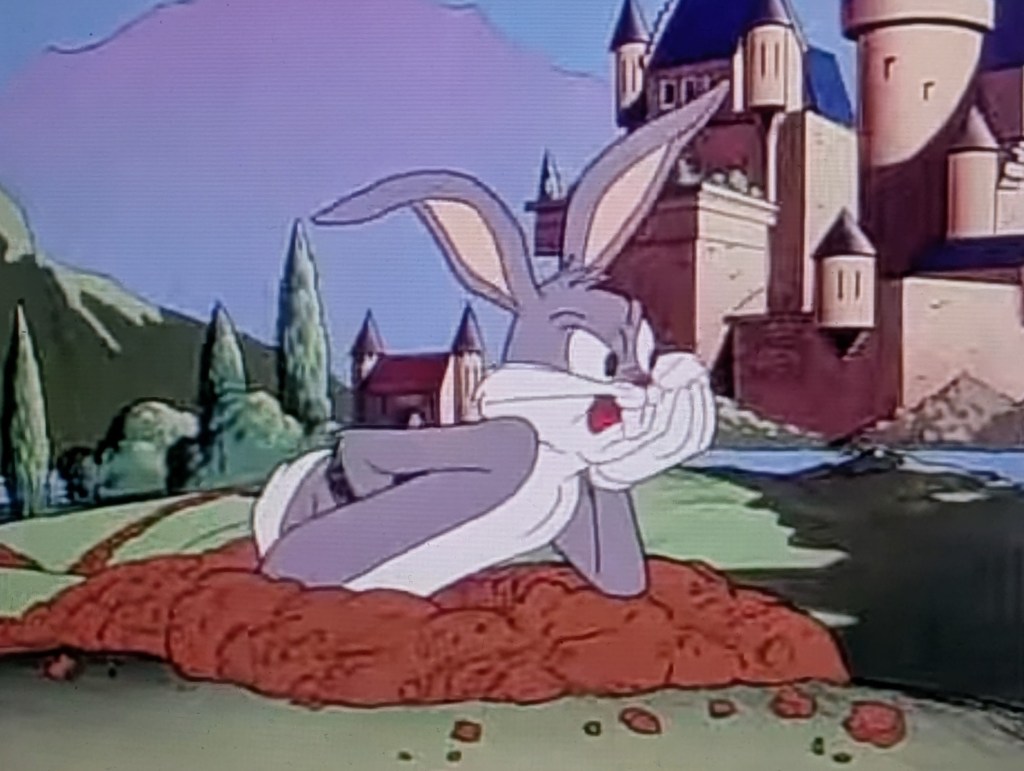
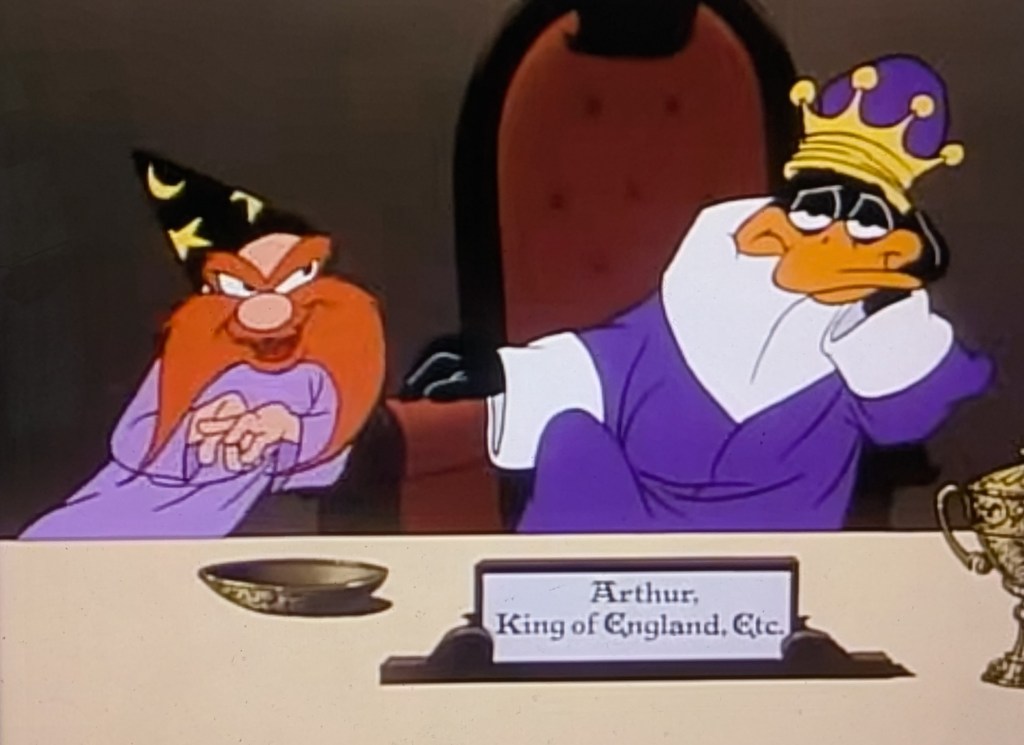
Bugs Bunny is trying to reach a peanut festival in Georgia, but thanks to faulty directions from Ray Bradbury, he takes a wrong turn at Albuquerque and time-travels to Camelot in the year 526. He mistakes Cmelot for Pittsburgh at first, but meets a fire-breathing dragon. After hiding in his hole to avoid the beast, Bugs mentions having previously time-traveled to 25th-century Mars thanks to Bradbury. Just then, his carrot is speared by Sir Elmer of Fudde (played by Elmer Fudd), a brave knight. Elmer tells him that he has been hunting for a dragon, and mistakes him for a transformed dragon. He captures Bugs, tells him that he is in Camelot after the latter sings “Barbara Allen”, and takes him to the castle of King Arthur. There Bugs is presented to the disinterested Arthur, King of England, Et Cetera (played by Daffy Duck), and bloodthirsty court magician Yosemite Sam as Merlin of Monroe, Baron of Yosemite (played by Yosemite Sam). Elmer tells everyone about his dragon-hunting skills and capture of Bugs, who calls him a “fibber”. Merlin wants Bugs drawn and quartered; when the rabbit begins talking about being in animated cartoons for years and not being born/literally drawn until 1940 and private quarters with nice views and baths, he tells him to shut up. This makes Bugs shed some tears, and Merlin seems to regret hurting his feelings at first, but then angrily yells for him to be burned at the stake. Bugs uses a solar eclipse to fool the locals into thinking that he can affect the sun’s movements. In spite of Merlin wanting him to be burned and much to Elmer’s chagrin, he is released, and Arthur grants him custody of an actual fire-breathing dragon.

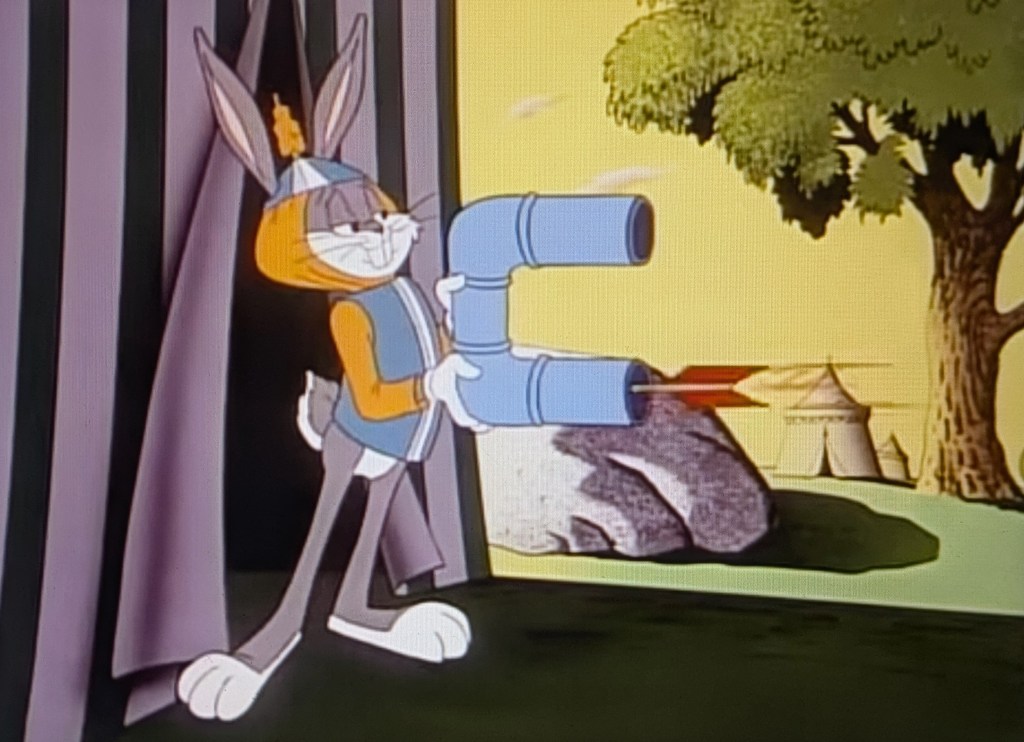
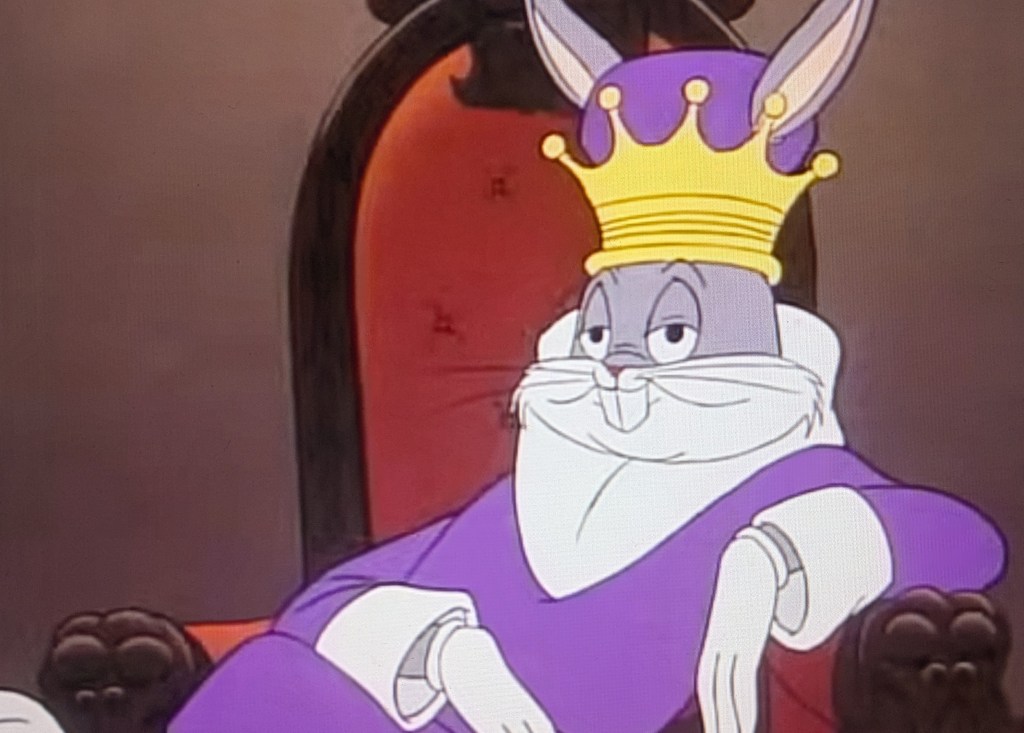
Two years later in 528, Bugs takes Sir Loin of Pork/Porkè of Pigge, the Varlet (played by Porky Pig), on a tour in his ACME Armour Factory, showing him inventions to reform medieval society, such as horsepower, dragon power, steam power, electric power, and armour created for endangered species like foxes, squirrels (not shown), deer, moose, elk, antelope, Tweety Birds, mice, cats, dogs, flies, roosters, rattlesnakes and porcupines. However, Elmer stab’s Bugs’ dragon with his lance, making him run away, yelping in pain. Bugs confronts Elmer, who still thinks that the latter is a transformed dragon. He takes off his glove and smacks the rabbit in the face, before challenging him to a duel, to which Bugs then punches Elmer’s face with a boxing glove. During the duel, Bugs uses his extremely long lance to pole vault over Elmer, douses him and Merlin (who has allied with the knight) in the moat, steals his armour using a magnet, and sends Elmer’s arrow and catapulted rock at them using a U-shaped pipe and spring, respectively, much to King Arthur’s amusement. Merlin skids out of a tent to light a cannon to kill Bugs, but Bugs tells him that he can’t use a cannon because gunpowder has not been invented yet. The magician takes a look inside and is blasted, cursing Bugs and calling him a “goldang coniglio lapin dragon” and “rampin’ frampin’ coneho lizard”. Bugs then finds what he thinks is a “neat carrot slicer” in a stone, unaware that Elmer and Merlin are pushing a wooden ax-wielding vehicle toward him. He innocently pulls the “carrot slicer” out of the stone, which is revealed to be Excalibur when a disembodied voice (God) proclaims him as the new king. Elmer and Merlin stop in their tracks as God says that anyone who does not like Bugs being the king will be boiled in baby oil. Porkè, Elmer and Merlin pledge their allegiance to him, and Daffy abdicates and relinquishes the crown to Bugs, the new ruler in “King Arth-Hare’s Court”.

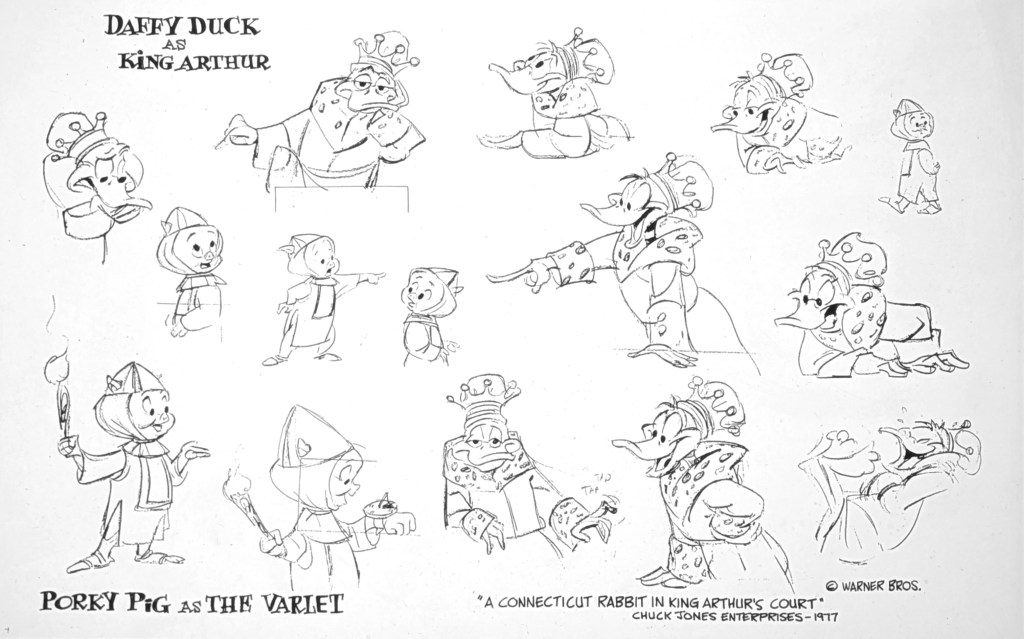
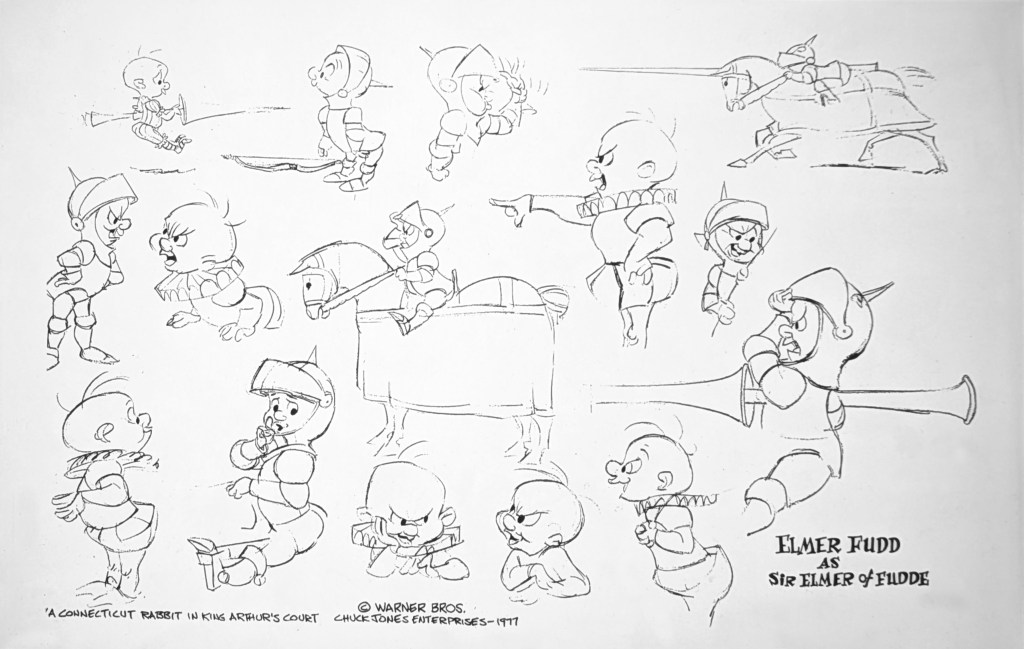

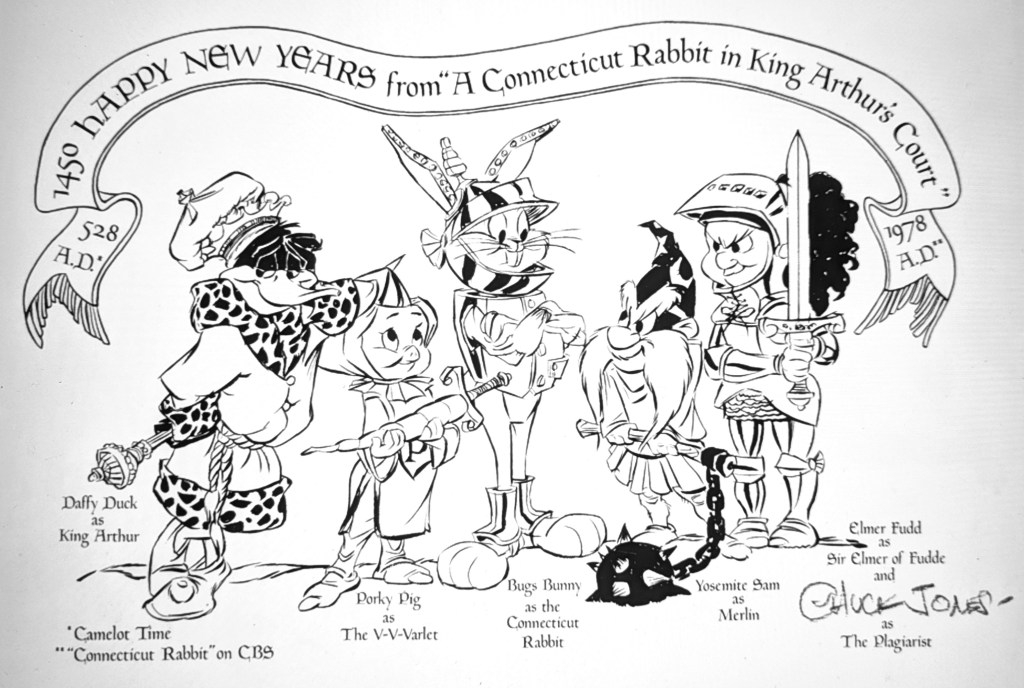
Prior to Chuck Jones’ firing from Warner Brothers in 1962, Michael Maltese worked with him and wrote stories for many of his Looney Tunes and Merrie Melodies cartoons in the 1950s. Due to Maltese’s absence, Jones wrote the story, dialogue and gags for the special on his own, which only made them (save for the gags during the jousting duel) feel too self-conscious, world-weary and sophisticated.[72][73] Bugs Bunny in King Arthur’s Court marked the first use of Yosemite Sam in a Jones-directed short or special, before From Hare to Eternity 19 years later in 1997. According to Ben Washam, there was a change in Jones’ animation direction in the late 1970s, where he become more lenient with his younger animators, allowing for visual elements that broke his earlier rules, such as trailing smoke or dust instead of dissipating smoke, seen when a character like the Road Runner runs off.[74] Since Maurice Noble was not working with Jones at the time, he also drew the layouts for the backgrounds, which were vastly different from the classic cartoons, being much longer, straightforward and larger, and his younger animators were mimicking his later, weaker drawings.[72] Though the animation in the special looked really rough and slow, it was more fluid than the limited animation in Daffy Duck and Porky Pig Meet the Groovie Goolies. Jones also had a dislike of limited animation, which he described as “illustrated radio”.[75][76][77][78][79] Even though there is no official record or evidence of Jones not liking the Groovie Goolies special, his dislike of limited animation could indicate that he at least heard of the special and its reception, and wrote the initially-disinterested King Arthur and Merlin being played by Daffy Duck and Sam, Bugs Bunny’s extremely long lance during the jousting duel, Bugs becoming the new king, and Daffy considering the idea of King Arthur being a duck ridiculous to poke fun at Filmation for their special, since it did not feel much like a Looney Tunes cartoon.[80] Animators and artists included Warner Brothers/Jones animators Ken Champin, Phil Monroe, Manuel Perez, Virgil Ross, Lloyd Vaughan, Irv Wyner, Don Foster (who did the title card artwork), Marlene Robinson May, Joe Roman, Ben Washam and Jean Washam; and Mitch Rochon, Woody Yocum and ink and paint artist Celine Miles, who painted the backgrounds.[81][82] Bugs Bunny in King Arthur’s Court was Yocum’s first time animating. He would later say that Jones had been a great director on the special.[83] Yocum and Robinson would later work at Filmation in 1978 and 1979, respectively. Roman had first worked for Jones on The Adventures of the Road Runner as a “master animator” in 1962, and returned to work on A Very Merry Cricket, Rikki-Tikki-Tavi, A Chosen Cricket, The White Seal and Mowgli’s Brothers before doing animation for the special. His only work for Filmation at the time was The New Archie and Sabrina Hour, The Fat Albert Halloween Special and Space Sentinels. The production assistants were Susan Charron, Linda Jones Clough, Mary Roscoe, Marian Dern and Marjorie Roach.[82] Roach had previously worked at Filmation as a production checker on Journey Back to Oz, Treasure Island and Oliver Twist. Mel Blanc provided the voices of Bugs Bunny, Daffy Duck, Porky Pig, Elmer Fudd, Yosemite Sam, the dragon and God.[81] The soundtrack was composed by Dean Elliot and Louise Di Tullio.[81][84] The special was edited by Sam Horta.[81] Jones had started using Horta-Mahana Corporation, the same post-production company that Filmation used for much of its lifespan, which explains the special’s usage of low-quality Hanna-Barbera and Disney sound effects. Horta was only credited as a film editor/camera operator in Jones’ specials (including Bugs Bunny in King Arthur’s Court) and never in Filmation’s shows (other people did the editing). The rostrum camera equipment was provided by a company called Animagraphics.[85][86][82] Despite not sourcing on the special, Maltese would sign a model sheet of Bugs in November 1979, with a dedication to Alan Hylton, a super-fan.[87] The special would be released on home video in March 1989, 1997 (both on Video Home System),[88] and 2008 (on digital video disc).[89] A merchandise shop themed to the special and named Bugs Bunny in King Arthur’s Court Toy Store (also known as Bugs Bunny Toys and Bugs Bunny Toys and Gift Store) opened with Warner Brothers Movie World in 1991.[90] The shop’s theming was designed by Sanderson Group.[91][92] It closed in 2007 to make room for Looney Tunes Carousel.[93] That same year, the video game Looney Tunes: ACME Arsenal was released. One of the levels “Camelot O’Trouble”, features King Arthur from the special as one of Daffy’s ancestors.[94] Merlin would be added to Looney Tunes: World of Mayhem as Merlin Sam in 2022.[95]
Steve Schneider called the special “one of the more highly regarded Looney Tunes specials”.[96] According to Jerry Beck, “It’s cartoon comedy in Camelot when Bugs Bunny and the Looney Tunes gang retell the classic Mark Twain story A Connecticut Yankee in King Arthur’s Court. The Brooklyn-born bunny burrows back in time to find the famous Round Table made up of some familiar friends and foes: Daffy Duck as King Arthur, mean-tempered Sam as the scheming Merlin of Monroe, the Baron of Yosemite, Porky Pig as Sir Loin of Pork and, of course, the wabbit-hating Sir Elmer of Fudde. Ye laughs come fast and furiously when our carrot-chomping hero duels a fire-breathing dragon, jousts an armor-plated Elmer and douses the hot-headed Sam. Then Bugs beats them all to the punchline when he pulls the sword from the stone and opens an ACME Armor Factory! Academy Award-winning animator/director Chuck Jones, one of the key ‘collaborators’ with the rascally rabbit over the past 50 years, here produces a legendary lineup of lunacy, making Bugs Bunny in King Arthur’s Court one of the funniest ‘knights’ in history.”[97] Kevin McCorry and Jon Cooke wrote an article titled The Looney Tunes Television Specials, in which they covered the special and referred to it as “Chuck Jones’ newly animated and rather bland return to the days of knights and roundtables, a premise far more entertainingly lampooned in Jones’ Knight-Mare Hare and Friz Freleng’s Knights Must Fall and Knighty Knight Bugs“.[98] Ben Olton stated, “For aficionados, this is not one of the better Bugs Bunny cartoons. In spite of the occaisional adult joke, it lacks the energy, visual detail and sophistication of earlier incarnations of these classic characters. Even Mel Blanc’s famous voice sounds tired and unenthusiastic throughout, approaching its old verve only with some of Porky Pig’s incredible stuttering. But, for all of its slapstick nonsense, Bugs Bunny in King Arthur’s Court is a fairly good children’s version of Mark Twain’s original.”[82] Michael Sporn called the special “a not-so-good television film”, and Ray Kosarin commented, “It is really sad (and maybe one of those elephant-in-the-living-room truths) how shoddily, in his television work, Chuck Jones handled the same Looney Tunes characters that he had directed so brilliantly at Warner Brothers. Whether it is having to write the films without Michael Maltese, or working with younger animators who, without the chops and familiar working relationship of Ken Harris or Ben Washam, were stuck mimicking his later, and weaker, drawings, these shows simply did not have the same grip on what made his Warner Brothers shorts so funny and good. The characters mug the camera with the same befuddled expressions that made sense (and were hilarious) in cartoons that he made 25 years earlier, but it is as if Jones, like his many imitators, had slipped into aping his own work, without quite knowing any more what made it so good.”[72] Michael N. Salda reviewd the special, stating, “A Connecticut Rabbit in King Arthur’s Court is an all-star special, casting familiar Warner Bros. properties in prominent Arthurian roles: Daffy Duck as a disinterested, world-weary ‘Arthur, King of England, Et Cetera’ (from his nameplate); Yosemite Sam as the king’s bloodthirsty magician, Merlin of Monroe, Baron of Yosemite; Sir Elmer of Fudde as the splenetic knight who captures the Yankee; Porkè of Pigge as the helpful varlet; and Bugges Bunnye of Carrot Patchville, U. S. A., once again playing the Yankee as he had in Friz Freleng’s 1947 Knights Must Fall and Chuck Jones’ own 1955 Knight-Mare Hare. Jones follows Twain’s basic plot with departures including: capture of the Yankee; conflict with a troublesome knight and Merlin; the newcomer gaining the king’s favor by ‘ending’ the eclipse; the Yankee’s factory-building and his inventions to reform medieval society; battle and defeat of Merlin and his allies; and end of story through some means other than the violent, sad one that Twain had described. Jones packs time-honored Arthurian references into his bright and cheerful cartoon; there are a Round Table at this Camelot, pavilions flying the pennons of Lancelot and Galahad, and Merlin of Monroe’s mailbox and tower from Knight-Mare Hare. Jones introduces a charmed sword at the end to complete the story, as Bugs innocently pulls a ‘neat carrot slicer’ from a stone. A disembodied, stately voice proclaims Bugs the ‘rightful king’. Daffy quickly abdicates and relinquishes the crown to Bugs, the new ruler in ‘King Arth-Hare’s Court’ (nameplate). “The pun is mightier,” Bugs quips, “than the sword.” With Daffy unseated, Bugs ruling the realm, and all Camelot’s subjects pledging their allegiance to the new king, Jones slyly rebukes Filmation for its dreadful Daffy Duck and Porky Pig Meet the Groovie Goolies. Jones’s long history with the Warner Bros. menagerie had taught him what fans also knew: only Bugs could ever be king. “It is sort of ridiculous for King Arthur to be a duck,” Daffy concedes as A Connecticut Rabbit in King Arthur’s Court comes to a close. After the relatively dry spell of the 1960s and early 1970s, creative Arthurianimation was on the rise again.”[80] Doctor Grob of Doctor Grob’s Animation Review gave the special 1 out of 5 stars, saying, “Although Chuck Jones’ mastery shines through at times, the episode is a sad caricature of the old cartoons. Just nothing seems right. The designs are weak, especially that of Yosemite Sam (not a Jones character), who is too small compared to the others. Moreover, the timing is remarkably slow, and there’s way too much dialogue, slowing down the animation. The gags are further hampered by Dean Elliott’s terrible, partly electronic music. Even Mel Blanc’s voices are poor: his imitation of Arthur Q. Bryan’s voice of Elmer Fudd is nothing like the real thing, and Porky Pig simply stutters too much. The episode’s trite story is expanded over 24 minutes, while, considering its flaws, it would already have been difficult to remain interesting within seven minutes. The result is a 24 minute long bore. The 1970s were the middle ages of animation, indeed…”[99] In 2018, Trevor Thompson uploaded hisn review of the special. In it, he called the special “a too late attempt to bring quality animation back to cartoons”, edited an advertisement for the special by CBS in TV Guide from November 1979 to say, “Filmation didn’t make this, so it might actually entertain!”, criticized the Looney Tunes characters appearing together in the story, called Bugs’ “Barbara Allen” song “a boring ballad that will make the audience agree that the Looney Tunes characters are in Arthurian times and England”, pointed out some “blatant, negative influence-giving Filmationisms” in the special, such as Bugs’ extremely long lance during the jousting duel (a confused Porkè wonders, “Filmation?”), “terrible, literal-minded, self-embarrassing (literal meaning of “self-conscious”) dialogue” (Bugs and Elmer’s dialogue when the latter captures the former, the “drawn and quartered” joke, Daffy considering the idea of King Arthur being a duck ridiculous, and Bugs calling his title as King Arth-Hare a “pun” that is “mightier than the sword”) due to the absence of Michael Maltese, King Arthur and Merlin as villains due to being played by Daffy and Sam, and “long establishing shots” (Elmer telling everyone about his dragon-hunting skills and capture of Bugs, the signs leading to the ACME Armour Factory, Bugs and Porkè’s tour in the Factory, and Porkè reading the jousting duel from a paper; as a joke, Trevor announces, “Watch Bugs Bunny in King Arthur’s Court, and see Chuck Jones bring back full animation. Dialogue and still pictures. That’s what it’s all about, kids!”, followed by Bugs saying, “Fibber.”), and gave a quick, angry analysis of the scene where Bugs is about to be burned at the stake, where only his head is animated on the stake, a painted background.[100] He also revealed himself to be a fan of the infamous John Kricfalusi (who worked at Filmation from 1979-1984 and disliked working there) when discussing and comparing the Looney Tunes shorts’ negative continuity with the episodic continuity of shows like The Ren and Stimpy Show,[101][102][103][104] reacted sarcastically to Filmation’s “dry” humor, called the writers at Filmation “hacks”, did not understand Bugs’ mention of Joan of Arc, criticized the physical gags during the duel as “drawn-out” and having “straightforward layouts”, and angrily ranted about Jones including Ray Bradbury’s name in the credits to make their friendship clear. He also incorrectly said that there is no online source for Jones’ claims of Bob Clampett trying to take sole credit for creating Bugs, and that Mel Blanc first voiced Elmer in a 1976 Hustler Magazine record named The Gay Ballad of Saturday Morning. Near the end of the review, he attributed Filmation’s alleged “influence” to more than a few people who worked there also working on the special, like Woody Yocum, Marlene Robinson May, editor Sam Horta, animator Joe Roman and production assistant Marjorie Roach. The artists were not bad at drawing, but Trevor could not figure out the reason behind the “peculiar shots” (“still pictures”, Bugs’ head in the stake-burning scene, and Bugs’ long lance during the duel) in the special, and said that this was “the earliest evidence that Jones was slipping”, before talking about the lenient change in his animation direction.[100] YouTuber Abdullahi Bouraleh commented, “Not to insult Mel Blanc, but I personally think his voice acting in the 1970s and 1980s, especially in this special, was horrendous. The animation and character designs aren’t much better either. I’ve never seen a Chuck Jones cartoon with animation this bad.”[105] Filmation was never a negative influence on this special. The dialogue and gags for the special (such as Bugs and Elmer’s dialogue at the beginning, the “drawn and quartered” joke and Bugs’ “pun is mightier than the sword” line) were only “terrible, unfunny, literal-minded and self-embarrassing” because Jones wrote the script instead of Maltese. The only elements of the special that feel like Jones, in Salda’s words, “slyly rebuk[ing] Filmation for its dreadful Daffy Duck and Porky Pig Meet the Groovie Goolies” are King Arthur and Merlin being played by Daffy and Sam, Arthur’s initial disinterest, Bugs’ long lance during the duel, Bugs becoming the new king, and Daffy considering the idea of King Arthur being a duck ridiculous. “Barbara Allen” was never a “boring ballad that will make the audience agree that the Looney Tunes characters are in Arthurian times and England”, and Bugs only sings one verse from the song. The term “England” as a specific political and geographical entity did not exist during the time of King Arthur, as he is a legendary figure from the early medieval period. The name “England” comes from the old English name “Engaland”, which means “land of the Angles”.[106] Only Merlin is a villain, as he was against Bugs and tried to turn King Arthur against him. Bugs and Merlin’s “Shut up shuttin’ up!” dialogue originates from The Fair-Haired Hare, which was directed by Friz Freleng and written by Warren Foster. Bugs’ head and upper part of his body were actually the only animated parts in the stake-burning scene, storyboarded by Jones and animated by Ben Washam, with the background painted by Celine Miles; both Washam and Miles never worked at Filmation. Joan of Arc was a patron saint of France, honored as a defender of the French nation for her role in the siege of Orléans and her insistence on the coronation of Charles VII of France during the Hundred Years’ War. She was put on trial by Bishop Pierre Cauchon on accusations of heresy, which included blaspheming by wearing men’s clothes, acting upon visions that were demonic, and refusing to submit her words and deeds to the judgment of the church. She was declared guilty and burned at the stake on 30 May 1431.[107] Considering that none of the animators and artists were bad at drawing and some of them would go on to work at Filmation afterward, they were definitely not responsible for the “peculiar shots” and were never bad influences on the special or indications that Jones was “slipping” in that sense. He was “slipping” soley because he was writing the script instead of Michael Maltese and doing the unusual layouts for the backgrounds, therefore being responsible for the “peculiar shots” and being lenient with his younger animators, who were mimicking his weaker drawings. The effect for the “still pictures” is called the Ken Burns effect, a type of panning and zooming effect used in film and video production from non-consecutive still images by other people and companies, not just Filmation.[108] The “still pictures” are likely another jab at Filmation by Jones for their frequent use of the effect. Although the special uses a lot of shortcuts like the “still pictures” and Bugs’ head in the stake-burning scene, it does have some scenes with full animation. A lot of the criticisms of Bob Clampett “taking credit for other’s work” stem from the documentary Bugs Bunny: Superstar. Blanc actually first voiced Elmer in Good Night Elmer in 1940, and would continue to fill in during Arthur Q. Bryan’s lifetime, before taking over in the 1960s and 1970s after his death in 1959. The Gay Ballad of Saturday Morning is actually a censored edit of The New Adventures of Bugs Bunny‘s Getting the Bugs Out in 1973. Trevor did correctly say that the special spawned a famous Internet meme with Bugs as the king, though. On February 22, 2024, YouTuber Mister Fox Enterprises uploaded a YouTube Poop of Daffy Duck and Porky Pig Meet the Groovie Goolies, named YouTube Poop: Bugs Bunny Meets The Groovie Goolies and influenced by wileyk209zback/Zak Wolf, with the addition of Bugs (making the video the second version to include the rabbit after my 2019 edit). The YouTube Poop focuses on him, Daffy and the other Looney Tunes characters making a film about King Arthur, only that this time they are producing Bugs Bunny in King Arthur’s Court at Warner Brothers instead of King Arthur and the Knights of the Round Table at Daffy Duck Studios. When the Phantom of the Flickers threatens to destroy all of the Looney Tunes master tapes (including their King Arthur film), the Groovie Goolies go to Hollywood and step in to save the day.[109] Anthony Kotorac gave a shorter, much satisfactory review of the special in his video Chuck Jones: The Later Years – After The Looney Tunes, saying, ‘This special is very uneven with very long sections of dialogue and a lack of focus. The gags from the joust and last third of the special are quite funny, and do make the special worth watching at least once, and there are some great moments of wordplay here and there in the otherwise overlong dialogue scenes, and for an animated special at the time, the animation is actually quite decent.’[110]


On September 8, 1997, the first episode of Animaniacs‘ fifth season premiered, Message in a Bottle/Back in Style/Bones in the Body.[111][112][113] Back in Style begins in a documentary-style sequence taking place in 1962, where Warner Brothers closes its animation department and gives their Looney Tunes stars and animators their walking papers. With no more cartoons to make, Yakko Warner, Wakko Warner and Dot Warner are permanently sealed in the Water Tower. Thaddeus Plotz bets the studio’s future on a high-budget, live-action film named Young Blood Squawk, starring Tab Boo (Chicken Boo). The film receives negative reviews because of the actor, causing a riot at the theater, and it turns out to be a box office bomb, leaving Warner Brothers’ profits dangerously low and in need of quick cash. To keep the studio afloat, Plotz loans the Warners out to Phil and Schmoe, a pair of producers working in the field of limited television animation. At their studio, the Warners first star in Hoo Hoo Hooey, where Calhoun Capybara is on a search to steal lunch boxes, but instead is pestered by them; they steal his opportunities to eat food and eventually march him off a cliff and into a geyser, causing his head to smell like cooked cauliflower, and they burn the script. Next, the trio star in Uhuru, Where Are You?, where they ride the show’s canine star like a horse and play a “cheesy fake rock song”, injuring the cast, with Uhuru ending up in the vet for 16 weeks. They also cause trouble on Phil and Schmoe’s other shows, resulting in dropping ratings: Riddsville, Penelope Pit-a-Pat Stop, Chun-King Fooey, Scare Bare Crunch and Spunky Phantom. After that, Phil and Schmoe return the Warners to the lot due to the chaos that they caused, who are off-model for months due to their time at the producers’ studio.
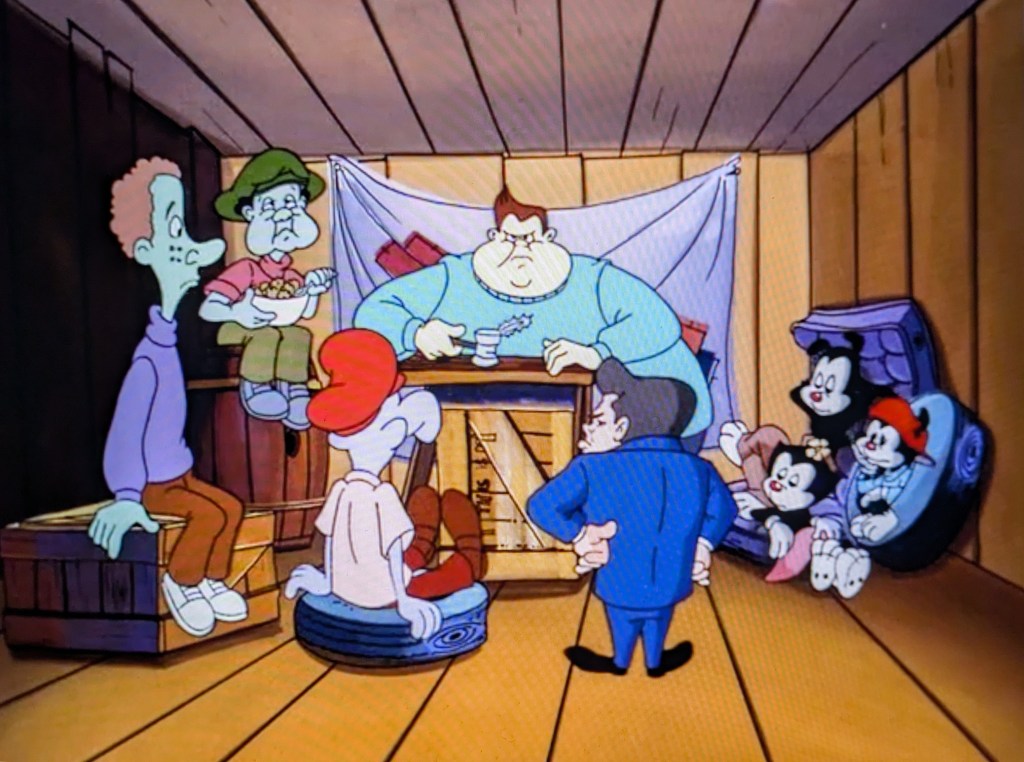
Plotz loses a costly gamble on another film starring Chicken Boo. Desperate for cash, Plotz has the Warners guest star on an episode of Thunderdogg, which has been sinking in ratings. They change up the show by stealing Thunderdogg’s magic feather and laminating it using the Gammalaminator, leaving him crushed by a heavy weight with a flattened lower body and legs after the show, while Sweet Polly Dognose is dropped into a tank of seawater and fed to a hungry seal bu Simon Sam Simeon. After that, the Warners are loaned out to Phlegmation. Phlegmation supervisor Lem Botchit explains that they never did cartoons like the Warners usually did, and that the Warners fouled up that studio’s stock animation system something awful. The Warners find themselves in a “vast video wasteland” in an episode of Orbese Orson, where they meet a morbidly obese boy named Orson, who says that he is going to chant a message to them. They prevent him from doing so, with Dot saying that they have suffered enough on Saturday mornings, and Wakko saying that they want to have fun. Orson takes them to a clubhouse, where he organizes a meeting with his friends: Gerald, Hooknoose Harold (who chokes on his nose), Muttermouth and Todd A-O (who is in the show because of his funny name). Upon hearing that the Warners want to have fun, Muttermouth and Gerald reveal that they do not have fun. Instead, they prefer to preach pro-social values until they spew out of everyone’s ears and all over the ground. Orson bans the Warners from their territory, much to their delight. They bring in the fun by rapidly kissing all the characters, who can’t move because of their limited animation. By this time, Warner Brothers eventually regains their profits, but Plotz neglects to inform the Warners about this, continuing to loan them out to other cartoons such as The Tro**kes (referred to as The Truffles by the Animaniacs Wiki). When the Warners learn of this, they return to the studio and beg Plotz to stop loaning them out. The CEO then explains that he intends to use the studio’s renewed profits to produce a follow-up film called Shamboo. Realizing that this is the same actor that starred in the box-office bomb Young Blood Squawk, the Warners destroy their loan-out contract and return to the Water Tower, kicking Shamboo out. They demand to not be called again until they can have their own network. As they play a game of cards, Yakko assures that they will be good for about 20 years, before Hooknose Harold ends the episode by choking on his nose.
Back in Style was written by Tom Minton and directed by Liz Holzman, the former of whom had worked as a storyboard artist at Filmation, Hanna-Barbera and Ruby-Spears. The main plot of the episode was loosely based off the time when Warner Brothers licensed the Looney Tunes characters (except Bugs Bunny, Speedy Gonzales and the Road Runner) to Filmation in 1972 for Daffy Duck and Porky Pig Meet the Groovie Goolies, and mostly inspired by Minton’s dislike of working on television cartoons with limited animation. Minton had also co-written the Mighty Mouse: The New Adventures episode Don’t Touch That Dial with Jim Reardon in 1988, which also involves a main character, Mighty Mouse, getting stuck in different television shows with limited animation.[114][115][111][112][116] Warner Brothers actually closed their animation department in 1963, but continued to release their last shorts until 1964. Chuck Jones was fired for working on Gay Puree at UPA before Warner Brothers’ animation department was closed in real life, and he spread a slightly inaccurate rumor that the animation department was closed in 1962 instead of 1963.[117][118] When Bugs Bunny and Daffy Duck leave the studio, Bugs says that there is a flavored drink commercial waiting for them, to which Daffy says, “Wait up, Texth!” The Looney Tunes characters did, in fact, star in commercials for flavored drinks like Kool-Aid and Tang after the Warner Brothers animation department closed, with Tex Avery returning briefly to direct them. Friz Freleng erases Bugs’ head on a drawing and replaces it with that of a panther. Speaking in a voice exactly like Yosemite Sam, he tells Chuck Jones that he has an idea and Jones does not, then rushes off to turn the drawing into a cartoon of his own, titled The Gray Panther, leaving a frustrated Jones in the dust. Sam walks out, happy to point out that Freleng sounds like him. Freleng drawing the Gray Panther is a reference to him co-creating the Pink Panther character alongside Hawley Pratt, initially for the opening credits of the 1963 Blake Edwards film of the same name, but the Panther would then star in a series of short films produced by DePatie-Freleng Enterprises, which Freleng co-founded with David H. DePatie. As mentioned some minutes ago, Jones was fired before Warner Brothers’ animation department closed in real life. Freleng’s Sam-like voice and the latter pointing it out is a reference to many people who worked with Freleng finding him to be rather similar to Sam. Treg Green’s name is a reference to Treg Brown, the sound editor for Looney Tunes and Merrie Melodies. Malice Ovey’s name is a reference to Alex Lovy, who worked at Hanna-Barbera and Warner Brothers-Seven Arts. Thus episode features parodies of Hanna-Barbera (Phil and Schmoe), Yogi Bear (Calhoun Capybara), Scooby-Doo, Where Are You! (Uhuru, Where Are You?), Underdog (Thunderdogg), Gamma Productions (the Gammalaminator), Filmation (Phlegmation), Lou Scheimer (Lem Botchitt), Fat Albert and the Cosby Kids (Obese Orson), Mike Todd of post-production company Todd-AO (Todd A-O), The Beatles television show (The Tro**kes/The Truffles), “Day Tripper” (“Night Traveler”) and Beatles impersonators Bay City Rollers (the Tro**kes/Truffles wearing kilts).[111][112][119][120][113] In Calhoun Capybara and Uhuru, Where Are You?, Hanna-Barbera sound effects are used to a moderate extent, as Yogi Bear and Scooby-Doo! were originally created by the latter studio. Also by that time, Hanna-Barbera officially became part of Time Warner, as its parent company Turner Broadcasting had merged with the latter nearly a year ago in 1996, in turn leading to its various properties becoming part of Warner Brothers in 2001. Additionally, Warner Brothers would assume production of new Scooby-Doo! material in 1999, beginning with Scooby-Doo on Zombie Island.[111][112][113] On the Variety newspaper saying, “Plotz’ Profits Thru Roof!” shown at the end of the Obese Orson scene, Microsoft Interactive is mentioned in one of the articles. Voices were provided by Rob Paulsen (Yakko Warner, Bristly (Shaggy Rogers) and Hooknose Harold (Old Weird Harold)), Jess Harnell (Wakko Warner, Lew-Lew (Boo-Boo Bear) Ed Meisker the Third, Muttermouth (Mushmouth) and Tro**kes/Truffles), Tress MacNeille (Dot Warner and Blance Sewer), Frank Welker (Thaddeus Plotz, Chicken Boo, Ralph T. Guard, Narrator, Uhuru (Welker’s Scooby-Doo impression), Ted (Welker’s Fred Jones voice) and Lem Botchitt (Welker’s impression of Lou Scheimer)), Jim Cummings (Yosemite Sam, Malice Ovey, Calhoun Capybara, Simon San Simeon (Simon Bar Sinister) and Obese Orson), Greg Burson (Bugs Bunny, Daffy Duck and Friz Freleng), Jeff Bennett (Chuck Jones, Treg Green, Thunderdogg, Gerald (Bill Cosby (character)), Todd A-O and Tro**kes/Truffles) and Gail Matthius (Phoebe (Daphne Blake and Velma Dinkley) and Sweet Polly Dognose (Sweet Polly Purebread)).[112][119][120] The episode was animated by Animation KOrea Movie Productions. It was originally supposed to air during Season 4, but it kept going through retakes because, ironically, AKOM kept making the animation too good when most of the parodies called for deliberately limited animation. This was also the last episode that AKOM animated for Animaniacs; Warner Brothers also never used them again for any series after this.[111][112][119][121][115][113]
Eric B stated, “All the spoofs were very good. They even did good remakes of Ray Ellis’ Fat Albert score and Hoyt Curtin’s early 1960s score for the Yogi spoof and his The New Scooby-Doo Movies score for the Scooby spoof. DePatie-Freleng Enterprises was in there too, briefly, when the caricature of Freleng changes Bugs Bunny into the “Gray Panther”. This truly was the “Silver Age” of Warner Brothers cartoons; exactly what made the Golden Age so great! Too bad it was quickly yanked away from the home of the Golden Age cartoons. And with the current policy of Warner Brothers making a not-so-integrated Turner company pay to air Warner Brothers properties, it probably won’t make any sense to try to get the rights to it back. I think that the racial swap in Obese Orson was just to support the spoof, and not for any sensibility or anything. If they made Orson and the others black, it would be too close to Fat Albert and take away from the humor of it. (And then the other characters; two of which are very close to the original Cosby Kids, they were just made raciallly neutral with green or purple skin). Also, I too didn’t understand the gag with the guy with the “funny name”. I at first thought that was the other guy in control of everything (Plotz) since he was short and wore the same blue suit, but the voice was completely different (Plotz was Frank Welker). So I looked up “Todd A-O” and it’s actually the name of a post-production company founded in 1953, providing sound-related services to motion picture and television industries, and also the name of the widescreen, 70 millimeter film format that the company was developed to promote and distribute. However, I still don’t quite get the joke, and why this guy named after this was suddenly stuck in the story there in the clubhouse. Was it a service that Filmation used often? I don’t remember seeing the name in any credits. Or was he really an Animaniacs supporting character? That’s what I was looking to see when I looked it up.”[119] Lou Scheimer himself mentioned the episode in his book Creating the Filmation Generation, and he seemed to have “had the power” (He-Man reference) to accept and handle the episode’s jab at Filmation and Tom Minton’s criticism.[122] Tumblr user legion1979 of Hello, Nice Warners! said, “Back in Style is generally considered one of the highlights from the later period of the series. It’s easy to see why, since it gleefully stomps all over the limited animation style that became prevalent in the 1960s and 1970s. The cartoon is stuffed full of references animation aficionados would recognize, from the closure of Termite Terrace (Bugs and Daffy head off to star in a flavored beverage commercial) to parodies of shows like Underdog and Fat Albert and the Cosby Kids. Much like The Warners’ 65th Anniversary Special, the cartoon is treated like a documentary. We get several interviews with people who worked behind the scenes at the studios the Warners were loaned out to, many of them well past the point of senility. One animator at a nursing home proceeds to draw all over the walls with his feet, while another ends his interview by asking who the current president is. The clips are remarkably true to the shows they are riffing on, and it’s been said that even AKOM (of all studios) had trouble to keeping the animation limited enough to mimic what Hanna-Barbera and Filmation used to do. The Calhoun Capybara cartoon has the appropriate simplistic backgrounds (which Wakko eats) and nonstop stock library music, while the Thunderdogg clip is particularly choppy and nonsensical. But the best is easily the Obese Orson sequence, which is a scathing commentary on just how terrible Filmation was as an animation studio. The entire segment is nothing but Orson and a group of Cosby Kid parodies sitting around a clubhouse talking, without moving anything but their eyes and mouths. None of the characters can do anything to stop the annoying Warners, since they have used up all the new animation (all three shots of it) just to get Orson to the clubhouse in the first place. A running gag involves someone named Hooknose Harold, who is constantly choking on his own nose in a tight close-up. It’s all unbelievably random and cheap, but that’s true of just about everything Filmation did. Writer Tom Minton had worked as a storyboard artist at Filmation (not to mention Hanna-Barbera and Ruby Spears) in the 1970s and 1980s, so all of this material must not only have been easy for him to write, but cathartic as well. But unfortunately, there’s one element that, at least to me, doesn’t work all that well. While the joke is that the Warners don’t belong in any of these low budget cartoons, they appear incredibly bored and lifeless throughout the whole thing. Very little of what they do is actually funny; Wakko eats some background overlays, they steal Thunderdogg’s magic feather and laminate it (why?) and bring Todd A-O into Orson’s clubhouse because he has a funny name. While the writing for the Warners definitely seems weak, what really hurts them is the animation. AKOM does a great job on the parodies, but their Warners are as bland as they usually are, when they really should be full of life and energy in order to contrast against the limited animation of the other characters. Instead, they tend to come off as flat as everything else they’re interacting with. Even a lot of their dialogue seems phoned in. Just imagine what this cartoon would have looked like if Wang had animated it, treating the parodies the same way they’re handled here, but working with the Warners in their usual snappy, fuller style. Fortunately, this cartoon is also the very last one animated by AKOM, and even with its faults, it’s still miles ahead of their previous batch of awful Warners cartoons. Despite how the Warners look, the studio really went the extra mile to make the limited animation parodies as authentic as possible. It’s nice that the studio was able to go out on a decent cartoon like this, as a good chunk of their work on this show usually ranged from average to terrible.”[111] DeviantArt user SofiaBlythe2014 stated, “If there’s one thing that can be said about television, corporate meddling can be problematic sometimes. I mean, you pour in all that hard work and sweat into the show only to be given the boot, or told to extend your show, because some people are too greedy. That is not right. But, we are not alone in that. The Warner siblings feel the same. In this episode, the Warner siblings get temporarily sent to different television shows when the studio is closed down. We have a lot of funny, over the top moments from Yakko, Wakko, and Dot. This cartoon features parodies of Yogi Bear, Scooby-Doo!, Underdog, Fat Albert and the Cosby Kids and The Beatles television shows, which are all awesome. It was cool to see the Warners play off the other characters. You definitely feel bad for them, and want to see them succeed. That ending was top notch. It’s a good episode.”[123] LuciferTheShort gave the episode a negative review, calling it “the absolute worst short from Animaniacs“. He said, “I understand that the Warners being annoying tricksters who aren’t above inflicting cartoonish injuries on other people is pretty much the point of their cartoons, but it only works if the people they annoy or harm did something to justify their actions. And the only conceivable offense that the unflattering parodies of Yogi Bear, Scooby-Doo!, Fat Albert and the Cosby Kids and Underdog could have possibly committed would be the simple fact that they are cartoons that weren’t made by Warner Brothers, and I consider it very petty to make digs at the competition (I know that the rights to Yogi Bear and Scooby-Doo! both belong to Warner Brothers now, but Hannah-Barbera was still a separate entity from Warner Brothers at the time). The absolute worst moment of the episode for me, however, was in the Underdog spoof, especially since I saw some Underdog cartoons when I was a child. Thunderdogg sees the equivalent of Sweet Polly Purebred about to be dunked into a tub by a parody of Simon Bar Sinister, but the Warners interfere and take away his magic feather before he can use it to regain his strength, resulting in the Polly ersatz being eaten alive by some manatee-like creature and Thunderdogg being squashed flat by the weight he was carrying. Now, one might at first assume that this was only how it happened in the filming of the episode and that Thunderdogg and Sweet Polly Dognose were none the worse for wear after their encounter with the Warners (after all, being crushed by weights and eaten alive were both things that already happened regularly on the show before), but in the present day Thunderdogg is shown to have never recovered from the injury when he opens his bathrobe to reveal his lower body still squashed and perched upon a stool. This gives the horrific implication that in bungling Thunderdogg’s rescue attempt, the Warners didn’t just cripple the canine hero for life, but also indirectly killed his significant other. I’d be a lot happier if cartoon parodies weren’t always slipshod potshots.” Anthone795 commented, “After seeing Back in Style, I quite agree. I mean look how sad all the characters from Looney Tunes (Porky, Daffy and Bugs) when have lost their jobs after Warner Brothers had closed down their cartoon studio for good. That episode was the worst I’ve ever seen in my entire life. It made me think about my mom’s restaurant, the Safari Dining Room in Atlantic City, which closed its doors forever on October 27, 2012.”[124] wileyk209zback/Zak Wolf gave the episode a positive review, saying, “Really funny stuff, I will say. For the most part, the Warners are quite bored being in these television cartoons, so they don’t get to do much of their usual schtick, but what makes it funny is how the cheesy animation and writing are parodied. The overseas animation was done by AKOM, whom did a pretty good job for the most part at mimicking each cartoon’s style. Though I think it may have been better if they got Wang Film Productions to animate it. Seeing as Wang originally started out in the late 1970s as a satellite animation house for Hanna-Barbera (very much like the ones they had in Australia and the Philippines), I bet Wang could have nailed Hanna-Barbera’s limited animation style very easily. Though ironically by the 1990s, Hanna-Barbera’s animation was often getting less and less limited and cheesy (with a few exceptions, like Scooby-Doo! in Arabian Nights and its wonky animation), as they were getting bigger budgets to work with, and had to step up its’ game due to their competiton improving in animation quality as well (it was Disney’s Gummi Bears and DuckTales that helped make way for high-quality television animation). Now I will point out that Warner Brothers Animation did briefly reopen in 1967, but their cartoons focused much less on their popular stars and more on new characters like Cool Cat, and also looked more like Filmation or Hanna-Barbera cartoons than classic Warner Brothers animation (kind of ironic here, huh?). As for loaning out the Warner siblings, this obviously appears to be inspired by the time Warner Brothers “loaned out” their Looney Tunes stars (sans Bugs Bunny) to Filmation for Daffy Duck and Porky Pig Meet the Groovie Goolies in 1972. The Tunes had to be adapted to limited animation (Daffy already had experience in the 1967-1968 Speedy Gonzales cartoons Warner Brothers Animation produced at that time), and for the most part it was a mess, but I find it to be a “so bad it’s good” kind of deal. Maybe that was why this Animaniacs apisode really bashed Filmation here? Whatever; it was still really funny!”[112] JCFanfictions gave the episode a negative review, saying, “Animaniacs is a good show, but there are shorts I hate, like this one, which is part of the first episode of the final season. Done in the form of a documentary, the short tells of a time when Warner Brothers closed its animation studio. As the beloved characters are fired, Mister Plotz decides to release a film called Young Blood Squawk starring Chicken Boo, but when it bombs (resulting in a riot), and the studio is in financial crisis, Plotz starts lending the Warners (who were locked in the Water Tower ever since the studio closed) to other companies, and this is where it gets bad, as the short basically shows the trio causing chaos on the sets of cartoons that are blatant parodies of other cartoons (and this was before the Warner Brothers-Hanna-Barbera merger). The parody characters get hurt by their antics (with Thunderdogg being permanently disfigured and the damsel being eaten alive, which is very out of character for the Warners, since their chaos is not supposed to be mean-spirited). And all the while, Mr. Plotz makes money off their chaos, with no consequence to the damage they did (possibly because of a clause in the contract). The bashing of other cartoons is uncalled for. Also, Thunderdogg’s voice sounds too close to Gogo Dodo, which makes his line annoying for my ears to tolerate.”[124][125] Michaelsar commented, “While I do not hate this short, I agree that the ‘Warners keep the Underdog parody from saving the day’ scene is pretty mean-spirited.”[126] Mike Clemente of MC ‘Toon Reviews gave the episode an A-, saying, “In addition to poking fun at how limited and low-budget early 1960s and 1970s animated shows were, this cartoon is also an inventive way of building the Warners’ background. It is all an interesting way of incorporating real life animation history, but part of it also takes out a lot of the animated fun that defines this series. Regarding the Warners’ role, I feel mixed. First, there are a few contradictions of established facts about them. It’s been constantly said that their cartoon careers ended long before this period with them sealed in the Water Tower in the 1930s. Also, despite taking being locked in the Tower well and enjoying the few times they were let out for fumigation, here they act tortured through the loaning process. In addition, it was shown not long ago that they were loaned out before to star with a parody of Fleischer cartoons and they took that reasonably well too. At the same time, they do succeed in pulling off hilarious riffs on how cheap cartoon production values were in this period, showing they still got comedic strengths. They first go after easy 1960s animation targets in spoofs on Hanna-Barbara shows. In a Yogi Bear parody, Calhoun Capybara, they mock the simplistic dialog and flat background overlays as they go after Calhoun for trying to poach lunchboxes. In a Scooby-Doo! parody, Uruhu, they ignore the boring talk of a mystery at hand to ride the dog. Going beyond Hanna-Barbara, the Warners are loaned out to other cheap cartoons. An Underdog parody is stripped of his McGuffin which gets him crushed and his bland girlfriend eaten. A Fat Albert parody is mocked for characters saying they’re going to have fun, but they just sit around and talk about boring stuff. These are all clever honest jabs at corny and cheap styles, but there are a few things holding it back. In addition to the Warners looking truly pained by the loan-outs, there are realistic repercussions to their antics. There is a mention of Uruhu being sent to the vet because of them, and the Underdog parody getting seriously injured after they let him get crushed. If they are cartoon stars, shouldn’t they easily be able to shake off any pain and not be dismembered for life like this? Things like this make the cheapness gags harder to enjoy than they need to be. For that it is practically refreshing when the Warners hear about Warner Brothers’ profits being through the roof and stop the process completely. All they have to do is tear up the contract and kick Chicken Boo out of their tower, and soon they will have their own network, the Warner Brothers channel as we know it. If you can’t get into cheap 1960s shows for their half-hearted scripts and lame production values, this is a solid watch. However, for how real it frequently makes the physical and emotional pain of others, its way of doing so is fine, but not the best way it could be pulled off.”[127] Kevin Johnson of The A.V. Club stated, “Back in Style sees the siblings loaned out to a variety of animation studios, letting the writers poke fun at the limited animated television programs from the 1950s through the 1970s. The reach of the shows parodied is impressive. Sure, they do the obvious ones like Yogi Bear and Scooby-Doo!, but they also get at Underdog, Pink Panther, and Fat Albert and the Cosby Kids, while also showing caricatures of creators like Friz Freleng and Chuck Jones. The broad jokes toward that era of animation were nothing new in 1997, but the visuals and funky narratives were effective, and even the Warners themselves are unable throw off these classic animated worlds. The bit still dips into lazy humor at times (the Fat Albert kids talk very explicitly about how limited they are in animation), but overall, it stays on the right side of mean. The loan-out documentary format adds some historical winking cleverness as well. Even at this point, when the show had a target in its sights that it really grasped, it went all out.”[128] TetsuKnife reviewed the episode, saying, “I honestly hated this segment in Animaniacs. Yeah, it’s technically funny, but give how all of Amblin’s animated shows from the 1990s used OUTSOURCED animation on its dime, where do they get off making fun of television-budgeted cartoons from yesteryears? This entire episode, whether it’s making fun of Yogi Bear, Underdog or Fat Albert, just came off as hateful. (And to be clear I’m not saying that you CAN’T make fun of these shows, just don’t aim below the belt.)”[120] Dinobolt1 commented, “To me it wasn’t that they were making fun of themselves but more of a series of bitter jabs at Hanna-Barbera, Filmation and Total Television. I thought that this sounded like a great episode but when I watched it for the most part I found the parodies to be too mean for me to enjoy. I did like the animation styles, but this is not what I thought it would be. I was expecting that we would just cut between the Warner siblings’ exploits in various other cartoons going along with the script but making jokes about the animation and the writing, not tormenting the characters for no good reason from the audience’s perspective. The Warner siblings are supposed to only be annoying characters who deserve it, like Dracula or the devil. The episodes with Mister Director worked for me as a kid even before I knew who Jerry Lewis was because he sounded so pretentious that it was hilarious to see him get smacked around. Here Warner Brothers Animation was like, “These shows are so lame, our characters are so much better!” and just focused on the superficialities of them making these seem like cheap caricatures. The Underdog parody was the worst because it made no sense why they took away his feather and Thunderdogg should NOT have been permanently crippled after that. He’s a cartoon character so shouldn’t he go back to normal eventually? Brain has been literally reduced to ashes but he recovered instantly so why the heck wouldn’t somebody merely squashed flat recover too? It’s pretty bad when a cartoon is very selective about who cartoon logic applies to. Obese Orson was my favorite because it was exactly like what I thought the episode would be like, and the jokes weren’t that mean. But as a whole, this just came across as wasted potential. There were so many other ways they could have made it funny; I am especially disappointed that they didn’t even face a monster in the Scooby-Doo! parody. They could have annoyed the monster or commented that it’s obviously a guy in a costume. I like Scooby-Doo! but my favorite series are the later ones like The 13 Ghosts of Scooby-Doo (which Tom Ruegger worked on), Scooby-Doo! Mystery Incorporated and Be Cool, Scooby-Doo!. These all bring something new to the table, and the episodes stand out more from another, especially 13 Ghosts, which is more than I can admittedly say for the original series. The Mighty Morphin’ Power Rangers parody Super Strong Warner Siblings was vastly superior to this episode because it does what the best parodies should do. It didn’t exaggerate the flaws of what it was making fun of, it merely held up a mirror to them.”[129] That Dude commented, “I do not really agree to that Animaniacs episode since they were bashing Hanna-Barbera and even Gamma Productions for no real reason other than to say, ‘Look, cheap cartoons, therefore, bad! Aren’t we relevant?’ I mean, if the whole episode was to trash on Filmation, then it is whatever since they are a nobody studio compared to Hanna-Barbera.”[130] Trevor Thompson incorrectly said that the epoisode was based on “standard Filmation s*****ness”, and despite Tom Minton being the sole writer of the episode, claimed that Minton “was a contributor to [the] script and it was written by former Filmation employees venting”,[131] and falsely called Hooknose Harold from Obese Orson “just as subtly racist as Fat Albert and the Cosby Kids” (the racism in Fat Albert was only one of the serious yet toned down themes taught by the series).[132] While Back in Style has some funny moments, in terms of story I do not like the fact that the limited animation parodies are not particularly affectionate, instead feeling more like bitter jabs. The Warners are usually karmic tricksters, but in this episode, even though they are loaned out against their will to the other studios by Plotz and confront and beg him not to do it again at the end, they are mean-spirited and do nothing but insult, humiliate and injure the cartoons’ main characters unprovoked. The worst offender would be in the Underdog parody, Thunderdogg, where they prevent Thunderdogg from rescuing Sweet Polly Dognose and cause him to suffer an injury that leaves his lower body deformed for life. Filmation (Phlegmation) and Fat Albert and the Cosby Kids (Obese Orson) also seem to particularly get the worst of the parodying, due to Warner Brothers licensing the Looney Tunes characters to Filmation for Daffy Duck and Porky Pig Meet the Groovie Goolies. The Lou Scheimer parody’s (Lem Botchitt) surname is clearly a harsh play on “botch it” as in “producing bad television animation”, and Hooknose Harold has an aquiline nose, which Weird Harold in Fat Albert never had. As a result, Filmation would eventually be sometimes mimicked as “Phlegmation” by people like wileyk209zback/Zak Wolf and Marc Baker. The Joseph Barbera parody’s name (Schmoe) is a pejorative term meaning “stupid” or “foolish”. The only known recollections of the real Barbera acting this way during his lifetime are when he was being a braggart and criticized Ed Benedict’s character designs for not looking cute enough at Hanna-Barbera,[133] agreed with and shared John Kricfalusi’s dislike of Scooby-Doo! and other modern cartoons of the time (he actually pretended to agree just to be on Kricfalusi’s good side),[134] agreed with the executives at Universal Pictures to replace Judy Jetson’s voice actress Janet Waldo with Tiffany for Jetsons: The Movie (though he did apologize for it at Don Messick’s retirement party),[135][136][137] and Dennis Marks and other writers taking dictation from Barbera every day.[137][138] The Alex Lovy parody’s (Malice Ovey) first name is a noun meaning “a desire to cause pain, injury, or distress to another, or the intent to commit an unlawful act without justification”, with the gag where he draws on the wall with his feet unfairly poking fun at Lovy’s work at Hanna-Barbera. It does not help that Don’t Touch That Dial, which was co-written by Tom Minton, makes fun of The Flintstones, The Jetsons, Scooby-Doo, Where Are You! and The Real Ghostbusters through widely inaccurate parodies. It also comes across as preachy because it ends with the message that Mighty Mouse: The New Adventures is good and all the other cartoons (and to a lesser extent, television in general) are bad.[139] Not all limited television animation is bad, and it has gotten better during the Renaissance age. To quote John of the Central Rappahannock Regional Library, “High-quality writing could make up for low-quality production. For example, The Adventures of Rocky and Bullwinkle and Friends was noted for clever humor and subversive writing that made it popular with teenagers as well as kids. Filmation’s Star Trek: The Animated Series employed many talented writers, including Larry Niven, to create its scripts. However, shows such as these tended to be the exception rather than the rule, as many television cartoons from the Dark Age tried to be as inoffensive and bland as possible to avoid angering parents’ groups.”[140] Ralph Bakshi rose to prominence during the 1970s and 1980s thanks to his breakout adult comedy hit Fritz the Cat, followed by The Lord of the Rings, Heavy Traffic, American Pop, Fire and Ice and Heavy Metal. All these films, along with Watership Down, proved that cartoons were and are not always for children. Fortunately, the Warners are shown to get along with the Beatles parodies, the Tro**kes/Truffles, and do not insult, humuliate or inure them (interestingly, Wakko’s Scouse accent was inspired by The Beatles drummer Ringo Starr). There was a series of 1997-1998 Cartoon Network bumpers where the Warners run through various programs and interact with the characters within, including Hanna-Barbera’s Scooby-Doo, Where Are You!, The Flintstones, The Smurfs, Snorks, and The Jetsons. In Scooby-Doo!, they disguise themselves as the Zombie and Witch (from the episode Which Witch is Which?) and exclaim, “Hello, Daphne!” upon being unmasked by Velma Dinkley, much to Daphne Blake’s confusion. Scooby-Doo runs away from Wakko, who says that he just wanted some Scooby Snacks. During his search for the snacks, he finds Velma’s glasses, to which Dot emerges from the door saying, “Jinkies!”[141][142][143] One of the bumpers features Slappy Squirrel interacting with Jonny Quest.[141] The Animaniacs reboot episode Suffragette City contains cameo appearances of actual Hanna-Barbera characters like Yogi Bear, Boo-Boo Bear, Huckleberry Hound, Snagglepuss, Auggie Doggie, Doggie Daddy, Yakky Doodle, Ricochet Rabbit, Magilla Gorilla, Secret Squirrel, Fred Flintstone, Barney Rubble, Wilma Flintstone, Betty Rubble, Pebbles Flintstone, Bamm-Bamm Rubble, the Great Gazoo, George Jetson, Penelope Pitstop, Speed Buggy, Mark, Tinker and Debbie.[144] Considering that the Warners do not injure Mystery Inc. when showing up in Scooby-Doo! in the bumpers, and Dot rallies the Looney Tunes and Hanna-Barbera characters to march for their cartoony rights to vote in the episode, she and her brothers seem to be nicer toward them than the parodies.
With all that said, what happened to Filmation in the end? Well, the studio was closed and sold to L’Oréal’s Paravision International by Westinghouse on February 3, 1989, nine years prior to Back in Style‘s airing.[145] Filmation may have given creative job titles and produced shows with limited animation, but that does not mean that they mocked animation or destroyed its legacy. According to Brian Camp of Cartoon Research, Lou Scheimer ran Filmation like a family and encouraged collaboration and sharing of ideas.[146] In the documentaries The Magic of Filmation (2006) and Animation Maverick: The Lou Scheimer Story (2008), Scheimer, director Hal Sutherland and numerous animators and writers who used to work for Filmation speak eloquently and enthusiastically about their tenure there. Filmation had a somewhat small staff, and tried to make the best programs that they could for the budgets that they were afforded, keeping all the work in the United States of America, whereas other studios would increasingly outsource the work off to countries like Japan, Taiwan and the Philippines. Not all of Filmation’s dialogue, jokes and gags were literal-minded, and even if they were, the writers genuinely made an effort to try to entertain the children watching back in the day. They even made a number of attempts to rise above the standard animated fare and produce good shows such as The Archie Show, Sabrina and the Groovie Goolies, Fat Albert and the Cosby Kids, Star Trek: The Animated Series, The New Adventures of Flash Gordon, He-Man and the Masters of the Universe, She-Ra: Princess of Power and Bravestarr. Chuck Menville and Len Janson wrote episodes for some of these shows, as well as ones not made by Filmation and considered the best Saturday morning cartoons, such as The Flintstones Comedy Hour, Hong Kong Phooey, The Smurfs and Sonic the Hedgehog (SatAM). Filmation also included “pro-social values” and post-episode public service announcements in most of their shows, just as a matter of principle, because Scheimer and company took their jobs as children’s entertainers seriously, not just to deflect criticism of shows like He-Man and Bravestarr being half-hour toy commercials. Their richer backgrounds made up for the limited animation and, in Eric B’s words, “are part of what made the shows memorable”. Despite the limited quality of their output and their strict “on-model” policies, there were a few animators who tried to do better, including Tom Sito and Eddie Fitzgerald. In their later years (1979-1989), Filmation made usage of smooth and fluid animation in their work, such as The New Adventures of Flash Gordon, Flash Gordon: The Greatest Adventure of All, Pinocchio and the Emperor of the Night, Bravestarr and Bravo!. In Flash Gordon‘s case, this proved that given the chance and the budget, the studio really could deliver animation worthy of the big screen. The studio also utilized new techniques, such as rotoscoping athletes for running, jumping and swimming scenes, and moire backlighting effects for lasers and energy fields. It is just sad to me that the studio is continuously bashed and dismissed solely as one with subpar animation and sanitized stories to this day, and its productions were in limbo in the early-to-mid 2000s, even after its closure in 1989 and Prescott and Scheimer’s deaths in 2005 and 2013, respectively.[147][148][149][150] Such examples of criticism include Trevor Thompson confusing the writers with the animators and calling them “hacks”; Tom Minton referring to the studio as “Phlegmation”, Don M. Yowp calling The Archie Show “wretched”[151] and refusing to watch cartoons on Saturday mornings because of the studio,[152] Mark Kausler calling Lou Scheimer, Norm Prescott and Hal Sutherland “the Terrible Threesome”[153] and calling the studio’s work “utter junk that doesn’t deserve preservation”, with Thad Komorowski agreeing and calling the studio “evil”;[154] Pembroke W. Korgi angrily shouting, “SCHEIMER!!!” in some of his videos focusing on Filmation’s shows,[155] criticizing Frank Welker’s female voices in The New Adventures of Mighty Mouse and Heckle and Jeckle and The Tom and Jerry Comedy Show, unkindly and jokingly calling Lou’s son Lane Scheimer “LAME Scheimer” for his poor voice acting for Sport Billy and seeing that as nepotism (Pembroke would later admit in 2024 that Lou Scheimer would hire his family members, including Lane, to do voices in Filmation’s shows mostly on the cheap and not entirely due to nepotism;[156] he would also apologize to Lane for calling him “LAME Scheimer” and say that he does not deserve that, and remember that Lane’s Billy voice was sped up slightly to sound like a kid in the Sport Billy episodes Joust in Time and A Race in Space, then the editor, Joe Gall or Robert Waxman, forgot to speed up the voice for the rest of the episodes;[157] Corinne Orr did a somewhat better job at voicing Billy in the Peter Fernandez feature film redub),[158] and childishly overreacting to the idea of Hal Sutherland’s son Keith Sutherland, Lou’s daughter Erika Scheimer and Lane voicing Ben Turner Junior, Susan Turner and Jackie Turner and Gene Fox in Lassie’s Rescue Rangers, seeing that as nepotism as well and Lane’s voicework as a “trigger” for his “bad memory” of Sport Billy (to be fair, the child actors’ voice acting in Lassie’s Rescue Rangers is not that bad, and Lane was a teenager when voicing Jackie and Gene and Lane was a teenager when voicing Jackie and Gene Fox at the time, who are teenagers themselves);[159] Jarmel Rudd commenting that Sport Billy is “the only show from Filmation that makes [him] run, RUN very far away from Lou [Scheimer]’s wrath”,[160] James Irish making a cruel knock knock joke about the Lassie’s Rescue Rangers episode Deadly Cargo (“Car go beep beep and almost run Lassie over!”) to give Pembroke an idea of the mood that he is in (anger),[161] whiningly disliking the inclusion of a raccoon (Robbie) in the show,[162] screaming about using “dodgems” instead of “bumper cars” to keep his sanity,[163] and indicating that Frank Welker’s female voices make him and Pembroke lose their sanity by saying, “So mercifully for our sanity…” when talking about Joyce Bulifant’s roles in Sport Billy;[164] and both preparing for war against Lassie’s Rescue Rangers before being told that they are covering Chip ‘n’ Dale: Rescue Rangers.[165] No offence, but Trevor, Yowp, Kausler, Thad, Pembroke, Jarmel and James’ dislike (love-hate for Pembroke) of Filmation and reactions just scream Hyde and Go Tweet Sylvester (05:55levels of cowardice to me.
*Written in Notepad.
 mysuperendeavour