
After the original 114 Tom and Jerry cartoons directed by William Hanna and Joseph Barbera, the Metro-Goldwyn-Mayer cartoon studio closed on May 15, 1957, and the cat and mouse duo were leased to Rembrandt Films (run by Gene Deitch) and Sib Tower 12 Productions (directed by Chuck Jones), who changed the designs and eliminated all of the supporting characters.[1][2] In 1975, Hanna and Barbera produced The Tom and Jerry Show under their own studio (with Metro-Goldwyn-Mayer) for the American Broadcasting Company. Due to the network’s Broadcast Standards and Practices and the reaction against violence in cartoons at the time, they made Tom Cat and Jerry Mouse friends in most of the episodes. The series was not well-received due to this change. Despite this, the sports-themed episodes stayed true to the original cat and mouse rivalry, depicted them as competing rivals, and some regular episodes pitted them against each other. The series also reintroduced Spike as a recurring character.[3][4] Metro-Goldwyn-Meyer did not like what Hanna and Barbera had done with the characters, so they approached Filmation Associates (Hanna-Barbera’s leading competitor for television animation at the time) and asked the studio to produce a new series and try to bring some life back to them. Their result was The Tom and Jerry Comedy Show, also known as The New Adventures of Tom and Jerry in other countries or referred as Tom and Jerry in the intro and title cards. The series aired on the Columbia Broadcasting System for Saturday mornings in 1980, and was the first attempt since the Metro-Goldwyn-Mayer cartoon studio’s closure to restore the original format of the cat and mouse team. This series was able to restore the familiar slapstick chase format, albeit with Tom and Jerry as “competing rivals” rather than enemies, similar to the 1975 sports-themed The Tom and Jerry Show episodes, and reintroduced not only Spike, Tyke and Nibbles (here named “Tuffy”), but also some of the other Metro-Goldwyn-Mayer stars, like Droopy Dog, Tex Avery’s villainous wolf and Barney Bear.[5][6] 30-minute episodes would consist of two seven-minute Tom and Jerry episodes, plus one Droopy cartoon in the middle.

Spike from Tom and Jerry was used in many of the Droopy episodes as well, filling in for the other “Spike” bulldog created by Tex Avery for the old Droopy cartoons, who was not used as a separate character here. The wolf was also included, here named “Slick Wolf”. The Droopy episodes usually featured Slick and sometimes Spike as antagonists. Barney had miscellaneous roles, such as being Droopy’s boss at a film studio in Star-Crossed Wolf and a frightful companion in a haunted house in Scared Bear. Due to the series being produced under the “Seal of Good Practice” code, Red from Red Hot Riding Hood (1943) who would not reappear until Tom and Jerry Kids (1990); the only cartoons featuring her that played at the time of the series’ airing were Swing Shift Cinderella (1945) and Little Rural Riding Hood (1949). Characters not seen in this series of Tom and Jerry cartoons are Mammy Two Shoes, Butch, Quacker, Meathead, Topsy, Lightning and Toodles Galore. The show’s intro begins with Tom chasing Jerry through a blank red screen (similar to the title card in the intro for the Tom and Jerry cartoons directed by Chuck Jones). Droopy Dog appears and says, “Hi, folks!”, and the screen collapses, revealing Spike, Slick and Barney building a giant “Tom and Jerry” sign (similar to the building in Tom and Jerry Kids‘ second intro). Tom and Jerry continue chasing, with Jerry eating a banana and throwing it in Tom’s path, causing him to crash into Slick, who lands in a bucket of red paint. This causes Spike to lose his balance and fall with his ladder, crashing into Barney, who gets one of Spike’s buckets of blue paint stuck on his head. Droopy, however, is unharmed. The familiar rotating executive producer credit of Lou Scheimer and Norm Prescott briefly runs as Barney slips on wet paint as he gets Spike’s bucket of blue paint off his head. Everyone except Droopy is chasing Jerry as the sign is ruined. After this, Tyke and Tuffy appear and are playing on the ladder. Tyke pulls a lever on the ladder, extending it and sending Tuffy up to Droopy. The ladder picks Droopy’s bucket of red paint up, and it falls on Tom’s head, and Spike, Slick and Barney fall over him. Jerry whistles and waves at Tom, Spike, Slick and Barney, who angrily arm themselves with paint as Droopy leaves. They throw the paint at Jerry, but they miss and cover the sign in paint, finishing it. An announcer (Scheimer) announces “The Tom and Jerry Comedy Show!”, while Tom and Jerry poke their heads through the sign and smile, and Jerry winks at the end. After the intro, the wraparound segments, hosted by Droopy, would begin. He would paint the whole background with a single large brush stroke (making stylistic use of Filmation Associates’ characteristic “limited animation” technique), and he, Spike, Tyke, Tuffy, Slick and Barney would engage in brief comedic sketches (like Droopy’s opening poem in the first episode, “Roses are red, violets are blue, painting’s my job, that’s what I do; cute and somewhat wet.”). The outro consists of a slightly different version of the opening theme song, with footage from Farewell, Sweet Mouse and Droopy’s Restless Night behind the credits. The Filmation logo appears, coming into focus, followed by the Metro-Goldwyn-Mayer Television logo.
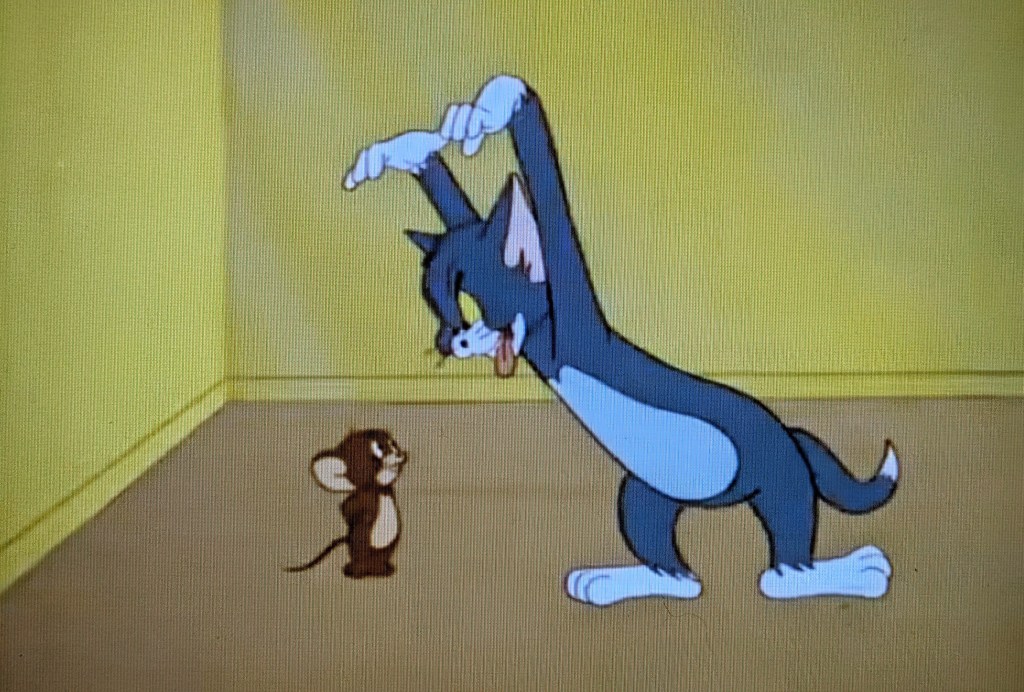
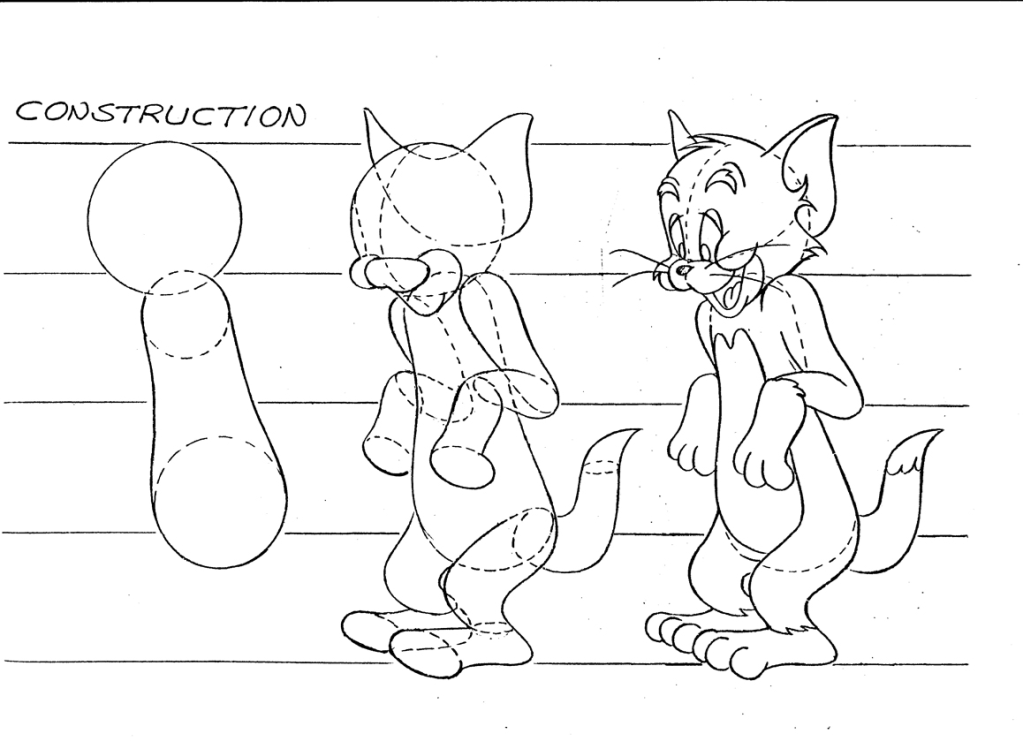
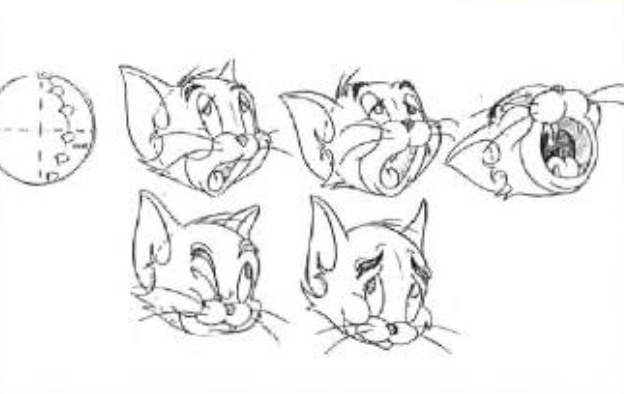

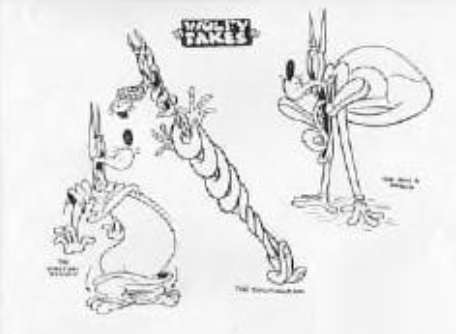
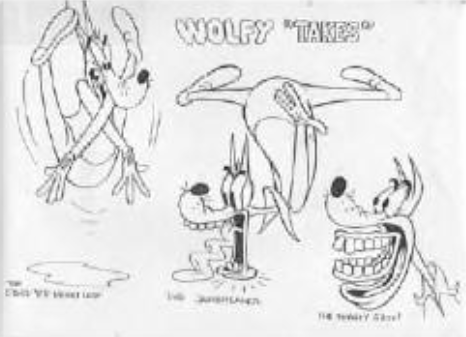
Generally, the animation quality was decent, but not as smooth as the Tom and Jerry cartoons directed by Hanna, Barbera and Chuck Jones. The animation of Tom chasing Jerry toward the screen at the beginning of the intro was reused. This was a common error with Filmation shows as they and DePatie-Freleng Enterprises were strongly against outsourced animation. In 1979, Filmation hired John Kricfalusi in the layout department headed by Franco Cristofani. The layout department was in an annex away from the main offices. There were two layout units, and Kricfalusi was in Cristofani’s working on the Droopy episodes. The studio’s character designer, Alberto De Mello, had recently discovered construction model sheets of classic cartoon characters from the 1940s, which showed artists how to draw the characters by dividing them into their basic shapes, like in Preston Blair’s famous animation instruction books. Eddie Fitzgerald or one of the storyboard artists had shown him the Preston Blair book and some original studio model sheets, much to De Mello’s excitement.[7][8][9] The animators had to draw Alberto De Mello’s model sheets, which Kricfalusi described as “wildly elaborate, yet nonsensical”, with the characters “being made up of frightening balloon-like shapes and sausage fingers and toes”. He refused to draw them this way, keeping the old model sheets at his desk and using those instead.[10][8][9] Working with the high-energy Metro-Goldwyn-Meyer characters seemingly created similar manic energy in Filmation’s staff, for the writers were suddenly able to come up with the laughs needed to make the show work. Coslough Johnson and Jack Hanrahan wrote a lot of the episodes’ scripts, though others such as animators Steve Clark and Jim Mueller contributed to the stories as well, therefore getting their names added to the credits. Due to the series’ low budget, Filmation could not put the same quality of animation that Metro-Goldwyn-Meyer had done for the theatrical shorts, but did try to let animators go wild as much as possible and add a lot of slapstick.[5] Kricfalusi and some of the animators, including classic 1930s-1940s animators Tom Baron, Ed Friedman, Dick Hall, Don Schloat, Larry Silverman, Kay Wright, Lou Zukor, Ed DeMattia, Lee Halpern, Alex Ignatiev, Jack Ozark and Curt Perkins, wanted to rebel against Filmation’s mandates of reusable animation and their strict “on-model” policies where model sheets had to be traced, and sneak in some fluid animation, as seen in episodes such as Scared Bear and Jerry’s Country Cousin. The working environment came to resemble that of the Metro-Goldwyn-Meyer animation studio, as Fitzgerald, Tom Minton and many other storyboard artists drew some funny and lively storyboards as reference for the animators,[10][8][11] developing unscripted sight gags as part of a genial rivalry with the writing staff. This overall sense of euphoria carried over into the cartoons themselves. Though hobbled by stock footage, limited animation and network censorship, The Tom and Jerry Comedy Show was, for Filmation at least, a remarkably fast-moving and funny program. To Kricfalusi, however, he felt that when the animators saw the finished cartoons, they “looked bland, stiff, lifeless and boring”. Kricfalusi found layout work to be much easier than creating storyboards. All the staging was already figured out, and Kricfalusi could draw bigger and concentrate more on the poses and expression of the characters. He always hoped for Fitzgerald’s boards because they were the easiest and most fun to work from, with clear staging, and dynamic, direct, funny poses. He copied Fitzgerald’s poses, making them bigger, drawing them tighter and adding more details to the expressions. He also started to add more poses on his own to break down the actions. Filmation only wanted one pose per scene, but drawing the characters acting was where Kricfalusi could exercise some creativity and have a good time. The other layout artists in the department would come over to see what he was doing because it was so much livelier than the typical television layout drawing. Doing layouts at Filmation gave Kricfalusi the foundation to later build on his own television animation system.[10][8][11] After Kricfalusi did the layouts, Lynne Naylor, who was in the animation department, would animate the Droopy episodes. According to Kricfalusi, this was the way that everything would get through the pipeline without being watered down. At the same time he was still discovering old cartoons that he had never seen before, and tried to put elements of them into his layouts. There was one particular scene in an episode that he was doing a layout for, where a character had to do a fast zip pan from one area to another. Kricfalusi had been studying Chuck Jones’ The Dover Boys at Pimento University, and saw abstract background pans that did not make sense but propelled the movement along, and he thought that was really neat. So he drew a long panning shot where each end of the pan was a normal background, but filled the middle with crazy, abstract shapes and floating eyeballs. A few days later, Cristofani came in and told Kricfalusi that there was a big problem downstairs with one of his scenes. The head of the background department, Erv Kaplan, who painted everything pink-purple-and green, was having a fit. He had discovered Kricfalusi’s eyeball pan and refused to paint it. Cristofani sent Kricfalusi down to speak with him. Not knowing what to say and expecting to get fired, Kricfalusi entered Kaplan’s office and saw him in a huff, sitting there in a pink, purple, and green-stained smock. When asked why he did not want to paint the background, Kaplan answered that he did not like it and it made no sense. Kricfalusi started talking about The Dover Boys to Kaplan, but he did not want any part of it, telling him never to put eyeballs or abstract shapes in the backgrounds again.[10][8] Naylor would never try to offend anyone, but she apparently offended Filmation producer Lou Scheimer one time. He had seen a section of Pest in the West at the Moviola, which was full of “smear frames”. He threatened to fire Naylor over her use of them, but the head of the animation department went to bat for her and managed to calm Scheimer down. Naylor kept her job, but was more cautious after that episode.[10][8][12][13] In addition to the limited animation, the show was characterized by a very limited music score. The particular genre of music used in the show was ragtime, in an attempt to mimic the classic cartoons (which used swing music, big band and funk music, but not ragtime). All of the episodes used the same stock, mostly created for the series, but consisting of only a handful of largely synthesized tunes, either with minor variations or played at different speeds or pitches. This did match the chase scenes, but gave the episodes a very monotonous soundtrack, making these episodes “stand out” to many Tom and Jerry viewers when they aired. Some of the tunes and sound effects were recycled from The Archie Show (1968) and The New Adventures of Mighty Mouse and Heckle and Jeckle (1979). Where the Tom and Jerry cartoons directed by Hanna, Barbera and Jones would have favorable endings for Tom occasionally, this series followed the Tom and Jerry cartoons directed by Gene Deitch in never having definite “wins” for Tom (although he won at the end of Most Wanted Cat (with Jerry) and Superstocker and they ended off mutual in When the Rooster Crows and A Connecticut Mouse In King Arthur’s Cork). Also similar to the Deitch cartoons was the character design, with Tom and Jerry being drawn similar to the original, but still slightly different; Tom’s design resembled his late 1940s-early 1950s Hanna-Barbera design and had thicker eyebrows similar to his design in the Jones cartoons, and the brown color of Jerry’s fur was darker. Spike’s design in the Tom and Jerry episodes and the wraparound segments was somewhat close to his Hanna-Barbera design, whereas his design in the Droopy episodes was more plump and portly in appearance and slightly shorter in height. Droopy was the most noticeable change, although unintentional, as his face was no longer drooping at times. He also had gray eyelids and a white muzzle instead of lavender eyelids and a peach muzzle, respectively.[14]

According to Lou Scheimer, Frank Welker provided voices for the first six episodes, but was unable to continue work when a Screen Actors Guild strike hit, so Scheimer had to fill in as voice actor.[1] Welker voiced Tyke (in The Puppy Sitter; the character was silent in the wraparound segments) and Droopy, and Scheimer voiced Tom and Jerry.[15][16] As a result of the strike, both Welker and Scheimer alternated the voices of Spike, Tuffy, Slick, Barney, Tom’s owner and other characters in the wraparound segments and episodes (Welker voiced Santa Claus in Snowbrawl, the radio announcer in the wraparound segment before Getting the Foot, and P.T. Barnone and Harry in The Great Mousini). Droopy was seemingly the only exception and the character that Scheimer filled in for the least, indicating that A) Welker recorded his voices (including Droopy) for the aforementioned first six episodes and more before the strike (most likely), or B) Scheimer filled in for Welker, and Welker returned to rerecord Droopy after the strike. Whereas Welker’s portrayals of Spike, Tuffy (in the wraparound segments before New Mouse in the House, Heavy Booking and Getting the Foot), Slick, Barney and Tom’s owner were pretty good, Scheimer’s takes on Spike, Tuffy, Slick, Barney and Tom’s owner were poor and rather inconsistent. For example, Scheimer erroneously gave Tuffy an adult voice, although his voice sounded appropriately higher and childlike in the wraparound segments before Droopy’s Restless Night (pitch-shifted), Pest in the West (pitch-shifted), Old Mother Hubbard (pitch-shifted) and The Great Mousini (pitch-shifted inconsistently). Scheimer’s Spike would say, “Ooh!” or “Ooh! Ooh!” (sort of like Joe E. Ross), and episodes and wraparound segments would have Spike speak in his thick New Yorker accent, a normal American accent, or a dumb voice (in Lumber Jerks (when he says, “Good luck, boss!”), No Museum Peace (when he sings) and A Day at the Bakery (when he says, “Come on! Let’s go to work!”)). Additional voices by Scheimer in the first six episodes include the radio announcer in Farewell, Sweet Mouse, Junior and the aliens in Heavy Booking, the speaker announcer in the wraparound segment before Matterhorn Droopy, the bartender in Most Wanted Cat, the sheriff in Pest in the West, the conductor (one pickup line) in Cat in the Fiddle, the narrator in The Incredible Droop, the ringmaster and rooster in When the Rooster Crows, the radio announcer in the wraparound segment before Disco Droopy, and the cheese shop owner in Pied Piper Puss. Additional uncredited voices on the show included Linda Gary as the trick-or-treaters in Farewell, Sweet Mouse (compare to her Alan in Filmation’s Ghostbusters), Hilda in Heavy Booking (compare Hilda’s angry voice to her Queen of the Grass Men in Spectreman and Critterina in Happily Ever After), and the robot maid and the blue robots in Mechanical Failure (compare the robot maid’s “Officially over!” to her Bee-Atrice in Pinocchio and the Emperor of the Night); Jay Scheimer as Junior’s mother in Heavy Booking, Claudia in School for Cats, Save That Mouse and Say What?, Mother Hubbard in Old Mother Hubbard, and Aunt Henrietta in Say What?; Alan Oppenheimer as the the conductor and violin player in Cat in the Fiddle (compare to his Japser Catdaver in Fraidy Cat), Droopy’s “Whoopee!” (either a fill-in or an outtake from the Fraidy Cat episode A Scaredy Fraidy) in The Incredible Droop, the ghost in Scared Bear (compare to his Gentleman Ghost in The All-New Super Friends Hour and Narrator in Hero High) and the city museum owner in The Great Diamond Heist (compare to his Japser Catdaver), Erika Scheimer as the crowd girls in Disco Droopy (compare their “Ooh, what a man!” to her Ellen in Fat Albert and the Cosby Kids and Lady Arvela and Arcadian Woman in He-Man and the Masters of the Universe), and Diane Pershing as Claudia in Mouse Over Miami and Jerry’s Country Cousin, Grandma in Save That Mouse (compare to her audition as Shady for My Little Pony: The Movie), and Little Red Riding Hood and Goldilocks in Old Mother Hubbard. Though Jay, Gary and Pershing provided female voices for the show, Welker voiced three (the remote-controlled female mouse in New Mouse in the House, Miss Kitty in Most Wanted Cat and the female hippopotamus in Disco Droopy) and Lou Scheimer voiced six (Hilda (additional vocal effects) in Heavy Booking, the woman in Getting the Foot, Claudia in Get Along, Little Jerry, Farah Wolfhound in A Day at the Bakery, and Princess Gwen and one of the citizens in A Connecticut Mouse In King Arthur’s Cork). Archive recordings used in the show included Alan Oppenheimer as Tom’s yawn in Farewell, Sweet Mouse and School for Cats (faintly) and Jerry’s yawn in Cat and the Fiddle and The Trojan Dog (Mighty Mouse’s yawn from the The New Adventures of Mighty Mouse and Heckle and Jeckle episode Stop…Pay Troll), Tom, Jerry, Spike and Tuffy’s gulps and the Saint Bernard in Matterhorn Droopy (Fraidy Cat’s gulp from the Fraidy Cat episode Love Is A Many Feathered Thing), Tom’s scream in The Plaid Baron Strikes Again and Slick’s growling in The Great Train Rubbery (Oil Can Harry’s scream from the The New Adventures of Mighty Mouse and Heckle and Jeckle episode The Star Of Cucamonga), and Tom’s sped-up sneeze in No Museum Peace (Oil Can Harry’s sneeze from the The New Adventures of Mighty Mouse and Heckle and Jeckle episode Pheline of the Rock Opera); Frank Welker as Tom’s yawn in When the Rooster Crows and The Great Mousini and Tuffy’s yawn in the wraparound segment before Kitty Hawk Kitty (Theodore H. Bear’s yawn from the The New Adventures of Mighty Mouse and Heckle and Jeckle episode Monster Mash); Lou Scheimer as the mouse group in Invasion of the Mouse Snatchers and mice and cats in School for Cats (the Mice of U-turnian’s gibberish in the The New Adventures of Mighty Mouse and Heckle and Jeckle‘s The Great Space Chase), Diane Pershing and Erika Scheimer as the crowd girls’ cheering and screaming in Disco Droopy (the crowd girls’ cheers and screams from the The New Adventures of Mighty Mouse and Heckle and Jeckle episode Mick Jaguar in Concert), and Hey Hey as Spike’s growling in Gopher It, Tom, Mouse Over Miami and Pie in the Sky and the robot dog’s growling in The Trojan Dog (Lassie’s growling from Lassie’s Rescue Rangers). Not sure who voiced the cow (first moo) in The Plaid Baron Strikes Again, but it is the same moo used for Billy Joe in Disney Discovery Series: Colors and Shapes. Interestingly, archive recordings from the show would be used in Hero High the following year in 1981, particularly Slick’s sneezing in Matterhorn Droopy for Peter Penguin and Jerry’s laugh for Giggler. The show lasted two seasons (with season two consisting of reruns) and the individual episodes were eventually added to syndicated Tom and Jerry packages in 1983, and occasionally appeared on Cartoon Network and Boomerang after Metro-Goldwyn-Mayer’s pre-1986 library was acquired by Turner Entertainment Company. Although it had a 7.6/10 on Internet Movie Database, the show, like its predecessor, received negative reviews from fans for its low budget, limited animation outsourced to Filmation by Metro-Goldwyn-Mayer, poorly drawn characters, lack of returnee characters from the old cartoons, awful writing, slow, awkward pacing, poor voice acting (two examples being Lou Scheimer’s portrayals of Tom, Jerry, Spike, Tuffy, Slick and Barney, and Welker and Scheimer’s portrayals of the female characters), terrible, unfitting, synthesized music, unfitting usage of Hanna-Barbera sound effects (in my opinion, the sound effects kind of fit with the show’s comedic tone, since the studio from which they originate from was founded in 1957 by William Hanna and Joseph Barbera, who created Tom and Jerry), poor usage of slapstick and violence, lack of involvement from William Hanna and Joseph Barbera, and the second season being reruns of the first season. Jerry Beck showed the episode Disco Droopy at one of his Worst Cartoons Ever shows in San Diego.[17] wileyk209zback/Zak Wolf criticized Frank Welker’s female voices and said that the show had “tons of off-model poses, frequent reuse of animation, and corny honky-tonk/synthesizer music”, and commented that Disco Droopy “pretty much showcases the nightmares of Filmation that John Kricfalusi shared on his blog”.[18] Pembroke W. Korgi thought that the show “deserves to be in the garbage”, describing the scenes in Spike’s Birthday in which Tom throws Jerry into the waste container and Spike throws Tom into the container as “a rare picture of this show’s birth”. He also called Jerry a “f*****g d**k, d**k with a capital ‘D’, and an extra ‘k’ on the end just for emphasis”, jokingly referred to Tom’s freakout over his owner and Spike returning from the pet shop in one hour as him having a seizure, and mistook Lou Scheimer’s portrayal of Spike for Frank Welker’s due to the latter being the only credited voice actor.[19] Trevor Thompson, the self-appointed Looney Tunes Critic, called the show “crummy”.[20] Despite this, there were some exceptions. Anime Superhero Forums user Howard said, “The cartoons I liked that no one else seems to would be Filmation’s Tom and Jerry cartoons. The animation is pretty bad, but they had some pretty funny ideas in them. I especially liked Spike’s Birthday where Jerry ruined Spike’s cake and steak, so Tom replaced them with a painted piece of a log and frosted wagon wheels. I always loved the look on Tom’s face when Spike shoved half of the “cake” in Tom’s mouth, and he’s trying to eat it. I wish someone would put them on DVD or something. I also liked the background music in these shorts. Very weird stuff…”[21] Eric B stated, “The last adaptation had been by the original creators, Hanna-Barbera, but they had been made almost completely friends! This fit to some extent, as they would at times team up under certain situations in the old series, but it was seen by many as a total departure from the old series. Filmation would actually bring back the chase, and even some of the side characters like Droopy, Spike and Tyke, not used by any of the other productions after the end of original Metro-Goldwyn-Mayer run in 1958. Unfortunately, like the second series (the Czech one by Gene Deitch with the funny sound effects), Tom never “won” in this one. It seems that Ray Ellis’ talent, or at least that of the studio’s music editors, sort of dried up after 1974, as everything became increasingly synthesized in a gaudy fashion, or simply reused stock. The low point was The Tom and Jerry Comedy Show itself. The score consisted of nice chasing-style tunes, but they were done with piercing, oddly toned or dissonant synthesizer sounds, and basically the same three or so tunes reused over and over (though there were different versions set to different tempos). The music did fit the scenes right, but should have been spread out more with other stock; most of Filmation’s other cartoons weren’t even that bad with the music. Some, such as Lassie’s Rescue Rangers, were better than a lot on television in the 1970s. These episodes, when eventually mixed with other Tom and Jerry cartoons in syndication or cable years later, really stood out, even moreso than the notably odd Czech ones. Fortunately, the show brought back the comedic horn blasts (like when someone gets hit with a pie or something). You also had frequent remakes of such classic Tom and Jerry gags as Tom crashing back and forth into a rake and hoe on the ground. And Tom nodding “no” pleading to Jerry not to do something, while Jerry nods “yes” and proceeds to do it. So Filmation actually seemed to understand the characters, as you have classic Tom and Jerry moments in an episode like Spike’s Birthday, where Tom foolishly teases some fish with Spike’s steak, and later breaks the fourth wall laughing to us at Spike eating the phony steak that he replaced the original one with. That was a very funny one. The limited animation actually made it look all the more funny, and Tom’s frantic rush to recreate the grub is classic, and the way he did it was ingenious. I also liked the episode New Mouse in the House, where a spinning record lands in Tom’s mouth, and Jerry turns one of his whiskers into a needle to play it. The Droopy‘s may have been a far cry from the original, but they had their entertaining moments. Disco Droopy was an interesting idea, and Star-Crossed Wolf was funny. And they rotated Spike and the wolf as Droopy’s adversary (like the original, but unlike Tom and Jerry Kids, where it’s always the wolf). It was interesting that they used the Spike from Tom and Jerry on the Droopy‘s. Not until the recent Magic Ring movie did Avery’s Spike return.”[22][23] YouTuber mightyfan said, “The Tom and Jerry Comedy Show is a strange one. You can clearly tell that some of the animators wanted to rebel against Filmation’s mandates of cheap, reusable animation. They managed to keep the characters in a close approximation of their original cartoons, and every so often you would get something weird. Like the short Most Wanted Cat where they try world building and have a seedy British pub down the street for some reason, and two cockney thugs, Squint and Mouser, steal all the canned goods in Tom’s house after he quits. Then there is Invasion of the Mouse Snatchers, the short where Tom dresses up as an alien and bullies Jerry around. You can tell that Filmation actually let Eddie Fitzgerald loose for him to come up with an episode that’s actually intentionally funny, he had his stamp all over the layout. I would not doubt for a second that Tom’s alien mask was supposed to be a caricature of Tom Minton. I would love to hear the story behind that short some day. There is a story about an episode of Filmation’s Mighty Mouse that one of the animators, Kent Butterworth, actually took a weekend or so and just did an entire wild take sequence because he wanted whoever did the storyboard (I think Eddie again) to see their vision out. Having said that, I do kind of like their Tom and Jerry cartoons, with the Droopy shorts not withstanding. Then again, I do not think anyone really did Droopy justice after his theatrical shorts. They just didn’t “get” him and his cartoons, they’re just freaking awful except for a decent Incredible Hulk parody, The Incredible Droop. There is a lot of nuance that was lost on them. Droopy could be slightly naive in the original shorts (depending on the short), but here he is almost downright stupid and childlike in the worst ways. The Action for Children’s Television era certainly nerfed the character, but even without the short and unexpected bouts of violence, the character could have worked. I am even putting aside the limited animation not being able to capture that Tex Avery wildness. Just a complete lack of detail and humor made these cartoons bad.”[24][25][26] Charles Gardner of Cartoon Research stated, “Although the episode’s title is a complete misnomer, The Plaid Baron Strikes Again tries about as hard as the studio was capable of to mirror a Hanna-Barbera original, within the crew’s limited budget and talent. For a Filmation episode, the chase is quite action-packed, with many decent gags almost killed by flashing past so fast, they do not always register to full effect. Tom encounters various obstacles: crashing into the side of a well, dislodging the foundation so that the structure slides forward several feet, allowing Tom to fall into the hole, then, with no apparent explanation, having Tom emerge from the hole, being snapped at by an alligator. Tom crashes into a loaded wheelbarrow, and is buried under a ton of bricks. And they even repeat Hanna-Barbera’s old rake and shovel gag, having Tom repeatedly step on the ends of the implements, to get whacked in the head by the handles.”[27] YouTuber Big Sky commented, “I think Disco Droopy was actually pretty charming despite being poor in quality. It still has that Hanna-Barbera charm to it. It is clearly trying more to be funny than cool. If it was the other way around, I do not think it would have worked quite as well.”[28] The show’s negative reception is speculated by some to have prevented it from having a complete series Digital Video Disc box set from Warner Brothers (who currently owns the rights to the show), although one episode, Jerry’s Country Cousin, did surface on the Tom and Jerry Deluxe Anniversary Collection in 2010, and all episodes of the show were available to stream on the Boomerang application under Tom and Jerry Classic Collection Volume 3 (bundled with some of the Tom and Jerry cartoons directed by Chuck Jones).[29][30]
Here are some additional facts and opinions about the show:
The show was referred to as The Cat and Jam Comedy Show in a publicity celluloid.[31] Another celluloid for the show was signed by Joseph Barbera, one of the creators of Tom and Jerry.[32]
The show was broadcast on several television networks and channels such as Pop in the United Kingdom,[33] the Sistema Brasileiro de Televisão in Brazil, TV 2 in Denmark, Nippon Television Network Corporation in Japan, and STS in Russia. In the Japanese dub, Tom, Jerry, Tyke and other non-speaking characters were given speaking roles. Tom was voiced by Kazue Takahashi, and Jerry was voiced by Yoshiko Ohta. There was also a narrator for the dub, Hitoshi Ueki. Other voices in the dub included Ryūsei Nakao, Junpei Takiguchi and/or Kenichi Ogata as Droopy, Toshiya Ueda and/or Shun Yashiro as Slick, and Shun Yashiro as Tom’s owner.[34][35]
The chase scenes in the Tom and Jerry episodes look like they could have been animated by Irv Spence (April Fools’ joke).[36]
In the wraparound segments and some episodes, when Droopy speaks, his head (with his mouth) moves, while his eyes remain still, due to the head and eyes being animated on separate celluloids. Droopy’s animations from The Tom and Jerry Comedy Show were used for Cartoon Network’s bumpers in the 1990s.
Part of the theme for Moo Moo Meadows in Mario Kart 64 (1996) sounds similar to part of one of the chase themes, used usually when Tom is chasing Jerry.
In New Mouse in the House, the animation of Tom looking up at something with one eye closed and then licking his lips is traced from Flirty Birdy (1945). At the end of the episode, Tom’s crying sounds similar to his crying at the end of Is There a Doctor in the Mouse? (1964).
In Heavy Booking, the animation of Jerry waving at Tom and running off is traced from Quiet Please! (1945).[14]
Music from the The Archie Comedy Hour (1969) is used in Heavy Booking, Under the Big Top and Kitty Hawk Kitty.
Although the human characters’ faces are never shown onscreen, the faces of Junior in Heavy Booking, the skier in Matterhorn Droopy, the French horn player and the crowd outside the Muzichmeister Hall in Cat in the Fiddle, the ringmaster (his eye and nose) and audience members in When the Rooster Crows and Tom’s owner in Gopher It, Tom are still shown onscreen.
Tom’s screeches when being woken by Jerry’s celery-chomping in Heavy Booking are reused screeches for the dragons from the Space Sentinels episode Loki (1977).
Music from The Brady Kids (1972) is used in Matterhorn Droopy, Most Wanted Cat, Incredible Shrinking Cat, When the Rooster Crows and School for Cats.
Music from Fabulous Funnies (1978) is used in The Puppy Sitter, Most Wanted Cat and Stage Struck.
In Cat in the Fiddle, the animation of Tom running from the stage entrance (reused in Incredible Shrinking Cat, Spike’s Birthday and Save That Mouse) is traced from Tee for Two (1945).[14]
The designs of the aliens and Tom’s alien disguise’s head in Invasion of the Mouse Snatchers are reused from the members of the Brain Trust in the The New Adventures of Mighty Mouse and Heckle and Jeckle episode Return of Star Boars (1979); both are caricatures of Tom Minton. At the end of the episode, when Tom is covered in pies, he resembles Hot Dog from The Archies.
The Angry Scientist from Sheep in the Big City was thought to have been inspired by the scientist in The Incredible Droop, as both characters hilariously object to being called “mad scientists”, but that is false since Sheep in the Big City‘s creator, Mo Willems, never worked at Filmation.[37] The animation of Barney falling onto the floor is traced from the Looney Tunes cartoon What’s Brewin, Bruin? (1948).[38]
Music from Sabrina and the Groovie Goolies (1970) is used in The Incredible Droop and Scared Bear.
In Incredible Shrinking Cat, the scene in which Tom crashes through the drawbridge and slides his way into the castle is a reanimated and shortened version of a scene from the Fraidy Cat episode Feline Fortune (1975). The episode’s plot reuses elements from that of Tex Avery’s King-Size Canary (1947).[39]
In When the Rooster Crows, when the ringmaster’s clothes are blown off by the rooster’s crow, he is seen wearing an “Eat at Joes” shirt with a woman in a swimsuit and palm tree obscured by the text.
Despite the fact that Disco Droopy aired in 1980, disco was already dead at the time, meaning that the episode takes place in 1978 or early 1979. Lynne Naylor designed the background characters in the episode. John Kricfalusi was believed to have designed them as well, but had left Filmation to work at Hanna-Barbera in 1979, one year before the episode aired. Considering that Kricfalusi mentioned that he worked on the show, this could indicate that he finished his work at Filmation before he left for Hanna-Barbera, and Naylor picked up from where he left off.[17][9][11][40][41] The disco music that Droopy, Slick and their dance partners dance to sounds like “Life on the Fast Lane” by The Eagles. Calamari Inkantation from Splatoon (2015) has a sort of similarity to Droopy’s singing and humming, but was most likely not inspired by it.[42]
Music from the The Secret Lives of Waldo Kitty episode Cat Man (1975) is used in Disco Droopy and The Great Mousini.
Music from the Fraidy Cat episode A Scaredy Fraidy (1975) is used in Disco Droopy and A Connecticut Mouse In King Arthur’s Cork.
At the beginning of Snowbrawl, Jerry is seen playing Pong (1972). This makes The Tom and Jerry Comedy Show the second Filmation show to have an episode with a Pong reference or cameo, the first being The New Adventures of Batman (1977) with the episode The Pest (1977), and the second being The New Adventures of Mighty Mouse and Heckle and Jeckle with the episode Moby Whale (1979).
At the end of Spike’s Birthday, Tom and Spike are seen eating Spike’s “birthday cake”, which is made of chocolate and wagon wheels. In real life, chocolate is considered toxic to cats and dogs.
The rainbow spiral effect used when Tom is “transported” into his medieval dream in A Connecticut Mouse In King Arthur’s Cork is reused from the Space Sentinels episodes The Sorceress (1977) and Fauna (1977) and The Groovie Goolies and Friends‘ (1977) intro.
I used to watch The Tom and Jerry Comedy Show on the computer when I was young. The episodes that I watched were When the Rooster Crows, Spike’s Birthday and Mechanical Failure. Years later in 2017-2019, I would rediscover the series through wileyk209zback/Zak Wolf’s post and Brazilian YouTube Poop videos, and watch episodes such as Farewell, Sweet Mouse, Droopy’s Restless Night, New Mouse in the House, School for Cats, Disco Droopy and Pied Piper Puss.
Here are some links to the episodes: https://kimcartoon.to/Cartoon/The-New-Adventures-of-Tom-and-Jerry
https://www.youtube.com/channel/UC7sTBvqZwWDE2HP7d9R9CAg/videos
https://www.dailymotion.com/video/x5ex03f (wraparound segments)
https://www.youtube.com/watch?v=bDoYr5FfIag& (wraparound segment)
https://www.youtube.com/watch?v=sfKIamJca2Q (Farewell, Sweet Mouse; English)
https://www.dailymotion.com/video/x3ut0ci (Farewell, Sweet Mouse; English)
https://www.dailymotion.com/video/x5h84ym (Droopy’s Restless Night; English)
https://www.dailymotion.com/video/x6i6zom (Droopy’s Restless Night; German)
https://www.dailymotion.com/video/x3zxyb5 (Droopy’s Restless Night; Brazilian Portuguese)
https://www.youtube.com/watch?v=6Z5b46fexIk (Droopy’s Restless Night; Russian)
https://www.dailymotion.com/video/x2zsvk2 (New Mouse In the House; Brazilian Portuguese)
https://www.dailymotion.com/video/x5etafg (Heavy Booking; English)
https://www.aparat.com/v/y4KX3/Tom_and_Jerry_Full_Episodes%3A_Heavy_Booking_%281980%29_%7C_Cartoons (Heavy Booking; English)
https://www.dailymotion.com/video/x703mtr (The Puppy Sitter; English)
https://www.dailymotion.com/video/x4nqy2h (Invasion of the Mouse Snatchers; English)
https://www.dailymotion.com/video/x2env4y (The Plaid Baron Strikes Again; German)
https://www.dailymotion.com/video/x5gc2wb (Scared Bear; English)
https://www.youtube.com/watch?v=wGGiIf9qAIQ& (Scared Bear; Brazilian Portuguese)
https://www.dailymotion.com/video/x2ehql5 (When the Rooster Crows; Brazilian Portuguese)
https://ok.ru/video/186411846399 (School for Cats/Disco Droopy/Pied Piper Puss; Russian)
https://www.dailymotion.com/video/x6g22ow (School for Cats; Brazilian Portuguese)
https://www.youtube.com/watch?v=-0pzis0IKaI (Disco Droopy; English)
https://www.dailymotion.com/video/xcsibv (Disco Droopy; English)
https://www.dailymotion.com/video/x5xhm8g (Disco Droopy; German)
https://www.youtube.com/watch?v=6hzWgHFL9zU (Disco Droopy; Russian)
https://www.youtube.com/watch?v=G7clTDUVX78 (Pied Piper Puss; English)
https://www.dailymotion.com/video/x3v1k2v (Pied Piper Puss; English)
https://www.nicovideo.jp/watch/sm7339049 (Under the Big Top/Lumber Jerks; Japanese)
https://www.dailymotion.com/video/x5wazf7 (Lumber Jerks; German)
https://www.youtube.com/watch?v=xBP__RF-fgM& (Lumber Jerks; Spanish)
https://www.youtube.com/watch?v=fojO6HYWOng& (Lumber Jerks; Spanish)
https://www.dailymotion.com/video/x3v1iht (Gopher it, Tom; English)
https://www.nicovideo.jp/watch/sm7341140 (Gopher it, Tom; Japanese)
https://www.youtube.com/watch?v=nAzLr-5rQSU& (Gopher it, Tom; Brazilian Portuguese)
https://www.dailymotion.com/video/x2ehtoy (Gopher it, Tom; Russian)
https://www.nicovideo.jp/watch/sm7345040 (Snowbrawl/Getting the Foot; Japanese)
https://www.youtube.com/watch?v=sZpHRZq3s2s& (Snowbrawl; Brazilian Portuguese)
https://www.youtube.com/watch?v=ZnsHQua42DY (Snowbrawl; Brazilian Portuguese)
https://www.youtube.com/watch?v=lkzIkfq0BIM (Kitty Hawk Kitty; English)
https://www.dailymotion.com/video/x3uskqh (Kitty Hawk Kitty; English)
https://https://www.nicovideo.jp/watch/sm7349916 (Kitty Hawk Kitty; Japanese)
https://www.nicovideo.jp/watch/sm7354567 (Get Along, Little Jerry/Star-Crossed Wolf; Japanese)
https://www.dailymotion.com/video/x5hdbpl (Spike’s Birthday; English)
https://www.nicovideo.jp/watch/sm7358858 (Spike’s Birthday; Japanese)
https://www.dailymotion.com/video/x3usiyu (Get Along, Little Jerry; English)
https://www.dailymotion.com/video/x6ggb04 (No Museum Peace; Brazilian Portuguese)
https://www.youtube.com/watch?v=6Yy9-NFvJuU (Mouse Over Miami; English)
https://www.dailymotion.com/video/x3vgqra (Mouse Over Miami; Brazilian Portuguese)
https://www.youtube.com/watch?v=LTEwTy6BNeI (Foreign Legion Droopy; Brazilian Portuguese)
https://www.dailymotion.com/video/x2ysxua (Foreign Legion Droopy; Brazilian Portuguese)
https://www.youtube.com/watch?v=jpbH2D-OIzg (Save That Mouse/Old Mother Hubbard/Say What?; Danish)
https://www.dailymotion.com/video/x3wrmj0 (Old Mother Hubbard; Brazilian Portuguese)
https://www.nicovideo.jp/watch/sm7367702 (Jerry’s Country Cousin/The Great Diamond Heist; Japanese)
https://www.nicovideo.jp/watch/sm7372037 (Mechanical Failure; Japanese)
https://www.dailymotion.com/video/x3vgfja (Mechanical Failure; Brazilian Portuguese)
 mysuperendeavour